Guides / Materials
2014 and 2024 Aluminum: Where These Alloys Fit on a Bike
October 5, 2026
Most bike parts are made of 6061 or 7075. Those two cover almost every brief, and a buyer can go a long time without hearing about anything else. But now and then a drawing calls for 2014 or 2024, or a shop suggests one. These are the copper-based aluminum alloys, the 2xxx family. They have real strengths and real limits, and the limits show up in the finishing step, not in the machine.
What 2014 and 2024 are
Both are heat-treatable aluminum alloys where copper is the main alloying element, with smaller amounts of magnesium, manganese and silicon.
- 2024 is the classic aircraft alloy. It is used in wing skins and fuselage structure, where fatigue and damage tolerance are critical. It is common in plate, sheet and bar.
- 2014 is a close relative with more copper and silicon. It is a common forging alloy and is used for heavily loaded structural parts, including forged wheels, brackets and fittings.
Both are sold in tempers such as T6 and T651 (2014) and T351 and T4 (2024). Bar is commonly specified under ASTM B211 and extrusions under ASTM B221.
How they compare
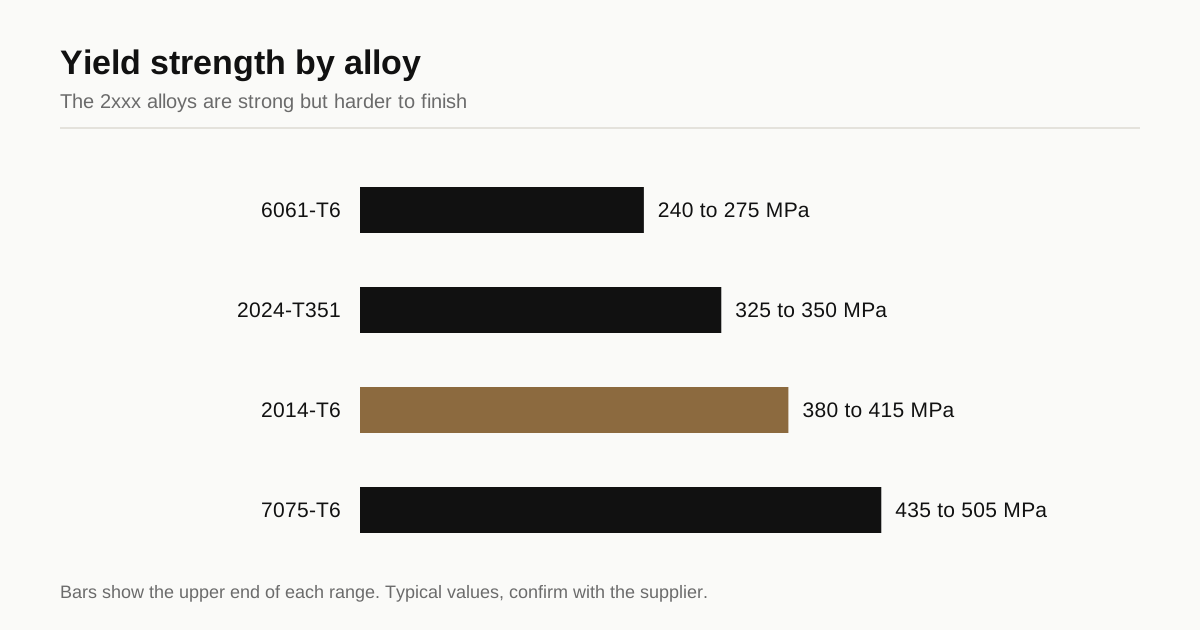
Typical values for orientation only. Real values depend on product form and thickness, and the mill certificate governs.
| Alloy and temper | Yield strength (typical) | Corrosion resistance | Anodize quality | Notes |
|---|---|---|---|---|
| 6061-T6 | About 240 to 275 MPa | Good | Excellent, uniform color | The default |
| 7075-T6 | About 435 to 505 MPa | Fair | Good | Highest strength, see the temper guide |
| 2014-T6 | About 380 to 415 MPa | Poor | Fair to poor | Forging alloy, strong |
| 2024-T351 | About 325 to 350 MPa | Poor | Fair to poor | Best fatigue crack resistance of the group |
The alloy reference lists the common alloys with sources. The point of the table is not the exact figures but the pattern. The 2xxx alloys are stronger than 6061, a little below 7075 in yield, and clearly worse on corrosion and finishing.
Why corrosion is the weak spot
Copper makes aluminum strong, but it also makes it electrochemically active. Copper-rich particles in the metal form tiny galvanic cells with the surrounding aluminum, and in a damp environment the alloy corrodes faster than 6061 or 7075. Aircraft skin made of 2024 is often clad with a thin layer of pure aluminum for this reason, or protected with a coating system.
For a bike, that means a bare 2014 or 2024 part will pit and stain if it sits in a wet environment, and a scratch through a thin coating exposes metal that corrodes. A part that lives inside a frame or a sealed housing is much safer than a part that is exposed to road spray.
Why anodizing is difficult
Anodizing 2xxx alloys is possible and common in aerospace, but the result is not like 6061.
- The copper-rich particles interfere with coating growth. The coating comes out thinner or less uniform in places, and dissolves faster in the tank.
- Color is dull. The base tone is darker and a little yellow-gray. Bright dyes look muddy and vary from part to part.
- Hard anodize works but is rough. A Type III coating on 2024 is used on aerospace parts, though it needs tuned process control.
- Color matching between lots is harder. If you sell a color range, expect more rejects.
The color matching guide explains how much variation to expect on well-behaved alloys. For 2xxx, add margin. If the part is meant to be black, the dull base tone matters little, and a black dye covers it. If it needs to be red or blue, choose a different alloy.
Where they make sense on a bike
The cases are narrow, but they exist.
- Hidden, load-bearing parts where nobody sees the surface, such as internal adjusters, pivot sleeves and structural brackets inside a frame or housing
- Fatigue-critical parts where a slow crack growth rate is worth the finishing limits, such as a highly loaded link in a suspension linkage
- Forged parts. 2014 is a standard forging alloy, so a forged structural part may already be specified in it. See the forging versus machining guide.
- Black-only product lines where finish color is not an issue
- Raw or clear finishes, with a conversion coating and paint instead of dyed anodize
A concrete example is a thick link plate in a mountain bike rear suspension, where fatigue life matters and the part is painted or black anodized. A less fitting example is a colored stem sold in six colors.
Where to avoid them
- Visible, color-anodized parts. Stems, seatpost clamps, caps and anything in a color range
- Parts that will be welded. Both alloys crack when welded by normal methods
- Parts in constant contact with water or salt without a protective coating
- Anything where 7075 or 6061 already meets the strength needs. Choosing a harder-to-finish alloy for no gain is a cost with no return
Machining behavior
Both alloys machine well, with good chip control and a good surface finish. They are a little harder than 6061, so tool wear is slightly higher. They may hold more residual stress in thick sections, so stress-relieved tempers such as T351 and T651 are preferred for machined parts. Distortion on thin parts is the usual issue. A shop that machines 7075 regularly will not find these alloys difficult.
Availability and cost
6061 and 7075 are stocked everywhere in bar, plate and extrusion form. 2024 is common in plate and sheet and found in bar from aerospace distributors. 2014 is less common as a stocked bar, and more often arrives as a forging or as a special order. Expect longer lead times and larger minimum buys than for 6061, and a higher price per kilogram than 6061. The price premium over 7075 varies. A good shop will tell you at quoting time what it can source.
The low MOQ guide explains how material minimums affect small orders. For a prototype run, a plate that is cut from a sheet can solve availability.
How to specify
- State the alloy and temper, such as “2024-T351 per ASTM B211” or “2014-T6511 extrusion”
- Say what finish is required: black anodize, clear anodize with conversion coating, paint or raw
- Note that the part is for a corrosive environment, if it is
- Ask for the mill certificate with the first order
- Ask the finisher whether it has experience with 2xxx alloys, before you commit
A short decision list
- Need color and strength: 7075 or 6061
- Need fatigue and damage tolerance, and finish is black or hidden: 2024 or 2014 is worth a look
- Not sure: ask the shop which alloys it holds in stock and which it has anodized before
Common mistakes
- Choosing 2024 for a color range. The dull base tone and uneven dye show up on the first batch.
- Leaving the part bare in a wet area. Copper-bearing alloys pit. Plan a coating system or keep the part sealed inside a housing.
- Assuming any shop can anodize it. Ask the finisher whether it has run 2xxx alloys, and ask for a test piece.
- Welding the part. Both alloys crack when welded by normal methods.
- Not asking for the mill certificate. Temper and alloy must match the drawing, and a distributor can substitute a similar-looking bar.
If the reason for the alloy is fatigue, say so on the RFQ. A shop that knows the reason can suggest the right temper and finish.
Send your drawing and finish requirement through the RFQ page and we match you with up to 3 machine shops. They reply within 24 business hours.
Frequently asked questions
Can 2024 be anodized in bright colors?
It can be anodized, but not well in bright dyed colors. The copper content gives a duller, less even coating and a darker base tone. Black and clear are the usual results. If your product needs a color range, 6061 or 7075 is the safer base.
Is 2024 stronger than 6061?
Yes, in most tempers. 2024-T351 and 2014-T6 typically have yield strengths well above 6061-T6, and both resist fatigue crack growth well. The price is poorer corrosion resistance and a harder time with finishing.
Why would anyone choose 2014 or 2024 over 7075?
Fatigue behavior and damage tolerance, mainly. The 2xxx alloys grow cracks more slowly than 7075 and are less prone to stress corrosion cracking. They are used in aircraft structure for that reason. For most bike parts, the finishing limits outweigh the gain.
Need a quote for this part?
Send the drawing. We match you with up to 3 shops that machine bike parts and reply within 24 business hours.
Get matched with a bike parts shop