Guides / Process
5-Axis or 3-Axis: What Your Bike Part Really Needs
October 11, 2026
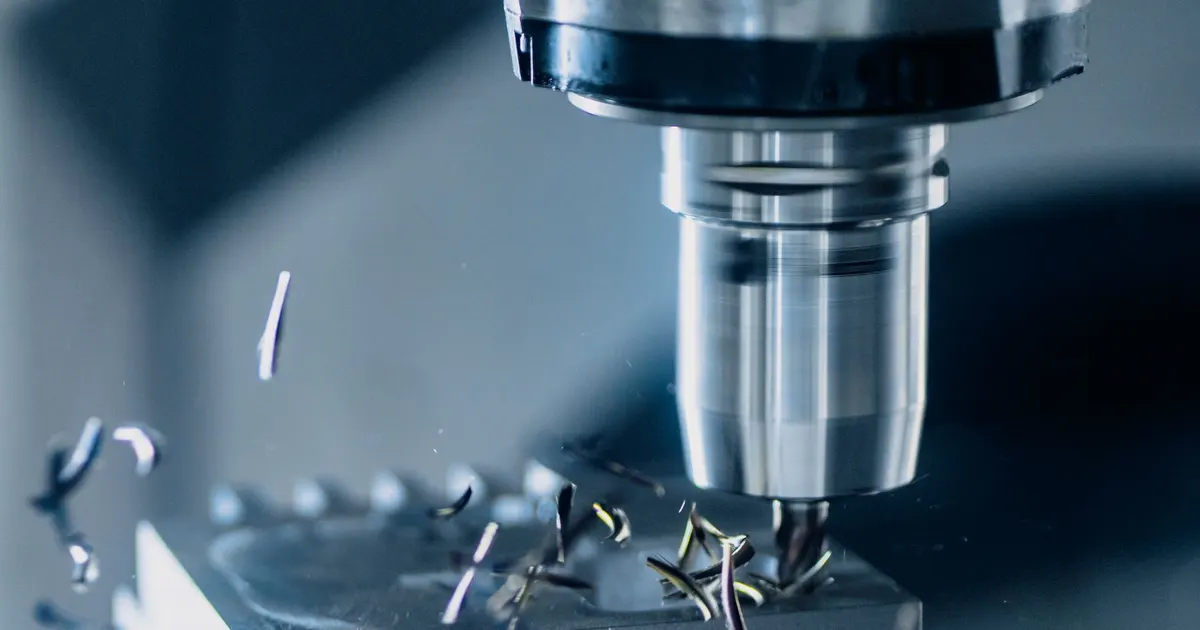
A machine axis is a direction the cutter or the part can move. A 3-axis mill moves the tool left and right, forward and back, up and down. A 4-axis machine adds a rotary axis that spins the part. A 5-axis machine adds a second rotation, so the tool can reach almost any face of the part without moving it by hand. The question for a bike part is not which machine sounds best. It is how many times a person has to unclamp the part and put it back.
Why setups are the real cost
Every time a part is unclamped and re-fixtured, three things happen. Someone spends time on the fixture and the program. The part is located again, and the new position never lines up exactly with the old one. And the part gets handled, which risks marks on finished surfaces.
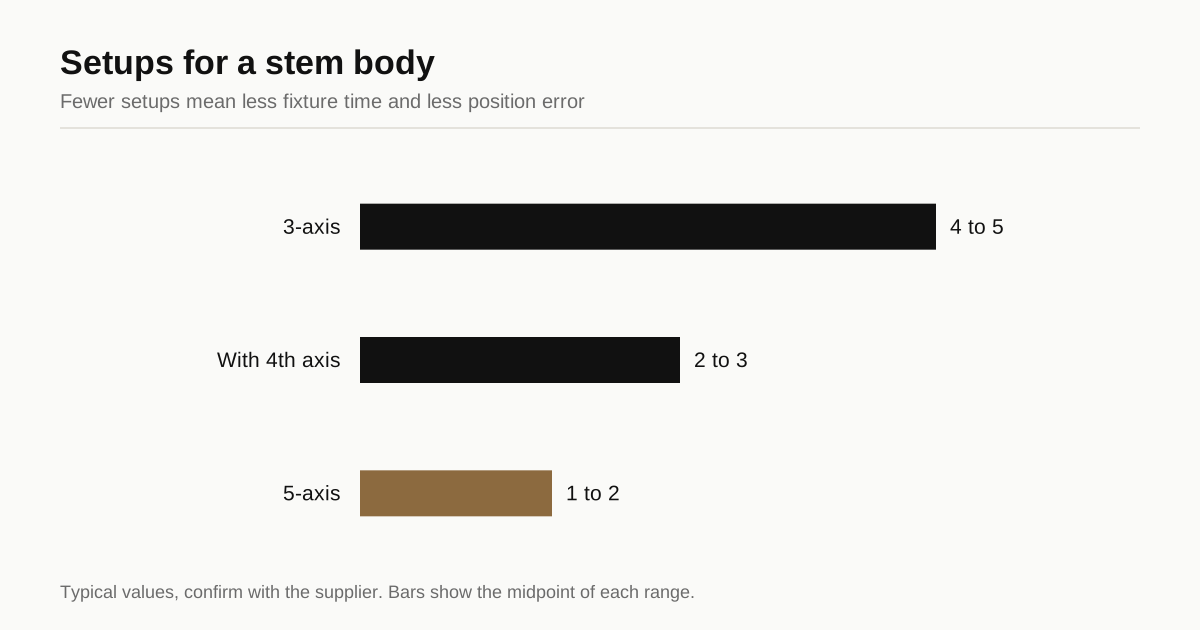
On a 3-axis mill, a stem body with features on the top, bottom, both sides and two bore axes takes four or five setups. Each one has its own fixture. On a machine with a 4th axis the number comes down to two or three. On a 5-axis machine the stem can often be finished in one or two. The stem guide walks through what happens to the price as the setups fall.
| Part | Typical setups, 3-axis | With 4th axis | With 5-axis |
|---|---|---|---|
| Stem body | 4 to 5 | 2 to 3 | 1 to 2 |
| Chainring | 2 | 2 | 2 |
| Crank arm | 3 to 4 | 2 | 1 to 2 |
| Hub shell | 2 (mostly turned) | 2 | 1 to 2 |
| Brake adapter | 3 | 2 | 1 |
These counts are typical for aluminum parts of normal complexity and change with the design. Use them to compare quotes, not to predict a price.
What a 3-axis machine does well
Flat parts with features on one or two faces. A chainring is cut from plate. The profile, the teeth, the bolt holes and the pockets are all reachable from the top, with one flip for the back. A 3-axis machine does this well, and a 5-axis machine adds no benefit. Read more on chainring tooth profiles and bolt circles.
Simple brackets and spacers. Parts that are mostly flat with drilled holes belong on the cheapest machine that can hold the tolerance.
High volumes of one part. A 3-axis cell with a good fixture and a pallet system can run a part for little cost per piece. If the design suits it, it is hard to beat.
What a 4th axis adds
A 4th axis is a rotary table or an indexer that spins the part around one line. It is the most common upgrade in bike parts work. It lets the cutter reach the sides of a cylindrical part, so a stem with two bore axes at an angle can be machined without flipping it by hand. It also suits hub shells, seatpost heads and any part that is roughly round.
If a shop says it will run your part on a 4th axis, it is saying it expects two or three setups where a 3-axis machine would need four or five. That is a real saving, and you can say on the RFQ that you expect it.
What a 5-axis machine adds
Reach and short tools. Tilting the part lets the shop use shorter, stiffer cutters on deep pockets and steep walls. Short tools chatter less, hold size better and leave a better surface.
Compound angles. A part with holes on faces at different angles can be drilled without a special fixture for each angle. E-bike motor brackets and brake mounts often have this. See the motor mount guide.
Curved surfaces. A sculpted crank arm with a smooth, flowing outer profile needs the cutter to keep a constant angle to the surface. Full 5-axis machining does that. A 3-axis machine can only approximate the shape with steps that need hand finishing.
Position accuracy between features. When two features are cut in the same setup, their relationship depends on the machine, not on how a person clamped the part. For a bearing seat and a bolt pattern that must line up, this is a real quality gain.
Where 5-axis does not help
A 5-axis machine costs more to run per hour. A typical hourly rate runs well above a 3-axis rate, and the programming time is longer. If the part is flat, if the volume is high and simple, or if the surface finish does not matter, the extra cost shows up in the quote with nothing to offset it.
There is also a skill factor. 5-axis programming needs a capable programmer and a machine with good collision checking. A shop that bought a 5-axis machine last year may be more experienced on 3-axis work. Ask what parts the shop has run on its 5-axis machine, and ask for a photo of a similar one.
Fixtures and break-even
The fixture is where the economics turn. A 3-axis job with five setups needs five fixtures or one modular system with changeovers. The first batch pays for all of them. On a prototype run of ten pieces, fixture cost can be half the price. On a run of five hundred it fades to a few percent.
That is why low volumes often favor 5-axis even though the hourly rate is higher. At ten pieces, one setup beats five fixtures. At five hundred pieces, five cheap fixtures on a fast machine may beat one slow, careful 5-axis program. The low MOQ guide covers how quantity moves the price.
How to ask for the right machine
You do not have to pick the machine. Describe the part and the quantity, and let the shops tell you how they would run it. Useful details on the RFQ:
- Annual and first-order quantity
- Which faces carry cosmetic requirements, so the shop avoids fixture marks there
- Which features must hold a tight relationship to each other
- Whether the surface is sculpted or made of flat faces and bores
- Target price range, if you have one
When quotes come back, compare the number of setups each shop plans, not only the price. A shop that plans fewer setups is telling you it understands the part. If you want to dig into drawing details first, the drawing review guide is a good companion.
The short version
- Flat parts with features on one or two faces: 3-axis is the right answer.
- Round or stepped parts, and parts with cross bores: 4-axis saves setups.
- Sculpted shapes, compound angles and low volumes: 5-axis saves total cost.
- Ask each shop how many setups it plans and why.
Common mistakes
- Choosing the machine instead of describing the part. A buyer who writes “5-axis only” on the RFQ may rule out a shop that could do the job well and cheaply on 4 axes.
- Comparing hourly rates and ignoring hours. A higher rate on fewer hours can be the cheaper quote.
- Ignoring fixture marks. Every setup clamps the part somewhere. Tell the shop which faces are cosmetic so it clamps on the others.
- Skipping the first article. Position between features machined in separate setups should be measured at first article, not assumed.
- Forgetting the next order. A shop that builds a good fixture for your part can run reorders cheaply, so ask whether the fixture is kept for you.
Two quotes that look far apart usually differ in setups, not in margin.
Machine choice is one step in our guide to custom bike parts manufacturing.
Send the drawing and the quantity through the RFQ page and we match you with up to 3 machine shops, who reply within 24 business hours.
Frequently asked questions
Does a 5-axis machine make a better bike part?
Not by itself. It makes fewer setups possible, and fewer setups mean less position error between features and less handling. A well run 3-axis shop can hold the same tolerances on a simple part. The advantage shows up on parts with features on many faces.
Is 5-axis always more expensive?
The hourly rate is higher, but the part can take fewer hours and less fixture work. On a complex part the total often comes out the same or lower. On a flat part with features on one side, 5-axis only adds cost.
What is the difference between 3+2 and full 5-axis?
In 3+2 machining the two rotary axes tilt the part to a fixed angle and lock, then the machine cuts with three axes. In full 5-axis machining all five axes move at once, which is needed for curved surfaces such as sculpted crank arms or continuous blends.
Need a quote for this part?
Send the drawing. We match you with up to 3 shops that machine bike parts and reply within 24 business hours.
Get matched with a bike parts shop