Guides / Process
Thread Milling or Tapping: Which One Your Bike Part Needs
October 28, 2026
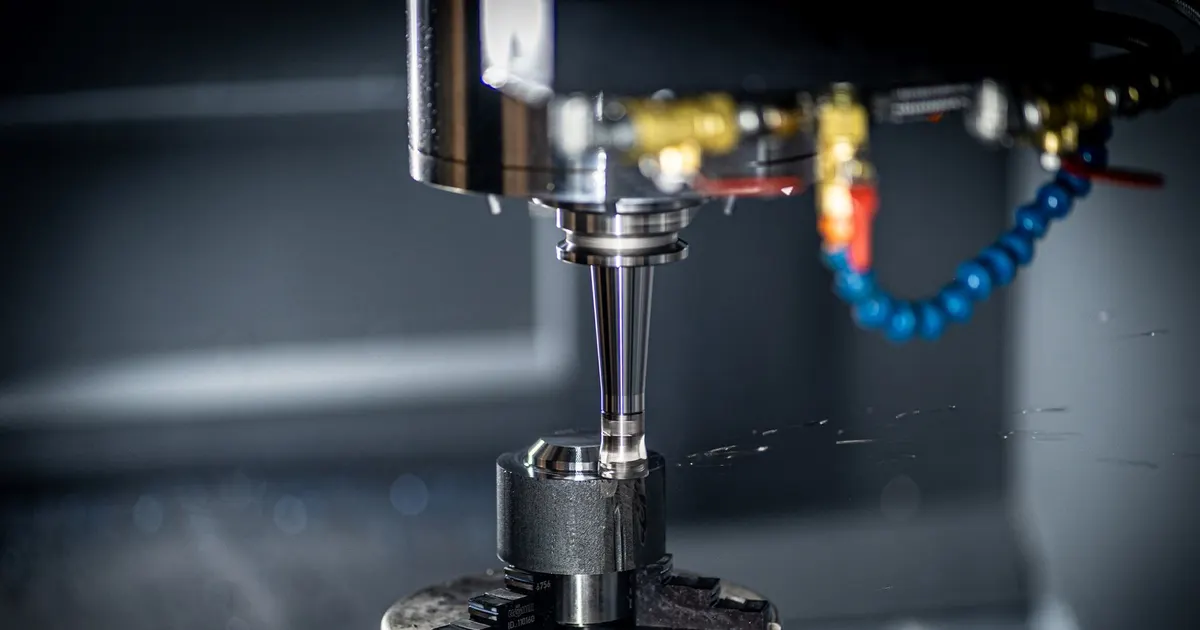
Most threads on a bike part are tapped, and most of the time that is the right call. A tap is fast, the tool costs little and the result is a standard thread. But there are cases where a thread mill gives a better part or a safer process, and the drawing is where the choice gets made. This guide explains the difference in plain terms so you can read a quote and know what you are paying for.
What each method does
A tap is a threaded cutter that goes into a drilled hole, turns and leaves a thread behind. It matches one diameter and one pitch. A thread mill is a small cutter that moves in a helix inside a larger hole and cuts the thread as it goes. One thread mill can cut any diameter above its own size at a given pitch, and right-hand or left-hand threads with the same tool.
There is a third method, form tapping, which pushes the material into the thread shape instead of cutting it. It makes no chips and gives a smooth thread in ductile aluminum such as 6061. It needs a slightly larger pre-drilled hole and does not suit brittle or very hard tempers.
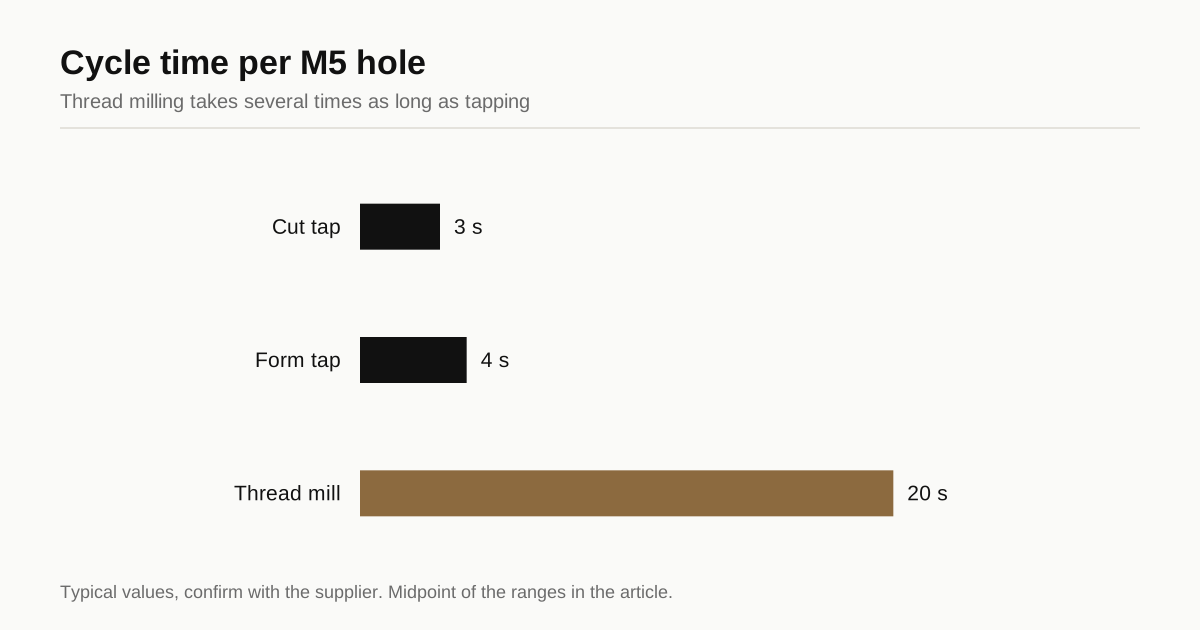
| Method | Cycle time for an M5 hole | Tool cost | Best for |
|---|---|---|---|
| Cut tap | 2 to 4 seconds | Low | Through holes and shallow blind holes in 6061 |
| Form tap | 3 to 5 seconds | Low to medium | Ductile aluminum, no chips in the hole |
| Thread mill | 10 to 30 seconds | Medium to high | Hard materials, blind holes, large threads |
These figures are typical and change with the machine, the depth and the programming. Treat them as a way to compare, not as a quote.
Where a thread mill earns its place
Blind holes with full thread near the bottom. A tap has a lead chamfer, so the last few turns near the bottom of a blind hole are partial. A thread mill can cut full thread almost to the bottom, which matters when the part is thin and the hole is short.
7075 and titanium. A broken tap in a finished stem or crank is scrap, with hours of machining already in it. A thread mill that breaks leaves the hole intact and the part recoverable. In harder alloys the risk of snapping a tap is real, and many shops switch to milling for that reason alone.
Large threads. A bottom bracket cup with a 1.37 inch by 24 tpi thread is cut far better by a thread mill than by a large tap. The same goes for the 47 mm by 1 mm thread on a T47 shell. Large taps need a lot of torque and chatter in thin walls. More on those parts in the bottom bracket cup guide.
Size adjustment. A thread mill can be tuned in small steps with a tool offset, so the thread fit can be dialed in after the first part is gauged. A tap is what it is. If the gauge says the thread is tight, the shop must change the tap or the hole.
Mixed hand threads. A crank pedal eye is right-hand on one side and left-hand on the other. A single thread mill covers both. The pedal thread and other common threads are listed in the threads table.
Where a tap is the better choice
High volume of small threads. Fifty M5 holes on a single faceplate batch run in seconds each with a tap. Milling them would add minutes per part. If the material is 6061 and the threads are through holes, there is no reason to pay for milling.
Cheap, repeatable parts. On a part made in the thousands, the cycle time of every feature is priced in. A tap wins unless there is a quality reason to avoid it.
Very small threads. Below about M3, thread mills become fragile and slow. A tap or a form tap is the practical answer.
The drawing decides more than the method
Whatever the method, the quote depends on what the drawing says. Four items remove most of the ambiguity.
- Thread, class and pitch. For metric, write M6 x 1.0 and the class, such as 6H for internal threads. For inch threads, write the series and the class, such as 2B. A thread with no class gets whatever the shop’s default tap gives.
- Depth of full thread. Write how deep the full thread goes, not just the drill depth. A tap leaves a partial thread near the bottom, and a drawing that is silent on this invites argument.
- Engagement. In aluminum a steel bolt needs roughly 1.5 to 2 times its diameter in thread engagement to avoid stripping. For parts that are taken apart often, such as seatpost clamps, say so and consider a threaded insert.
- Gauge requirement. State whether threads are checked with go and no-go gauges and on how many pieces. A requirement to gauge every threaded hole adds time, but it is far cheaper than finding a stripped thread on the assembly bench. The quality control guide covers how much inspection to ask for.
Threads and anodizing
Coating changes thread size. Type II anodize builds up on the surface and also grows into it, so an internal thread comes out slightly tighter and an external thread slightly larger. The usual practices are to mask the threads, to chase them after anodizing or to cut them oversize before coating. Say which one you expect. For a part that is hard anodized, the effect is larger and masking is the safer route. Check the numbers for your coating with the anodize growth calculator.
A thread that is chased after anodizing leaves bare aluminum at the thread flanks. For a bolt with a steel thread, that is rarely a corrosion problem on a bike. If the part sees salt road spray, ask for the threads to be sealed or greased at assembly.
Reading the quote
If two quotes for the same part differ by a few percent, look at the number of threaded holes and the material. A part in 7075 with thirty threads and a thread-milling process can fairly add a few minutes to the cycle. A part in 6061 with the same thirty holes should not. If the price gap seems large, ask the shop what method it plans to use for each thread and why.
If you are not sure which method suits your part, you do not need to decide. Send the drawing with the thread callouts, the material and the volume. Shops that bid will tell you what they plan to use, and the spread between answers shows you where the real cost sits.
Common mistakes
- Naming the method on the drawing for no reason. It limits the shops that can quote and rarely improves the part.
- Leaving the thread depth open. The shop drills to its own depth and the bolt bottoms out or the thread is short.
- Forgetting the coating. An anodized thread that was cut to nominal size will be tight.
- Using a thread insert and a thread callout together without saying which governs. State the finished thread inside the insert.
- Skipping gauges on safety threads. Pedal eyes, brake mounts and clamp bolts deserve a fixed gauge on every part.
A thread that fails on the assembly line is cheaper than one that fails on the road. Spend the inspection money where the consequence is highest.
A thread checklist for the drawing
- Thread size, pitch and class for every threaded feature
- Depth of full thread, and whether the hole is through or blind
- Material and temper, since 7075 and titanium change the safe method
- Gauge requirement and sampling plan
- Whether threads are masked, chased or cut oversize for anodizing
- Which threads are assembled often and may need an insert
Put these on the drawing and the shop can pick the cheapest method that meets the requirement. Send the drawing through the RFQ page and we match you with up to 3 machine shops, who reply within 24 business hours.
Frequently asked questions
Is a milled thread weaker than a tapped thread?
No. Both produce a cut thread with the same profile, and strength is set by the thread engagement, the material and the fit class. A rolled (formed) thread can be somewhat stronger in ductile aluminum because the grain flows with the profile, but that is a third option and not the choice between milling and tapping.
Why does a shop quote more for thread milling?
Each hole takes longer. A tap finishes an M5 thread in a few seconds. A thread mill follows a helical path and needs several times that. On a part with four threaded holes the difference is small. On a part with sixty it adds up.
Should I specify the method on the drawing?
Usually not. Specify the thread, the class, the depth of full thread and any gauge requirement. Naming the method locks out a shop that could do the job better another way. Name it only when a tapped thread has failed for you before.
Need a quote for this part?
Send the drawing. We match you with up to 3 shops that machine bike parts and reply within 24 business hours.
Get matched with a bike parts shop