Guides / Materials
Magnesium Bike Parts: What You Save and What You Risk
October 25, 2026
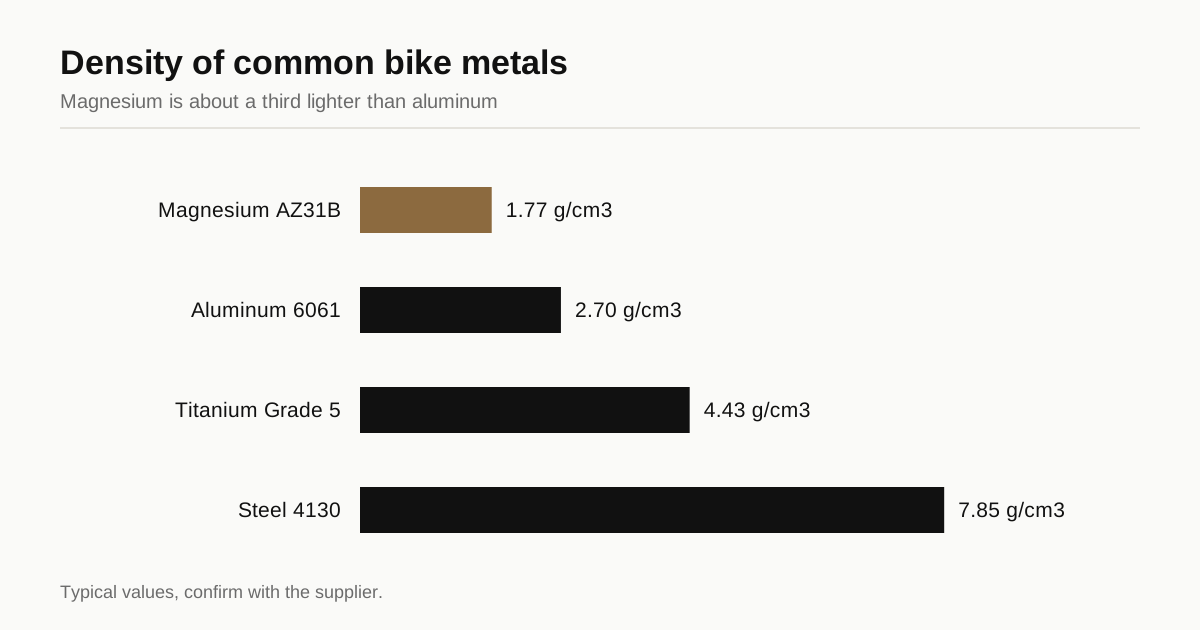
Magnesium is the lightest structural metal. At about 1.74 to 1.81 g/cm³ it is roughly 35 percent lighter than aluminum, which sits at about 2.70. For a rider counting grams, that is attractive. Magnesium has a long history in bikes, from pedals and crank arms to frames and cast wheels, and it comes back as an option every few years. It also has a reputation for corroding, burning and costing more than it saves. Both the promise and the reputation are partly right.
The numbers
Typical properties for orientation. They vary with alloy and process.
| Property | Magnesium AZ31B (wrought) | Magnesium AZ91D (die cast) | Aluminum 6061-T6 |
|---|---|---|---|
| Density | About 1.77 g/cm³ | About 1.81 g/cm³ | About 2.70 g/cm³ |
| Yield strength | About 200 MPa | About 160 MPa | About 275 MPa |
| Elastic modulus | About 45 GPa | About 45 GPa | About 69 GPa |
| Corrosion in wet service | Poor without coating | Better than AZ31, needs coating | Good |
| Machinability | Excellent, with fire precautions | Good | Good |
Two things matter here. First, strength per weight is similar to aluminum, not far better. Second, the elastic modulus is about two thirds that of aluminum. A magnesium part has to be thicker to be as stiff, which eats into the weight saving. A stem or crank that is stiffness-limited gains less than the density alone suggests.
The common alloys are AZ31B for wrought bar, plate and extrusions and AZ91D for die castings. Extruded bar is covered by ASTM B107 and sheet and plate by ASTM B90. For machined parts from bar, AZ31B is usual. For complex shapes made in volume, die casting in AZ91D is more common.
Where magnesium is used on bikes
- Pedal bodies. Magnesium has long been used for lightweight flat and clipless pedals, since the shape is simple and the load is moderate.
- Die-cast parts, such as motor housings on e-bikes and gearbox cases
- Cast wheels and some hubs, used historically
- Frames and forks, in small production runs, where the shape suits casting
- Brake and lever bodies, where weight matters and stiffness is secondary
Machined magnesium parts from billet are rare. The weight savings are small compared with the extra care, and most brands choose 7075 aluminum or titanium instead. The aluminum alloy reference lists the common alternatives.
The fire question
Magnesium burns, and that fact is often exaggerated. A solid block of magnesium is hard to ignite. Fine chips, thin ribbons and dust are the risk, because they have a lot of surface area and little mass to carry heat away.
A shop that machines magnesium should:
- Use sharp tools with a positive rake, to keep cutting heat low and chips coarse
- Avoid dull tools, rubbing and very high speeds with low feed
- Keep the machine and floor clear of fine chips and dust
- Use a mineral oil coolant or machine dry, since water-based coolant can react with hot fine chips and release hydrogen
- Keep a class D extinguisher or dry sand within reach, never water
- Store chips in covered metal containers and dispose of them correctly
None of this is exotic, but it is a commitment. Many shops that are comfortable with aluminum choose not to take magnesium, and some insurers raise their rate. That limits the number of shops that can quote. The guide to choosing a shop lists questions that tell you whether a shop has real experience.
Finished magnesium parts are not a fire risk in normal use. The risk is in the machine shop and in the grinding and polishing steps afterward.
Corrosion and galvanic contact
Magnesium sits at the active end of the galvanic series. Next to steel, stainless steel, titanium or even aluminum in a wet joint, magnesium is the one that corrodes. A bike spends a good part of its life wet and often salty, so this is the main design problem.
The usual protection is a coating system.
- Conversion coatings such as chromate-free treatments are the base layer.
- Anodizing processes for magnesium build a harder oxide but are less forgiving than aluminum anodize. They are usually sealed or painted.
- Paint or powder coat over the pretreatment gives a barrier.
- Sealant at every fastener. A steel bolt through a magnesium part creates a galvanic cell. Isolate with washers, coated bolts or a sealant, and avoid exposed bolt heads in the splash zone.
Any scratch that cuts through the coating exposes bare metal. On a part that is bumped, such as a pedal, coating damage is certain over time, so design for it. A part that sits in a protected place, such as inside a motor housing, is far safer.
Strength, creep and heat
Magnesium alloys lose strength above about 120 degrees Celsius and may creep under load at elevated temperature. For most bike parts that is not an issue, but e-bike motor housings run warm and fasteners can lose preload as the metal creeps. Design them with that in mind, and use thread inserts instead of threading magnesium directly if the joint is taken apart often. Threads in magnesium are weaker and prone to galling with steel bolts.
Fatigue strength is lower than aluminum in the same condition, and notch sensitivity is higher. Sharp corners and tool marks matter more. Design generous radii. See the design for machining guide.
Cost
Magnesium stock typically costs more per kilogram than 6061, and bar is less widely stocked. Machining is faster than aluminum, since the cutting forces are low and chips come off easily. The costs come from handling, coating and the small number of qualified shops. On a prototype, the premium can be large. On a die-cast production part, the economics are different and the tooling dominates.
The cost guide explains how material, machine time and finishing split in a price. If you are comparing magnesium with 7075 for a single part, ask for a quote on both and look at the finished and coated part, not the machined part.
Testing and standards
Parts for sale in many markets must pass the strength and fatigue tests in ISO 4210. A magnesium part is not exempt, and the test lab will see the same load. Corrosion is not part of those tests, so run a salt-spray or a cyclic corrosion test on coated parts as part of your own validation. The ISO 4210 overview lists the relevant parts of the standard.
When magnesium makes sense
- The part is simple and the weight saving matters
- A coating system and sealing plan are part of the design
- The part sits in a protected position or is easy to inspect and replace
- A shop with real magnesium experience is available
When to choose something else
- The part sits in wet joints with steel or titanium bolts
- The part is stiffness-limited, so thicker sections give back the weight saving
- The part has fine threads that are taken apart often
- You need many shops to quote, since few can
Common mistakes
- Assuming a magnesium part saves a third of the weight. The saving is smaller once sections are thickened for stiffness.
- Using steel bolts bare. The joint becomes a galvanic cell. Isolate or coat every fastener.
- Skipping the coating test. Run a salt-spray or cyclic corrosion test on the finished part, not on a bare sample.
- Sending the job to a shop that has never cut magnesium. The fire precautions are real, and a shop that improvises is a risk to your parts and to itself.
- Forgetting end-of-life. Magnesium chips and scrap need separate handling, which the shop will price in.
For a first trial, choose a simple, protected part and learn the process before moving to a visible, exposed one.
Magnesium is the special case in our guide to the best material for CNC bike parts.
Send your drawing through the RFQ page and tell us the material question. We match you with up to 3 machine shops. They reply within 24 business hours and will say whether they handle magnesium.
Frequently asked questions
Is it safe to machine magnesium?
Yes, in a shop set up for it. Fine chips and dust can ignite, so the shop needs sharp tools, no pile-up of fine chips, good housekeeping and a class D fire extinguisher or dry sand. Many general shops decline magnesium for that reason.
How much weight does magnesium save over aluminum?
The metal is about a third lighter by volume. The part saving is smaller, often 15 to 25 percent, because magnesium is less stiff and sections often have to be thicker to match.
Can I anodize magnesium like aluminum?
Not in the same way. Magnesium has its own conversion coatings and anodizing processes, usually followed by paint or sealer. The result is more fragile than aluminum anodize and needs more care around fasteners.
Need a quote for this part?
Send the drawing. We match you with up to 3 shops that machine bike parts and reply within 24 business hours.
Get matched with a bike parts shop