Guides / Materials
Grade 9 or Grade 5 Titanium: Which Fits Which Bike Part
October 17, 2026
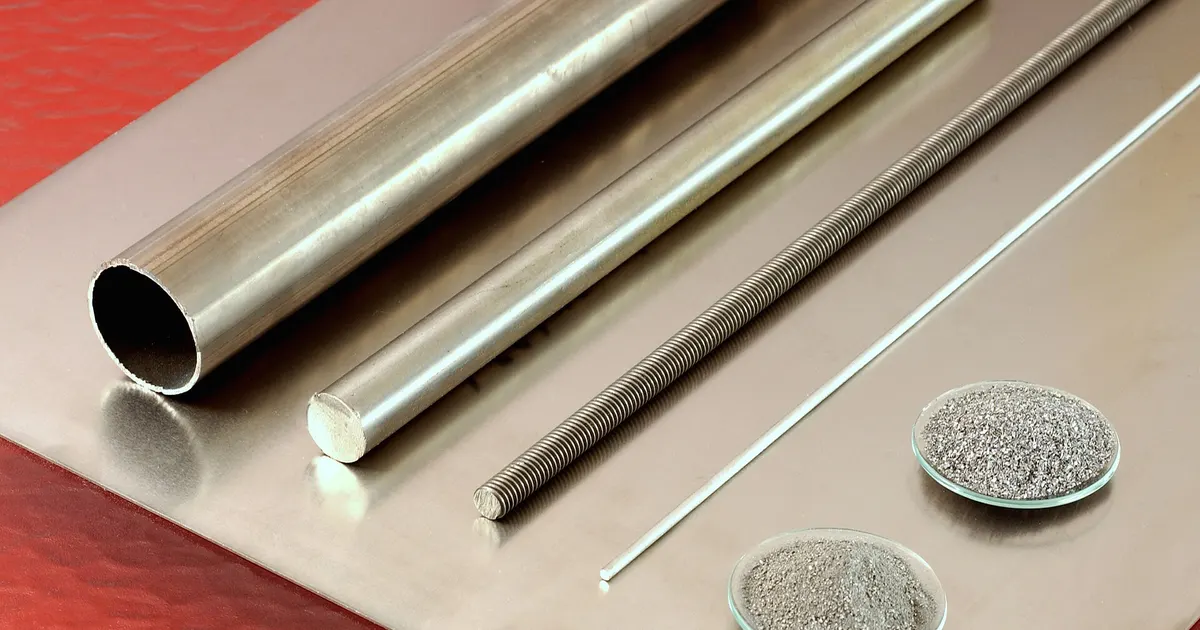
Titanium on a bike usually means one of two alloys. Grade 5, also called Ti-6Al-4V, is the workhorse for machined parts and fasteners. Grade 9, also called Ti-3Al-2.5V, is the alloy for tubes and formed parts. They look the same, weigh almost the same and cost within a similar range. The difference is in strength, forming and where each one shows up on a bike.
What the numbers mean
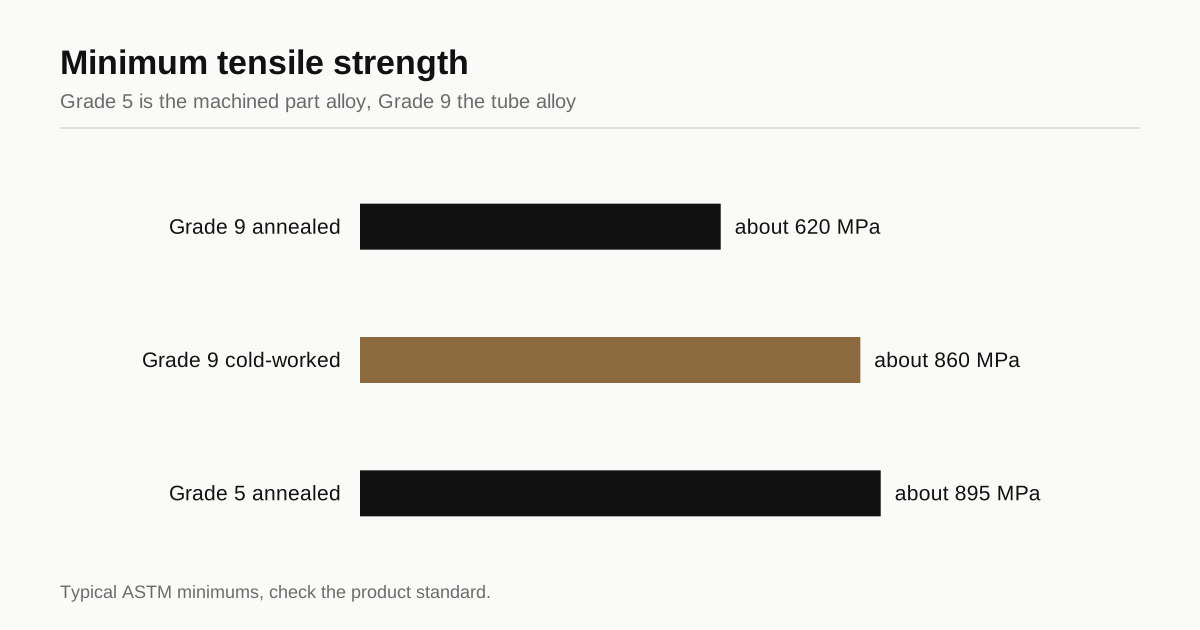
The grade numbers come from the ASTM standards for titanium. The names say what is in the alloy: Grade 5 is 6 percent aluminum and 4 percent vanadium. Grade 9 is 3 percent aluminum and 2.5 percent vanadium. Less alloying means a softer, more workable metal.
| Property (typical minimum) | Grade 5 annealed | Grade 9 annealed | Grade 9 cold-worked, stress-relieved |
|---|---|---|---|
| Ultimate tensile strength | About 895 MPa | About 620 MPa | About 860 MPa or more |
| Yield strength | About 828 MPa | About 483 MPa | About 725 MPa or more |
| Density | About 4.43 g/cm³ | About 4.48 g/cm³ | About 4.48 g/cm³ |
| Cold forming | Poor | Good | Good before work hardening |
| Weldability | Good with shielding | Good with shielding | Strength drops in the weld zone |
| Common product forms | Bar, plate, forgings, fasteners | Seamless tube, sheet, wire | Seamless tube |
These are minimum values to orient a buyer. The mill certificate and the product standard govern. Titanium bar is commonly purchased to ASTM B348, plate and sheet to ASTM B265 and seamless tube to ASTM B338. For a titanium bike, the broader comparison with aluminum explains where titanium wins and where it does not.
Grade 5: the machined part alloy
Grade 5 is by far the most common titanium alloy in the world. It is strong, stable and well documented. On a bike, you find it in:
- Machined stems, seatpost clamps and cranks, when weight and corrosion resistance justify the price
- Bolts and fasteners. Most titanium bolts are Grade 5.
- Dropouts and brackets, cut from plate
- Axles and pins, where strength and low weight both matter
- Forged parts, which start as bar and are hot-formed
Its strength means a part can be thinner than in aluminum, but the modulus is lower than steel and higher than aluminum, so stiffness-critical parts still need care. The weight versus strength guide covers how that plays out on typical parts.
Machining Grade 5 takes patience. It has low thermal conductivity, so heat stays at the cutting edge, and it tends to work-harden and gall. Shops use sharp carbide tools, low speeds, heavy coolant and rigid setups. Cycle times are longer than for aluminum, and tools wear faster. That is why a titanium stem costs several times the price of an aluminum one even when the raw bar price does not explain the gap.
Grade 9: the tube and formed part alloy
Grade 9 is the alloy of titanium bicycle frames. It can be drawn into seamless tube with thin walls and welded into a frame. Cold-worked and stress-relieved tube is stronger than annealed and is the form most frame builders use. It is also used for handlebars, seatposts and some forks.
For machined parts it is less common. Bar in Grade 9 exists but is made in smaller volumes, and many shops have more experience with Grade 5 than with Grade 9.
There are situations where Grade 9 bar makes sense:
- A part that will be welded to a Grade 9 tube, such as a dropout or a cable guide welded to a frame, where matching the alloy simplifies the weld
- A part that will be bent or formed after machining, where lower strength and better ductility help
- A part where the strength of Grade 5 is not needed, and the lower hardness makes machining a bit easier
The savings in machining time are modest. Titanium is still titanium.
Welding and heat
Both grades are weldable by gas tungsten arc welding with inert gas shielding on both sides of the weld. Titanium picks up oxygen and nitrogen at high temperature and becomes brittle, so a full shield around the weld and the cooling metal is a must. The color of the weld shows the result: silver and light straw are good, blue and gray signal contamination.
Cold-worked Grade 9 loses some strength in the heat-affected zone, so frame designers allow for it. Grade 5 can be welded but is usually heat treated after welding for best properties, which adds a step. For bike frames, Grade 9 wins because tube and weld are straightforward.
Finishing and color
Titanium can be anodized to produce color by interference, with no dye. The color depends on the oxide layer thickness, and a range from gold to blue to purple is possible. Both grades take it, but color can differ slightly between grades and between lots. If you plan a colored titanium part, ask the finisher for samples on your actual alloy. The other finishes guide covers bead blast and other options.
Bare titanium is already corrosion resistant, so many parts are left blasted or brushed with no coating. Titanium touching aluminum can still cause galvanic corrosion of the aluminum in a wet joint. Grease or isolate the joint.
Cost
Material cost is a modest share of the price of a machined titanium part. Raw Grade 5 bar costs several times as much as 7075 per kilogram, but the larger factor is machining time. Grade 9 bar is similar in price per kilogram to Grade 5 and sometimes more, because production volumes are lower. For tube, Grade 9 is the standard and the price follows the supply of seamless tube.
The cost guide shows how material and machine time split on a typical part. For a prototype in titanium, the cost of failed attempts matters. Parts scrapped for tool breakage or distortion are charged to the job.
Choosing: a short list
| Part | Likely grade | Why |
|---|---|---|
| Frame tubes, handlebars, seatposts (tube) | Grade 9 | Formable seamless tube |
| Machined stem, clamp or crank | Grade 5 | Strength, data, stock |
| Bolts and axles | Grade 5 | Strength |
| Dropouts welded to Grade 9 tube | Grade 9 or Grade 5 | Match the tube if possible, otherwise follow the frame builder |
| Parts that need bending after machining | Grade 9 | Ductility |
What to put on the RFQ
- Grade and product form, such as “Ti-6Al-4V bar per ASTM B348, annealed”
- Whether the part will be welded or heat treated after machining
- Finish: blasted, brushed or anodized color
- Whether the shop has experience with titanium, and how it handles galling and heat
- Quantity, since titanium bar often has minimum purchase lengths
Common mistakes
- Writing only “titanium” on the drawing. The shop will quote whatever bar it has, and the grade changes strength, machining time and price.
- Assuming Grade 9 is easy to machine. It is softer than Grade 5, but it still galls, work-hardens and holds heat at the cutting edge.
- Welding without shielding. Both grades pick up oxygen when hot. A weld that turns blue or gray is contaminated and brittle.
- Mixing titanium with aluminum in wet joints without grease or an isolator.
- Expecting a color range to match. Interference colors vary by lot and by grade, so approve a sample on your alloy.
If a part will be tested to a standard, run the test on the real grade and finish, not on a stand-in alloy.
The grade belongs on the callout; our guide to the best material for CNC bike parts shows how to write it.
Send your drawing through the RFQ page and we match you with up to 3 machine shops that run titanium. They reply within 24 business hours.
Frequently asked questions
Which titanium grade is stronger?
Grade 5 (Ti-6Al-4V). Its minimum tensile strength is around 895 MPa in the annealed condition, against about 620 MPa for annealed Grade 9. Cold-worked and stress-relieved Grade 9 tube reaches higher, but still below Grade 5.
Why are frame tubes made from Grade 9?
Grade 9 can be cold worked into seamless tube, drawn to thin walls and welded without special treatment. Grade 5 is hard to form cold and needs more care when welded. For tubing, Grade 9 is the practical choice.
Can I machine a stem from Grade 9 bar?
Yes, but it is unusual. Grade 5 is the standard for machined structural parts, so bar stock, data and experience are easier to find. Grade 9 bar can make sense where the part is later welded or formed, or where lower strength is acceptable.
Need a quote for this part?
Send the drawing. We match you with up to 3 shops that machine bike parts and reply within 24 business hours.
Get matched with a bike parts shop