Guides / Materials
Stainless Steel Bike Hardware: 17-4 PH Axles, Pins and Bolts
October 27, 2026
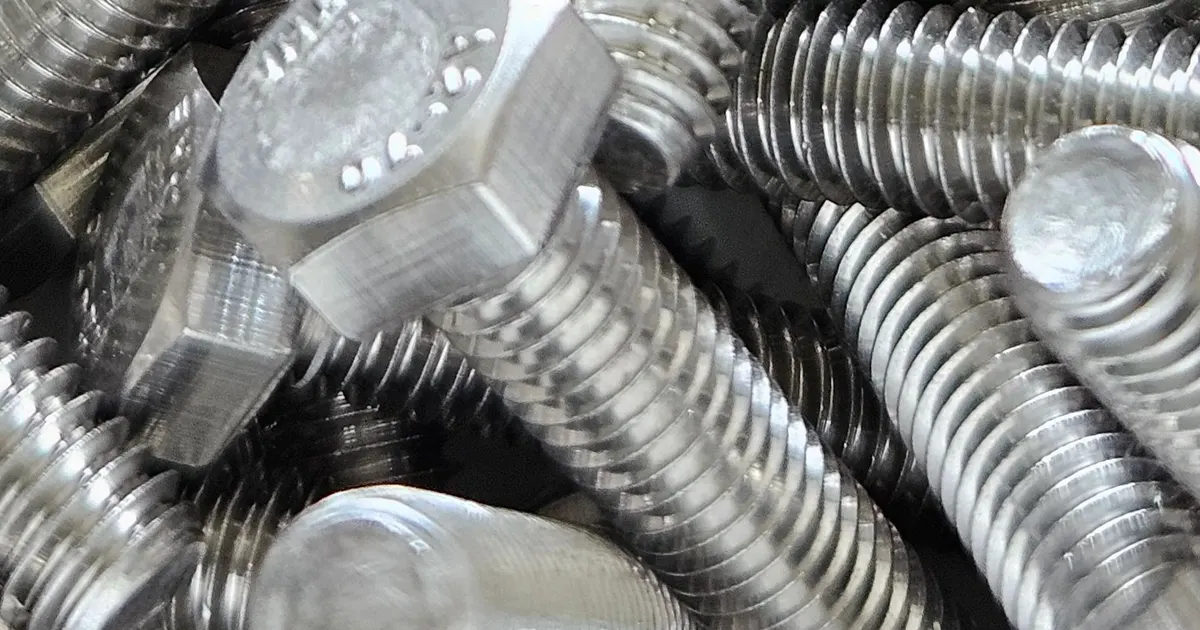
Stainless steel is the answer people reach for when a bolt has to survive rain, salt and a pressure washer. It does survive them. It is also weaker than most buyers expect, and it seizes in the thread if treated like plain steel. For bike axles, brake pins and critical bolts, one stainless grade stands out: 17-4 PH. This guide explains why, what the heat treatment letters mean and how to specify it.
The usual stainless is not that strong
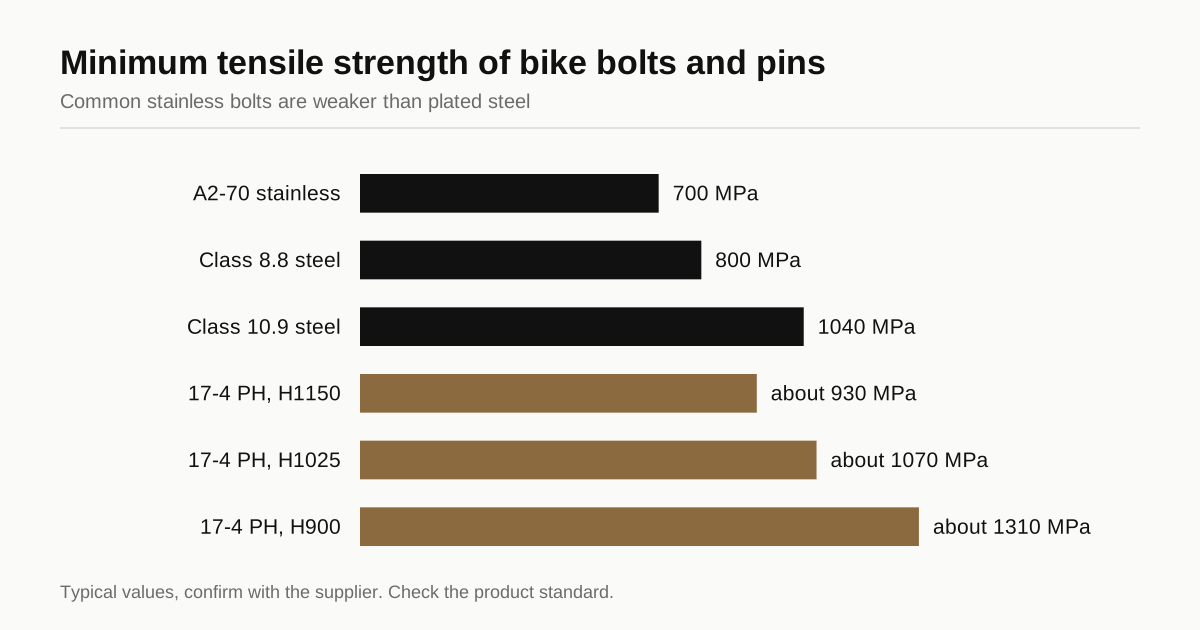
Most stainless fasteners are austenitic grades, called A2 (304 type) or A4 (316 type). They are marked with a property class such as 70 or 80, which means a minimum tensile strength of 700 or 800 MPa.
| Material | Minimum tensile strength | Notes |
|---|---|---|
| A2-70 stainless bolt | 700 MPa | Good corrosion resistance, soft |
| A4-80 stainless bolt | 800 MPa | Better in salt, only in smaller sizes |
| Class 8.8 steel bolt | 800 MPa | Plated for protection |
| Class 10.9 steel bolt | 1040 MPa | Plated, higher strength |
| 17-4 PH, H1025 | About 1070 MPa | Stainless and strong |
| 17-4 PH, H900 | About 1310 MPa | Highest strength, lower toughness |
These are typical minimums for orientation. Check the product standard for the exact figure. The point is that A2 and A4 bolts are at the bottom of the range, and they also yield early, so a bolt that is torqued to a steel bolt’s value can stretch.
Austenitic stainless is not hardened by heat treatment. It gains strength only by cold work, which is why small bolts are stronger than large ones.
What 17-4 PH is
17-4 PH is a precipitation-hardening stainless steel, with about 17 percent chromium and 4 percent nickel, plus copper and niobium. The PH means precipitation hardening: a low-temperature aging heat treatment makes tiny particles form in the metal and strengthen it. It is martensitic in structure, which makes it magnetic, unlike A2 and A4.
Its corrosion resistance is good in air, fresh water and mild environments, and a little below 316 in salt. For a bike, that is fine in most conditions, and a coastal rider should coat or inspect more often.
The common specifications are ASTM A564 for bar and shapes and AMS 5643 for bar. State one of them and the condition on the drawing.
Conditions: H900, H1025, H1150
The standard starting condition is Condition A, solution annealed. In that state the steel is soft and machines well. It then goes through an aging treatment, and the number after H is the aging temperature in degrees Fahrenheit.
| Condition | Aging temperature | Tensile strength (typical) | Toughness | Stress corrosion resistance |
|---|---|---|---|---|
| H900 | About 480 degrees Celsius | About 1310 MPa | Lowest | Lowest |
| H1025 | About 550 degrees Celsius | About 1070 MPa | Better | Better |
| H1150 | About 620 degrees Celsius | About 930 MPa | Best | Best |
H900 gives the strength but gives up toughness and resistance to stress corrosion cracking. Most designers pick H1025 or H1150 for bike parts that see a wet environment and constant load, such as an axle pin that carries a clamp load. H900 is reserved for situations where strength is paramount and the environment is dry or protected.
Aging causes a small contraction, on the order of a few hundredths to about a tenth of a percent depending on the condition. Machine in Condition A, age, and then finish critical dimensions by grinding or a light cut, or allow for the shrinkage in the program. Ask the shop and the heat treater to agree on the sequence.
Where 17-4 PH fits on a bike
- Thru-axles and axle pins, where strength and corrosion resistance both matter
- Brake pivot and caliper pins
- Suspension pivot axles and clevis pins
- E-bike hardware, where parts see constant load and moisture
- Special bolts and studs that need more strength than A2 or A4
It is heavy, about 7.8 g/cm³. For weight-critical parts, titanium is the alternative, and the titanium guide explains the trade. For an axle in a hub, see the hub guide.
Galling and how to avoid it
Galling is the main practical problem with stainless threads. Stainless relies on a thin oxide film for protection. Under pressure and sliding, the film breaks, and the clean metal surfaces cold-weld together. Tightening tears material off one thread and deposits it on the other, until the bolt seizes.
Ways to reduce it:
- Use anti-seize compound on stainless threads at assembly. Choose one that is compatible with the application.
- Mix alloys. A stainless bolt in an aluminum or a bronze thread galls less than stainless in stainless.
- Mix hardness. A hardened 17-4 bolt in a softer nut galls less than two soft parts.
- Slow down. High tightening speed generates heat and promotes galling.
- Keep threads clean and free of burrs. See the deburring guide.
- Use rolled threads. A rolled thread has a smoother surface than a cut thread and galls less.
- Use a coating such as a dry film lubricant or a silver plating, where assembly is repeated often.
Stainless bolts in aluminum threads also carry a galvanic issue, though stainless and aluminum are close enough in the series that it is usually minor. Grease the joint if it sees road salt.
Passivation and surface condition
Machining leaves iron particles from the tools on the surface, and those particles rust. Stainless parts are passivated after machining to remove them and to let the chromium oxide film form fully. The usual standard is ASTM A967, which covers nitric and citric acid passivation. For 17-4 PH, citric acid is common, since strong nitric acid can attack the martensitic structure if it is not controlled.
Specify passivation when the part is cosmetic or sits in a wet area. A part that rusts spots on the first ride is a warranty claim. The other finishes guide covers bead blast and polish options on stainless.
Machining 17-4 PH
In Condition A, 17-4 machines reasonably but not like aluminum. It is gummy and work-hardens, so tools must stay sharp and keep cutting. Shops use carbide tools, steady feeds, plenty of coolant and rigid setups. Cycle times are longer than for aluminum and the surface needs care. After aging, hardness rises and machining gets harder, which is why most cutting happens before aging.
Threads are usually cut or rolled before aging, then checked after, since the size changes slightly.
Cost and lead time
17-4 PH bar costs several times the price of 6061 per kilogram and takes more machine time. The extra steps of heat treatment and passivation add cost and days, because they usually go to outside vendors. For prototypes, ask the shop for a plan with lead time for each step. The prototype to production guide covers sequencing.
What to put on the drawing
- Material and specification: “17-4 PH bar per ASTM A564 / AMS 5643”
- Heat treatment condition: “Age to H1025” or “H1150”
- Whether machining is in Condition A, and whether final dimensions are after aging
- Thread class and whether threads are cut or rolled
- Passivation per ASTM A967, with method
- Surface finish and any hardness test requirement
Common mistakes
- Specifying “stainless” with no grade. A2, A4 and 17-4 PH differ by a factor of two in strength.
- Torquing a stainless bolt to the value for a steel bolt. A2 and A4 yield earlier and can stretch.
- Ordering H900 for a wet, loaded part. The lower toughness and stress corrosion resistance can bite. H1025 or H1150 is the safer default.
- Machining after aging without checking size. Aging shrinks the part slightly, and hard material is slow to cut.
- Skipping passivation. Embedded tool iron rusts and makes a new part look old.
If a part has failed in the field, keep it. A fracture surface tells a lab whether the cause was overload, fatigue or stress corrosion.
Bolt and axle material is one choice in our guide to the best material for CNC bike parts.
Send the drawing through the RFQ page and we match you with up to 3 machine shops. They reply within 24 business hours.
Frequently asked questions
Are stainless bolts as strong as steel bolts?
Common A2-70 and A4-80 stainless bolts are weaker than a zinc-plated 8.8 or 10.9 alloy steel bolt. Their minimum tensile strengths are roughly 700 to 800 MPa, against 800 to 1000 MPa for classes 8.8 and 10.9. Precipitation-hardening stainless such as 17-4 PH can match or exceed them.
What does H900 or H1025 mean?
They are aging conditions for 17-4 PH. The number is the aging temperature in degrees Fahrenheit. H900 gives the highest strength and lowest toughness. H1025 and H1150 trade strength for toughness and resistance to stress corrosion cracking.
Why do stainless threads seize?
Stainless steel galls. The passive oxide film wipes off under pressure and the bare surfaces weld together. Anti-seize compound, different alloys on the bolt and the nut, a lower speed when tightening and clean threads all reduce it.
Need a quote for this part?
Send the drawing. We match you with up to 3 shops that machine bike parts and reply within 24 business hours.
Get matched with a bike parts shop