Guides / Finishing
Shot Peening Bike Parts: What It Does and When It Pays Off
October 26, 2026
Fatigue is what breaks bike parts. Not a single overload but millions of small loads, each below the strength of the metal, until a crack starts and grows. Cranks, stems and dropouts all live in this world. Shot peening is one of the few processes that attacks fatigue directly, and it is often misunderstood because bead blasting looks similar. This guide explains what it does, where it helps and how to ask for it.
What peening does to the surface
In shot peening, a stream of small round media hits the surface at speed. Each impact makes a tiny dent. The surface layer is stretched, but the metal below holds it back, so the surface ends up in compression, held tight by the core.
Fatigue cracks start in tension, usually at the surface. A layer of built-in compression has to be overcome before the surface can go into tension at all. The effect is that the same load produces a smaller effective stress at the surface, and cracks start later or not at all.
The compressed layer is shallow. In steel it is commonly a few tenths of a millimeter. In aluminum it can be somewhat deeper at low intensity, since aluminum is softer. It does nothing for a crack that starts below the layer, such as one from an internal defect.
Peening versus bead blasting
| Shot peening | Bead blasting for finish | |
|---|---|---|
| Purpose | Fatigue life, stress corrosion resistance | Cosmetic texture |
| Media | Cast steel shot, ceramic beads or glass beads, size-controlled | Glass beads or aluminum oxide, often unmeasured |
| Control | Intensity measured on test strips, coverage verified | Visual |
| Specification | Reference to a peening standard | Often none |
| Cost | Higher, needs a qualified shop | Low |
A bead blasted part may get some compressive benefit, but nobody has measured it. If fatigue is the reason, ask for peening to a standard. If the matte look is the reason, ask for bead blast. Do not assume one gives the other. The other finishes guide covers where blasting fits in a finish plan.
How peening is specified
A peening call-out has four elements.
- Media. Cast steel shot, cut wire, glass beads or ceramic beads, with a size. Steel shot is common on steel and titanium. Glass or ceramic is used on aluminum and where iron contamination is a concern.
- Intensity. A measure of how hard the stream hits. It is checked by shooting a small strip of spring steel, called an Almen strip, and measuring how much it bows. The result is reported in thousandths of an inch on a defined strip type. The test method is in SAE J442 and the general practice in SAE J443.
- Coverage. The percentage of the surface covered by dents. One hundred percent coverage means every spot has been hit. Two hundred percent means the time was doubled.
- Areas. Which surfaces are peened and which are masked.
For aerospace work, the process often references SAE AMS 2430. For a bike part you do not need to match that rigor, but naming a standard gives the shop a defined target. A call-out such as “shot peen per AMS 2430, intensity and coverage as agreed with first article” is a start that a qualified shop can read.
Where it helps on a bike
Peening is most useful where a part carries cyclic load and has a notch or a stress concentration that cannot be removed by design.
- Crank arms. The spindle area and the pedal eye see high repeated loads. A crank is a classic fatigue part.
- Titanium parts. Titanium is sensitive to surface condition. Machining marks and notches reduce fatigue life, and peening helps restore it.
- Dropouts and thin tabs. Thin sections with bolt holes near the edge.
- Springs and fasteners. Where load cycles are high.
- Forged or cast parts. Surface defects are more likely than on machined billet.
It is less helpful on parts that never see high cyclic loads, such as spacers, covers and caps. It is not a fix for a design that has too little material in the wrong place. A part that is under-designed will crack even with a peened surface. The weight versus strength guide is a better place to start if the part is marginal.
Peening and anodizing
Anodize on aluminum is brittle and can crack under load. Those cracks can start fatigue cracks in the metal underneath. Hard anodize (Type III) is thicker and generally has a larger effect than Type II. Testing in the industry has shown a meaningful drop in fatigue strength for hard anodized aluminum compared with bare metal.
Peening before anodizing puts compression into the aluminum surface, which opposes crack growth. The coating still cracks, but the metal below is better equipped to resist. The effect depends on the alloy, the thickness and the load, so the number should come from test data on your own part and not a published figure. The Type II versus Type III guide covers the coating side.
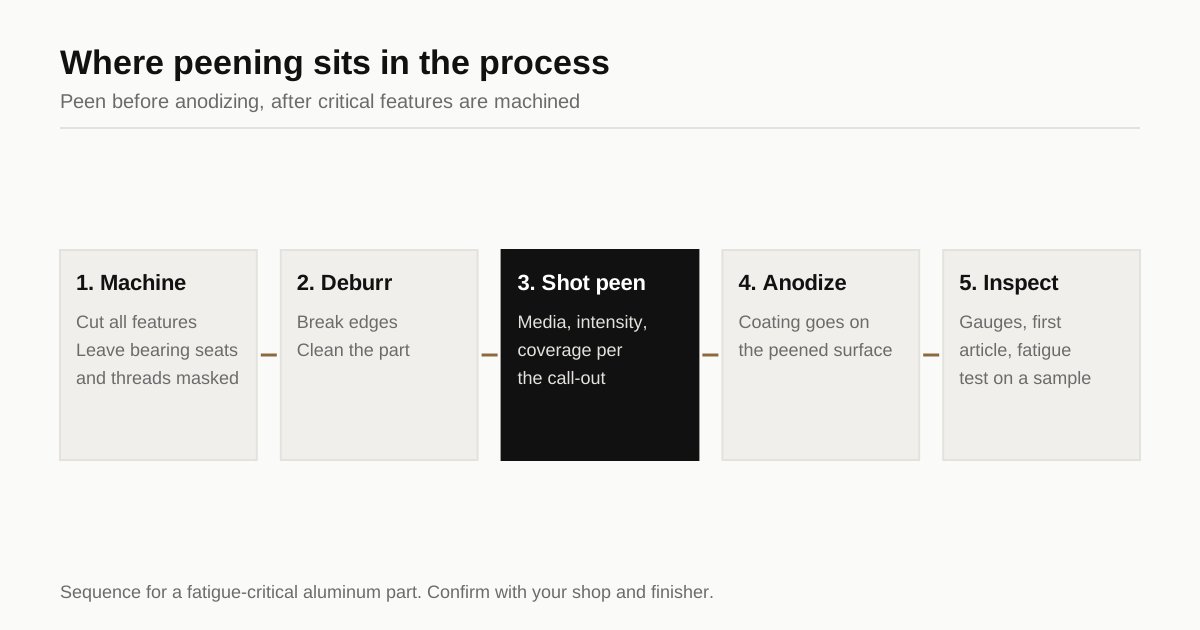
Order matters. Peen before anodizing, not after, since the peening would crack the coating. Mask or avoid critical features such as bearing seats and threads, because peening raises roughness and can change size slightly.
Cost and lead time
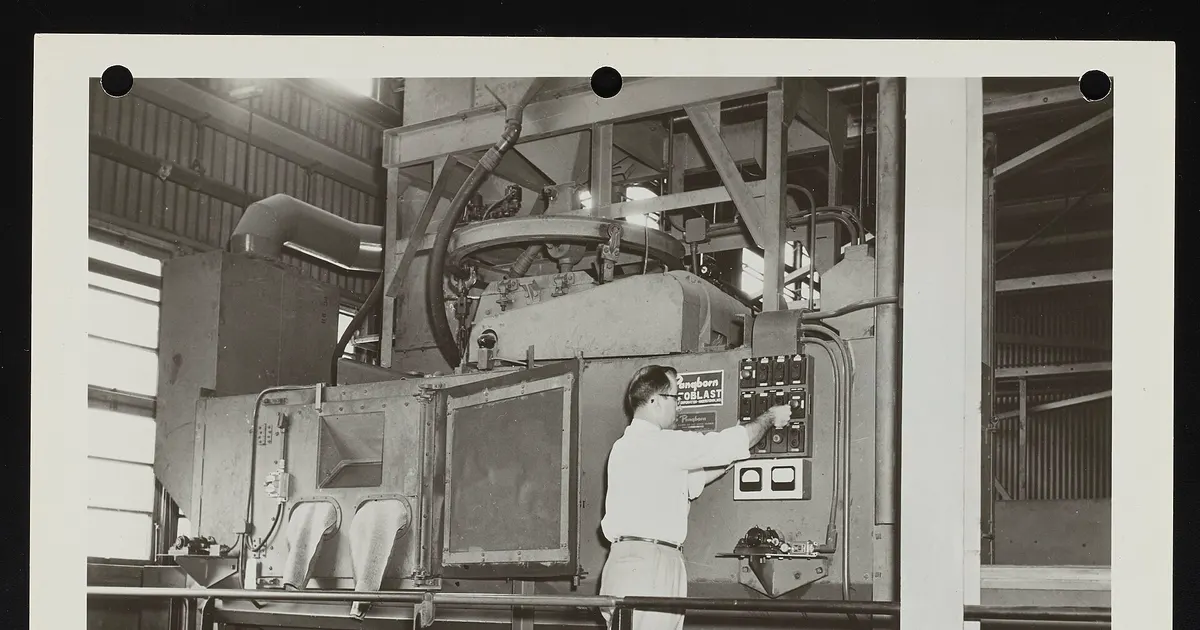
Peening is a batch process. The part goes into a cabinet or a wheel machine, is exposed for a set time, and comes out. The price depends on part size, fixturing and how many pieces fit in a load. On a small run, a minimum lot charge can dominate. On a run of hundreds of parts, the cost per piece is small compared with machining.
Lead time is the bigger issue. Qualified peening shops are not on every corner, and parts must travel to them. Plan for a few extra days in the schedule, and make sure your machine shop knows the sequence: machine, deburr, peen, anodize, inspect. The prototype to production guide covers how to plan process steps that sit outside the machine shop.
What to ask for
- State why you want peening (fatigue life on a named feature), so the shop can advise
- Name the media type or a standard, and the intensity and coverage
- Mark the areas to peen and the areas to mask on the drawing
- Say whether peening comes before or after machining of critical features
- Confirm the sequence with anodizing
- Plan to verify with a fatigue test on a few parts, as in the test lab guide
Common mistakes
- Asking for peening with no reason. A part that is not fatigue-limited gains little, and the extra step adds cost and days.
- Peening after anodizing. The impact cracks the coating and ruins the finish.
- Forgetting the masks. Bearing seats, threads and flat sealing faces change when peened. Mark them on the drawing.
- No acceptance method. A call-out that names no intensity or coverage cannot be checked. Ask the peening shop to send its Almen strip results with each lot.
- Treating peening as a repair. It improves a good part. It does not rescue a part with a deep tool mark or a sharp corner in the wrong place.
A short conversation between the machine shop, the peening shop and the finisher before the first lot saves a failed batch later.
If you are not sure peening is needed, send the drawing and the loads through the RFQ page. We match you with up to 3 machine shops, who reply within 24 business hours, and they can tell you whether they have a qualified peening partner.
Frequently asked questions
Is bead blasting the same as shot peening?
No. Bead blasting for a cosmetic matte finish uses light, uncontrolled impact and no measured intensity. Shot peening uses a defined media, a measured intensity checked on test strips and a coverage requirement. A part that looks the same can be treated very differently.
Does peening change part dimensions?
Slightly. The surface stretches and thin sections can bow, and the surface gets rougher. On parts with tight bores, bearing seats or flat faces, peen first and machine the critical features afterward, or mask them.
Can I peen a part and then anodize it?
Yes, and it is a common sequence for aluminum. Hard anodize in particular reduces fatigue strength of aluminum, and peening before anodizing helps recover part of it. Confirm the combined process with test data on your own part.
Need a quote for this part?
Send the drawing. We match you with up to 3 shops that machine bike parts and reply within 24 business hours.
Get matched with a bike parts shop