Guides / Cost
Bicycle Component Tariffs in 2026: A Landed Cost Guide
November 8, 2026
For a brand importing machined bicycle parts into the US, the 2026 duty on a part is the normal tariff-schedule rate for that part plus a country-based Section 301 duty that started on July 24, 2026. The rate depends on what the part is and where it was made, so the same pedal costs a different amount landed from different origins. This guide gives the rates we could verify, a worked example and a checklist for quotes. It is not customs or legal advice, so confirm each part line with a broker, as of October 2026.
What changed in 2026
Three things changed the stack within seven months.
- IEEPA tariffs ended. The Supreme Court decided Learning Resources v. Trump on February 20, 2026 and held that IEEPA does not authorize the President to impose tariffs.
- A temporary surcharge followed. Trade press and PeopleForBikes report that a 10% Section 122 tariff replaced it and expired when the new action began. Treat that as directional, since we did not open the proclamation.
- Section 301 took over. The Trade Representative’s notice of July 28, 2026 imposes additional duties on products of 60 economies, for entries on or after 12:01 a.m. eastern time on July 24, 2026. Goods already loaded on a vessel and in transit before that time are excepted if they entered before July 28.
The Trade Representative can modify these actions, so recheck the rate on the day you issue a purchase order.
The Section 301 rates by origin
The notice sets two flat tiers and two “net of MFN” caps.
| Origin | Section 301 treatment |
|---|---|
| India, Mexico, Canada, Cambodia, Indonesia, Malaysia, Pakistan, Sri Lanka, UK and others in the 10% list | 10% on the product |
| European Union, Taiwan | MFN plus 301 equals 10% total; 301 is zero if MFN is already 10% or more |
| Japan, Korea, Switzerland | MFN plus 301 equals 12.5% total; zero if MFN is already 12.5% or more |
| China, Thailand and all other investigated economies | 12.5% on the product, on top of the MFN rate |
The notice does not apply the duty to products of Canada or Mexico entered free of duty under USMCA (U.S. note 52(g) and (h)). It also exempts informational materials, donations, accompanied baggage and all articles and parts of articles subject to Section 232 tariffs, plus a list of products in annexes. We searched the notice for chapter 8714 and found no annex entry for bicycle parts, so assume bike parts are in scope.
Under U.S. note 52(a), products subject to these duties remain subject to the general rates of duty and to other additional duties in chapter 99. For a China-origin part, ask whether older China-specific duties also apply to your line. We could not verify that stack, so we do not quote a China total.
The base rate: HTS lines for common machined parts
The general rate comes from the Harmonized Tariff Schedule of the United States. These rates were read from the USITC schedule in October 2026.
| Part | HTS line | General rate |
|---|---|---|
| Frames and forks and parts, other | 8714.91.30 | 3.9% |
| Wheel rims | 8714.92.10 | 5% |
| Spokes | 8714.92.50 | 10% |
| Hubs, quick-release aluminum alloy | 8714.93.05 | Free |
| Hubs, other | 8714.93.28 / .35 | 3% / 10% |
| Brakes, caliper and cantilever and parts | 8714.94.30 | Free |
| Brakes and brake parts, other | 8714.94.90 | 10% |
| Pedals and parts | 8714.96.10 | 8% |
| Cotterless crank sets and parts | 8714.96.50 | Free |
| Other crank-gear and parts | 8714.96.90 | 10% |
| Aluminum alloy handlebar stems over $2.15 each | 8714.99.60 | Free |
| Other bicycle parts | 8714.99.80 | 10% |
The line a part falls in drives the rate, so a thru axle or a headset cup may land in “other” at 10%. Classification is the importer’s responsibility. Give your broker the drawing and the function of the part, not just the name.
A worked example
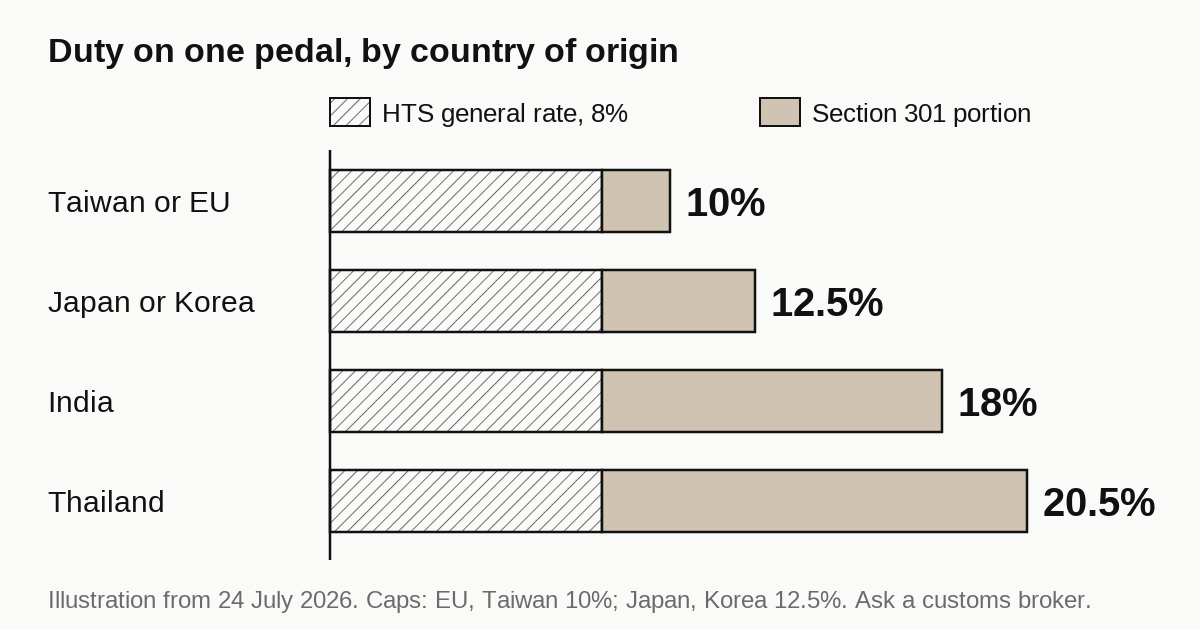
Take a machined pedal body set at 8% in the HTS, with a customs value of $10.00 per pair.
| Origin | Section 301 | Total duty rate | Duty per pair |
|---|---|---|---|
| Taiwan or EU | 2 points (to reach 10% total) | 10% | $1.00 |
| Japan or Korea | 4.5 points (to reach 12.5% total) | 12.5% | $1.25 |
| India | 10% | 18% | $1.80 |
| Thailand | 12.5% | 20.5% | $2.05 |
The numbers are illustrative: the tier math follows the notice, but your classification and other duties may change the total. The point is the spread: a pedal that costs the same at the factory can differ by about $1 per pair in duty, which is 10% of the price in this case. Add freight, insurance and fees on top.
Need a quote for this part? Get a quote for your bike parts
Section 232 and the steel and aluminum parts
The new Section 301 duty excludes parts subject to Section 232. In April 2026 PeopleForBikes said that Section 232 steel and aluminum tariffs would not apply to bicycles, e-bikes or frames, and that component categories such as chains remain subject to tariffs. BRAIN posted that statement unedited, so treat it as an industry position, not a customs ruling. The statement names chains as covered and does not list stems, cranks or hubs. Our view: whether a given 8714 line sits on a Section 232 list is a classification question, so have your broker confirm each part before you set a landed cost.
What to watch before your next order
Three things can move the number after you place the order. The Trade Representative can modify the Section 301 action, so a rate in a quote can be wrong within weeks. A change in the country of origin of a part, for example when a shop moves a finishing step to a second site, can change the tier. And a reclassification of a part to a different HTS line changes the base rate. Keep the broker’s written classification with each purchase order so that you can reprice quickly.
How to budget a quote
- Ask each shop for price ex works and a stated country of origin, then add duty yourself. A delivered price hides the tariff and can change when the rate does.
- Add a clause that either side can reopen the price if a government duty changes before shipment.
- Quote validity: keep it short, 30 days is common, because the rule changed more than once this year.
- Keep one origin file per part number: material certificate, machining location and finish location, as the EU guide also advises for the EU market.
- Compare suppliers on landed cost, not unit price. The cost guide shows what moves the factory price, and the MOQ guide shows how run size interacts with it.
- For stems, cranks and hubs, a lower duty origin is worth little if quality fails, so read the quality guide before switching origin for 2% of the price.
Send drawings, the target market and the origins you can accept through the RFQ page. We quote the finished parts within 24 business hours and place the work with a partner shop.
Sources
- USTR, Notice of Actions in Section 301 Investigations (forced labor), July 2026, full text
- USTR, Fact sheet on the Section 301 action against 60 economies
- USITC, Harmonized Tariff Schedule, heading 8714
- Supreme Court, Learning Resources, Inc. v. Trump (No. 24-1287), decided February 20, 2026
- PeopleForBikes, 2026 bike industry tariff updates (industry position)
- Bicycle Retailer, industry statement on Section 232 and bicycles, April 2026
- Bicycle Retailer, new Section 301 tariffs take effect, July 23, 2026
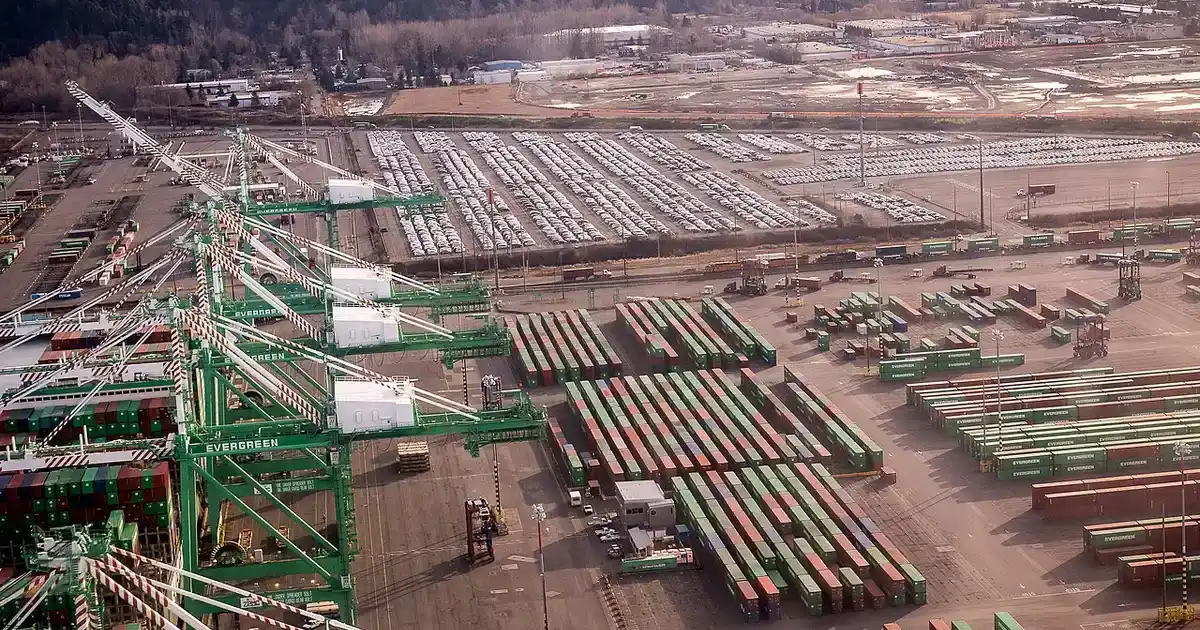
- Wikimedia Commons, Aerial view of shipping containers at Tacoma’s container port

Frequently asked questions
What tariffs apply to bicycle parts imported into the US in 2026?
The importer pays the normal HTS rate for the part, such as 8% on pedals or free on cotterless crank sets, plus a Section 301 duty of 10% or 12.5% set by country of origin since July 24, 2026. IEEPA tariffs ended in February 2026. Other duties may stack, so confirm the total with a customs broker.
Did the Supreme Court end the IEEPA tariffs?
Yes. In Learning Resources v. Trump, decided February 20, 2026, the Court held that IEEPA does not authorize the President to impose tariffs. A temporary 10% Section 122 surcharge followed, and trade press reports it expired on July 24, 2026, when the new Section 301 duties began. Ask your broker whether duties already paid can be recovered.
What does net of MFN mean for a bike part?
For EU and Taiwan products, the Section 301 duty is set so that the MFN rate plus the new duty equals 10%, and it is zero if the MFN rate is already 10% or more. For Japan, Korea and Switzerland the cap is 12.5%. A Taiwan pedal at 8% MFN pays 10% in total.
Do Section 232 steel and aluminum tariffs apply to bicycle parts?
The new Section 301 duty excludes articles and parts subject to Section 232. In April 2026 an industry statement said 232 steel and aluminum tariffs would not apply to bicycles, e-bikes or frames, while chains stayed covered. Each part line needs its own check, so ask your broker before you quote.
Need a quote for this part?
Send the drawing. We quote the finished parts, place the work with a partner shop that machines bike parts and reply within 24 business hours.
Get a quote for your bike parts