Testing and Certification for Bike Components
Reference hub. Last reviewed October 19, 2026.
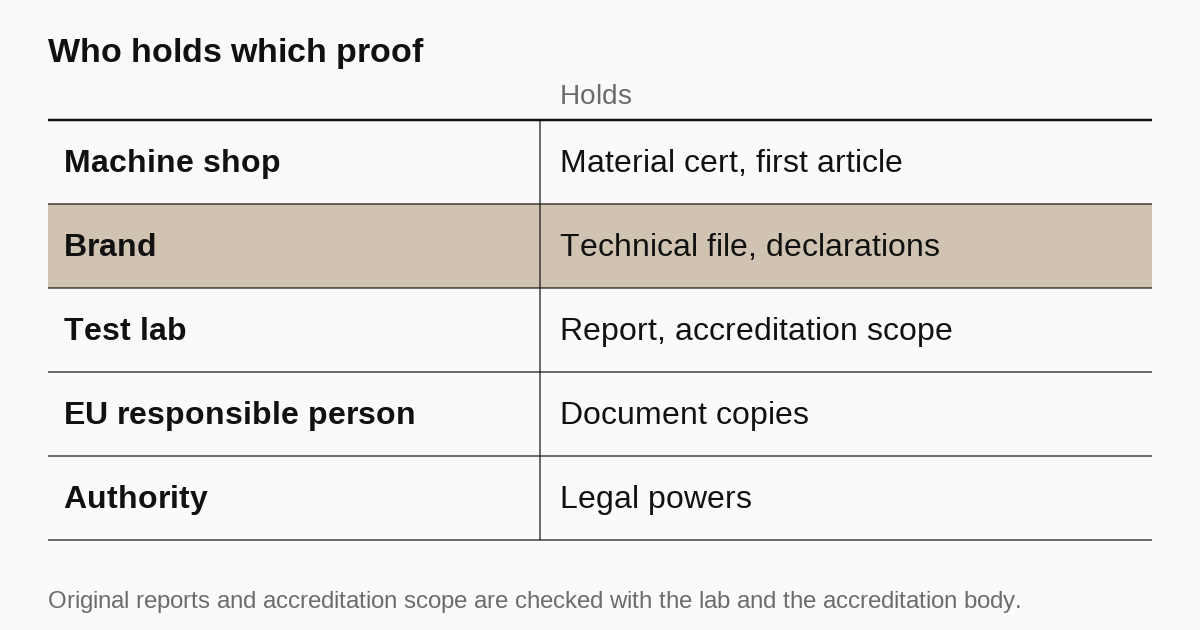
A bicycle component is seldom certified on its own. The brand that sells it owns the safety file. An independent lab tests samples to ISO 4210 or EN 15194. A machine shop supplies parts that match the drawing, with records. This hub shows who holds which proof and where each test and rule is explained.
| Who | What they do | What they hold | What they do not do |
|---|---|---|---|
| Machine shop | Machines the part to the drawing and inspects it | Material certificates, first article and inspection records, finish process records | Certify a design, run a safety test for the brand, or accept responsibility for a design flaw |
| Bike brand | Designs the part, orders the tests, sells it under its name | The technical file, lab reports, declarations, change records | Hand the file to the shop |
| Test lab | Tests samples against a named standard and issues a report | The report, its own quality system, often an accreditation to ISO/IEC 17025 | Say the design is safe beyond the samples tested |
| Importer or EU representative | Makes sure someone in the EU answers to the authorities | Contact details on product or packaging, a copy of the documents | Test the part |
| Accreditation body | Assesses whether a lab is competent for listed methods | The lab’s scope of accreditation | Test your part |
| Market authority | Surveys the market, can order withdrawal | Powers under national and EU law | Approve a part before sale |
Which proof answers which question
| The question | The proof to ask for | Page |
|---|---|---|
| Does the part survive repeated loading? | A lab report that names part revision, finish, standard, load case and every sample | Reading a fatigue test report |
| Is the 7075 temper what the drawing says? | Mill certificate plus a conductivity and hardness check on the finished part | 7075-T73 verification |
| Are there cracks after machining or peening? | Penetrant or eddy current record, with method and acceptance | Crack detection on bike parts |
| Is the anodize the thickness and seal the drawing asks for? | Coating report with method and measurement points | Anodize thickness and seal tests |
| Which anodize spec goes on the drawing? | A call-out that names standard, class, color, seal and masks | Anodize call-outs for bike parts |
| Does the part belong to a city, mountain or racing category? | The brand’s category decision, which sets the test severity | Bicycle categories in the standards |
| Is it an e-bike part? | The brand’s EN 15194 file for the complete cycle | EN 15194 for machined parts |
| Is the lab accredited for this test? | The lab’s entry in its accreditation body’s directory, with the ISO 4210 part in the scope | Accredited test labs and how to check them |
| Does the shop’s ISO 9001 certificate mean anything for this part? | The certificate’s scope, site and accreditation, plus the part records the certificate does not replace | ISO 9001 for a bike component shop |
| Does a small shop without a certificate have a quality system? | Ten procedures and the record each one leaves | A minimal quality system |
| Which social and environmental audit will a brand ask for? | The audit the brand accepts: amfori BSCI, SMETA, a sector platform or its own | Supplier codes of conduct |
| Does the tapped hole hold the bolt? | Pull-out or strip torque result, bolt grade and failure mode | Thread pull-out and torque tests |
| Will the finish survive salt? | A corrosion report that names the standard, hours, samples and failure criteria | Salt spray tests for finishes |
| May it be sold in the EU? | Responsible person, batch marking and technical documentation under GPSR; machinery rules for e-bikes | GPSR for bicycle parts and Machinery Regulation and e-bikes |
| May it be sold in Great Britain? | Pedal Bicycles (Safety) Regulations for complete bicycles, general product safety law for parts | UK rules for bicycle parts |
| May it be sold in California? | Declarations about alloy, plastics, finish chemistry and hardware | Prop 65 for bicycle parts |
| Which customs code does it travel under? | The importer’s declaration, with the shop’s description, material and drawing | HS 8714 for bicycle parts |
How the pieces fit
The standard is the test. ISO 4210 for bicycles and EN 15194 for electrically power assisted cycles define what is loaded, how and what counts as failure. The lab applies it and writes the report. The brand uses the report, together with its drawing, material and finish records, as evidence that the product it sells is safe. Authorities and customers ask the brand for that evidence, which is why the brand also needs the shop’s records to match the drawing revision that was tested.
Two older articles cover the same ground from the shop side: what brands need from a test lab and the overview of ISO 4210 and EN 15194. For the United States see CPSC 16 CFR 1512.
A typical order of evidence for a small brand
- Freeze the drawing. Revision, material, temper and finish are named before any sample is made.
- Make samples from production material. Same billet source, same machining route, same finish line. A bench prototype with a different finish tests a different part.
- Inspect the samples. A first article report records the measured features and links the material lot.
- Test. The lab applies the named standard. The report lists each sample by serial number.
- Verify the quality-critical steps in production. Temper checks, crack inspection and coating measurement are repeated on production lots, since the lab report cannot cover them.
- Control change. Any change to alloy, temper, finish, supplier or geometry is logged against the report, and the brand decides whether a retest is needed.
Steps 3 and 5 are where a machine shop is involved, and steps 1, 4 and 6 are where the brand decides. A shop that understands the sequence answers an RFQ with the records already planned, which is much of what separates a shop that can cut the shape from one that can supply a part a brand can file.
What goes on a drawing or RFQ
State the standard and edition if the part will be tested, the material and temper, the finish with thickness class and seal, and the records you need back: material certificate, first article report, anodize report. A shop that already works to that discipline will say so in its reply. See first article inspection and the bike part traceability article.
A note on this site. We hold no certificate and certify nothing. Ask the lab or shop for original reports and certificates and check accreditation with the accreditation body.
Detail pages
Frequently asked questions
Does a machined bike part carry a certificate?
Usually not as a part. The records that travel with it are a material certificate, an inspection report and, for the finish, a process record. Safety evidence is a lab report on the assembled or tested component, held by the brand that sells it.
Who is responsible when a part fails in the field?
The party that placed the product on the market under its name, which in most cases is the brand. In the EU, General Product Safety Regulation 2023/988 defines the manufacturer as the party that markets the product under its own name or trademark. A shop answers for departures from the drawing.
Does this site certify anything?
No. CNC Bike Parts matches RFQs with machine shops. It runs no lab and holds no certificate. The pages explain what a test or rule covers and what proof to ask a shop or lab for.
Sources
- Standards Council of Canada, ISO 4210-3:2023 catalogue entry (common test methods for ISO 4210-2) ccn-scc.ca
- Soulier Bunch, overview of Regulation (EU) 2023/988 (definitions of manufacturer, importer, responsible person) soulierbunch.com
- European Accreditation, interpretation of ISO/IEC 17025:2017 clause 7.8.2.1 item l european-accreditation.org
Standards and rules are cited as references. Nothing here says that a part, a shop or this site meets them. Not legal advice.
Your drawing cites one of these?
Say so on the RFQ. We quote the finished parts and reply within 24 business hours, or tell you plainly if we cannot make it.
Send your RFQ