Guides / Cost
What Your Alloy Choice Does to the Price of a Machined Bike Part
November 21, 2026

The alloy changes the price of a machined bike part through five channels: the metal itself, the minutes it takes to cut, the wear on the tools, the size of the blank and the swings in the metal market. For 6061 and 7075 the tool maker lists the same starting speeds and one public retail list shows nearly the same bar price. For titanium and 17-4 PH stainless the starting speeds are far lower, so the machine minutes dominate. This post is part of our guide to the best material for CNC bike parts, and it shows each driver with a source, a worked example and the lines to ask for in a quote.
The drivers in one table
| Driver | Direction | Size of the effect | Who controls it |
|---|---|---|---|
| Metal price per kilogram | Titanium above aluminum | Primary metal alone: titanium sponge $12 per kg, aluminum ingot about $3.97 per kg, three times (USGS, 2025 estimates) | The market |
| Mill form and cutting | Bar is worked and cut metal; the premium over ingot is not public | We found no public mill price for bar by alloy. One retailer lists 7075-T651 about 5 percent above 6061-T651 | The shop’s purchasing, and what forms you allow |
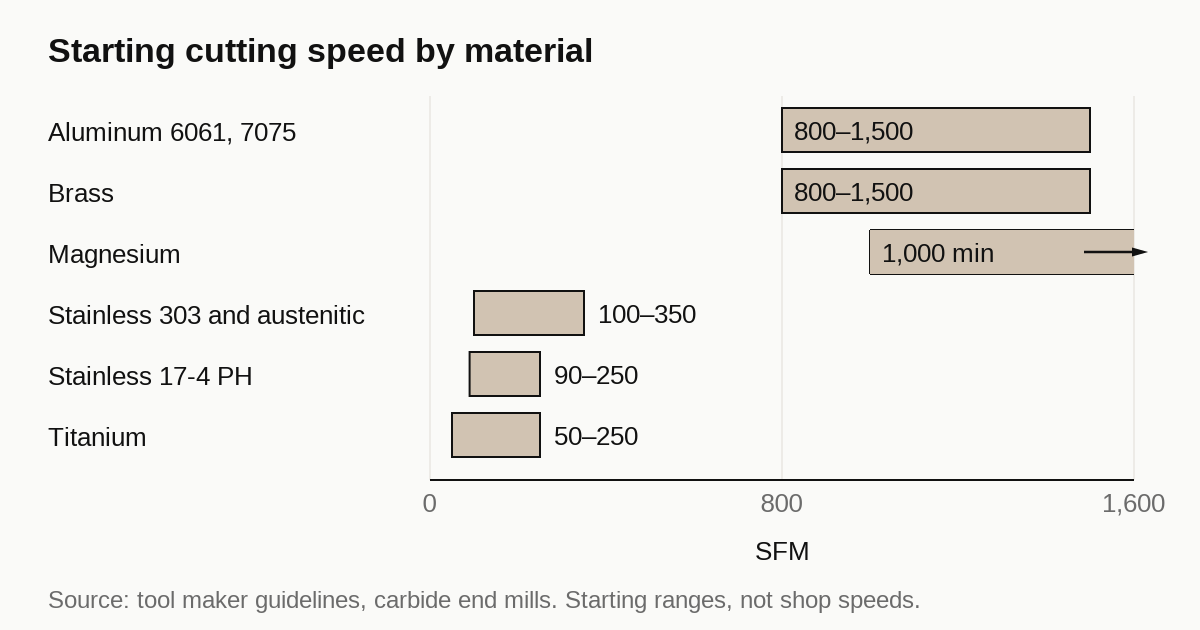
| Machining speed | Slower in titanium and 17-4 PH | Tool maker’s starting speeds: 800 to 1,500 SFM aluminum, 50 to 250 titanium, 90 to 250 for 17-4 PH | You, by alloy choice |
| Tool wear | Higher in titanium | Heat flows into the tool, not the chip. We found no public per-part figure | You, by alloy choice |
| Stock size and scrap | Bigger blank, more metal bought and removed | See the worked example | The drawing: envelope and features |
| Price swings | Up or down | USGS: aluminum ingot up about 39 percent, titanium sponge down about 10 percent, 2024 to 2025 | Quote validity terms |
| Certificates and lot control | Adds a quote line | No public figure found; ask for it as its own line | You, on the RFQ |
Caption: USGS Mineral Commodity Summaries 2026 for aluminum and titanium; Harvey Tool general machining guidelines (carbide end mills); retailer list from Alcobra Metals, opened October 2026. Percentages and the $3.97 per kg are our arithmetic from the published figures.
Raw metal price is not bar price
The cleanest public numbers are for primary metal. The USGS puts the 2025 estimate for titanium sponge at $12 per kilogram, a landed duty-paid import value, and for aluminum ingot at 180 cents per pound. Convert the aluminum to $3.97 per kilogram and the primary metal ratio is three to one.
That ratio is for primary metal only. A bar is sponge or ingot that has been melted, alloyed, worked and cut to size, and each step has its own cost. We found no public price survey for bar by alloy. Our 6061 versus 7075 guide says 7075 stock costs roughly two to three times as much as 6061, and our titanium versus aluminum guide says titanium costs ten times or more. We could not trace either ratio to a public bar price, so we treat them as rules of thumb.
One public retail list gives a different picture for aluminum. Alcobra Metals lists 2 inch cold-finished round bar at $59.29 at the low end of the range for 6061-T651 and $61.99 for 7075-T651. At 1 inch it is $14.47 and $15.17. That is a premium of about 5 percent for 7075. The page does not state the price basis. The low end grows with the square of the diameter, which fits a price for a short length of bar. The page does not say which length. Read it as an index of relative price from one seller, not as a quote. A shop buying by the bar from a mill pays something else again.
Machine time moves more than metal
Surface speed is the starting point for how long a part takes. Harvey Tool’s general machining guidelines give starting ranges for carbide end mills.
| Material | Tool maker row | Starting range, SFM |
|---|---|---|
| Aluminum 6061-T6 and 7075-T6 | Non-ferrous, aluminum | 800 to 1,500 |
| Brass, yellow and high lead | Non-ferrous, copper | 800 to 1,500 |
| Magnesium, die-cast and extruded | Non-ferrous | 1,000 minimum |
| Stainless 303, 304L, 316L | Iron, steel, stainless, austenitic | 100 to 350 |
| Stainless 17-4 PH | Iron, steel, stainless, precipitation | 90 to 250 |
| Titanium, including Ti-6Al-4V | High temperature alloys | 50 to 250 |
Caption: Harvey Tool, General Machining Guidelines, carbide end mills; the page is undated and shows a 2026 copyright. These are starting ranges, not shop speeds. The page does not list 4130 or acetal.
Compare the ends of the ranges and titanium starts between about one sixth and one sixteenth of aluminum’s speed. A Makino paper on titanium explains why. Ti-6Al-4V is strong, its heat does not move into the chip but flows into the tool, and its high elasticity makes it prone to vibration. The paper treats 50 meters per minute, about 165 SFM, as an already slow speed for Ti-6Al-4V, and says the conventional wisdom is to cut other titanium alloys 30 to 50 percent slower.
A speed ratio is not a cycle time ratio. The program also contains tool changes, finishing passes, setups and probing, which do not scale with speed. Our titanium guide gives two to four times the machine time of aluminum. We found no public cycle time comparison for a bike part, so ask for the minutes per part.
Stock size and scrap
You pay for the blank, not the part. Our cost guide gives the example of a 130 gram stem cut from a 400 gram block. Two drawings of the same part can need different blanks because of one boss or one long arm, and the blank sets both the metal bought and the minutes spent cutting it away.
Three habits reduce the blank. Allow the shop to choose a stock size that clears the part with the least waste. Say whether a forged blank is acceptable. Group parts that can be cut from the same bar.
Need a quote for this part? Get a quote for your bike parts
Price swings and quote validity
Metal prices move, and a quote is only as good as its validity date. The USGS table gives the average US aluminum ingot price as 138.5, 152.6, 125.9, 129.5 and 180 cents per pound for 2021 to 2025, with 2025 an estimate. That is about 39 percent up from 2024 to 2025. Titanium sponge went from $13.30 to $12 per kilogram over the same year, about 10 percent down. Both are primary metal, and both are US figures.
Ask how long the quote holds and whether the shop fixes the metal price at order or at shipment. On a large order, ask how a metal price move is shared.
A worked example
This is an example with assumptions, not a price from any shop. The part is a round machined part cut from 2 inch bar, with a 3 inch blank and a finished weight of 120 grams. Assume a machine rate of $75 per hour, a $60 setup spread over 50 parts, and 12 minutes of machining in 6061 and in 7075, because the tool maker lists the same starting range for both. Assume 36 minutes in titanium, three times the aluminum time, which is inside the range in our titanium guide.
The blank is a cylinder of 2 inch diameter and 3 inch length, which is 154 cubic centimeters. At 2.70 grams per cubic centimeter for 6061 that is 417 grams, and at 2.81 for 7075 it is 434 grams (densities from Wikipedia). The 120 gram part is under 30 percent of the blank. Material is the low-end retailer price for the 2 inch bar divided by four, which assumes the low end is a 12 inch length (the page does not say).
| Line | 6061-T651 | 7075-T651 | Titanium Grade 5 |
|---|---|---|---|
| Material blank | $14.82 | $15.50 | No public bar price found |
| Machining | $15.00 (12 min) | $15.00 (12 min) | $45.00 (36 min) |
| Setup share | $1.20 | $1.20 | $1.20 |
| Total before finish, inspection and packing | $31.02 | $31.70 | $46.20 plus the titanium blank |
Caption: assumed numbers for arithmetic. Material from the Alcobra list, price basis unstated. Tool wear, finishing and inspection are not included.
In this arithmetic 7075 adds $0.68 per part, about 2 percent. Titanium adds $30 of machine time before any bar cost. Even if the titanium blank cost the same as the aluminum one, which it will not, the part would be about $61, roughly twice the aluminum part. The lesson is the order of the effects: machine time first, metal second, and for 6061 against 7075 the metal difference in this list is small next to the machine line.
Lines to ask for in the quote
- Material: alloy, temper, form, stock size and the certificate type.
- Blank size and the number of parts per bar.
- Machine minutes per part, or the rate and the setups, so you can see the alloy effect.
- Price for the same part in a second alloy, if you are undecided.
- Validity date, and how the metal price is treated after it.
- Who keeps the leftover bar on a repeat order.
Use the same lines on every quote. Our cost guide, linked above, shows the other blocks you will see next to the material line.
Send the drawing
Send the drawing, the alloy and temper, and the honest quantity through the RFQ page. We read it, quote the finished parts within 24 business hours and place the work with a partner shop that already machines and anodizes bike components. The quote is itemised and has no separate service fee. For the wider decision, read our guide to the best material for CNC bike parts.
Sources
- USGS, Mineral Commodity Summaries 2026, Titanium and titanium dioxide
- USGS, Mineral Commodity Summaries 2026, Aluminum
- Harvey Tool, General Machining Guidelines
- Makino, Machining Titanium Part 3, Machining the Less Common Titanium Alloys (2021)
- Alcobra Metals, 7075-T651 cold-finished round bar
- Alcobra Metals, 6061-T651 cold-finished round bar
- Wikipedia, 6061 aluminium alloy
- Wikipedia, 7075 aluminium alloy
Frequently asked questions
How much more does 7075 cost than 6061?
It depends on the size, form and supplier. Our older guides say roughly two to three times for the stock, but we could not trace that to a public price. One US retailer's list shows 7075-T651 round bar about 5 percent above 6061-T651. Ask a shop to quote both alloys on your drawing and read the material line.
Why is titanium so much more expensive to machine?
Mostly machine time. A tool maker's starting surface speeds are 50 to 250 SFM for titanium against 800 to 1,500 for 6061 and 7075, because titanium holds heat in the tool. Slower cutting means more minutes per part, and the machine rate is charged per minute. The metal price comes on top.
Does the price of aluminum change between quotes?
It can. The USGS estimates the average US ingot price at 180 cents per pound in 2025 against 129.5 in 2024, a rise of about 39 percent. Ask how long each quote holds and whether the metal price is fixed at order or at shipment. A quote without a validity date is a risk to you.
How can I lower the material cost without changing the alloy?
Open the stock size. A blank that clears the part with the least waste costs less to buy and less to cut away. Say which bar sizes and forms are acceptable, group parts that share a bar and accept the shop's standard stock. Never lower the cost by leaving the temper or certificate out.
Need a quote for this part?
Send the drawing. We quote the finished parts, place the work with a partner shop that machines bike parts and reply within 24 business hours.
Get a quote for your bike parts