Guides / Standards
EU Bicycle Anti-Dumping Rules and Essential Parts Imports
November 7, 2026
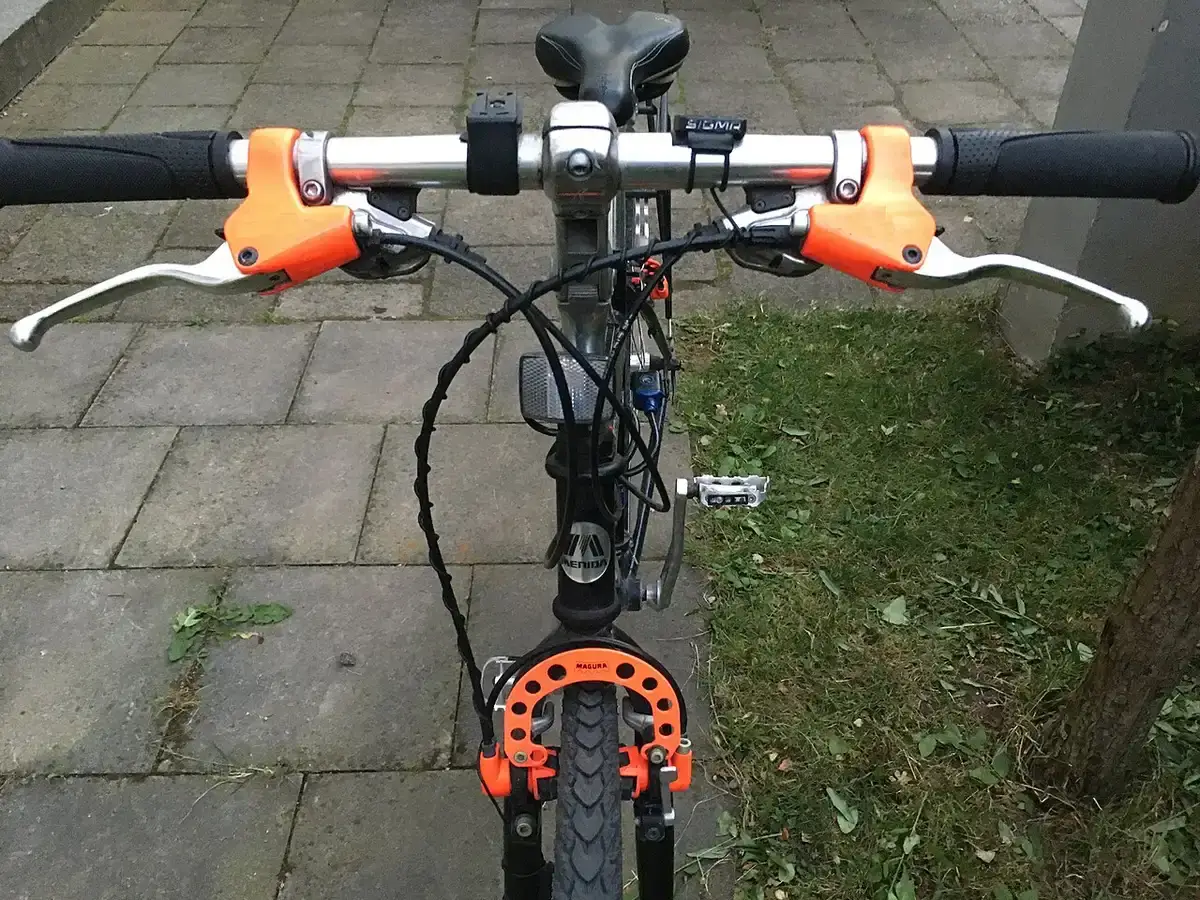
If you import machined bicycle parts into the EU, check two things before you place the order: where the part is made, and whether the part is on the Commission’s list of “essential bicycle parts”. A short list of parts from China carries the anti-dumping duty on bicycles, set at 48.5% for most exporters. Most of what this site’s shops machine, such as stems, pedals, hubs and headsets, is not on that list, but cranks, brake levers and handlebars are. This guide sets out what the regulations say. It is not legal or customs advice, so confirm with a customs broker before you commit, as of October 2026.
The measure in one paragraph
The base measure is a definitive anti-dumping duty on bicycles from China. Commission Implementing Regulation (EU) 2025/2146 of 22 October 2025 renewed it after an expiry review. For bicycles under CN 8712 00 30 and ex 8712 00 70, the duty is 48.5% for all exporters not named, 19.2% for one named company and 0% for two others, applied to the net free-at-Union-frontier price before duty. The regulation also extends the duty to bicycles consigned from Indonesia, Malaysia, Sri Lanka, Tunisia, Cambodia, Pakistan and the Philippines, whether or not declared as originating there, with named producers exempt in some of them. That part concerns complete bicycles. For parts, you need the older regulation below.
Which parts are covered
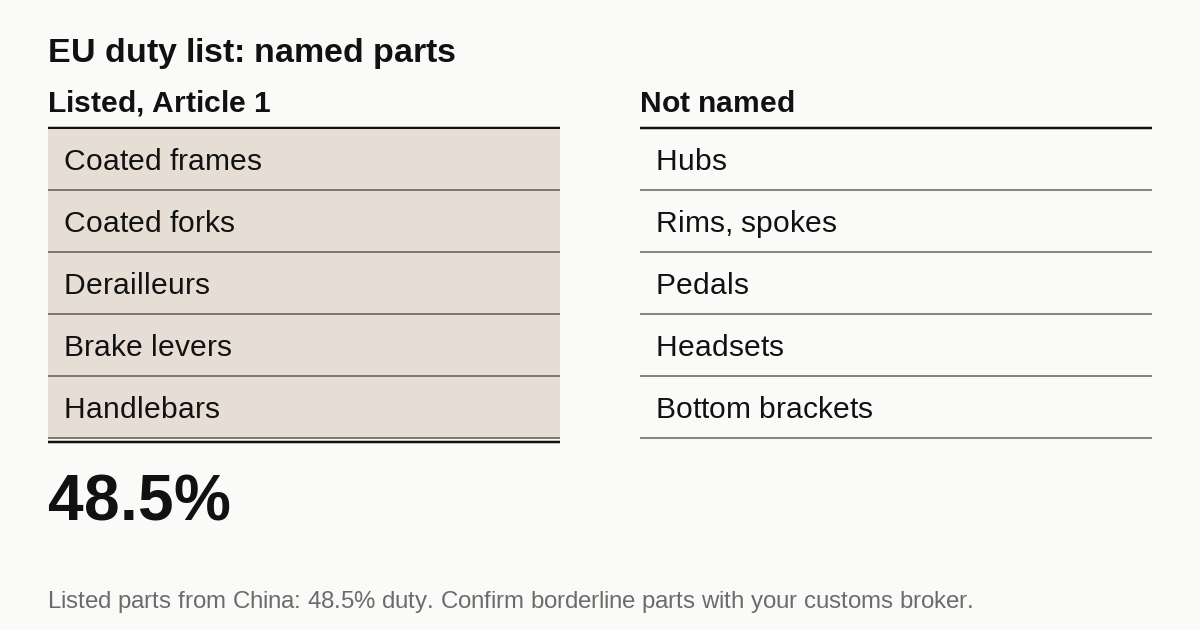
Council Regulation (EC) No 71/97 extended the bicycle duty to “essential bicycle parts” from China. Article 1 lists them, with the 1997 CN codes. Article 1(5) of the 2025 regulation states that this extension is maintained, at the 48.5% rate.
| Listed in Regulation 71/97 Article 1 | 1997 CN code |
|---|---|
| Painted, anodized, polished or lacquered frames | ex 8714 91 10 |
| Painted, anodized, polished or lacquered front forks | ex 8714 91 30 |
| Derailleur gears | 8714 99 50 |
| Crank-gear | 8714 96 30 |
| Free-wheel sprocket-wheels | 8714 93 90 |
| Brakes, other | 8714 94 30 |
| Brake levers | ex 8714 94 90 |
| Complete wheels | ex 8714 99 90 |
| Handlebars, with or without stem, brake or gear levers attached | 8714 99 10 |
Frames, forks, gears and brakes are covered whether or not presented in sets. Codes have been renumbered since 1997, so check the line in TARIC (the EU tariff database) with your broker. Note the wording on frames and forks: the list names coated ones, which includes anodized.
The list as published does not name hubs, rims, spokes, pedals, headsets, seat posts, bottom brackets, saddles or chains, and a stem appears only as an optional attachment to a handlebar. That is our reading of the text, so confirm any borderline part, such as a crank arm sold without chainrings, with your broker before you rely on it.
For a bike brand, the exposed machined parts are therefore cranks and chainrings, brake levers, handlebars with stems, derailleur parts and wheels. Our other guides cover them: crank arms, chainrings and brake levers.
Origin decides the duty
The duty targets Chinese-origin parts. Article 2(2) of Regulation 71/97 deems essential parts consigned from China to originate there, unless an origin certificate proves another country. Customs may also ask for an origin certificate for essential parts shipped from another country. A part made elsewhere from Chinese bar or forgings is a question of the EU origin rules, not of the invoice, so settle it before the order and keep the paperwork: the drawing, the material certificate and the shop’s route card.
Three practical steps:
- Ask each shop where the part is cut and finished, in writing, on the quote.
- Keep an origin file for each part number: material mill certificate, machining location, finishing location.
- Ask your broker to confirm the CN code and the origin treatment before the first shipment, not at the border.
How exemptions work
Article 3 of Regulation 71/97 lets the Commission exempt parts that do not circumvent the duty, under the system in Regulation 88/97. Exemptions go to named companies. In its Implementing Decision (EU) 2026/671 of 20 March 2026, the Commission exempted two assemblers and suspended payment for three more under examination. It found Chinese-origin parts under 60% of the total value of parts in the bicycles those companies assemble, so their assembly falls outside the anti-circumvention rule in Article 13(2) of Regulation 2016/1036.
Our view: this scheme is built for companies that assemble complete bicycles in the EU. The decision we read does not mention aftermarket part brands. If you sell parts and do not assemble bicycles, do not assume the exemption fits you; ask a trade lawyer.
Need a quote for this part? Get a quote for your bike parts
Three common cases
- An aftermarket brand importing machined cranks or brake levers. Both are on the list. If they are Chinese in origin, the 48.5% rate is the starting point, and the exemption scheme named assemblers, not part sellers. Budget the duty or choose another origin.
- A bike brand assembling complete bicycles in the EU. The assembler route in Regulation 88/97 may apply, but only after the Commission has examined the company and named it in a decision. The March 2026 decision shows the timing: its exemptions take effect from requests received in April 2024 and August 2024, so a decision can arrive about two years after the request.
- A brand buying stems, hubs, pedals or headsets. These are not named in Article 1 as we read it, so this duty is not the cost driver. Classification and origin still need to be right on the customs declaration.
E-bikes and everything else
Electric bicycles are not covered by the 2025 bicycle regulation, which applies to non-motorized cycles. E-bikes from China carry separate anti-dumping and countervailing duties, which the Commission said in January 2025 it had extended for five years: anti-dumping rates of 10.3% to 70.1% and countervailing rates of 3.9% to 17.2%. E-bike motor mounts and brackets, covered in the e-bike mounts guide, follow the classification of the part, so check each one.
This guide covers EU anti-dumping only. Ordinary customs duty, VAT, and the compliance side (see the ISO 4210 overview) are separate, and US rules differ, as the CPSC 1512 guide shows.
What to ask before you order
- Is the part on the Article 1 list, and under which CN code does the broker classify it?
- Where is it machined and where is it finished? Is the country of origin documented?
- Does the supplier have its own origin certificate process?
- Does any exemption apply to my company by name? If not, budget the duty.
- Is the price quoted EXW, FOB or delivered, and does it include duty? Compare quotes on the same basis, as the cost guide recommends.
Send drawings, the target market and the origin you need through the RFQ page. We quote the finished parts within 24 business hours and place the work with a partner shop.
See also: selling bike parts in Germany, with GPSR, the amended ProdSG, pedal reflectors and packaging registration.
Sources
- EUR-Lex, Implementing Regulation (EU) 2025/2146 (bicycles from China, expiry review)
- EUR-Lex, Council Regulation (EC) No 71/97 (essential bicycle parts)
- EUR-Lex, Implementing Decision (EU) 2026/671 (exemptions)
- European Commission, EU extends duties on electric bicycles from China, 24 January 2025
- Wikimedia Commons, Handle with brake levers and front brake of Merida bicycle

Frequently asked questions
Does the EU anti-dumping duty on Chinese bicycles apply to bicycle parts?
Yes, for a short list. Regulation 71/97 extends the bicycle duty to essential parts from China: coated frames and forks, derailleurs, crank-gear, free-wheel sprockets, brakes, brake levers, complete wheels and handlebars. The 2025 expiry review regulation keeps that extension at the 48.5% rate. Hubs, pedals, headsets and seat posts are not on the list.
What is the current EU anti-dumping rate on Chinese bicycles?
Implementing Regulation (EU) 2025/2146 of 22 October 2025 sets 48.5% for all other Chinese exporters, 19.2% for one named company and 0% for two others. The duty is extended to bicycles consigned from several other countries, with named exempt producers. Rates apply to the net free-at-Union-frontier price before duty.
Can an assembler import Chinese bicycle parts duty free?
Under Regulation 88/97, the Commission can exempt assemblers whose assembly does not circumvent the duty. In its March 2026 decision it found Chinese parts were under 60% of the total parts value for the exempted assemblers. Exemptions are granted to named companies, so ask a trade lawyer whether a parts brand qualifies.
Are electric bicycles covered by the same duty?
No. E-bikes from China have separate anti-dumping and countervailing duties. The Commission said in January 2025 that it extended them for five years, with anti-dumping rates of 10.3% to 70.1% and countervailing rates of 3.9% to 17.2%. The 2025 bicycle regulation covers non-motorized cycles only.
Need a quote for this part?
Send the drawing. We quote the finished parts, place the work with a partner shop that machines bike parts and reply within 24 business hours.
Get a quote for your bike parts