Guides / Standards
Bicycle and E-Bike Component Rules in 2027: Machinery, Batteries, Forced Labour and CPSC
November 21, 2026
Five rules reach bicycle and e-bike components with a date in 2027: the US foreign trade zone step of CPSC eFiling on 8 January, the EU Machinery Regulation on 20 January, the Battery Regulation’s removability, QR code and passport rules on 18 February, the Cyber Resilience Act’s main duties on 11 December and the Forced Labour Regulation on 14 December. This page puts the dates in one table, says who each rule addresses and what it changes for a machined part. It is not legal advice. Facts are as of 25 October 2026, so confirm each date with your compliance adviser.
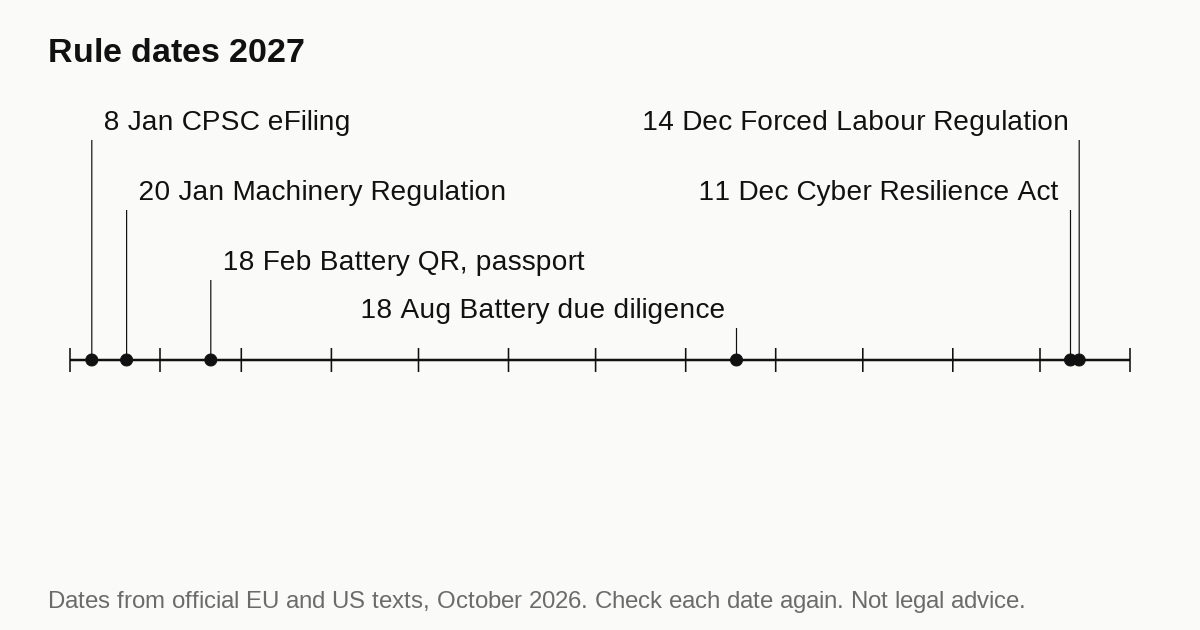
The calendar in one table
| Applies from | Rule | Who it addresses | What it changes for a component | Official source |
|---|---|---|---|---|
| 13 Dec 2024 (already) | General Product Safety Regulation (EU) 2023/988 | Brand selling to EU consumers | Responsible person, part identification, technical file. No new 2027 date | Art. 52 of the Regulation |
| 8 Jul 2026 (already) | CPSC eFiling of certificates | US importer of regulated products | Certificate data goes to CBP electronically at entry | CPSC release, 8 Jul 2026 |
| 8 Jan 2027 | CPSC eFiling, foreign trade zone entries | US importer using an FTZ | Same duty extended to FTZ entries | CPSC release |
| 20 Jan 2027 | Machinery Regulation (EU) 2023/1230 | E-bike brand | Replaces Directive 2006/42/EC; larger technical file | Arts. 51, 52, 54 as corrected |
| 18 Feb 2027 | Battery Regulation (EU) 2023/1542, Arts. 11, 13(6), 77 | Whoever places an LMT battery or e-bike on the market | Battery and cells removable by an independent professional; QR code; battery passport | Arts. 11, 13, 77, 96 |
| 18 Aug 2027 | Battery due diligence, Art. 48 as amended by 2025/1561 | Battery economic operators | Raw material due diligence, moved from 2025 | Reg. (EU) 2025/1561 |
| 11 Dec 2027 | Cyber Resilience Act (EU) 2024/2847 | Maker of a connected e-bike product | Security rules for products with digital elements; reporting duties from 11 Sep 2026 | Art. 71 |
| 14 Dec 2027 | Forced Labour Regulation (EU) 2024/3015 | Anyone placing products on the EU market | Ban on products made with forced labour; investigations by authorities | Art. 39 |
The dates in this table come from the Official Journal texts for the EU rules and from CPSC for the US step. The Section 301 duty and the EU anti-dumping measures are rolling measures with no 2027 start date, so they sit outside the table: see the 2026 tariff guide and the EU anti-dumping guide.
Machinery Regulation: 20 January 2027, not 14 January
The Machinery Regulation was published in the Official Journal on 29 June 2023. The sources on our Machinery Regulation page read it as covering e-bikes without vehicle type approval. Its Article 54 as first published printed 14 January 2027. A corrigendum published on 4 July 2023 changed the date to 20 January 2027 in Article 51 (repeal of Directive 2006/42/EC), Article 52 (transitional provisions) and Article 54 (application). The Publications Office copy of the act as first published still shows 14 January, because the correction is a separate document. We opened both and use 20 January.
Article 52(1) says Member States may not impede the making available of products placed on the market in conformity with the Directive before that date. The German statutory accident insurer DGUV states that there is no period in which a manufacturer may choose between the two texts: until 19 January 2027 the Directive applies and from 20 January 2027 the Regulation does. A brand that finishes a product line before the date follows the old text. A new model released after it follows the new one.
The standards side is not settled. The Commission’s last status we found, checked on 24 September 2026 by a standards consultancy, said the first list of harmonised standards for the Regulation was being prepared and expected before the end of 2026. We found no published list as of 25 October 2026. Separately, Genorma lists a revision of EN 15194, the e-bike standard, as a draft at the stage “DIS ballot initiated: 12 weeks”, dated 22 October 2026, and notes it relates to Regulation 2023/1230. The edition in use today is EN 15194:2017+A1:2023. For what a part must carry, see the Machinery Regulation page and the EN 15194 page.
Battery Regulation: 18 February 2027 and the bracket you machine
Article 3 of Regulation (EU) 2023/1542 defines an LMT battery as a sealed battery of 25 kg or less, designed to provide traction power for wheeled vehicles that run on a motor alone or on a motor combined with human power. It also defines a portable battery as one that is neither an electric vehicle battery nor an LMT battery. An e-bike traction battery therefore follows the LMT rules, not the portable rules.
Three LMT duties start on 18 February 2027:
- Removability (Article 11). Whoever places a product with an LMT battery on the market must ensure that the battery and the individual cells in the pack are readily removable and replaceable by an independent professional at any time in the product’s life. Article 11(7) adds five years of spare-part availability after the last unit of the model, and Article 11(8) bars software that impedes replacement.
- QR code (Article 13(6)). From 18 February 2027 every battery carries a QR code. For an LMT battery it leads to the battery passport.
- Battery passport (Article 77). From the same date each LMT battery has an electronic record with the information in Annex XIII.
The European Commission’s battery passport page still lists 18 February 2027, and a standards-news update of October 2026 reports that the date did not move. The same update says the implementing act on access rights, due by 18 August 2026, is not yet adopted and is planned for the fourth quarter of 2026.
Labelling under Article 13(1) and (2) applies from 18 August 2026 or 18 months after a related implementing act enters into force, whichever is later, so check the status with the battery maker. Raw material due diligence under Article 48 moved to 18 August 2027 through Regulation (EU) 2025/1561.
What this means for a machined part is our reading, not a rule addressed to shops. The duty sits on the brand, but a battery rail, mount or housing that traps the pack with bonded joints or tools only the factory owns can break it. Expect the brand to ask for fasteners that a service workshop can reach, tool access in the drawing and a drawing revision that matches the tested design. The motor mount guide covers the loads and fasteners worth specifying.
Need a quote for this part? Get a quote for your bike parts
Forced Labour Regulation and the Cyber Resilience Act: December 2027
Regulation (EU) 2024/3015 applies from 14 December 2027, with some articles earlier. It bans placing products made with forced labour on the EU market and it does not add due diligence duties of its own. What a brand should keep on file is in our forced labour guide for bicycle component brands.
The Cyber Resilience Act, Regulation (EU) 2024/2847, applies from 11 December 2027, with the manufacturer reporting duties of Article 14 from 11 September 2026. It covers products with digital elements whose use includes a data connection. A connected drive unit, display or app may fall in scope. A machined bracket does not, so the Act reaches a shop only through the brand’s supplier requests. We have not assessed which e-bike parts qualify, so ask your adviser.
US dates: eFiling and duty
CPSC began requiring electronic filing of certificate data for regulated imports on 8 July 2026 and applies the rule to foreign trade zone entries from 8 January 2027. CPSC says importers already had to create the certificate information; eFiling changes how it is sent. The CPSC 1512 guide lists the bicycle rules and who certifies. For duty rates, see the tariff guide linked above.
What to ask a supplier before these dates
- Which drawing revision was fatigue tested, and does the part you receive match it? See lot marking for warranty tracing.
- Can a service workshop remove the battery and its cells without destroying a part?
- Which material certificates, finish records and lot codes can you give for each batch?
- Who in your supply chain machines, anodizes and ships the part, so that the brand can answer an authority’s request?
Send the drawing, the target market and the dates you need to hit through the RFQ page. We quote the finished parts within 24 business hours and place the work with a partner shop.
Sources
- Regulation (EU) 2023/1230 on machinery, Official Journal L 165, 29.6.2023, Articles 51, 52 and 54 (Publications Office)
- Corrigendum to Regulation (EU) 2023/1230, Official Journal L 169, 4.7.2023, p. 35 (copy hosted by IBF Solutions)
- Regulation (EU) 2023/1542 on batteries and waste batteries, Articles 3, 11, 13, 77 and 96 (Publications Office)
- Regulation (EU) 2025/1561 amending the date for battery due diligence (Publications Office)
- Regulation (EU) 2024/2847, Cyber Resilience Act, Articles 2 and 71 (Publications Office)
- Regulation (EU) 2024/3015, Forced Labour Regulation, Article 39 (Publications Office)
- Regulation (EU) 2023/988, General Product Safety Regulation, Article 52 (Publications Office)
- European Commission, batteries and the digital product passport
- DGUV, EU Machinery Regulation (application 20 January 2027, no transition between the two texts)
- CPSC, mandatory eFiling for certificates of compliance (8 July 2026, FTZ 8 January 2027)
- European Standards, Machinery Regulation harmonised standards status, checked 24 September 2026 (secondary)
- Genorma, prEN 15194 status (secondary)
- DPP Atlas, update of October 2026 on the battery passport (secondary)
Frequently asked questions
Which rules start in 2027 for e-bike components sold in the EU?
Regulation (EU) 2023/1230 on machinery applies from 20 January 2027. The Battery Regulation (EU) 2023/1542 applies its removability rule for light means of transport batteries, the QR code and the battery passport from 18 February 2027. The Cyber Resilience Act applies from 11 December 2027 and the Forced Labour Regulation from 14 December 2027.
Is an e-bike battery a portable battery or an LMT battery?
The Battery Regulation defines a portable battery as one that is neither an electric vehicle battery nor an LMT battery. An LMT battery is sealed, weighs 25 kg or less and is designed for traction of wheeled vehicles powered by a motor alone or with human power. An e-bike traction battery fits the LMT definition, so the LMT rules apply.
Does the Machinery Regulation apply from 14 or 20 January 2027?
20 January 2027. The text published on 29 June 2023 printed 14 January 2027, and a corrigendum published on 4 July 2023 changed the date to 20 January 2027 in Articles 51, 52 and 54. Older copies of the text may still show 14 January.
Does a machine shop have to comply with these rules itself?
Mostly not directly. The Machinery, Battery and Forced Labour Regulations address the brand or importer that places the product on the market. The rules reach a shop through the brand's requests: drawings that allow a battery to be removed, material and lot records, and supplier information.
Need a quote for this part?
Send the drawing. We quote the finished parts, place the work with a partner shop that machines bike parts and reply within 24 business hours.
Get a quote for your bike parts