Guides / Standards
16 CFR 1512 and Machined Bike Parts in the US
November 6, 2026
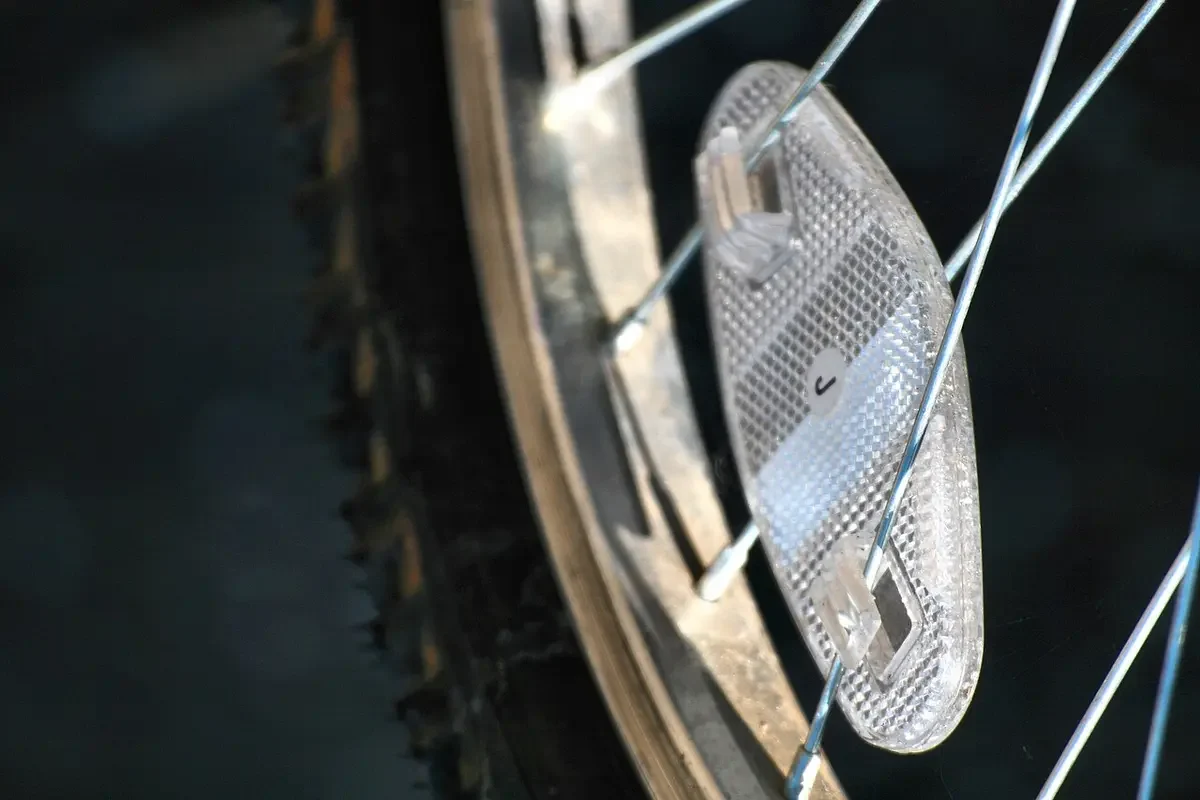
The US bicycle rule, 16 CFR part 1512, regulates the complete bicycle. It does not set a standard for a stem, a pedal or a thru axle sold alone, but a machined part still has to let the finished bicycle pass the tests, and your US customer will hold you to that. This guide covers what the rule says, which clauses touch a machined part and what to write on the drawing. It is not legal advice, so confirm your product with a compliance specialist.
What 16 CFR 1512 covers
Section 1512.1 sets the scope as bicycles defined in 1512.2(a), and 1512.2 reads as follows. A bicycle is a two-wheeled vehicle with a solely human-powered rear drive wheel, or a two- or three-wheeled vehicle with fully operable pedals and an electric motor under 750 watts. A sidewalk bicycle is one with a seat height of no more than 635 mm (25 in). Track bicycles built as velodrome machines and one-of-a-kind bicycles made to an individual consumer’s order are outside the rule.
Section 1512.3 adds that a bicycle must meet the requirements in the condition in which it is offered for sale. A bicycle sold partly assembled must meet them after assembly under the maker’s instructions. CPSC’s business guidance states that bicycles failing any requirement are banned under the Federal Hazardous Substances Act, so the rule is a hard gate, not a guideline.
Our view: because the unit is the bicycle, a loose component has no separate pass or fail mark under this rule. The pages we read do not say how a part sold alone is treated, and that gap is the reason to ask a compliance specialist before you market an aftermarket part as “CPSC compliant”.
Clauses that reach a machined part
Most of the rule tests the whole bicycle: braking distance, a 4 mile road test, reflectors, tires. A few clauses set numbers that land on the part you machine.
| Part | Clause | What the text says | Drawing consequence |
|---|---|---|---|
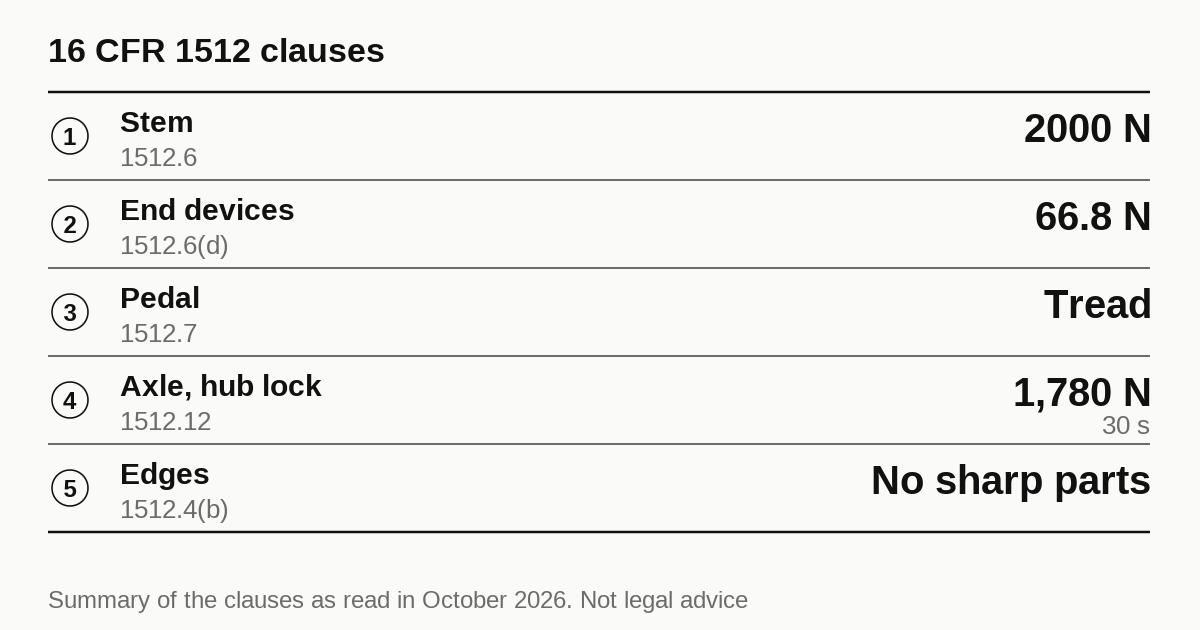
| Stem | 1512.6(a), (b) | Quill stems carry a permanent insertion mark at least 2.5 times the stem diameter from the lowest point. Stem withstands 2000 N (450 lbf) | Mark location and depth; radii at the clamp and the stem neck |
| Handlebar ends | 1512.6(d) | Ends capped or covered. Grips, end plugs and end-mounted devices resist a 66.8 N (15 lbf) removal force | Bar end bore and plug seat tolerance |
| Pedals | 1512.7 | Tread on both top and bottom surfaces, unless the pedal has a definite preferred position. Reflectors per 1512.16(e), except on sidewalk bicycles | Tread pattern, reflector pockets |
| Wheel hubs and axles | 1512.12 | Positive locking device. Rear axle: no relative motion under 1,780 N (400 lbf) for 30 seconds. Front lock (not quick release): 17 N-m (12.5 ft-lb) removal torque | Thread class and engagement, step radii |
| Any edge or point | 1512.4(b) | No unfinished sheared metal edges or other sharp parts that hands or legs are, or may be, exposed to | Break-edge note; deburring step |
| Fasteners | 1512.4(d) | Screws, bolts and nuts must not fracture, loosen or fail during testing | Thread spec, locking method, torque |
| Seat post | CPSC guidance | Permanent minimum insertion mark at least 2 times the post diameter from the bottom | Mark position |
Note what the table does not show. The stem clause gives a strength figure and a mark, not a stem bolt torque. The text says the assembly instructions must warn about overtightening the stem bolt and give a clear tightening procedure. That puts a fastener and torque spec on you or your customer, not on the rule.
Brake levers have their own set of numbers under 1512.5, covered in the brake lever guide. The pedal clause is walked through in the platform pedal guide, the axle clause in the thru axle guide, and the stem in the stem guide.
Edges and burrs
The edge clause is the one that costs money in practice. A machined part with a razor edge at a pocket exit can fail 1512.4(b) on a complete bicycle even though it passed every strength test. Put a break-edge value on the drawing and keep the deburring step in the quote. The deburring guide explains why this must happen before anodizing.
Who certifies, and what eFiling changes
CPSC says manufacturers and importers of bicycles must certify that they comply with 16 CFR part 1512. The route depends on the buyer of the bicycle.
- Children’s bicycles (designed or intended primarily for children 12 years of age or younger): testing must be done by a CPSC-accepted third-party lab, and the manufacturer or importer issues a Children’s Product Certificate that cites 16 CFR part 1512.
- Other bicycles: a General Certificate of Conformity. CPSC states that a CPSC-accepted lab is not required for general use products, and that first-party testing or testing from any qualified lab can support a GCC.
A machine shop does neither. It machines to your drawing and can report what it measured. The brand or importer of the bicycle holds the certificate, which is why the ISO 4210 overview and the test lab guide are worth reading together with this one: the lab tests the finished product, not the part.
eFiling since July 2026
On July 8, 2026, CPSC began requiring importers of regulated consumer products to submit certificate data electronically to CBP before products enter US commerce. Entries from a foreign trade zone start January 8, 2027. CPSC states that eFiling creates no new testing, certification or compliance obligations, that importers must already create and maintain this information, and that it does not apply to domestic manufacturers. For a brand that imports complete bicycles, the practical effect is that the certificate data (product, rule cited, manufacture date and place, test date and lab) must be correct and ready at entry. Your customs broker will ask for it.
Need a quote for this part? Get a quote for your bike parts
What to put on the drawing and the RFQ
- Part type, the bicycle it fits and the market (US, EU or both)
- Whether the part is for a children’s bicycle, a sidewalk bicycle (seat height 635 mm or less) or a general bicycle
- Any permanent mark required by the clause (stem or seat post insertion line), with position and depth
- Break-edge value on every external edge and pocket exit
- Thread designation, class and locking method on every fastener
- Strength or fatigue data you hold from the bicycle test, and the finish used on the tested sample
- Marking: the 1512.19 manufacturer name and month and year sit on the frame, so do not assume a part marking can replace them
- Annual volume and release size
On finish: a test result on a bare part does not cover the anodized one, as the ISO 4210 overview explains. Test the finish you ship.
Common mistakes
- Calling a part “CPSC certified”. The certificate belongs to the bicycle’s manufacturer or importer.
- Skipping the children’s bicycle question. It changes who tests and what paper you need.
- Ignoring edges. A sharp edge fails the bicycle, not just the part.
- Treating the insertion mark as cosmetic. On a quill stem it is a rule requirement with a set minimum distance.
- Assuming EU and US rules match. ISO 4210 and 16 CFR 1512 are different documents with different test loads.
Send the drawing, the bicycle type and the target market through the RFQ page. We quote the finished parts within 24 business hours and place the work with a partner shop.
See also: selling machined bike parts in the US, the full US checklist with duty, de minimis and origin marking.
Sources
- Cornell LII, 16 CFR part 1512 Requirements for bicycles
- Cornell LII, 16 CFR 1512.2 Definitions
- Cornell LII, 16 CFR 1512.4 Mechanical requirements
- Cornell LII, 16 CFR 1512.6 Steering system
- Cornell LII, 16 CFR 1512.7 Pedals
- Cornell LII, 16 CFR 1512.12 Wheel hubs
- CPSC, Bicycle Requirements Business Guidance
- CPSC, Rules Requiring Third-Party Testing and a Children’s Product Certificate
- CPSC, Mandatory eFiling for Certificates of Compliance, July 8, 2026
- Wikimedia Commons, Bike wheel reflector

Frequently asked questions
Does CPSC 16 CFR 1512 apply to a bicycle part sold on its own?
The rule regulates bicycles, defined in 16 CFR 1512.2 as a two-wheeled vehicle with a solely human-powered rear drive wheel, or a two- or three-wheeled vehicle with working pedals and a motor under 750 watts. The pages we read set no requirements for a component sold alone. A part reaches the rule through the complete bicycle it is fitted to.
Who certifies a bicycle to 16 CFR 1512?
CPSC says manufacturers and importers of bicycles must certify compliance. Bicycles designed or intended primarily for children 12 and younger need testing at a CPSC-accepted third-party lab and a Children's Product Certificate. For other bicycles a General Certificate of Conformity can rest on first-party testing. A machine shop does not certify the bicycle.
What strength must a bicycle stem meet under 16 CFR 1512.6?
The stem must withstand 2000 N (450 lbf) on a bicycle and 1000 N (225 lbf) on a sidewalk bicycle, tested under 1512.18(g). Quill stems also need a permanent insertion mark at least 2.5 times the stem diameter from the lowest point. The text gives no torque value for the stem bolt.
Do importers have to eFile bicycle certificates with CBP?
Since July 8, 2026, importers of most CPSC-regulated products send certificate data electronically to CBP, and bicycles are on CPSC's certification lists. Entries from a foreign trade zone start January 8, 2027. CPSC says eFiling creates no new testing or certification obligations and does not apply to domestic manufacturers.
Need a quote for this part?
Send the drawing. We quote the finished parts, place the work with a partner shop that machines bike parts and reply within 24 business hours.
Get a quote for your bike parts