Guides / Design
Hub Engagement Explained: How Ratchet Tooth Count Sets the Degrees
November 21, 2026
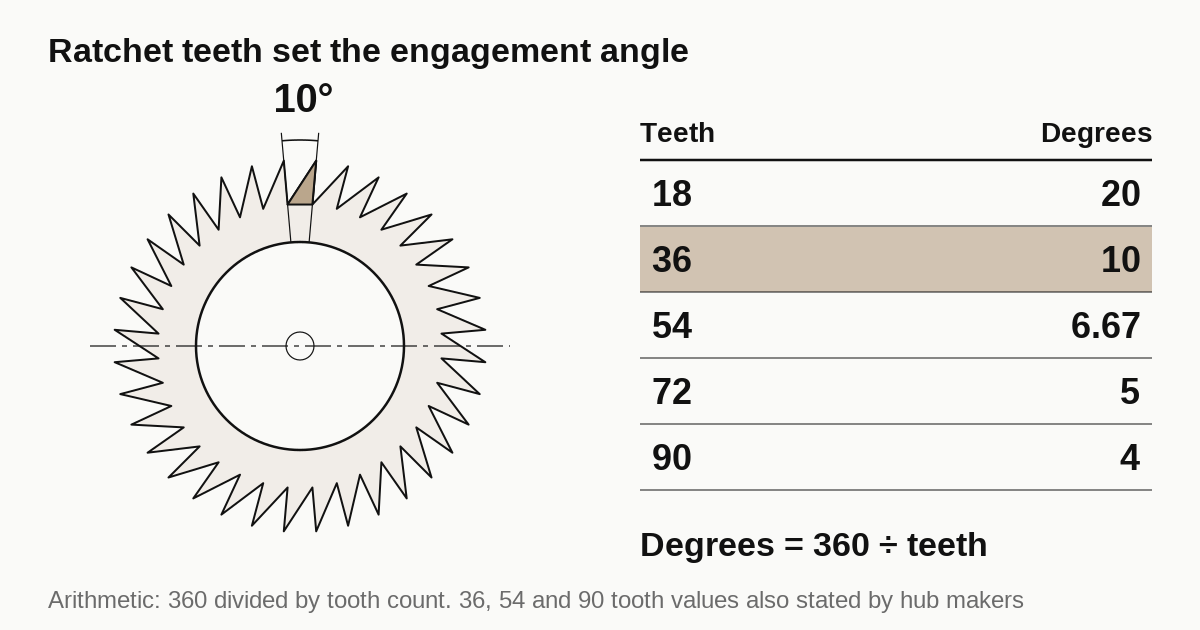
Hub engagement is how far the freehub has to turn before it picks up the drive and the wheel moves. For a ratchet hub it comes from one piece of arithmetic: 360 degrees divided by the number of teeth on the ratchet ring. A 36-tooth ring gives 10 degrees, and this post shows the numbers, the conversion to pedal rotation and what a ring drawing needs. It sits beside the guide to machining hub shells and freehub bodies.
What the ratchet does
A freehub lets the cassette spin freely while coasting and locks it to the hub when you pedal. Wikipedia’s freehub article describes the cassette sitting on a splined shell, with the ratcheting mechanism part of the hub itself. Wikipedia’s ratchet article defines a ratchet as a toothed gear with a spring-loaded pawl, and defines backlash as the limited backward movement a ratchet allows, a maximum distance equal to the spacing between the teeth. On a round ring that spacing is an angle: the tooth count sets it.
One hub maker defines engagement angle as the degrees of movement required from the freehub body to engage the drive, and calculates it as the total degrees in a circle divided by the number of teeth. That is the same arithmetic.
Tooth count to degrees
| Ratchet teeth | Engagement angle (degrees) | Basis |
|---|---|---|
| 18 | 20 | arithmetic |
| 24 | 15 | arithmetic |
| 36 | 10 | stated by a hub maker, matches arithmetic |
| 48 | 7.5 | arithmetic |
| 54 | 6.67 | maker states 6.66, the exact value is 6.67 |
| 72 | 5 | arithmetic |
| 90 | 4 | reported by BikeRadar for the DT Swiss Ratchet DEG, matches arithmetic |
| 120 | 3 | arithmetic |
Source line: 36 and 54 teeth from Scribe Cycling’s engagement angle page; 90 teeth from BikeRadar’s report on the DT Swiss Ratchet DEG, which describes a 4-degree engagement angle with 90-tooth ratchets. Other rows are 360 divided by the tooth count, calculated here.
The arithmetic assumes each tooth on the ring is a separate engagement step. If a maker quotes a figure that does not equal 360 divided by its tooth count, ask what the figure counts.
From the hub to the pedals
A rider feels the engagement at the crank, not at the hub. The cassette turns at a different rate from the crank, set by the ratio of cog teeth to chainring teeth.
Crank angle = hub angle × cog teeth ÷ chainring teeth.
The example below uses a 32 tooth chainring, an assumed value, with the 10, 6.67 and 4 degree rings from the table.
| Hub engagement | 11 tooth cog | 32 tooth cog | 50 tooth cog |
|---|---|---|---|
| 10 degrees (36 teeth) | 3.4 degrees | 10 degrees | 15.6 degrees |
| 6.67 degrees (54 teeth) | 2.3 degrees | 6.7 degrees | 10.4 degrees |
| 4 degrees (90 teeth) | 1.4 degrees | 4 degrees | 6.3 degrees |
These are worst case values, the most the freehub can turn before it drives. The point where a given pedal stroke lands within one tooth step varies, so the real delay at any moment can be anywhere from zero up to the figure shown.
Need a quote for this part? Get a quote for your bike parts
What the maker side controls
The ring is a machined or ground part with teeth cut around a face. Tooth count sets the angle on the drawing, but the part still has to deliver it.
- Tooth size shrinks as the count rises. For an assumed 40 mm pitch diameter, the tooth pitch along the circle is about 3.49 mm at 36 teeth and about 1.40 mm at 90 teeth.
- Pitch error counts for more on small teeth. An assumed pitch error of 0.02 mm is about 0.6% of the 36-tooth pitch and about 1.4% of the 90-tooth pitch.
- Both rings must match. In a hub with two mating ratchet rings, the faces that meet must line up in angle as well as in diameter, which is a drawing requirement on both parts.
One hub maker also says its finer teeth close a shorter distance when coasting, which it ties to a quieter, softer sound. That is the maker’s description, and no part drawing can settle which count a rider prefers. The bearing press fit guide covers the neighboring bearing seats, which share the hub shell with the ratchet.
What to put on a ratchet ring drawing
- Tooth count, with the engagement angle written next to it as a calculated reference
- Tooth profile: angle, depth and the faces that carry load
- Pitch circle diameter and the tolerance on tooth pitch, as total and tooth to tooth
- Face flatness and the datum it is measured from
- Material, heat treatment and hardness, since the teeth carry the drive load
- How the first article will be checked: which gauge or measuring machine, and how many teeth
Do not write only “high engagement”. It is a result, not a dimension. To get quotes on a ring or a hub shell, send the drawing through the RFQ page. We quote the finished parts within 24 business hours and place the work with a partner shop. For the rest of the hub, see the hub shell and freehub guide.
Sources
- Wikipedia, Freehub
- Wikipedia, Ratchet (device)
- BikeRadar, DT Swiss Ratchet DEG with a 4-degree engagement angle
- Scribe Cycling, engagement angle, 36 tooth versus 54 tooth (hub maker, formula and examples)
Frequently asked questions
How are degrees of engagement calculated for a ratchet hub?
Divide 360 degrees by the number of teeth on the ratchet ring. A 36-tooth ring gives 10 degrees, a 54-tooth ring about 6.7 degrees and a 90-tooth ring 4 degrees. Hub makers state these values for their own rings. The result is the largest rotation of the freehub before it drives the wheel.
Do more ratchet teeth always make a better hub?
More teeth give a smaller engagement angle, but each tooth gets smaller and the ring is harder to make accurately. One hub maker also says its finer teeth close a shorter distance when coasting, which gives a quieter, softer sound. The best count depends on the rider, the ring diameter and the loads, so it is a design choice, not a ranking.
Is the engagement angle at the hub the same as at the pedals?
No. The cassette turns more slowly than the crank in a low gear, so the same hub angle takes more crank rotation. Crank angle equals hub angle times cog teeth divided by chainring teeth. A 10 degree hub angle is about 3.4 degrees at the crank with a 32 tooth ring and an 11 tooth cog, and about 15.6 degrees with a 50 tooth cog.
Need a quote for this part?
Send the drawing. We quote the finished parts, place the work with a partner shop that machines bike parts and reply within 24 business hours.
Get a quote for your bike parts