Guides / Design
What to Write for the Material on a Bike Part Drawing So Every Shop Quotes the Same Metal
November 21, 2026
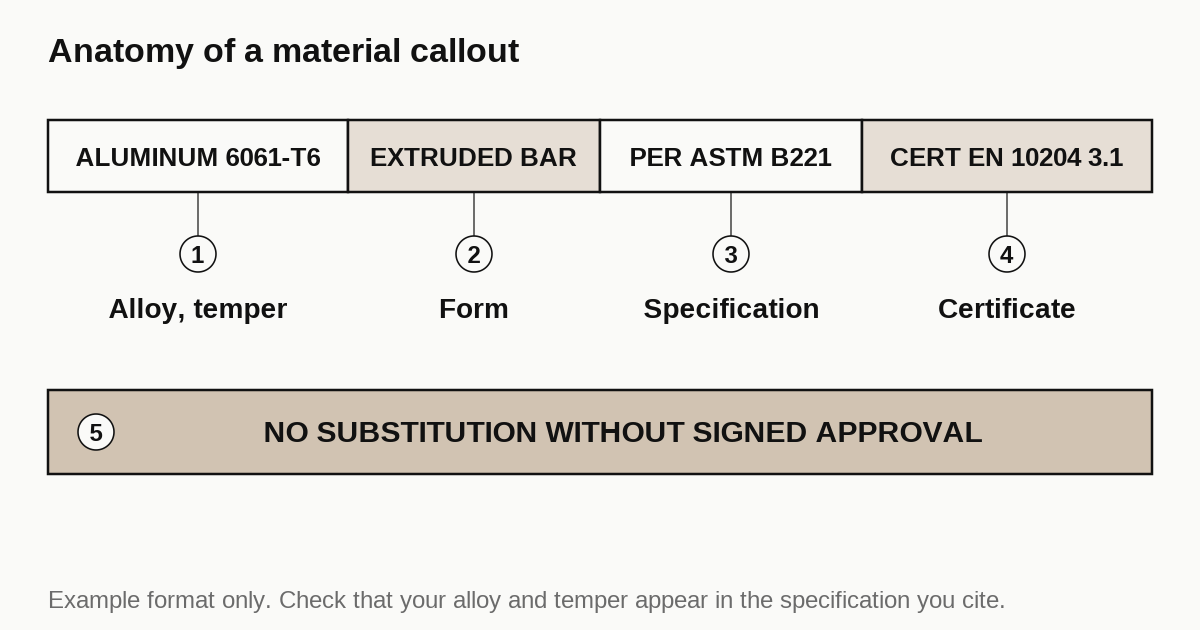
The material callout on a bike part drawing is one line, and it decides what metal arrives. Write four things: the alloy with its temper, the product form, the specification the bar was made to and the certificate you want with it. Left out, each item becomes the shop’s choice, and a shop pricing against a competitor chooses the cheapest option that still matches your words. This post is part of our guide to the best material for CNC bike parts, and it shows what to write, how to read what comes back and how to handle a substitution request.
What a complete callout holds
A callout is a short string, and each piece answers a different question. The table shows the pieces, an example of each and the usual mistake.
| Element | Example | What it settles | Common mistake |
|---|---|---|---|
| Alloy | 6061 | The chemistry | Writing “aluminum” or “alloy” |
| Temper or condition | T6 | The strength and hardness | Leaving it out, so the shop buys what is in stock |
| Product form | Extruded bar, rolled bar, plate, forging blank | Grain direction, stock size, price | Not saying whether a forging blank is allowed |
| Specification | ASTM B221 or B211 | A document the mill certificate can be checked against | Citing a specification for a form the part is not cut from |
| Certificate | EN 10204 type 3.1 | What the mill declares about the lot | Asking after the metal is cut |
Caption: author’s summary. Examples are placeholders to replace with your own values; confirm that your alloy and temper appear in the specification you cite.
Do not stop at the alloy. Wikipedia’s alloy article describes a four-digit wrought system in which the first digit gives the main alloying group, so 6xxx means magnesium and silicon and 7xxx means zinc. The digits identify the group, but they say nothing about strength until a temper follows.
Reading the alloy and temper
The temper follows the alloy number after a dash. Wikipedia’s aluminium alloy article lists the letters: F as fabricated, O annealed, H strain-hardened and T heat-treated to a stable temper. For machined bike parts the T tempers matter. T6 is solution heat-treated and artificially aged. T651 adds stress relief by stretching before the aging step.
Some 7075 parts are specified in an overaged temper on purpose, and our guide to 7075-T6 versus 7075-T73 explains when that is worth doing. The callout must carry the exact temper, because 7075 in one temper and 7075 in another are different parts.
Titanium uses a grade system instead. ASTM’s catalog page for B348 lists Grade 5 (6Al-4V) and Grade 9 among the grades its bar specification covers. Wikipedia lists Ti-6Al-4V under UNS R56400 and notes that it is also called Grade 5. A callout such as “titanium Grade 5, annealed” is complete enough to quote; “titanium” is not, because the grade changes strength and machining time. Our Grade 9 versus Grade 5 guide shows how far apart they are.
Product form and the specification
The form is a cost and a performance choice. Extruded bar, rolled or cold-finished bar and plate arrive in different sizes and tempers, and a forging blank has a different grain structure again. Say which you allow.
ASTM’s catalog pages show how the aluminum bar specifications divide the work. B221 covers extruded bars, rods, wire, profiles and tubes. B211 covers rolled or cold-finished bar, rod and wire. Both state that alloy and temper designations follow ANSI H35.1. The B348 page covers annealed titanium and titanium alloy bars and billets. We read only the catalog front matter, because the tables and requirements sit behind a purchase, so we did not read what the tables say about your alloy and temper. Check that the pair you want appears in the specification before you cite it. The pages we opened are older editions (B221-13, B211/B211M-19 and B348/B348M-19), and ASTM’s B348 page lists B348/B348M-25 as the active version, so confirm the current edition of each before you cite it.
European suppliers often work to EN standards instead. Wikipedia lists EN 573-3 for the chemical composition and form of wrought products and EN 755-2 for extruded rod, bar, tube and profile mechanical properties, and notes that 6082 is not strongly featured in ASTM standards. We did not read the EN standards or EN 10204 themselves, only these Wikipedia summaries. If your shop works to EN, ask which alloy and standard it is quoting, and write that on the drawing. A UNS number is a different thing again. Wikipedia describes it as one letter and five digits that name a chemistry and says properties and testing come from separate specifications.
The certificate
A certificate is the only way to learn what the lot was. Wikipedia describes the EN 10204 type 3.1 certificate as one issued by the manufacturer that declares the products comply with the order and supplies test results. Type 3.2 adds an inspector independent of production and a second inspector for the purchaser or one designated by official regulations. Most bike parts need type 3.1 at most. Ask for it on the RFQ, with the lot number, because a certificate is easiest to get before the bar is cut.
Match the lot on the certificate to the lot on the first article report, so that a part that fails in the field can be traced back to the bar it came from.
What you need before you start
- A design decision on alloy and temper. The person who owns the design makes it, ideally from a test or an earlier part, not from a catalog page.
- The form you will allow. Bar, plate, extrusion or a blank, as in the sections above.
- The specification page, opened and checked. Confirm that your alloy and temper appear in the specification you plan to cite.
- A named person to sign any substitution. Usually the same person who made the design decision.
- Time. About the time of one drawing revision, plus the wait for any question to a shop.
Need a quote for this part? Get a quote for your bike parts
Steps, with the failure point of each
- Name the alloy and temper from your design decision. Failure point: copying a callout from an older drawing without checking that the alloy is still the one you tested.
- Choose the form you will allow. Failure point: leaving “bar or plate” open, then finding a price difference you cannot compare.
- Cite a specification that matches the form. Failure point: citing the plate specification for a part cut from extruded bar.
- Check that the alloy and temper are in the specification. Failure point: assuming a pair exists because both are common.
- State the certificate type and ask for the lot number. Failure point: asking for “material certs” without a type, and receiving a distributor’s copy.
- Add the substitution rule. Failure point: no rule, so a shop quietly swaps in an alloy it holds.
Example callouts
Replace the bracketed items with your own choices. These are examples of format, not recommendations for your part.
MATERIAL: ALUMINUM 6061-T6, EXTRUDED BAR PER ASTM B221 [CHECK TABLE]. CERT: EN 10204 3.1 WITH LOT NUMBER. NO SUBSTITUTION WITHOUT SIGNED APPROVAL.
MATERIAL: ALUMINUM 7075-[TEMPER], ROLLED OR COLD-FINISHED BAR PER ASTM B211. CERT: EN 10204 3.1 WITH LOT NUMBER. NO SUBSTITUTION WITHOUT SIGNED APPROVAL.
MATERIAL: TITANIUM GRADE 5 (UNS R56400), ANNEALED BAR PER ASTM B348. CERT: EN 10204 3.1 WITH LOT NUMBER. NO SUBSTITUTION WITHOUT SIGNED APPROVAL.
For stainless 17-4 PH, write the condition as well (H900, H1025 or H1150); our 17-4 PH hardware guide lists what each condition changes.
How a substitution request should work
A shop may find that your alloy is out of stock or that a close alternative is cheaper. That is a design decision, not a purchasing one. The drawing line says no substitution without signed approval, and the request should arrive as one short message that names:
- the alloy, temper and form you asked for;
- the alloy, temper and form the shop proposes;
- the reason, such as stock or lead time;
- the price and lead time effect;
- the shop’s statement that the proposed material meets the same specification.
You decide, you reply in writing and the answer goes with the purchase order. Two alloys that look similar on a quote can differ in anodize response, strength or corrosion behavior. Wikipedia’s aluminium alloy article gives 6082 as about 1.0 percent silicon, 0.85 percent magnesium and 0.65 percent manganese and 6061 as about 0.6 percent silicon, 1.0 percent magnesium, 0.25 percent copper and 0.2 percent chromium, so they are different chemistries even though both are popular 6xxx alloys. Treat a swap between them as a request, not a formality.
Checklist to copy
- Alloy and temper on one line, with no abbreviations the shop must guess.
- Product form allowed, and whether a forging blank is acceptable.
- Specification cited, with a note that you checked the alloy and temper against it.
- Certificate type and lot number requested on the RFQ.
- Substitution rule on the drawing.
- Finish named separately, because the finish depends on the alloy.
- The drawing revision letter on every sheet.
Send the drawing
Put the callout on the drawing, then send the drawing and the honest quantity through the RFQ page. We read it, quote the finished parts within 24 business hours and place the work with a partner shop that already machines and anodizes bike components. The quote is itemised and has no separate service fee. For the wider choice behind the callout, read our guide to the best material for CNC bike parts.
Sources
- Wikipedia, Aluminium alloy
- Wikipedia, 6082 aluminium alloy
- Wikipedia, Ti-6Al-4V
- Wikipedia, Mill test report
- Wikipedia, Unified numbering system
- ASTM, B221 catalog page
- ASTM, B211/B211M catalog page
- ASTM, B348/B348M catalog page
Frequently asked questions
Is writing 'aluminum 6061' on the drawing enough?
No. 6061 is sold in several tempers that differ in strength, and bar, plate and extrusion are different products. Write the alloy, the temper, the product form and the specification, then ask for a certificate. Each missing item lets a shop pick the cheapest option that still matches your words.
What does the T in 6061-T6 mean?
T marks a heat-treated temper. Wikipedia describes T6 as solution heat-treated and then artificially aged, and T651 as the same with stress relief by stretching. The temper sets the strength, so it belongs on the drawing next to the alloy number, not in a separate email.
Do I need a UNS number or an ASTM specification?
A UNS number names a chemistry and is not a specification. A product specification such as ASTM B221 for extruded bar or B211 for rolled or cold-finished bar covers form, tolerances and tests. For a bike part, alloy, temper and form usually carry the decision, and a specification adds a testable reference.
Can the shop substitute a similar alloy?
Only with your written approval. Add a line to the drawing that no substitution is allowed without a signed request. The shop states the proposed alloy, temper, form and reason, you decide, and the answer is filed with the purchase order. A verbal yes cannot be found when a batch fails.
Need a quote for this part?
Send the drawing. We quote the finished parts, place the work with a partner shop that machines bike parts and reply within 24 business hours.
Get a quote for your bike parts