Guides / Quality
Quality Agreement for Machined Bike Parts: Clauses Worth Including
November 21, 2026
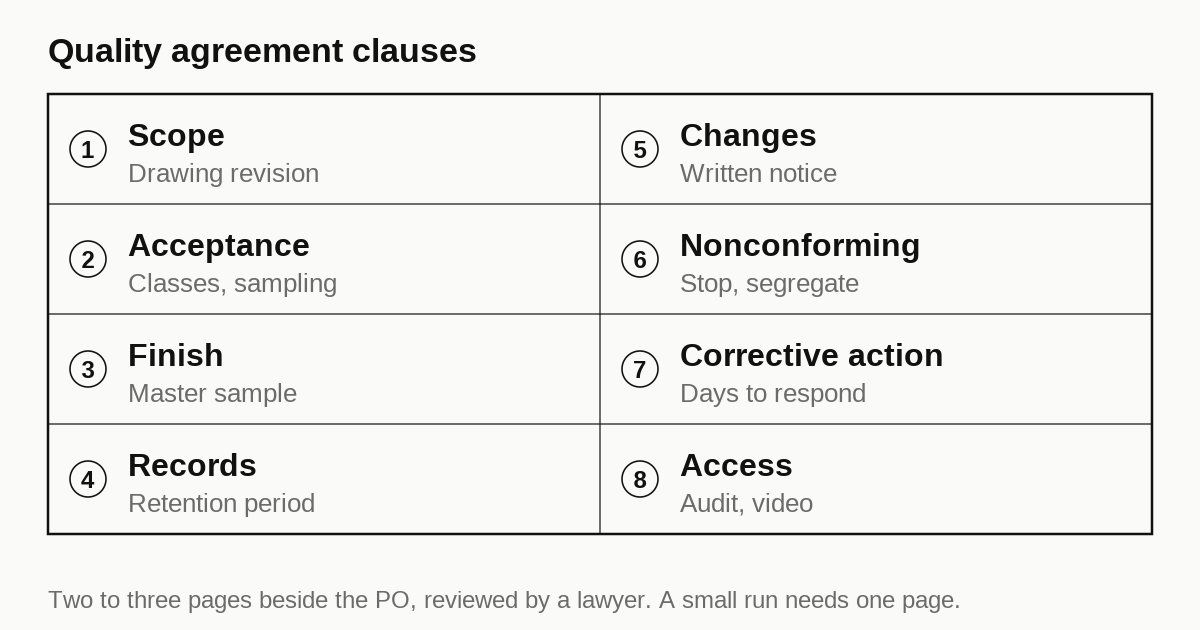
A quality agreement is a short document that sits next to the purchase order and fixes how quality is judged, recorded and corrected. For a bike brand it is the place to write down what the drawing cannot say: how many pieces are measured, who keeps the color master, when the shop must tell you it changed anodizers and what happens to a failed lot. It is not legal advice and not a substitute for a lawyer’s review. This guide lists eight clauses worth including and how to size the document to the order. It is part of our buyer’s guide to quality control.
What it is and what it is not
Brands often mix up four documents. Each does a different job.
| Document | What it does | What it leaves out |
|---|---|---|
| Drawing | Defines the part, tolerances and finish callouts | How inspection is done and recorded |
| Purchase order | Price, quantity, date, delivery term | Quality method and corrective action |
| NDA | Protects files and designs | Anything about parts quality |
| Quality agreement | How quality is proven, recorded and corrected | Price, volume and design ownership |
An ISO 9001 certificate is not a quality agreement either. Wikipedia notes that third-party certification bodies confirm that an organization meets ISO 9001, and that ISO itself does not certify organizations. The certificate speaks about the shop’s management system, not your parts. Our page on ISO 9001 for bike component suppliers explains what a certificate does and does not show.
We found no bike-specific public template for a supplier quality agreement. Published examples come from other industries, so this guide adapts their structure and says where it does so.
Clause 1: Scope and document priority
Name the part numbers, the drawing revision and the finish specification. Say which document wins if two disagree, usually the drawing over the PO over the shop’s own routing. State that a new revision applies only from the date and order it names, so that a shop never works from a drawing you have already replaced.
Clause 2: Acceptance
This is the heart of the agreement. Write down:
- the characteristic classes (critical, major, minor) and which drawing features fall in each;
- the inspection method for each critical feature and the gauge used;
- the first article requirement, with measured values and not a pass or fail sheet;
- how lots are sampled after the first article, and which features are measured on every piece.
Wikipedia defines first article inspection as a validation process that verifies a new or modified production process produces conforming parts, normally done by the supplier and reviewed by the purchaser. Our guide to first article inspection lists what the report should hold, and the shop-side inspection plan shows what a shop can offer. On sampling, note that Wikipedia says acceptance sampling uses a sample to accept or reject a lot, is typically used when testing is destructive or full inspection is costly or slow, and that 100% inspection does not guarantee 100% compliance. Agree which features are measured on every piece and which by sample.
Clause 3: Finish
Finish is where most bike part disputes start, so give it its own clause. Include the finish type and thickness range, the seal, the alloy and temper, any masking and the color rule. Anodize color is not paint: Wikipedia says dyed coatings are sealed to limit dye bleed, and that the colors produced tend to vary according to the base alloy. So write a physical master sample into the agreement, keep one pair with the shop and one with you, and say how color is judged, for example under agreed lighting against the master. If you also want a measured limit, name the color difference formula and the illuminant. Wikipedia notes industries quote tolerances under stated illuminants and that typical limits differ between automotive and printing, so there is no bike number to copy. Our guides on anodizing color matching and anodize thickness and seal tests cover what to specify.
Clause 4: Records and retention
Say which records the shop keeps for each lot: measured values, the material certificate and the anodize lot record, plus the lot marks on the parts. Add how long they are kept and whether a retained sample is held back. One published supplier agreement, from the hygiene products industry and not a bike document, asks for quality records for at least 5 years after production and a retention sample for at least 12 months. Treat those as an example of the form. For bike parts, set the period against your warranty and product liability exposure and ask a lawyer to confirm it. Our guide to lot marking and warranty tracing shows how records connect to a returned part.
Clause 5: Change notification
A shop that changes material source, machine, site, anodizer, dye supplier or subcontractor can change your part without touching the drawing. Require written notice before such a change, with enough detail to judge its effect, and say which changes need your approval and a new first article. The same published agreement lists changes in material, raw materials, production line, production facility or processes as needing notice, and excludes minor changes with no effect on quality or function. Copy the idea, then tighten it for bike parts by naming the anodizer and the alloy source. The part of it we could read gives no notice period, so choose your own and state it in days.
Need a quote for this part? Get a quote for your bike parts
Clause 6: Nonconforming product
Write the sequence the shop follows when it finds a bad part: stop, segregate, identify the lot, tell you promptly if affected parts may have shipped, and do not ship nonconforming parts without your written consent. Say who decides whether a lot is reworked, remade or scrapped. Rework on a finished part is risky for anodized and heat-treated work, so name which rework is never allowed, such as re-machining a feature after anodizing without a repeat finish and inspection.
Clause 7: Corrective action
For a failed lot or a field return, ask for containment first, then a root cause and a corrective action, with a response time. Do not use one time for everything. Scale it: a few working days for a containment note, more for a root cause on a complex finish problem, and agree the number with the shop. Define when the case closes, such as after the next lot passes.
Clause 8: Access and sub-suppliers
Say what you may see. A site visit is ideal, and a live video walk-through of the machines, the gauge room and the anodize line is a practical second. Include the anodizer and any outside heat treater or lab in the clause, since your part passes through them. A shop that sends parts to a partner anodizer should name it and flow the finish requirements down in writing.
Match the document to the order
A quality agreement should be proportionate. Wikipedia’s page on the production part approval process, an automotive method, lists 18 elements from design records and a control plan to a master sample and an appearance approval report. That is a menu, not a template: a bike brand ordering a few hundred pieces needs perhaps five of them.
| Order | What to use |
|---|---|
| Fit samples and function samples | A one-page note: drawing revision, who measures what, finish master |
| Pilot batch | The one-page note plus records and change notice; see pilot batch before a run |
| Repeat production | All eight clauses, with agreed response times |
| Safety-critical parts such as cranks and stems | All eight, plus test evidence: see what bike brands need from an ISO 4210 test lab |
Caption: author’s guidance, not a standard.
Send the draft to the shop before the first order, not after the first failure. A shop that marks it up with sensible changes is a good sign. A shop that refuses to discuss change notice or records tells you something before you place the order.
Start with the drawing and the requirements
Put your acceptance method, finish master and record needs on the RFQ so that each quote prices them. Send the drawing through the RFQ page, and we read it, quote the finished parts within 24 business hours and place the work with a partner shop that already machines and anodizes bike components.
Sources
- Ontex, Supplier Quality Agreement (example from the hygiene products industry, not bike-specific)
- Wikipedia, ISO 9001
- Wikipedia, First article inspection
- Wikipedia, Acceptance sampling
- Wikipedia, Anodizing
- Wikipedia, Color difference
- Wikipedia, Production part approval process
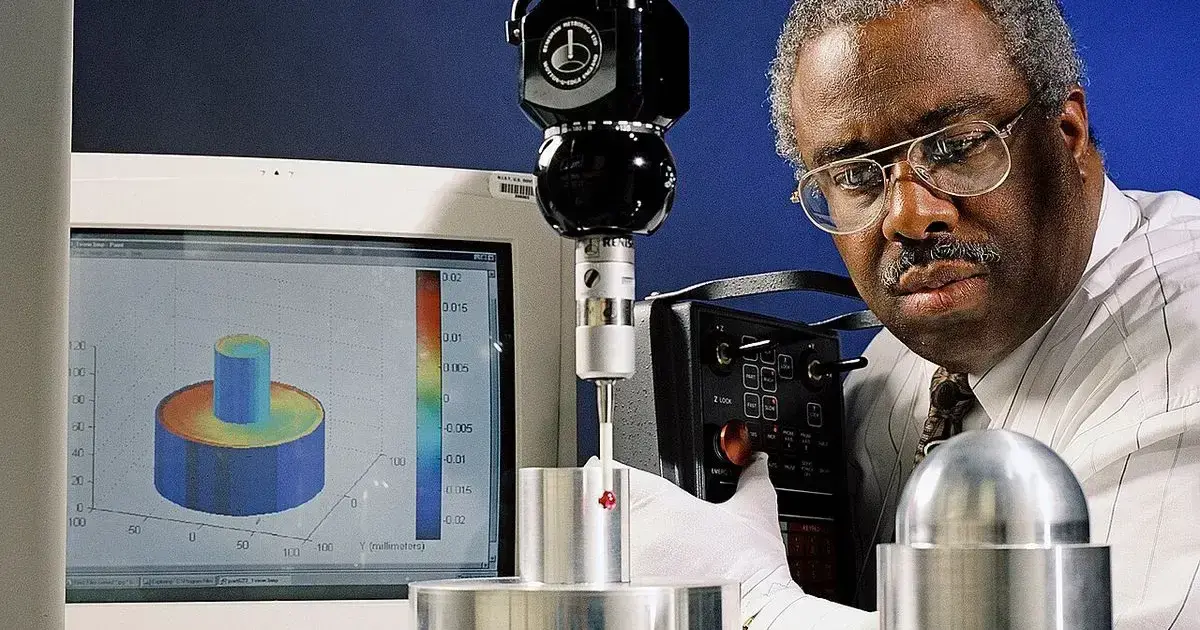
- Wikimedia Commons, Coordinate Measuring Machines (NIST)

Frequently asked questions
What is a quality agreement with a supplier?
A short document, signed next to the purchase order, that says how quality is judged, recorded and corrected: which drawing revision rules, how parts are inspected, which records the shop keeps, when it must tell you about a change and what happens to a failed lot. It does not replace the drawing or the PO.
Do I need one if the shop has ISO 9001?
A certificate shows that a third-party certification body found the shop's management system to meet the standard. It does not say how your parts will be measured, how long records are kept or when a change must be reported. Those are terms of your order, so write them down even for a certified shop.
How long should a bike part quality agreement be?
Two or three pages is enough for most brands. A one-page version works for a small run: drawing revision, acceptance method, finish master, records, change notice and what happens to a failed lot. Put long supplier manuals aside until the order volume justifies them.
How long should a shop keep inspection records?
We found no public bike rule. One published supplier agreement from another industry asks for quality records for at least 5 years after production and retention samples for at least 12 months. For bike parts, tie the period to your warranty and product liability exposure and ask a lawyer to confirm it.
Need a quote for this part?
Send the drawing. We quote the finished parts, place the work with a partner shop that machines bike parts and reply within 24 business hours.
Get a quote for your bike parts