Guides / Quality
Tracing a Failed Batch: Lot Marking for Bike Warranty Claims
November 10, 2026
A lot code on a machined bike part does one job: when a rider reports a cracked part, it tells the brand which run the part came from, so the response covers one batch and not the whole product line. Without it, a single failure can mean a stop-sale on every unit in the field. This guide covers what the code must link to, how to mark small aluminum parts without hurting fatigue life, the rules that already require batch identification on some products, and what to write on the purchase order.
Why the scope of a recall depends on the mark
Two public recalls show how an identifier sets the size of the response. In November 2020 Santa Cruz Bicycles recalled about 2,900 aluminum frames in the US, plus about 216 in Canada, after finding that frame pieces may have suffered thermal damage during a non-standard paint-stripping process. The US Consumer Product Safety Commission notice says the serial number sits on the bottom bracket shell, and that only frames without six small indents above the first letter of the serial number are included. The recall followed a process step, and the marks on the frame separated affected parts from the rest.
In July 2020 Rocky Mountain Bicycles recalled about 1,530 bikes in the US and about 1,470 in Canada after 12 reports of cracking in the front triangle. The CPSC notice says every serial number beginning with PRK17 or PRK18 is affected, while only listed ranges within PRK19 are. A prefix did the sorting.
Both are complete frames, not machined components, and neither case is a statement about the brands’ quality. They are examples of the mechanism: the cheaper and faster the sort, the narrower the recall. A stem, a crank or a thru-axle that carries no mark gives the brand only two choices, recall everything sold in the period or wait for the next failure.
What the code has to link to
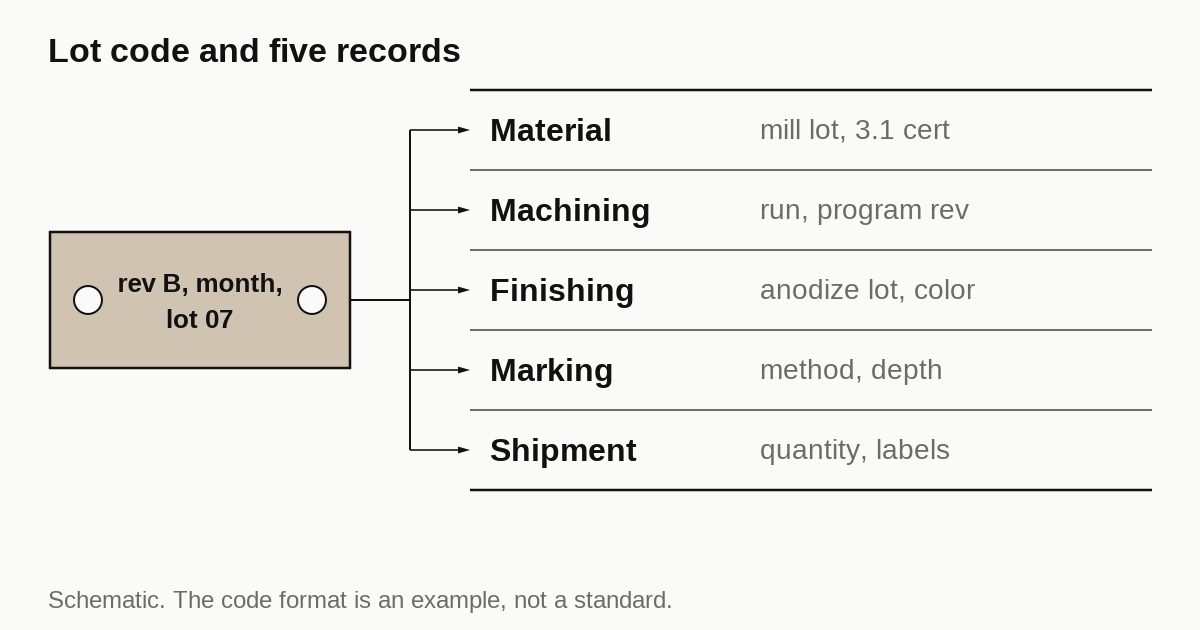
The mark itself can be short. The value sits in the records behind it. For a machined and anodized part, the chain has five links.
| Link | What the record shows | Who holds it |
|---|---|---|
| Material | Alloy, temper, mill lot or heat number, test results | Shop, from the mill certificate |
| Machining run | Date, machine, program revision, first article result, operator | Shop |
| Finishing | Anodize lot, thickness readings, seal, color check against the master | Shop or anodizer |
| Marking | Mark method, depth, which lot code was applied | Shop |
| Shipment | Quantity per lot, box labels, ship date, destination | Shop and brand |
The material link is the one brands most often skip. A mill certificate under EN 10204 type 3.1 states the order compliance and the results of specific inspections, validated by the manufacturer’s authorized inspection representative who is independent of the production department. Type 2.2 reports non-specific inspection results and is validated by the manufacturer alone. If you plan to trace a fatigue failure back to material, ask for 3.1 per lot and make sure the heat number on the certificate is the one recorded against your parts. The quality control guide lists the four documents a brand should ask for, and the aluminum billet supplier guide shows why mill lots matter to the shop’s own stock.
The finishing link matters too. Anodize color and thickness shift between batches, which is why the color matching guide tells brands to approve a master sample. If a batch of parts shows crazing or a color drift, the anodize lot should be on the record, so you can see whether the problem sits in one tank load.
How to mark a small aluminum part
There is no single right method. The options differ in contrast, depth and what they do to the surface.
- Data Matrix, laser or dot peen. Data Matrix codes can be marked directly onto components by ink-jet, dot peen, laser or electrolytic etching, and they give a permanent mark. The ECC 200 version uses Reed-Solomon error correction, which can reconstruct the data when the symbol has sustained 30 percent damage. Wikipedia describes marking small items as the most popular use, with about fifty characters held in a symbol readable at 2 to 3 square millimeters. The international standard is ISO/IEC 16022.
- Plain alphanumeric laser mark. Readable by eye, which helps in a service shop. Needs more space than a 2D code.
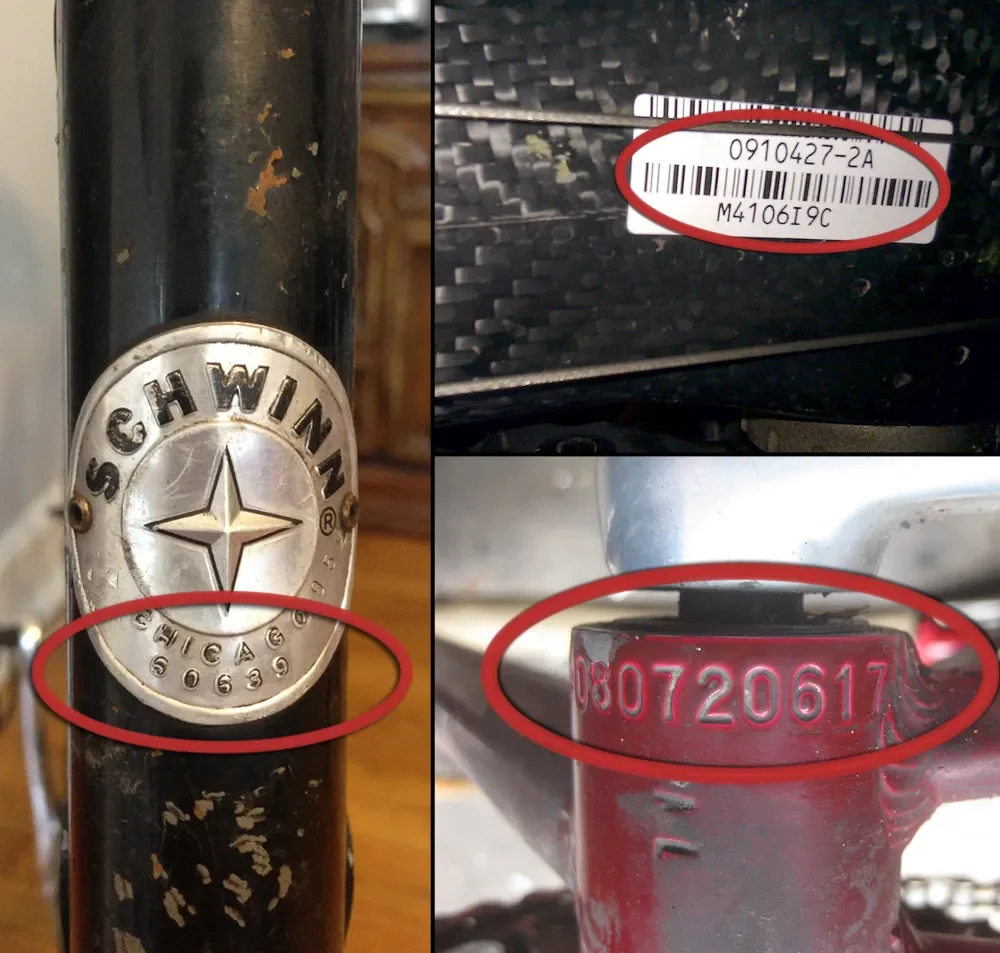
- Stamped or engraved serial number. The usual choice on frames and shells, as the photo above shows. It is a heavy mark for a thin-walled machined part.
- A label on the pack. For parts too small or too fatigue-critical to carry a mark. The code must stay with the part until installation, so label the smallest pack, not only the carton.
Depth is the risk. The direct part marking article on Wikipedia says intrusive marks can deform or weaken a part, and gives one-tenth of the part thickness as a rule of thumb for the upper limit of depth. It also recommends non-intrusive methods for safety-critical components. No public test applies that rule to aluminum bike parts, so treat it as a starting point. Our view: keep marks out of fillets, bore edges and thread roots, put them on a flat low-stress face, and ask the shop to confirm the mark depth on the first article. For fatigue-critical parts such as cranks and thru-axles, fatigue test the marked part, as the ISO 4210 test lab guide describes.
Order of operations matters as well. A mark made before anodizing sits under the coating, which can change contrast. A mark made after anodizing cuts through the finish and exposes bare metal. The laser engraving guide covers contrast and drawing notes, and the same notes apply to a lot code.
Need a quote for this part? Get a quote for your bike parts
What the rules already ask for
A brand does not always have a choice about batch identification.
US children’s products. CPSC requires tracking labels on products designed or primarily intended for children 12 years of age or younger. The permanent marks must let someone find the manufacturer, importer or private labeler name, the location and date (month and year) of production, and a batch or run number or other identifying details, to the extent practicable. The importer of record is responsible for goods made overseas. The marks may be coded, and there is no set size, location or format. A kid’s bike component may fall under this. Most adult parts do not, but check the age range on the product page.
EU consumer products. The EU General Product Safety Regulation applies to consumer products sold in the EU. Per an unofficial copy of the text, Article 9(5) requires a type, batch or serial number or other element enabling identification of the product, on the product or, if its size or nature does not allow, on the packaging or an accompanying document. Article 9(6) asks for the manufacturer’s name and postal and electronic address, and Article 9(3) asks manufacturers to keep technical documentation available for 10 years after the product is placed on the market. We could not open the official EUR-Lex text, so confirm the wording there and with a compliance adviser before relying on it. This reflects what we could check as of October 2026, and rules change.
For the US standard that covers whole bicycles, see the CPSC 16 CFR 1512 guide. Labeling a part for the shelf is a separate matter, covered in the retail packaging guide.
What to write on the purchase order
- Mark spec: method, location dimensioned from a datum, character height or code size, maximum depth, and whether it goes on before or after anodizing.
- Code format: a short code that maps to the record, for example part revision, month and lot. Do not try to encode the whole history in the code.
- One lot per box: no mixing of lots in a pack unless the pack label lists each lot.
- Material: a 3.1 certificate per mill lot, with the heat number recorded against the part lot.
- Records: first article, in-process checks, anodize thickness and color checks, kept by lot for a stated number of years.
- Retained samples: an agreed number of parts per lot, kept by the shop, for a stated period. The number is a commercial decision, so name it.
- Shipping document: lot codes and quantities on the packing list.
- Containment: if a lot is questioned, the shop quarantines stock on hand and answers within 24 business hours with the records for that lot.
Common mistakes
- A code with no record behind it. The mark exists, but nobody can say which mill lot or anodize batch it belongs to.
- Marking in a high-stress spot. A deep mark in a fillet can start the crack you wanted to trace.
- Mixed lots in one box. The tracing then stops at the box.
- Relying on the shop’s memory. Records need a place, a format and a retention period.
- Finding out at the first claim. A traceability plan needs to exist before the pilot lot ships.
The RFQ checklist includes the traceability lines. Send the drawing and the mark requirements through the RFQ page. We quote the finished parts within 24 business hours and place the work with a partner shop that keeps batch records for bike brands.
Sources
- CPSC, Santa Cruz Bicycles recalls bicycles with aluminum frames due to fall risk
- CPSC, Rocky Mountain Bicycles recalls Instinct, Instinct BC and Pipeline bicycles
- CPSC, Tracking label FAQ
- Wermac, EN 10204 certificate types (directional summary of the standard)
- Wikipedia, Data Matrix
- Wikipedia, Direct part marking
- Eduverse, GPSR operator obligations (unofficial text of Regulation (EU) 2023/988, Article 9)
- Wikimedia Commons, Bicycle serial number compilation

Frequently asked questions
What is a lot code on a machined bike part?
A short mark that ties the part to one production record: the material lot, the machining run, the anodize batch and the ship date. When a rider reports a failure, the code lets the brand pull only the parts made in the same run, not every part it has sold.
Where should the lot code go on a bike part?
On a flat, low-stress face that is visible after assembly or easy to find during service, and away from fillets, bore edges and thread roots. If the part is too small to mark, put the code on the smallest pack and keep the mark list in the shipping record.
How long should a shop keep batch records?
Agree it in the purchase order. The EU General Product Safety Regulation tells manufacturers to keep technical documentation for 10 years after a product is placed on the market, so a brand selling into the EU will usually want the shop to keep its records for at least that long.
Does a Data Matrix code survive anodizing?
It can, if the marking method and the order of operations were tested. A laser mark made before anodizing may change contrast, and a mark made after anodizing depends on the dye color. Test a sample from the real anodize lot, as the laser engraving guide on this site advises.
Need a quote for this part?
Send the drawing. We quote the finished parts, place the work with a partner shop that machines bike parts and reply within 24 business hours.
Get a quote for your bike parts