Guides / Process
Bike Part Pilot Batch: What to Prove Before the Full Run
November 21, 2026
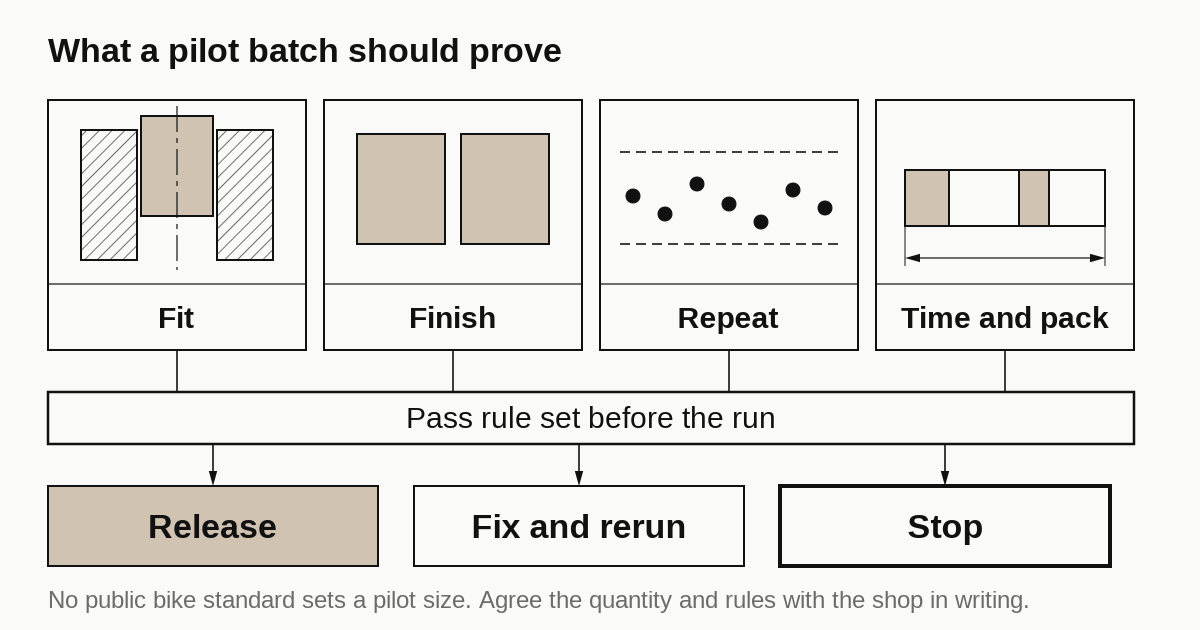
A pilot batch proves that a shop can make your part again and again, not that the design works. By the time you order one, a prototype has shown the fit and a first article has shown that the first piece meets the drawing. The pilot batch answers a different question: whether the next 50 pieces look like the first, in size, in color and in packing, and how long they really take. This guide covers what to measure, how to write the pass rules before the batch runs and how to read the result. It goes deeper on stage 3 of our prototype to production guide.
Pilot batch, first article and prototype compared
| Stage | Question it answers | Typical size | Who decides |
|---|---|---|---|
| Prototype or fit sample | Does the design work? | 1 to 20 pieces | Brand |
| First article | Does the first piece meet the drawing? | 1 to a few pieces | Brand, on the shop’s report |
| Pilot batch | Does the process repeat, finish included? | 25 to 100 pieces, our working range | Brand and shop, by written rules |
| Production | Delivery at scale | Order quantity | Brand, with the agreed inspection plan |
Caption: author’s summary. We found no public standard that fixes a pilot size for bike parts.
Wikipedia defines first article inspection as a validation process that verifies a new or modified production process produces conforming parts. A pilot batch extends that idea from one piece to a run. Our first article guide covers the first piece.
Run it on the production setup
The most common waste is a pilot batch made on a different setup than production. If the pilot uses a prototype shop’s machine, hand fixturing or a stock anodize load, it proves nothing about the real process. Ask for the same machine class, the production fixture, the real anodizer and the final packing. Wikipedia’s page on the production part approval process lists initial process studies and sample production parts among the elements a customer can request, and describes the aim as confidence that a supplier’s processes can consistently produce conforming parts. The method is automotive, but the logic carries over: samples that do not come from the production process do not count.
The four things a pilot batch should prove
1. Fit
Measure the critical interfaces on the pieces, not just the first. On a stem that is the bar clamp and steerer bore, on a chainring the bolt circle and the tooth form, on a thru axle the thread and the shoulder. Name the gauge, and check that it can tell good from bad: our guide to gauging bike part interfaces covers it. Measure the finished part, after anodizing, because the coating changes size.
2. Finish
Compare batch color to the approved master under agreed light. Wikipedia says the colors produced by dyed anodizing tend to vary according to the base alloy, and that sealing is what keeps the dye in, so check the thickness and the seal records for each load, not just the look. If you use more than one alloy in a range, put them in the batch. Our guide to anodize crazing suggests a pilot lot of 10 to 20 parts through the full process to see whether an alloy crazes.
3. Repeatability
A single measurement says nothing about spread. Ask for measured values for each piece or a stated sample, and look at how far they range inside the tolerance. If the shop gives a capability index, ask what it rests on. Wikipedia explains that Cpk is the smaller of the upper and lower one-sided indices, that capability only holds meaning for a process in statistical control, and that each index assumes output is approximately normal. It gives one author’s minimums: 1.33 for an existing process, 1.50 for a new one and 1.67 for a safety or critical parameter on a new one, and calls such thresholds a matter of opinion that varies by industry. A pilot batch is often too small to prove control, so use the numbers as a conversation starter and prefer a look at the raw values.
4. Time and packing
Add up the real days: material, programming, machining, deburring, anodizing including waiting for a batch, inspection, packing and transport. This is the number you plan from, and it is often longer than the quote. Compare it with the one you built in our lead time guide. Ship the packed pilot to your own door if you can, and check that parts arrive unmarked. Our packaging guide covers a drop and vibration check on a packed lot.
Need a quote for this part? Get a quote for your bike parts
Write the pass rules first
Write a table before the batch runs and agree it with the shop. It stops the argument about what a good result is from starting after the parts arrive.
| Characteristic | Limit | Method | Sample | Pass rule | If it fails |
|---|---|---|---|---|---|
| Bar clamp bore | Drawing limits | Gauge named in the plan | Every piece | All within limits | Stop, find cause |
| Color | Master, agreed light | Visual side by side | Every load | Judged a match by both | Fix and rerun |
| Anodize thickness | Range on drawing | Shop’s method | Per load | Inside range, records sent | Fix and rerun |
| Thread fit | Go and no-go | Gauge | Every piece | All pass | Stop, find cause |
| Cosmetic faces | Reference photos | Visual | Every piece | No rack marks on cosmetic faces | Sort or rerun |
| Real lead time | Quoted days | Stage log | The batch | Within agreed margin | Re-plan |
Caption: example rows only, not requirements. Use your own critical features and limits.
On sampling, Wikipedia says acceptance sampling is typically used when testing is destructive or full inspection is costly or slow, and notes that 100% inspection does not guarantee 100% compliance. For a pilot, a practical split is to measure critical features on every piece and sample the rest. If you need fatigue or proof tests, pull the test pieces from the pilot batch, since those tests destroy the part. How many and which test is set by the test method you follow: see our guide to ISO 4210 and EN 15194 for machined parts and what bike brands need from a test lab.
Read the result: release, fix or stop
| Outcome | What it looks like | What to do |
|---|---|---|
| Release | Every rule met, records complete | Lock the inspection plan, the master and the real lead time, then order the run |
| Fix and rerun | A cause is known and fixable, such as a rack position or a thread gauge | Fix, then run a smaller second pilot on the failed feature |
| Stop | The process cannot hold the drawing, or color cannot be held | Change the drawing, the process or the shop |
If the pilot fails because of the shop, do not release the run on a promise. If it fails because of the drawing, fix the drawing: a tolerance tighter than the process can hold is a drawing problem. Our guide to design for machining covers that. Keep the pilot’s records and master as the baseline for every later lot, and write the key points into the quality agreement.
Use a pilot when you change shop
A pilot batch is also the right test when you move a part to a new supplier. The new shop’s pilot is your proof that the process, finish included, matches the one you had. Our guide to moving a bike part to a new shop without a color change shows how to run it beside the old shop.
Request the pilot with the RFQ
Say on the RFQ that you want a pilot batch before the run, with the quantity, the finish master and the rules above. Shops price a pilot and a run differently, so ask for both. Send the drawing through the RFQ page, and we read it, quote the finished parts within 24 business hours and place the work with a partner shop that already machines and anodizes bike components. Our guide to comparing quotes shows how to line them up.
Sources
- Wikipedia, First article inspection
- Wikipedia, Production part approval process
- Wikipedia, Process capability index
- Wikipedia, Acceptance sampling
- Wikipedia, Anodizing
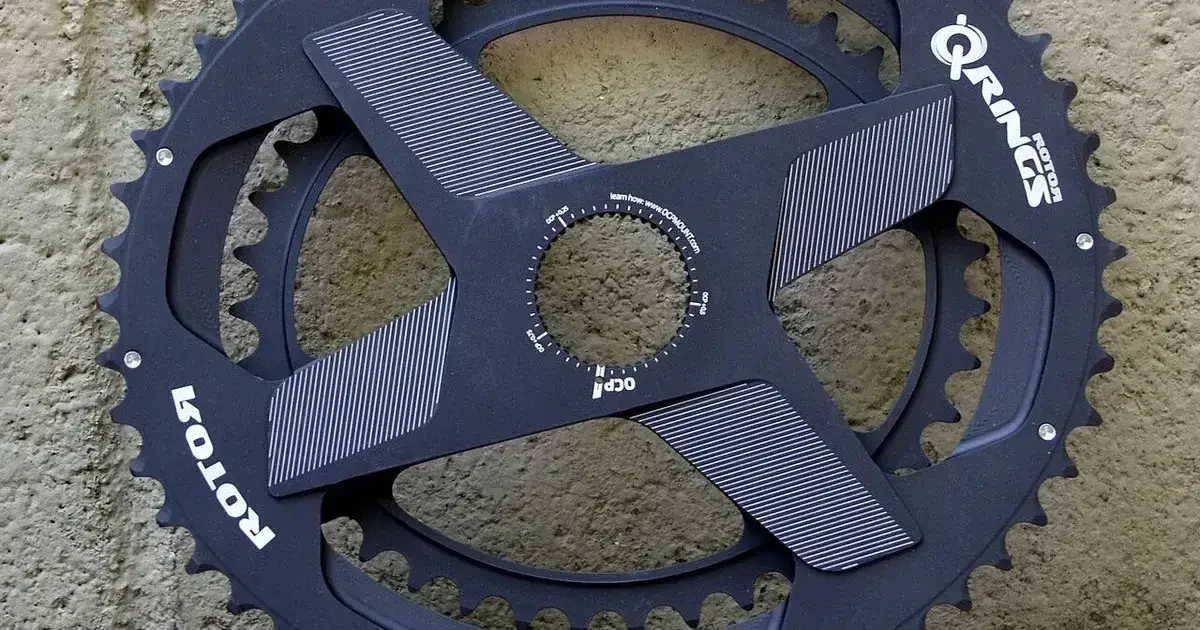
- Wikimedia Commons, Rotor 2INpower DM Road Crankset 03

Frequently asked questions
What is a pilot batch for bike parts?
A small run made on the production setup, with the production fixtures, finisher and inspection plan, to prove the process repeats before you order the full run. A prototype proves the design. A first article proves the first piece. A pilot batch shows whether the next fifty pieces look like the first.
How many pieces should a pilot batch have?
No public bike standard sets a number. A working range of 25 to 100 pieces is common practice in our prototype to production guide, which is an author's rule of thumb. Pick a quantity large enough to fill an anodize load and show spread, and agree it with the shop in writing before it runs.
What should I measure on a pilot batch?
The critical interfaces on every piece or a defined sample, the color of the batch against the master, the anodize thickness and seal records, the real days spent at each stage and how the parts arrive after packing. Set a pass rule for each before the batch runs, so the result decides the outcome.
Do I need a Cpk for a pilot batch?
Only if you and the shop agree on one. Wikipedia says a capability index only holds meaning for a process in statistical control, and cites one author's guide of 1.50 for a new process and 1.67 for a safety-critical one. A pilot batch may be too small to show control, so ask how many pieces the figure rests on.
Need a quote for this part?
Send the drawing. We quote the finished parts, place the work with a partner shop that machines bike parts and reply within 24 business hours.
Get a quote for your bike parts