Guides / Materials
7075-T6 or 7075-T73: Strength Against Stress Corrosion
October 12, 2026
7075 is the alloy people reach for when 6061 is not strong enough. It is the standard aluminum for high-end cranks, stems and brake parts. What is less known is that 7075 comes in several tempers, and the one most buyers ask for, T6, is not always the best choice. T73 is the other common option. The trade is simple: give up some strength to buy resistance to a failure mode that does not show on a drawing.
What the letters mean
The T number describes the heat treatment. Both tempers start with a solution treatment and quench, followed by artificial aging, but the aging is different.
- T6 is aged to the peak. The result is the highest strength 7075 can reach.
- T73 is over-aged, past the peak, in a longer or hotter cycle. The result is lower strength and a different microstructure.
The over-aging changes how the precipitates sit at the grain boundaries. That change is the reason T73 resists stress corrosion cracking.
You will also see T651 and T7351. The extra 51 means the material was stretched after quenching to relieve internal stress, which reduces warping when you machine it. For machined bike parts, the stress-relieved versions are the sensible choice.
The numbers
Typical minimum properties for plate and bar, which vary with product form, thickness and the governing specification:
| Property | 7075-T6 / T651 | 7075-T73 / T7351 |
|---|---|---|
| Ultimate tensile strength | About 510 to 570 MPa | About 460 to 505 MPa |
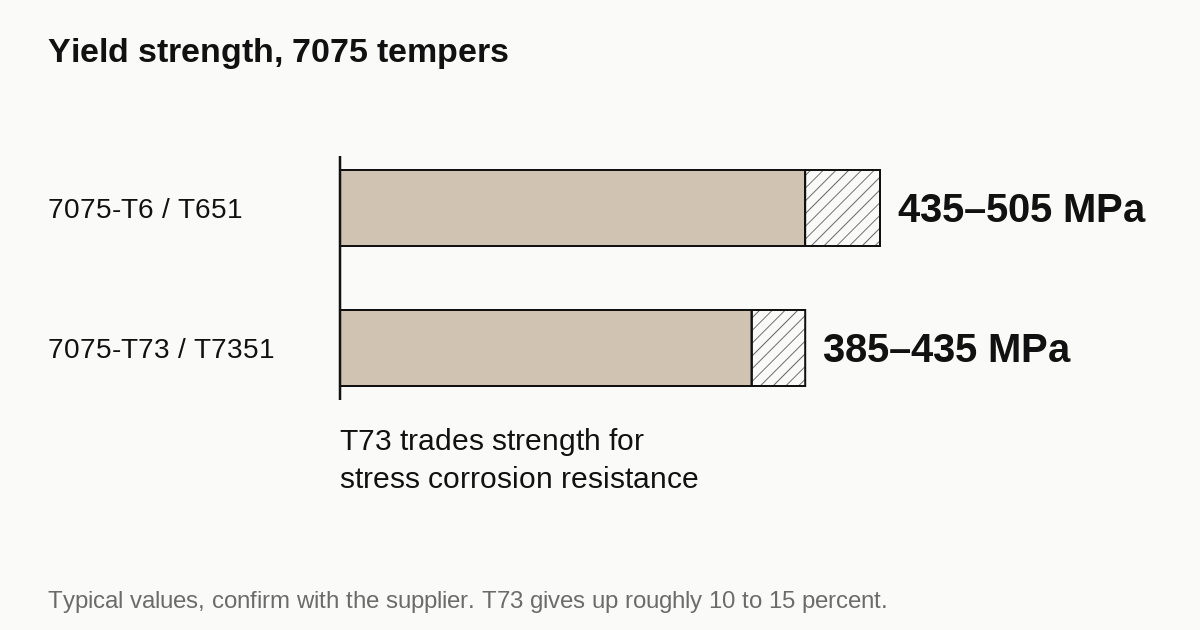
| Yield strength | About 435 to 505 MPa | About 385 to 435 MPa |
| Stress corrosion resistance | Low in the short transverse direction | High |
| Electrical conductivity | Low 30s % IACS | About 40 % IACS or higher |
| Typical availability | Common | Less common, longer lead time |
These are ranges for orientation. Use the values in the governing standard or the mill certificate for design. Bars and plates are normally specified under ASTM B211 for bar and ASTM B209 for sheet and plate, and the alloy reference lists the common alloys with sources.
The strength drop of about 10 to 15 percent is real. On a part sized by strength, it can mean more material. On a part sized by stiffness or by fit, it makes no difference, since the elastic modulus is the same in both tempers.
What stress corrosion cracking is
Stress corrosion cracking (SCC) is a failure that needs three things at once: a susceptible alloy, a constant tensile stress and a corrosive environment. When all three are present, a crack can grow slowly with no cyclic load. There is no warning and no bending.
High-strength 7xxx alloys in the T6 temper are susceptible, mainly when the stress acts across the short grain direction. In a bar or forging, the grains are flattened like pancakes. The short direction is the thickness of the pancake. Stress along that direction opens the grain boundaries, and cracks follow them.
Where does a constant tensile stress come from on a bike part?
- Press fits. A steel sleeve or bearing pressed into a 7075 bore holds the bore in permanent hoop tension.
- Interference threads or tapered fits. The same effect, concentrated at a small area.
- Bolted joints under preload. A bolt in a thick section holds the material under constant load, mostly in the direction of the bolt.
- Residual stress from machining or heat treatment. An unrelieved bar can hold stress inside.
The environment on a bike is often wet, salty and muddy. Winter commuting, coastal riding and cleaning with a hose all supply water and chloride. That is the third ingredient.
Where T73 earns its place
T73 makes sense on parts that match the pattern: constant tensile stress, short-transverse loading and a wet environment.
- Thick billet parts with press-fit bushings, such as a pivot housing or a hub flange with a bearing pressed in a heavy section
- E-bike motor brackets and housings with pressed bearings and steel sleeves
- Heavily preloaded joints in thick sections, such as a clevis or a large pivot
- Parts made from forgings or thick plate where the short transverse direction faces the load
For the thin walled parts, such as chainrings, stems and most brake adapters, SCC is rarely an issue. The stress is cyclic and the walls are thin, so the conditions do not line up. T6 has a long record on those parts.
Where T6 is the right call
- Cranks. Fatigue strength and static strength dominate, and the stress is cyclic.
- Chainrings. Thin plate, strength and wear are the issues.
- Stem bodies and faceplates, where clamp stress is moderate.
- Any part that is sized by strength and has no sustained tensile stress.
A designer who chooses T73 for every part pays in weight and in availability. T73 bar is harder to find in small quantities, and some mills quote longer lead times. The alloy comparison for 6061 and 7075 explains why 7075 is chosen in the first place.
Need a quote for this part? Get a quote for your bike parts
T73, T76 and other options
There are other tempers in between.
- T76 is a lighter over-aging. Strength is closer to T6 and SCC resistance is better than T6 but less than T73. It is more common in aerospace sheet and extrusions.
- T74 is also an intermediate step, mostly seen in forgings.
- 6061-T6 is not susceptible to SCC in the same way, so on a part with press-fit stress the simplest fix can be a different alloy and a larger section.
If you are not sure which fits, describe the loading and the environment to the shop and ask for a recommendation. Machine shops that make a lot of 7075 parts have seen the failures and know which parts need care.
Machining and finishing
Both tempers machine well and anodize well. T73 is slightly softer and may leave a little more burr, which is a small matter. Color matching between T6 and T73 lots can differ, since the microstructure affects the anodize slightly. If cosmetic matching matters, buy one temper for the whole product line. See color matching in anodizing.
Anodizing itself does not cure SCC, though a sealed coating helps keep water away from the surface. Hard anodize reduces fatigue strength, so on cyclic parts the choice between types is a second decision. The Type II and Type III guide covers that.
How to specify the temper
State the alloy, the temper and the specification on the drawing, not just “7075”. A line such as “Material: 7075-T7351 bar per ASTM B211” tells the shop what to buy. If you accept either temper, say so, and give the lower strength as the minimum.
Ask for the mill certificate to be sent with the first order, and check that the temper on the certificate matches the drawing. If the shop buys from a distributor, ask for the original mill test report. For a quick check on finished parts, an eddy current conductivity test separates T6 from T73 in seconds.
A short decision list
- Thin, cyclic, strength-sized part: 7075-T6 or T651
- Thick section, press fit or preloaded, wet service: consider 7075-T73 or T7351
- Strength not needed and fit is the issue: 6061-T6 may be simpler
- Not sure: describe the loads and the environment on the RFQ
Common mistakes
- Writing “7075” with no temper. The shop buys what is cheapest or in stock.
- Choosing T73 for every part. It costs weight and lead time where stress corrosion was never a risk.
- Choosing T6 for a thick, press-fit part in a wet climate without checking the grain direction and the stress.
- Mixing tempers in one product line. Anodize color can differ slightly between them.
- Trusting a distributor’s label. Ask for the mill test report and, on critical lots, a conductivity check.
When in doubt, describe the part, the loads and the climate on the RFQ and let an experienced shop suggest the temper.
Temper is one line of the material callout; our guide to the best material for CNC bike parts covers the whole line.
Send your drawing and the loads through the RFQ page and we quote the finished parts within 24 business hours, with material advice, and place the work with a partner shop.
See also: how to verify the temper of finished 7075 parts.
Frequently asked questions
Is T73 stronger or weaker than T6?
Weaker. Typical minimum yield strength of 7075-T73 is roughly 10 to 15 percent below 7075-T6. In return it resists stress corrosion cracking much better. If strength is the only goal, T6 wins.
Do most bike parts need T73?
No. Most machined 7075 bike parts are made in T6 or T651 and run for years. T73 is worth asking for on parts that carry a constant tensile stress in a corrosive setting, such as press-fit sleeves or thick bolted sections. It is rarely the default.
How can I confirm which temper I received?
Ask for the mill certificate, which states the temper. A shop can also run an electrical conductivity test, since T73 conducts noticeably better than T6. The test is quick and cheap on a bar or a finished part.
Need a quote for this part?
Send the drawing. We quote the finished parts, place the work with a partner shop that machines bike parts and reply within 24 business hours.
Get a quote for your bike parts