Guides / Materials
How to Choose the Material for a Machined Bike Part, From Alloy to Drawing Callout
November 21, 2026
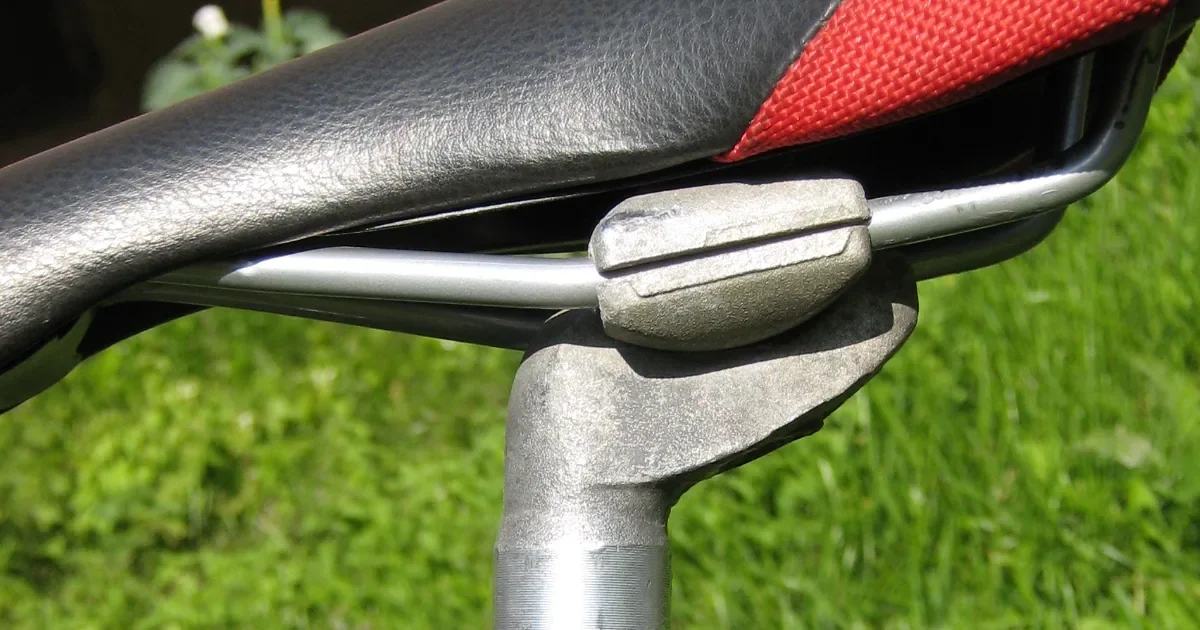
The best material for a CNC bike part is the least expensive alloy that meets the limit that sizes the part, survives where the part lives and arrives in a form the shop can buy. For stems, spacers, collars and brackets that is usually 6061-T6. Cranks, chainrings and thin sections move to 7075. Axles, bolts and weight-critical small parts can justify titanium Grade 5 or 17-4 PH stainless, and magnesium and plastics are special cases. The choice ends as one callout line on the drawing, and it comes with a plan for every place the part meets a different metal. This guide is for a bike brand or a founder choosing the material for an RFQ, and it leads to one decision: what goes on that line.
We make no claim about any shop’s certificates. You send one drawing, we quote the finished parts and place the work with a partner shop that already machines and anodizes bike components.
Last reviewed: October 2026. Figures carry the date they were checked; metal prices move, so confirm them with a current quote.
- Start with what limits the part
- Which material for which part
- Aluminum: 6061, 7075 and the rest
- Titanium: Grade 5 or Grade 9
- Steel, stainless and chromoly
- Magnesium and plastics
- Write the material on the drawing
- Where different metals touch
- What the alloy does to the price
- Finish follows the alloy
- Carbon fiber parts and inserts
- Certificates, lots and European alloys
- Checklist before you send the RFQ
- Send the drawing
Start with what limits the part
A bike part is sized by one limit, and the alloy only helps if it moves that limit. The four usual ones are stiffness, static strength, fatigue life and the environment. Wikipedia’s alloy pages show why this matters for the common metals. The elastic modulus is 69 GPa for 6061 and 71.7 GPa for 7075, so changing from one to the other raises stiffness by about 4 percent. The yield strength goes from a typical 270 MPa for 6061-T6 to 500 MPa for 7075-T651, about 1.8 times. Ti-6Al-4V has a modulus of 104 to 113 GPa and a density of 4.43 to 4.51 grams per cubic centimeter, so its modulus divided by density comes to about 23 to 25.5 (GPa per gram per cubic centimeter), against 25.6 for 6061. A part sized for stiffness is not lighter in titanium.
| What limits the part | Direction for the material | Typical parts | What to check |
|---|---|---|---|
| Stiffness (flex under load) | Keep the cheapest alloy and change the section | Stems, clamps, brackets | Deflection in the design, not in the alloy |
| Static strength in a small section | A stronger alloy | Axles, pins, bolts | Grade and condition on the callout |
| Fatigue life | Alloy plus radii, finish and a test on the real part | Cranks, chainrings | Fatigue test on your sample |
| Wear or galling at threads and pivots | A different metal at the contact | Pivot pins, axle threads | Hardness and the mating metal |
| Corrosion in wet or salt service | Alloy, finish and metal pairing | Exposed hardware, inserts | The pair table below |
| Weight at any cost | Titanium or magnesium | Boutique small parts | Price, lead time, corrosion plan |
Caption: author’s summary. Moduli, densities and strengths are typical values from Wikipedia’s 6061, 7075 and Ti-6Al-4V articles, checked October 2026; the mill certificate governs. Modulus divided by density is our arithmetic. The site’s reference table lists 276 MPa and 503 MPa yield for 6061-T6 and 7075-T6, close to the Wikipedia values.
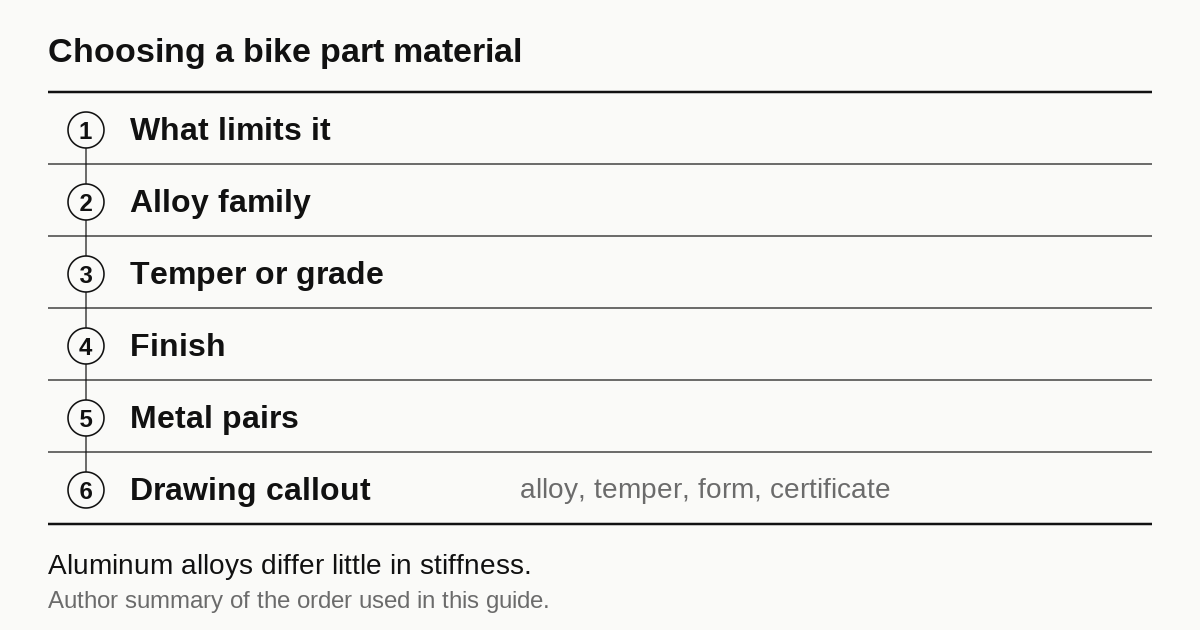
The sequence in the figure is the order of this guide. Decide what limits the part, choose the alloy family, name the temper, plan the finish and the metal pairs, then write the callout. Our materials page holds the property tables, and this guide goes one level deeper into the per-part choice.
Which material for which part
Most bike parts fall into a small number of habits. The table follows our materials page. Wikipedia lists bicycle frames and components among the uses of 6061-T6 and bicycle components and chainrings among the uses of 7075.
| Part | Usual start | Alternative | Watch |
|---|---|---|---|
| Stems, brackets, collars, spacers, derailleur hangers | 6061-T6 | 7075 or titanium in thin or highly loaded sections | Color match to other anodized parts |
| Cranks, chainrings, direct mount rings | 7075 | A forged 2014-T6 blank, machined, at volume | Corrosion at steel hardware |
| Axles, pins, bolts | Titanium Grade 5 or 17-4 PH | 303 stainless where galling is the problem | Thread finish and the mating metal |
| Tube-based parts: seatposts, bars | Titanium Grade 9 | Grade 5 for machined clamp parts | Grade named on the callout |
| Dropouts, yokes, fittings | 4130 steel | Titanium matched to the tube | Coating against corrosion |
| Pulley wheels, bushings, chain guides | Acetal or nylon | Aluminum where stiffness or heat decides | Moisture and fit |
Caption: author’s summary after the site’s materials page; not a standard. Use it as a starting point and test on your own part.
If you cannot choose between two alloys, put both on the same RFQ as separate lines. One drawing then gives you two quotes, with the weight and price of each finished part, which is the comparison our titanium guide recommends. Once the material is chosen, the rest of the order path, from the first article to the packed carton, is in our guide to custom bike parts manufacturing.
Aluminum: 6061, 7075 and the rest
6061-T6 is the default. Wikipedia describes the T6 temper as solution-treated and artificially aged for maximum precipitation hardening, with a typical tensile strength of 310 MPa and a typical yield of 270 MPa. It is highly weldable, and Wikipedia says it remains resistant to corrosion even when the surface is abraded. For most machined bike parts, those properties are enough and the price is lower.
7075 is the step up. Wikipedia gives T6 a tensile strength of 510 to 540 MPa and T651 a tensile strength of 570 MPa with a yield of 500 MPa. Its weak point is stress corrosion cracking: Wikipedia says 7075 is vulnerable, and that overaged T7 tempers reduce the susceptibility. The FAA’s corrosion circular for aircraft shows intergranular corrosion in 7075-T6 beside a steel fastener, so keep this alloy away from bare steel hardware. Our temper guide puts the strength loss from T6 to T73 at about 10 to 15 percent. Wikipedia’s T7 figures (505 MPa tensile, 435 MPa yield) sit close to its T6 ranges, so the size of the penalty depends on the source and the thickness. Ask for the mill certificate of the actual lot.
2014 and 2024 appear in older forgings and aerospace hardware. Wikipedia’s aluminium alloy article says the 2xxx copper alloys were once common in aerospace and are prone to stress corrosion cracking. The FAA’s corrosion circular says the opposite about the 2000 series: it calls them known to have better stress-corrosion resistance than the 7000 series, and our guide to them says the same relative to 7075. We found no source that reconciles the two statements, and temper and alloy may explain the difference, so do not treat either wording as settled. For a bike part, ask for the mill certificate and the temper, and do not choose a 2xxx alloy for its corrosion behavior alone. Our guide to them explains why they are rare on bikes.
Read more: 6061 or 7075 for bike parts
Read more: 7075-T6 versus 7075-T73
Read more: 2014 and 2024 aluminum for bike parts
The alloy and finish reference lists the data in one table.
Titanium: Grade 5 or Grade 9
Grade 5, also called Ti-6Al-4V, is the machined-part titanium. Wikipedia gives a tensile yield of 880 to 920 MPa, a tensile ultimate of 900 to 950 MPa and a thermal conductivity of 6.7 to 7.5 W/m·K, and says that low conductivity contributes to relatively poor machinability. A Makino paper on machining titanium explains the mechanism: heat flows into the cutting tool instead of the chip, and the metal is springy, which invites chatter. The same paper calls 50 meters per minute, about 165 SFM, an already slow speed for Ti-6Al-4V.
Grade 9, with less alloying, is the tube and formed-part alloy. Our guide compares the two grades by strength, forming and weldability. The practical rule is to name the grade on the callout, because the shop will quote whatever bar it holds.
Titanium earns its price where strength or corrosion decides, on small and highly loaded parts. Where stiffness decides, the arithmetic above says it is not lighter than aluminum. Quote both alloys on the same drawing and compare the finished parts.
Read more: Titanium or aluminum for bike parts
Read more: Grade 9 versus Grade 5 titanium
Steel, stainless and chromoly
Three steels do most of the work on a machined bike part. 17-4 PH is the strong stainless: our guide lists three conditions, H900, H1025 and H1150, that trade strength against toughness, so the callout must name one. 303 is the free-machining stainless for axles and pins that must not rust or gall. 4130 chromoly suits dropouts, yokes and fittings on steel frames, and needs a coating.
Harvey Tool’s guidelines for carbide end mills give 90 to 250 SFM for 17-4 PH and 100 to 350 SFM for the austenitic grades that include 303. That puts stainless in a similar slow range to titanium, which is why stainless parts take longer to cut than aluminum ones. The page does not list 4130.
In a joint with aluminum, steel and stainless fall into different corrosion groups in the FAA table, so check the pair in the section below before you choose a bolt material. Fasteners also carry a property class, which the stainless guide explains, so name the class as well as the material when you specify a bolt.
Read more: Stainless steel bike hardware and 17-4 PH
Read more: 4130 chromoly dropouts, yokes and fittings
Magnesium and plastics
Magnesium is, per our guide, the lightest structural metal on the list and the most exposed to corrosion. Wikipedia’s galvanic corrosion article gives it an anodic index of -1.75 against -0.90 for aluminum, a gap of 0.85 V, and the FAA uses magnesium next to a steel fastener as its example of galvanic attack. Harvey Tool lists extruded and die-cast magnesium at a minimum of 1,000 SFM, so the cutting is fast. Few shops take it and the fire precautions add cost, as our guide explains. Seal and isolate every fastener.
Plastics are a different case. Acetal and nylon are not conductors, so they form no galvanic cell, and they suit parts that must not mark a frame or that need low friction. Our guide to them covers moisture and fit. Specify the polymer and the grade on the drawing, because “Delrin” and “nylon” are families.
Read more: Magnesium bike parts
Read more: Delrin and nylon bike parts
Write the material on the drawing
A material is not chosen until it is on the drawing in words a shop cannot misread. A complete callout holds the alloy with its temper, the product form, the specification and the certificate. ASTM’s catalog page for B221 describes it as the specification for extruded bars, rods, wire, profiles and tubes, and says rolled or cold-finished bar and rod fall under B211. So the form you allow decides which specification applies.
Wikipedia describes the EN 10204 type 3.1 certificate as one issued by the manufacturer that declares the products comply with the order and supplies test results. Ask for it with the lot number when you send the RFQ.
An example line, to adapt: “MATERIAL: ALUMINUM 6061-T6, EXTRUDED BAR PER ASTM B221. CERT: EN 10204 3.1 WITH LOT NUMBER. NO SUBSTITUTION WITHOUT SIGNED APPROVAL.” Check that your alloy and temper appear in the specification you cite. We read only the catalog page, not the tables, and the page we opened is the 2013 edition (B221-13), so confirm the current edition.
The callout looks different for each metal. Aluminum needs the alloy and temper. Titanium needs the grade, and Grade 5 and Grade 9 are not interchangeable. 17-4 PH needs the heat treatment condition. A plastic needs the polymer and the grade. Whatever the metal, the question to ask of a line is whether two shops reading it would buy the same bar.
Read more: Material callout on a bike part drawing
Need a quote for this part? Get a quote for your bike parts
Where different metals touch
Two different metals in contact with water between them form a corrosion cell, and the less noble metal is the one that corrodes. The FAA’s corrosion circular groups metals so that metals in one group are relatively safe together and metals in different groups are not. The table shows the groups that matter on a bike.
| FAA group | Metals | On a bike | Against aluminum |
|---|---|---|---|
| I | Magnesium and alloys | Magnesium parts | Magnesium corrodes |
| II | Aluminum and alloys, zinc, cadmium | Most machined parts | Same group |
| III | Iron and steels except stainless | Steel bolts, 4130 parts | Aluminum corrodes |
| IV | Stainless steels, titanium, carbon graphite, brass, bronze, nickel alloys | Stainless and titanium hardware, carbon parts | Aluminum corrodes |
Caption: FAA Advisory Circular 43-4B (2018), Table 4-2, abridged. The circular is written for aircraft and we found no bike-specific standard, so read it as physics, not as a bicycle rule. Wikipedia’s anodic index gives 0.40 V between aluminum (-0.90) and 18 percent chromium stainless (-0.50) and quotes 0.15 V as a guide for harsh environments.
For a bike part the rule is short. Do not pair aluminum with magnesium, bare steel or bare carbon. Pair it with stainless or titanium only with grease or an isolating layer, and decide on the drawing what finish the thread carries. Anodizing helps and is not enough: the FAA describes anodizing as thickening the natural oxide film, and damage to it is only partly restorable.
Read more: Galvanic corrosion on bike parts
What the alloy does to the price
The alloy changes the price through the metal, the machine minutes, the tool wear, the size of the blank and the swings in the metal market. The USGS puts the 2025 estimate for titanium sponge at $12 per kilogram and for aluminum ingot at 180 cents per pound, about $3.97 per kilogram. Primary metal is three times dearer for titanium, and we found no public price for bar by alloy. Aluminum ingot went up about 39 percent from 2024 to 2025 in the same table, so a quote without a validity date is a risk.
Machine time is the larger swing. Harvey Tool gives starting speeds for carbide end mills.
| Material | Starting range, SFM |
|---|---|
| Aluminum 6061-T6 and 7075-T6 | 800 to 1,500 |
| Magnesium | 1,000 minimum |
| Stainless 303 and the austenitic grades | 100 to 350 |
| Stainless 17-4 PH | 90 to 250 |
| Titanium, including Ti-6Al-4V | 50 to 250 |
Caption: Harvey Tool, General Machining Guidelines, carbide end mills; undated page with a 2026 copyright. Starting ranges, not shop speeds; a speed ratio is not a cycle time ratio.
Our guides give two rules of thumb: 7075 stock at roughly two to three times the price of 6061 and titanium at ten times or more. We could not trace either to a public bar price, so the cost post tests them against one retail list and works an example. Ask each shop for the material line, the minutes per part and the validity date.
Read more: What your alloy choice does to the price
Read more: CNC bike parts cost
Finish follows the alloy
The alloy decides the finish options. The FAA describes anodizing as thickening aluminum’s natural oxide film, so it applies to aluminum alloys. Our materials page says 6061 takes Type II anodize evenly, 7075 anodizes darker and is harder to match, titanium takes voltage colors with no dye and stainless is passivated instead. The consequence for a product range is color: a stem in 6061 and a crank in 7075 will not match unless the finisher works at it.
Decide the finish when you decide the alloy, not after the first article. Wikipedia notes that 6061 stays corrosion resistant even when abraded, and our materials page says 2014 gives a dull, uneven anodize. If two parts must match, say so on the RFQ and agree a color master.
Read more: Anodizing color matching across bike part batches
Carbon fiber parts and inserts
Carbon frames, cranks and bars still need metal where a thread, a bearing or a clamp meets them. Carbon is cathodic to most structural metals. Wikipedia says carbon fibers can cause galvanic corrosion when CFRP is attached to aluminum or mild steel, and the FAA table puts carbon graphite in the same group as stainless steel and titanium. So an aluminum insert needs a continuous barrier against the carbon, and a titanium or stainless insert does not.
Our materials page lists where inserts appear: threaded pedal and spindle interfaces in carbon cranks, bottom bracket and headset sleeves, dropout and derailleur hanger mounts, bottle cage bosses and seatpost head clamps. It names 7075 and 6061 as the usual insert materials and titanium where the joint sees high load or must not corrode. The corrosion rule above is the reason for that last clause.
How the insert is held is a separate decision. The deep post compares bonded, press-in and threaded inserts, includes what one published test of bonded inserts in carbon laminates found and says what to write on the drawing.
Read more: Bonded, press-in or threaded inserts in carbon fiber bike parts
Certificates, lots and European alloys
A material choice is only as good as the bar that arrives. Wikipedia describes the EN 10204 type 3.1 certificate as manufacturer-issued, and type 3.2 as adding an independent inspector and a second inspector for the purchaser or one designated by official regulations. Ask for type 3.1 on the RFQ, with the lot number, and match it to the lot on the first article report so that a field failure can be traced. When the bar arrives, compare the certificate with the callout line by line: alloy, temper, form and lot. A mismatch found when the bar arrives is cheaper to fix than one found after finishing.
A European drawing may name a 6xxx alloy other than 6061. Wikipedia’s aluminium alloy article gives 6082 as about 1.0 percent silicon, 0.85 percent magnesium and 0.65 percent manganese and 6061 as about 0.6 percent silicon, 1.0 percent magnesium, 0.25 percent copper and 0.2 percent chromium. They are different chemistries, so treat a swap between them as an engineering request with signed approval, not a purchasing choice. We do not yet have a bike-specific comparison of the two.
Checklist before you send the RFQ
- The limit that sizes the part, written in one line: stiffness, strength, fatigue or environment.
- Alloy and temper on one line, with the grade for titanium and the condition for 17-4 PH.
- Product form allowed, and whether a forged blank is acceptable.
- Specification cited, checked against the form.
- Certificate type and lot number requested.
- A rule that no substitution is allowed without signed approval.
- Every metal that touches the part, bolts and inserts included, with the finish at each thread.
- Carbon interfaces: insert metal, barrier layer and bond face finish.
- Finish and color named, with a color master if parts must match.
- Quantity for this order and the likely repeat, so the shop can price the setup and the stock.
The site’s RFQ checklist covers the other lines of the quote.
Send the drawing
Send the drawing, the material callout and the honest quantity through the RFQ page. We read it, quote the finished parts within 24 business hours and place the work with a partner shop that already machines and anodizes bike components. The quote is itemised and has no separate service fee.
Sources
- Wikipedia, 6061 aluminium alloy
- Wikipedia, 7075 aluminium alloy
- Wikipedia, Ti-6Al-4V
- Wikipedia, Aluminium alloy
- Wikipedia, Galvanic corrosion
- Wikipedia, Carbon fiber reinforced polymer
- Wikipedia, Mill test report
- FAA, Advisory Circular 43-4B, Corrosion Control for Aircraft
- Harvey Tool, General Machining Guidelines
- USGS, Mineral Commodity Summaries 2026, Titanium and titanium dioxide
- USGS, Mineral Commodity Summaries 2026, Aluminum
- ASTM, B221 catalog page
Frequently asked questions
What is the best aluminum alloy for CNC bike parts?
6061-T6 is the default for stems, spacers, collars and brackets, because it machines and anodizes well and costs less. 7075 suits cranks, chainrings and thin sections where strength sizes the part. The two have nearly the same stiffness, so a stiffness-limited part gains nothing from 7075. Match the alloy to what limits the part.
Is titanium worth it for a machined bike part?
On small, highly loaded parts such as axles and bolts, often. On a part sized by stiffness, usually not: stiffness divided by density is about the same for Grade 5 titanium and 6061. Titanium also cuts at a fraction of aluminum's speed, so the machine time adds to the price. Quote both alloys and compare the finished parts.
Can I use titanium or stainless bolts in an aluminum bike part?
Yes, but treat the joint as a corrosion pair. The FAA groups aluminum apart from steel, stainless steel and titanium, so a wet joint corrodes the aluminum. Use grease or an isolating layer at threads and under heads, decide the finish at the thread on the drawing and inspect the joint in service.
What should the material callout on the drawing say?
Four things: the alloy with its temper, the product form, the specification the bar was made to and the certificate you want, such as EN 10204 type 3.1. Add a rule that no substitution is allowed without signed approval. Anything left out becomes the shop's choice when it prices the job.
How do I put threads or bearings into a carbon fiber part?
Usually with a machined insert. Aluminum corrodes against carbon, so use a titanium or stainless insert or keep a continuous barrier between the aluminum and the carbon. Bonded inserts are the usual route, and a separate post compares the three holding methods. Ask the carbon part maker which method it has validated.
Does the choice of alloy change the price much?
Through machine time more than metal. A tool maker's starting speeds are 800 to 1,500 SFM for aluminum and 50 to 250 for titanium. Primary metal alone is about three times dearer for titanium, and we found no public price for bar. Ask for the material line, the minutes per part and the quote validity date.
Need a quote for this part?
Send the drawing. We quote the finished parts, place the work with a partner shop that machines bike parts and reply within 24 business hours.
Get a quote for your bike parts