Guides / Materials
Aluminum Has No Fatigue Limit: What a Bike Part Spec Should Say Instead
November 21, 2026
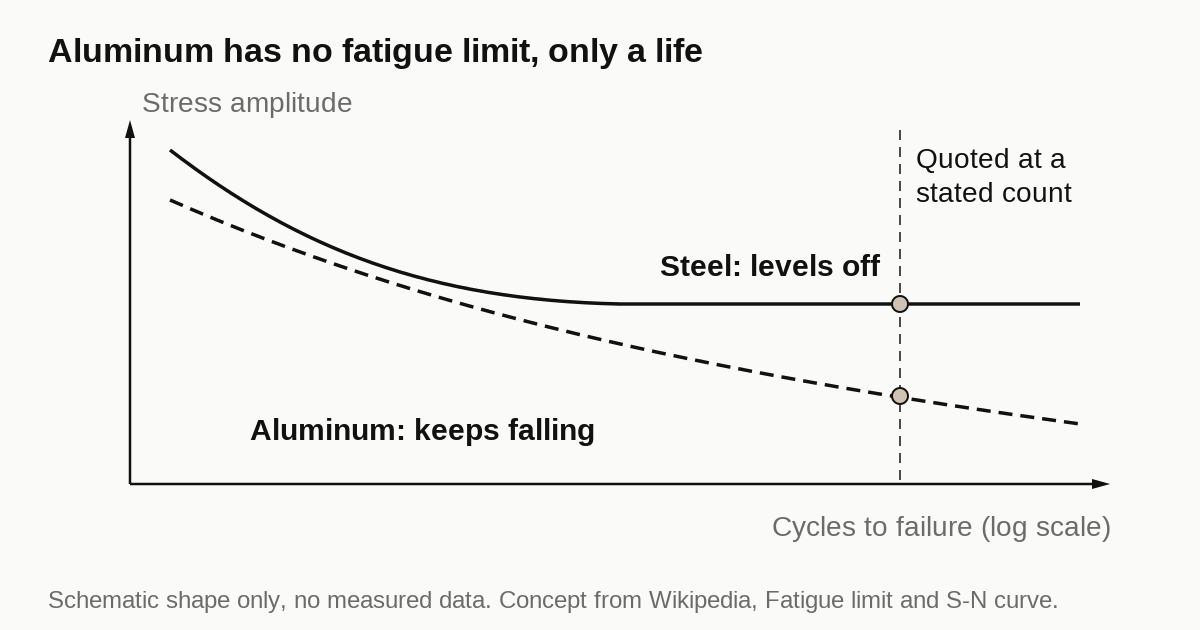
Aluminum does not have a true fatigue limit. Steel and titanium can have a stress level below which a part runs for any number of cycles; aluminum keeps losing life, however slowly, at every stress level. That is why aluminum data sheets quote a strength at a stated number of cycles, and why a bike part spec needs a cycle count and a load, not only an alloy and a temper. This post is part of the guide to choosing the material for a machined bike part.
What a fatigue limit is, and why aluminum lacks one
Fatigue tests plot stress amplitude against the number of cycles to failure. The plot is the S-N curve, also called a Wöhler curve. Wikipedia’s article on the fatigue limit describes the endurance limit as the stress level below which an infinite number of loading cycles can be applied. Some materials, such as steel and titanium, may show such a level. The same article says testing at higher cycle counts suggests a limit may not exist for any metal.
For aluminum the S-N article gives a structural reason: aluminium has a face-centred cubic structure, and for those metals the Wöhler curve generally drops continuously. So engineers use the terms fatigue strength or endurance strength, defined at a specified number of loading cycles. Wikipedia’s example of that count is 500 million cycles.
What the numbers look like for 6061-T6
| Quantity | Value | Condition | Source |
|---|---|---|---|
| 6061-T6 ultimate tensile strength, typical | 310 MPa | tensile test | Wikipedia, 6061 aluminium alloy |
| 6061-T6 fatigue strength | 97 MPa | 500 million cycles, fully reversed, RR Moore test, standard specimen | Wikipedia, 6061 aluminium alloy, citing an ASM data sheet |
| Ratio of the two | 0.31 | arithmetic from the rows above | calculated here |
| Rule of thumb for iron, aluminium and copper alloys | about 0.4 times tensile strength, aluminum maximum typical 130 MPa | smooth, un-notched specimens | Wikipedia, fatigue limit |
| 7075-T6 ultimate tensile strength | 510 to 540 MPa | tensile test | Wikipedia, 7075 aluminium alloy |
Source line: values as stated by the Wikipedia pages named, which cite ASM data; the ASM data sheet itself was not opened for this post, so treat the figures as directional. The 7075 page opened for this post gives no fatigue strength, and we found no figure for it on the pages we opened. For a fatigue critical part, ask the material supplier or the test lab for data on the exact temper and product form.
Two points from the table. A fatigue strength of 97 MPa is about a third of the tensile strength, so a part loaded to a large share of its tensile strength will not last 500 million cycles. And the rule of thumb of 0.4 is a ceiling for smooth specimens, not a design value for a machined part.
Why 500 million cycles is not a design life
A pedal stroke loads each crank arm about once per crank revolution. As an illustration with assumed numbers, take a rider at 80 revolutions per minute.
- 80 revolutions per minute is 4,800 cycles per hour of pedaling.
- 500 million cycles divided by 4,800 is about 104,000 hours.
- At 10 hours of riding a week, that is about 200 years.
The reference count on a data sheet is far beyond the life of any bike. The relevant question is the strength at the number of cycles the part must survive, with a safety margin, and that comes from the part’s own S-N data or from a fatigue test on the finished part. The guide to fatigue test rigs covers who runs those tests.
Need a quote for this part? Get a quote for your bike parts
Why the data sheet number overstates a machined part
Data sheet specimens are smooth. A machined bike part is not.
- Notches and corners: a sharp internal corner or a hole raises the local stress. The Roy Mech reference gives the fatigue notch factor as Kf = 1 + q(Kt − 1), where Kt is the geometric stress concentration factor and q is the notch sensitivity. It notes that when q is not available, using Kt is conservative. The next post covers stress concentration in machined bike parts.
- Surface condition: tool marks and deep engraving act as small notches. Shot peening is one answer for fatigue critical surfaces.
- Anodize: the site’s alloy reference states that anodizing reduces fatigue life and that the penalty grows with coating thickness. Test structural parts in the finish you will ship.
What to write in the spec
- The alloy and temper, with the product form
- The critical load case and the cycle count it must survive, or the test standard that sets them
- The pass criterion, such as no visible crack and no loss of function at the stated count
- The finish, because the test must run on the finished part
- Whether data sheet figures are accepted or a part level test is required
Do not write “fatigue limit” for an aluminum part. Write the stress or load, the cycles and the test. If you want quotes from shops that can build to a fatigue requirement, send the drawing and the load case through the RFQ page. We quote the finished parts within 24 business hours and place the work with a partner shop. The material choice guide continues from here.
Sources
- Wikipedia, Fatigue limit
- Wikipedia, S-N curve
- Wikipedia, 6061 aluminium alloy
- Wikipedia, 7075 aluminium alloy
- Roy Mech, Metal Fatigue: stress concentration
Frequently asked questions
Does aluminum have a fatigue limit?
Not a distinct one. Wikipedia's fatigue limit article says aluminium will eventually fail even from small stress amplitudes, unlike steel, and uses fatigue strength or endurance strength for such materials. Strength is then quoted at a stated number of loading cycles, with 500 million given as an example.
What cycle count should I use for a bike part?
Use the count the part will see in service or the count in the test standard you are bound to, not the 500 million used on data sheets. The data sheet number is a reference point. Write the load, the cycle count and the pass criterion on the drawing or the test plan, and agree them with the lab.
Can I use the data sheet fatigue strength for my machined part?
Only as a starting point. Data sheet values come from smooth, polished specimens. A machined part has tool marks, corners, holes and often an anodized surface, and each of these lowers fatigue life. Test the finished part in the finish you will ship, as the shop and lab guides on this site recommend.
Need a quote for this part?
Send the drawing. We quote the finished parts, place the work with a partner shop that machines bike parts and reply within 24 business hours.
Get a quote for your bike parts