Guides / Materials
Bonded, Press-In or Threaded Inserts in Carbon Fiber Bike Parts
November 21, 2026
Where a bike part needs a thread, a bearing seat or a clamp face in carbon fiber, the metal usually arrives as a machined insert, and the choice is how it is held: bonded with adhesive, pressed in with an interference fit or screwed in with an external thread. Bonding is the usual route for loaded threads, and a published test of metallic inserts in carbon laminates describes interference-fit installation as a source of delamination. The insert metal matters as much as the method, because carbon corrodes aluminum. This post is part of our guide to the best material for CNC bike parts, and it compares the three methods and shows what to write on the insert drawing.
The three ways to hold an insert
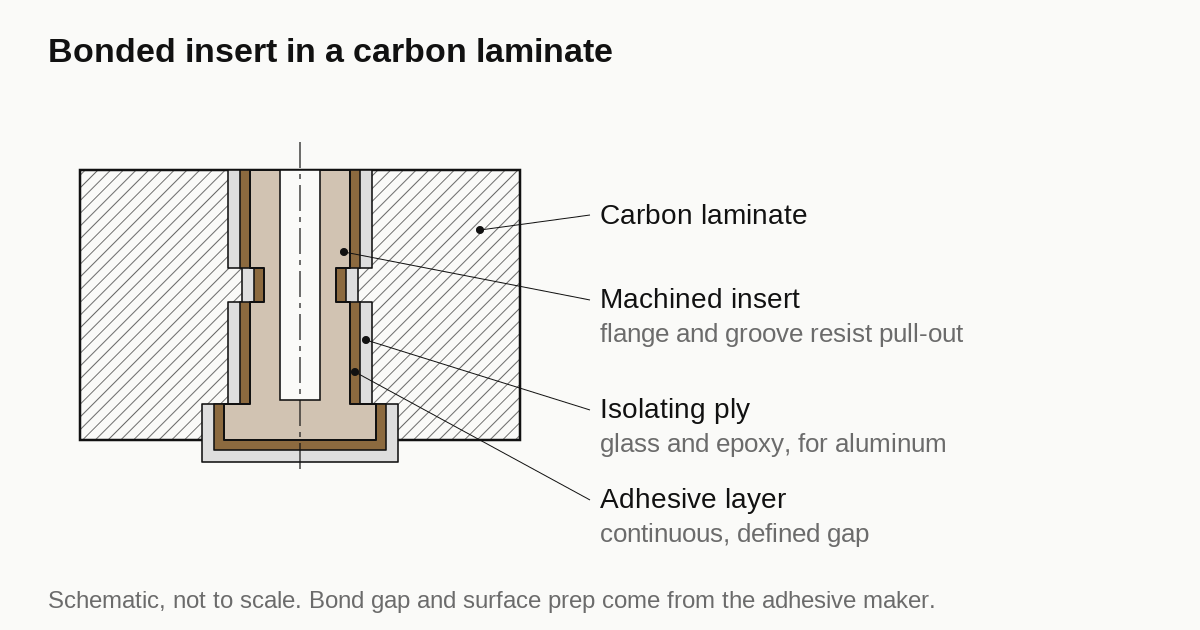
Wikipedia’s threaded insert article sorts inserts by how they hold. Knurled press-fit inserts are pressed into a plain hole. Externally threaded inserts have threads inside and out, and self-tapping versions cut their own thread in the host. Potted inserts are set in epoxy, as in honeycomb sandwich panels. A bonded insert is the potted idea applied to a solid laminate: an oversize hole, a machined insert and an adhesive layer between them. Wikipedia does not list bonded inserts as a separate category, so we use the word in the way our materials page does.
Two terms from the same article matter for what follows. Pull-out resistance is the force needed to start pulling the insert out. Torque-out resistance is the torque needed to start turning it. A drawing for a threaded interface should say which load the insert has to carry.
| Criterion | Bonded | Press-in | Threaded, self-tapping |
|---|---|---|---|
| How the load enters | Through the adhesive over the whole wall of the hole | By friction from the interference | Through the thread flanks cut in the host |
| Installation risk in a carbon laminate | Hole preparation and adhesive control | A source of delamination, per the paper we read | Our reading: cutting a thread is the same kind of risk as pressing; we found no data |
| Barrier to the corrosion cell | The adhesive layer, if it stays continuous | None: metal touches carbon | None: metal touches carbon |
| Removable | No | No | In principle, our reading |
| What controls quality | Surface prep, adhesive mix, cure | Hole size and tolerance | Hole size and torque |
Caption: author’s summary. The load and installation rows for bonded and press-in follow Liu et al. (2015). We found no public test data for press-in or threaded inserts in bike-part carbon laminates, so treat those cells as questions to ask a carbon part maker.
How the load gets into the laminate
A 2015 conference paper by authors at an aeronautics institute and an aircraft maker tested metallic inserts bonded into CFRP laminates. Its introduction says the traditional interference fit is not adapted to CFRP, because stress concentration and delamination at the hole reduce fatigue strength. It also says bonding changes the load transfer: radial tractions pass through the whole surface of the hole instead of about half of it, and the failure mode moves from bearing toward tension-bearing.
The test itself was small. The insert was steel, 3 millimeters in outside diameter, in a 5 millimeter laminate with an epoxy adhesive, and the authors tried four hole designs. The minimum push-out values were 703 to 929 newtons depending on the hole type, and the authors attribute the differences mainly to the adhesive mix ratio rather than to how precisely the insert was installed. Take two things from it. Adhesive control matters more than a polished hole, and the numbers are for a tiny aerospace insert, not a bike crank. We found no public push-out or torque-out data for bike inserts.
Galvanic corrosion: choose the insert metal first
Carbon is cathodic to most structural metals. Wikipedia’s carbon fiber article says carbon fibers can cause galvanic corrosion when CFRP parts are attached to aluminum or mild steel. The FAA’s corrosion circular for aircraft says graphite and epoxy composites act as a very noble, or cathodic, material and recommends a nonconductive layer between composite and dissimilar metal, such as fiberglass and epoxy, sealant or both. The same circular puts carbon graphite, stainless steel and titanium in one group of metals that are relatively safe in contact.
That gives a short rule for the insert metal:
- Titanium or stainless steel: the same FAA group as carbon, so the cell is weak. They weigh more than aluminum, and titanium costs more.
- Aluminum: the usual choice by weight. The wet joint corrodes the aluminum, so it needs a continuous barrier.
- Mild steel: corrodes against carbon, per Wikipedia, and needs the same barrier or a coating.
An aluminum insert with a bonded, continuous adhesive layer has a barrier built in, which is one reason bonding is favored. A press-in or self-tapping insert has no such layer unless a coating or an isolating ply is added. A 2023 paper that reviews earlier work reports that anodized aluminum corrodes to a lesser degree against CFRP, but still corrodes, so do not treat the anodize as the barrier. Our guide to galvanic corrosion on bike parts gives the full pair table, and the titanium versus aluminum guide explains when titanium is worth its price.
The bond face: surface and adhesive
The Aluminum Anodizers Council’s bulletin on adhesives for anodized aluminum is the most useful source we found for the bond face. It says correctly processed anodic coatings can serve as a good base for paints and adhesives. It says that if the coating is left unsealed, bond strength may be higher because the adhesive has more pore surface to grip, but that leaving it unsealed can mean poorer finish quality and dye fading outside the bond area. If the coating is sealed, the bulletin says to seal in deionized water with no wetting agents, because surfactants harm adhesion. It calls phosphoric acid anodizing a primer coat for bonding and the optimum way of preparing aluminum for bonding, and says epoxies have the highest bond strength in elevated salt, temperature and chemical environments.
Our materials page says a sealed anodize bonds poorly. The bulletin is more careful than that: it names the sealing bath and the surfactants as the problem. The practical reading is the same, which is to decide the bond face finish on purpose, state it on the drawing and test it. The bulletin’s own advice is to test your adhesive selection, and it notes that adhesives fill the gap between the substrates, with cure thicknesses that differ by adhesive.
Need a quote for this part? Get a quote for your bike parts
Clamp faces, grease and torque
Not every carbon interface is an insert. Where a clamp closes on a carbon tube, the clamp face matters more than any insert. Sheldon Brown’s seatpost page says carbon frames and posts should not be greased, because grease can make them swell, and that carbon posts can be damaged by seatpost clamps. Follow the carbon part maker’s torque and compound instructions, and keep the insert’s threads and the carbon’s surface separate in your thinking: the threads take lubricant per the maker, and the carbon does not.
Choose by use case
Choose bonded when a load or a thread passes into a solid laminate and you can control surface preparation, adhesive mixing and cure. It is the method the paper we read favors for carbon laminates, and the adhesive layer adds a barrier against corrosion.
Choose press-in when the host is not a carbon laminate, for example a metal or plastic part inside the assembly. The one paper we read says interference is poorly suited to CFRP, and we found no published support for pressing inserts into bike-part carbon.
Choose a threaded self-tapping insert when the host is a soft metal or plastic, which is where Wikipedia says threaded inserts give durable threads. We found no public data for them in carbon bike laminates, so ask the carbon maker.
What a wrong choice costs: a bonded insert that debonds leaves a loose thread in a structural part, an aluminum insert without a barrier corrodes into the bond line, and an interference fit can start a delamination. None of this has a public failure rate for bike parts that we found.
What to write on the insert drawing
Insert material: [titanium Grade 5 or stainless steel or aluminum 7075-T6, with temper]. Bond faces: [bare, unsealed or sealed in deionized water without wetting agents]. Surface texture on bond faces: [value from the adhesive maker]. Bond gap: [value from the adhesive maker]. Anti-rotation and anti-pull features: [groove, flange or flats]. Functional threads: [masked or finished].
Mark which surfaces are bonded and which are functional, name the adhesive, and ask for a pull-out and torque-out test on your own sample.
Checklist
- Insert metal chosen first, with the corrosion group in mind.
- Barrier layer or adhesive layer defined where an aluminum insert touches carbon.
- Bond faces named: bare, unsealed or sealed without surfactants.
- Adhesive named, with its surface prep and bond gap taken from the adhesive maker.
- Test plan: pull-out and torque-out on the real part, not a table.
- Torque and compound instructions taken from the carbon part maker.
Send the drawing
Add the insert note to the drawing, then send it and the honest quantity through the RFQ page. We read it, quote the finished parts within 24 business hours and place the work with a partner shop that already machines and anodizes bike components. The quote is itemised and has no separate service fee. For the wider choice, read our guide to the best material for CNC bike parts.
Sources
- Wikipedia, Threaded insert
- Liu et al., An Experimental Study of Installing-Holes Parameter Optimization for Metallic Inserts Bonded into CFRP Laminates, ICMSE 2015
- FAA, Advisory Circular 43-4B, Corrosion Control for Aircraft
- Wikipedia, Carbon fiber reinforced polymer
- Ofoegbu, Ferreira, Zheludkevich, Galvanically Stimulated Degradation of Carbon-Fiber Reinforced Polymer Composites: A Critical Review, Materials 2019
- Jáquez-Muñoz et al., Corrosion behavior of aluminum-carbon fiber/epoxy sandwich composite exposed on NaCl solution, Frontiers in Metals and Alloys 2023
- Aluminum Anodizers Council, Technical Bulletin 1-08, Guide to Selecting the Proper Adhesive for Anodizing Applications
- Sheldon Brown, 16 Ways to Unstick a Seatpost
Frequently asked questions
Which insert method is best for a carbon fiber bike part?
Bonded inserts are the usual route where a load or thread enters a laminate. A 2015 paper on metallic inserts in carbon laminates says interference fits tend to cause delamination and that bonding is considered a good alternative. We found no public bike-specific test data, so ask the carbon part maker which method it has validated.
Can I use an aluminum insert in a carbon part?
Yes, with a barrier. Carbon is cathodic to aluminum, so a wet joint corrodes the aluminum. The FAA recommends a nonconductive layer such as fiberglass and epoxy between composite and dissimilar metal. Titanium and stainless steel sit in the same corrosion group as carbon in the FAA table, which is why they are the other choice.
Should a bonded insert be anodized?
Ask the adhesive maker and test coupons. The Aluminum Anodizers Council says correctly processed anodic coatings can serve as a base for adhesives, that an unsealed coating may show higher bond strength, and that a sealed one should be sealed in deionized water with no wetting agents. Mark the bond face on the drawing.
Can I grease a threaded insert in carbon?
Follow the part maker's instructions for the metal threads, and keep grease away from the carbon itself. Sheldon Brown's seatpost page says grease can make carbon frames and posts swell. Use the part maker's torque and compound advice for each interface rather than a general rule.
Need a quote for this part?
Send the drawing. We quote the finished parts, place the work with a partner shop that machines bike parts and reply within 24 business hours.
Get a quote for your bike parts