Guides / For Shops
Fatigue Test Rigs for Bike Part Shops: Buy One or Outsource the Test
November 15, 2026
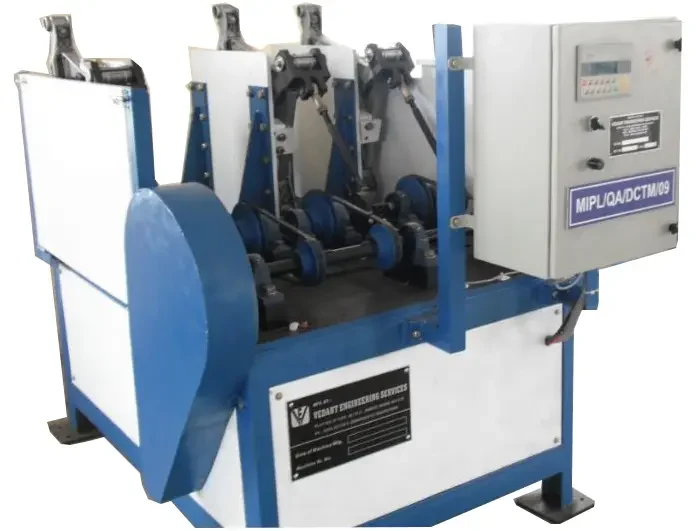
A bike brand that sells stems, cranks or thru-axles has to show that they survive repeated loading, and the shop that makes the parts is often asked, sooner or later, whether it can test them. The choices are to buy or build a rig, to send samples to an outside lab or to mix the two. This article gives a shop the numbers and questions needed to decide, using sources we could open. It does not give an ISO 4210 test procedure: the standard sets loads, cycle counts and failure criteria, and you need your own copy of it for any compliance test.
The short answer
For most shops the better first step is to outsource the formal test and, if volume justifies it, build a modest rig for comparing revisions in house. A rig that you run yourself is a good tool for engineering decisions. It is not automatically a source of a report a brand’s file can rely on. The reasons are below.
Time: the number that decides rig size
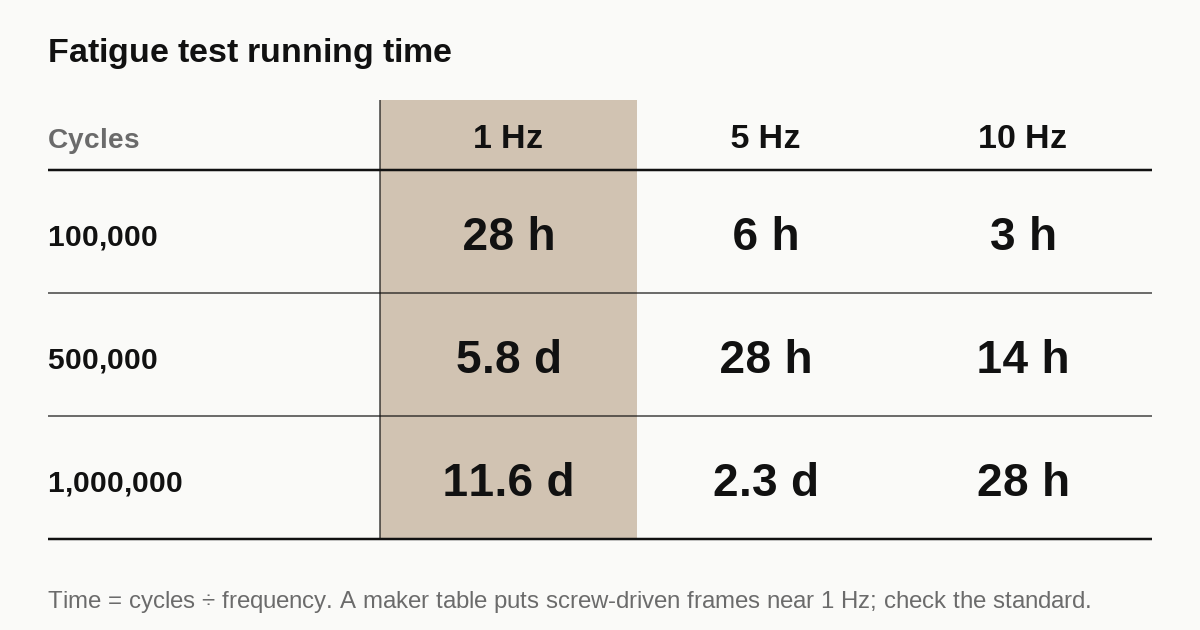
Fatigue is progressive damage from cyclic loading. A fatigue test applies a load repeatedly until a crack appears or the part reaches a set cycle count. The running time is cycles divided by frequency, with no allowance for stops.
| Cycles | At 1 Hz | At 5 Hz | At 10 Hz |
|---|---|---|---|
| 100,000 | 27.8 hours | 5.6 hours | 2.8 hours |
| 500,000 | 5.8 days | 27.8 hours | 13.9 hours |
| 1,000,000 | 11.6 days | 2.3 days | 27.8 hours |
These cycle counts are placeholders for the arithmetic. They are not the values in ISO 4210, which sets its own for each test. Two consequences follow:
- A slow rig with one station gives you very few results per month. Three stations at 1 Hz can run three parts at once, but each still takes the same elapsed time.
- A fast rig needs more force control, a stiffer fixture and a check that the standard allows the frequency. Do not assume it does.
A buyer’s guide from ZwickRoell, a testing machine maker, lists electromechanical frames at 1 to 100 kN with frequency of approximately 1 Hz, and servo-hydraulic frames at 10 to 2,500 kN with frequency up to 100 Hz. This is vendor information, and published specifications differ by model.
Rig types, from a vendor’s view
The same ZwickRoell comparison, which we treat as directional, describes four drive types:
| Drive type | Force range | Frequency | Running cost and maintenance |
|---|---|---|---|
| Electromechanical | 1 to 100 kN | approx. 1 Hz | Low, no media supply |
| Linear motor | 1 to 10 kN | up to 100 Hz (120 in the table) | Low |
| Servo-hydraulic | 10 to 2,500 kN | up to 100 Hz | High: oil, filters, hoses and a power pack that is energy-intensive |
| Resonance | up to 1,000 kN | up to 285 Hz | Very low, about two percent of a hydraulic machine’s energy use, with a stroke of up to 6 mm |
Bike stems, cranks and thru-axles are small parts. In our view the first two lines are the realistic options for a shop, but confirm the force the test needs before you choose. The resonance type has a short stroke, which suits stiff specimens with small deflection and is a poor fit for a part that bends noticeably. Check any rig’s stroke, force and frequency against the test you want to run.
We found no independent public comparison of purchase prices. Vendors quote by configuration. Treat any figure in a brochure as a starting point for a quotation request.
What a rig needs besides the frame
A frame and an actuator are the start. A useful bike component rig also needs:
- Fixtures that reproduce the bike interface. A stem needs a steerer tube, a handlebar section and a way to apply the load. A crank needs a spindle and a pedal-end load point. The fixtures decide whether the test resembles the standard, and they are often the larger share of the work.
- A calibrated load measurement. Load cells use strain gauges. A strain gauge measures deformation from the change in electrical resistance of a metal foil bonded to the part. The load cell must be calibrated, with the calibration dated and traceable, or the loads are only assumed.
- A cycle counter and an automatic stop. A crack in a stem changes its stiffness. The rig should stop on a displacement or load limit, so it does not run for days on a failed part.
- Safety guarding. Fatigue failures can release broken pieces.
- Record keeping. The drawing revision, the material lot, the finish, the load level, the cycle count and the photographs of the failure. The test lab guide lists the file a brand expects.
A real example of what the data looks like
Sheldon Brown’s site hosts an older stem fatigue comparison, with a note by John Allen. The rig was a rigid steel frame with a fork steerer tube and a bar bolted into the stem. The load was +1651 in-lb applied to one side at about one cycle per second.
Seven stems were tested. Cycles to failure ranged from 91,200 for a TIG welded steel stem to 1,090,440 for a raw titanium stem. A polished titanium stem was still intact when the machine was stopped at 2,323,090 cycles. Most failures were cracks at the quill, the extension or the weld between them.
Three lessons for a shop:
- Scatter is large. A single sample proves very little. Plan several, as the standard and your customer require.
- A run-out is a result. Wikipedia describes a run-out as a test that ends without failure because the time to failure exceeds what is available. It is censored data, not a failure and not a proof of infinite life.
- Surface and geometry matter. Wikipedia lists surface finish, temperature, microstructure and residual stresses among the factors affecting fatigue life, and holes, keyways and sharp load direction changes as common crack starters. The shot peening guide and the anodizing cracking post cover two process factors specific to bike parts.
This example is an old comparison on a simple rig, not a standard test, and the loads are not ISO values. It shows what a simple rig can do.
Need a quote for this part? Get a quote for your bike parts
The case for outsourcing the formal test
A lab that is accredited to ISO/IEC 17025 has had its competence for specific methods confirmed by a third-party accreditation body, within a defined scope. Wikipedia notes that many regulators and suppliers do not accept results from a lab without that accreditation. Whether a bike brand’s file needs it is a question for the brand and its own conformity route. Ask before you decide.
Proficiency testing also shows what a lab has to maintain. A German proficiency test listed in the EPTIS database covers the handlebar and stem assembly fatigue test under ISO 4210-5 and related standards. It is run by LaborEP, for accredited and non-accredited labs in continental Europe, with a fee of approximately 2,900 EUR per participant, every two years, with the first run in 2026. A shop that runs its own rig and wants its results to be trusted takes on that kind of cost and effort.
Questions for an outside lab:
- Which edition of which part of ISO 4210 or EN 15194 is the test run to?
- Is the method on your accreditation scope, and can I see the certificate?
- How many samples does the test consume, and what happens after a failure?
- What does the report contain: loads, cycle counts, photographs, failure location?
- How long from sample receipt, not from purchase order?
- Do you accept samples finished as production will be, and what do you need us to include?
Break-even: a way to do the arithmetic
The break-even point is the cost of the rig divided by the saving on each test.
Illustrative placeholders, not market data: a one-station rig with fixtures, a calibrated load cell and installation costs 40,000. An outside test costs 2,500 for a sample set. Your own cost per test, counting operator time, electricity and fixture wear, is 800. The saving per test is 1,700, so break-even is about 24 tests. At four tests a year, that is six years, and it ignores your time to maintain the rig and the cost of calibration.
Replace each number with a quote. Include the less obvious ones: the staff member who owns the rig, the floor space, calibration every year, replacement fixtures when the design changes and the downtime between tests. If your shop makes a dozen bike part designs and revises each yearly, the figures look different. If it makes two, they rarely do.
A middle path
Many shops that want to understand fatigue use two tiers:
- Screening in house. A simple rig or even a single-station setup to compare a revision with the previous one at the same load. It answers “did this change make it better or worse?” and costs less than a formal test each time. Label the results as internal in any report.
- Formal test outside. A lab runs the standard procedure on finished production-equivalent samples, and you keep the report in the brand’s file.
Fatigue is one input. The weight versus strength guide and the crank arm guide show where design decisions come in before any test.
Decision checklist
| Question | If yes | If no |
|---|---|---|
| Does the brand require an accredited lab’s report? | Outsource the formal test | An in-house result may be accepted. Ask in writing |
| More than a handful of tests per year? | Rig cost may pay back | Outsource |
| Do you have a staff member who will own the rig and its calibration? | Consider a rig | Do not buy one |
| Do you revise designs often? | A screening rig helps | Outside tests are enough |
| Can you pay for fixtures per design? | Fixtures are a one-time design cost | A rig is idle between jobs |
If you are a machine shop that makes bike components, register through the supplier page. If you run a test lab that brands and shops can use, register as a vendor. Neither listing promises orders.
Sources
- Wikipedia, Fatigue (material)
- Wikipedia, Strain gauge
- Wikipedia, ISO/IEC 17025
- Sheldon Brown, Stem Fatigue Testing
- ZwickRoell, Dynamic materials testing: which drive is right (vendor, directional)
- BAM EPTIS, Proficiency test: handlebar and stem assembly fatigue test
- Wikimedia Commons, Fatigue testing

Frequently asked questions
How long does a bike component fatigue test take on a rig?
Cycles divided by frequency. At 1 Hz, 100,000 cycles take about 28 hours of running time and 1 million cycles take about 11.6 days. At 5 Hz the same million cycles take about 2.3 days. The standard sets the cycle count and may limit the frequency, so read the clause before you plan rig time.
Can a machine shop run ISO 4210 fatigue tests in house?
A shop can build or buy a rig and run tests, but a brand may want a report from an independent lab that is accredited to ISO/IEC 17025 for the method. Ask the brand what it will accept before you spend money. An in-house rig is often best used to compare revisions before the formal test.
What do fatigue test rigs cost?
We found no independent public price survey. Vendors quote by force, frequency and stroke, and hydraulic systems carry higher running and maintenance cost than electromechanical ones. Get three written quotes, including fixtures, load cell calibration, installation and training, and compare them with the price of outside tests over several years.
Why do fatigue samples fail at such different cycle counts?
Fatigue life scatters, even between identical parts. One published stem comparison on a simple rig ran seven stems at the same load and got lives from 91,200 cycles to one stem still intact at 2,323,090. Surface finish, stress concentrations and processing history all matter, so plan several samples, not one.
Need a quote for this part?
Send the drawing. We quote the finished parts, place the work with a partner shop that machines bike parts and reply within 24 business hours.
Get a quote for your bike parts