Guides / Finishing
Anodize Cracking and Crazing on Bike Parts: What Causes It
November 9, 2026
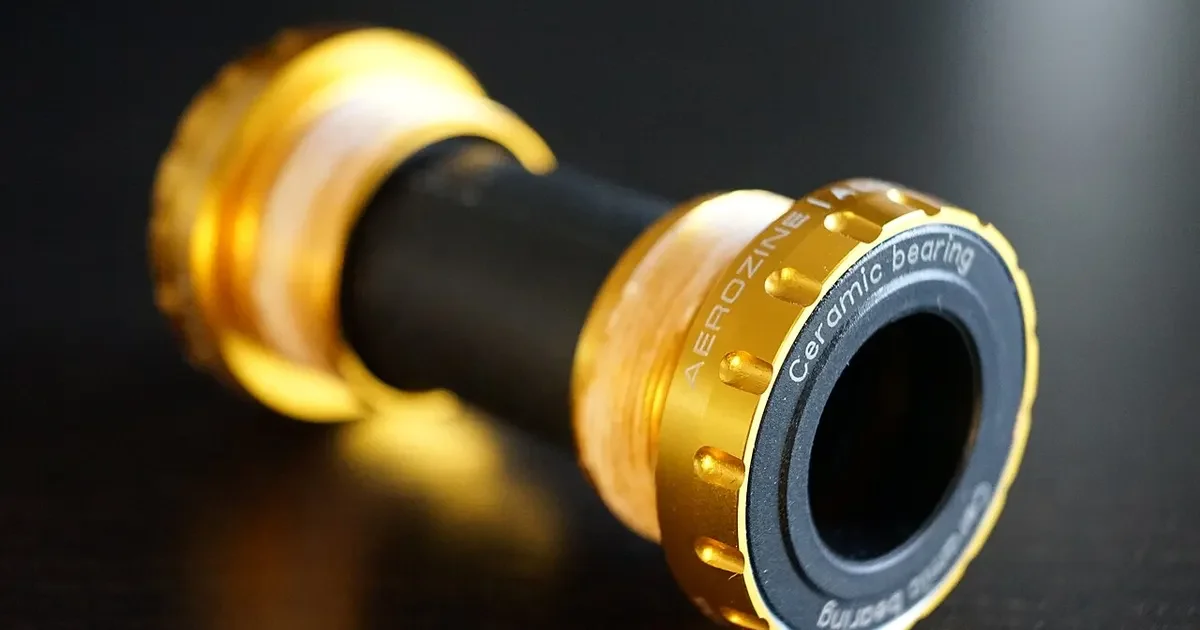
Anodize crazing is a network of fine cracks in the anodic oxide layer. It is rarely a sign of bad aluminum. It is a thermal and thickness problem, and a bike brand can prevent most of it with a few lines on the drawing and a conversation with the anodizer. This guide covers what causes it, how to read the crack pattern, and what to put in the specification. Evidence here comes from Wikipedia, a patent and finishing practitioners, who do not always agree, so test your own alloy, thickness and process.
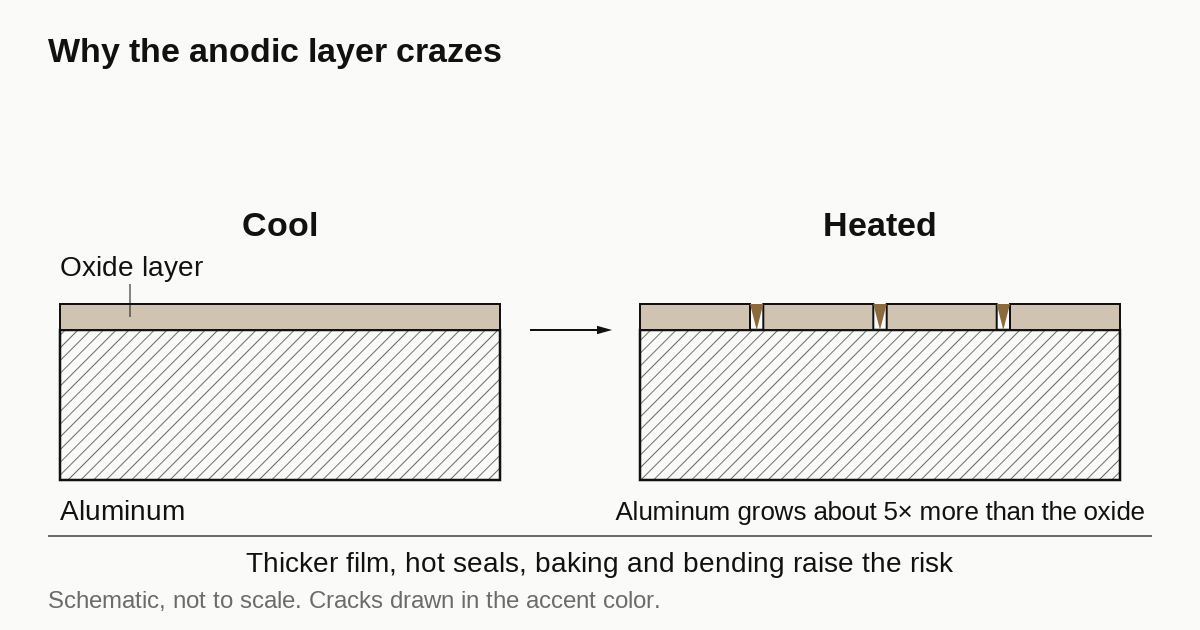
Why the oxide cracks
Aluminum oxide is a ceramic grown from the metal. When the part heats, the aluminum expands and the oxide, which expands far less, cannot follow. A patent filed by Apple describes crazing as thermal-shock cracking of the newly formed oxide layer and puts the oxide’s expansion coefficient at approximately one-fifth that of aluminum. A finishing supplier gives the same ratio, five to one, and adds that the oxide is about three times harder than the raw aluminum, so it does not stretch when the part is formed.
Wikipedia says the coating will crack from thermal stress if exposed to temperatures above 80 degrees C (353 K), and that it can crack but will not peel. The 80 degree figure is a general guide, not a pass line. Thicker film cracks at lower temperatures than thin film, and sudden change matters more than the final temperature.
The oxide also grows into and out of the surface. Wikipedia states that each surface grows by half the oxide thickness, so a 2 micron coating adds 1 micron per surface. That growth builds tensile stress at curves and corners, which is why geometry shows up in the causes below.
The five usual triggers
| Trigger | What happens | What to do |
|---|---|---|
| Thermal shock in the process | Parts go from a cold anodize bath to a hot rinse or seal. A finishing practitioner calls this the most common cause | Ask for stepped warm-up rinses and a ramped seal temperature |
| Heat after anodizing | Baking a screen print at 275 to 300 degrees F for 30 minutes, powder coat curing, hot washing | Keep hot processes before anodizing, or tell the anodizer the part will see heat |
| Thick film | Type III hard coat is 13 to 150 microns per Wikipedia, much thicker than Type II at 1.8 to 25 microns. The Apple patent says layers two to four times thicker than conventional Type II, and parts with curves, are more susceptible | Specify a thickness range and ask whether a thinner film meets the need |
| Forming after anodizing | Bending, swaging or hard clamping stretches the metal under a brittle layer | Form first, anodize second |
| Hot sealing | Boiling water or steam seals at 96 to 100 degrees C. The patent says cold sealing does not normally induce crazing | Discuss seal type: mid-temperature sealing can leach dye, cold sealing is not suited to bonding, per Wikipedia |
Alloy and shape matter too. A practitioner on finishing.com says all hard coat has microcracks that can be minimized but not eliminated, and that extruded alloys are more prone. Check with your anodizer before assuming a 6061 bar and a 7075 forging behave the same, and see the 6061 versus 7075 guide for the alloy trade.
Read the crack pattern
Finishing practitioners use the pattern to find the cause. These are field rules, not a standard, so treat them as clues.
- Parallel cracks across a bend or a crease: mechanical, from forming or bending.
- Radial cracks from a point: a point load, or an inclusion under the film.
- Wavy cracks like a dried lakebed: thermal stress, from heat or thermal shock.
- Straight cracks perpendicular to the surface in a cross section: typical of thermal crazing.
On a bike part, a stem or caliper adapter that shows a mesh across its face after the seal tank points to the process. Cracks that appear only after the customer’s paint bake point to the downstream heat. Cracks along a clamp slot point to mechanical load.
Does it matter?
The Apple patent calls crazing an undesirable cosmetic and functional defect. The oxide is thin, so crazing alone is mainly about appearance. It becomes a functional issue when cracks reach bare metal and let moisture in, and colored parts show cracks more clearly. Soderberg of Lorin Industries notes that darker colors hide crazing better than light ones, which is a design choice, not a cure.
Fatigue is a different question. Wikipedia says anodizing can significantly reduce fatigue life or increase it by preventing pitting, depending on alloy and thickness. A visual crack check does not tell you the fatigue answer. For load-bearing parts, test the finished part, as the ISO 4210 overview explains, and read the shot peening guide for one way to protect fatigue life under the film.
Need a quote for this part? Get a quote for your bike parts
What to put in the specification
- The anodize type, class and a thickness range in microns, not just “hard anodize”. The Type II versus Type III guide helps you choose, and the growth calculator shows what the coating does to your machined size.
- The seal type, and who may change it.
- Any heat the part will see after anodizing: bake, cure, wash or service. Brake mounts and adapters near a rotor are the obvious case, covered in the disc brake mount guide. Give the real maximum temperature if you know it.
- A requirement to form and deburr before anodizing, in line with the deburring guide.
- A limit sample: a physical part that shows the worst acceptable cracking, agreed before the production run. We found no public standard that sets an acceptance limit for crazing, so make one with the anodizer.
- A pilot lot of 10 to 20 parts through the full process, including your downstream steps, before you release a full run. One practitioner suggests a boiling-seal test coupon to see whether an alloy crazes.
On who does the anodizing, the in-house or partner guide and the anodizer’s guide explain the handoff, and the color matching guide covers batch consistency.
The trade-off with thickness
A thinner film is the simplest way to lower crazing risk, but it gives up something. Wikipedia lists Type II film at 1.8 to 25 microns and hard anodizing at 13 to 150 microns. Our view: hard coat is usually chosen for wear, so a surface that rubs against a clamp or a bearing may need it, while a cosmetic stem cap does not. Decide per surface, not per part: a decorative face can take a thin Type II film while a sliding surface is hard coated, with the anodize growth calculator used to set the machined size for each.
Common mistakes
- Specifying “hard anodize” for looks. It is the thick film that carries the crazing risk.
- Baking or hot washing after anodizing without telling the anodizer.
- Bending a part after anodizing to straighten it.
- Testing the bare part for strength and shipping the anodized one.
- No limit sample, so every batch is judged by whoever inspects it that day.
Send the drawing, the finish spec and the downstream heat steps through the RFQ page. We quote the finished parts within 24 business hours and place the work with a partner shop that works with anodizers on bike parts.
Sources
- Wikipedia, Anodizing
- Google Patents, US9702053B2, Elimination of crazing in anodized layers
- Steven Soderberg, Lorin Industries, How anodize crazing forms and how to avoid it
- finishing.com, Anodize crazing Q&A (practitioner forum, directional)
- Wikimedia Commons, Aerozine Bottom Bracket Ceramic BB-08-XC

Frequently asked questions
What causes anodize crazing on aluminum bike parts?
Mostly a thermal mismatch. The oxide expands about one-fifth as much as the aluminum under it, so a sudden change in temperature cracks the layer. The usual triggers are hot sealing after a cold rinse, baking or hot washing after anodizing, a thick hard coat and bending the part after anodizing.
At what temperature does anodizing crack?
Wikipedia states that an anodized coating cracks from thermal stress above 80 degrees C (353 K), and a practitioner on finishing.com reports cracking starting near the same point. The real threshold depends on film thickness, sealing and how fast the part heats or cools, so test your own alloy, thickness and process.
Does crazing weaken an anodized bike part?
The crack pattern is a defect in the oxide, which is thin compared with the part, so crazing alone is mainly cosmetic and a corrosion path if it reaches bare metal. Anodizing itself can reduce fatigue life, depending on alloy and thickness, so test the finished part and do not rely on the crack check.
How do I prevent crazing on a hard anodized part?
Specify a thickness range, not just Type III. Ask the anodizer to warm the part in steps before a hot seal, or to use a cold seal. Avoid baking or hot processes after anodizing, form or bend the part before anodizing and agree a limit sample for what crazing is acceptable.
Need a quote for this part?
Send the drawing. We quote the finished parts, place the work with a partner shop that machines bike parts and reply within 24 business hours.
Get a quote for your bike parts