Guides / Process
Milestone Reviews for a Bike Component Launch: Sample, Test, Pilot, Ship
November 21, 2026
A model year is a date, and a machined bike part that misses it usually misses it in small steps: a sample that took an extra week, a lab slot nobody booked, a color nobody approved until the pilot arrived. The fix is not a longer schedule. It is a short list of gates, each with one question the shop and the brand answer together. This guide gives the five gates, what each must prove, a one-page review sheet and a calendar built backward from a launch date for a stem and for a chainring.
Model-year launches and why parts slip
A launch date is fixed by outside events: a trade show, a catalog, a retailer’s order window. The parts date is the one the brand can influence, and it is a sum of stages, as our guide to lead time for machined bike parts explains. Three things make a bike component slip more than the stage list suggests.
- Several people must say yes. The brand approves the sample, the lab reports on the test, the finisher matches the color. A delay in any one waits on a person, not on a machine.
- A failed step repeats the steps after it. A failed fatigue test changes the design, and the design change means new samples, a new test slot and a new pilot.
- Nobody owns the calendar between the stages. Each party knows its own task and not the date the next one needs it.
Gate reviews answer the third problem. They put one date on each decision and one name against it.
The five gates and what each must prove
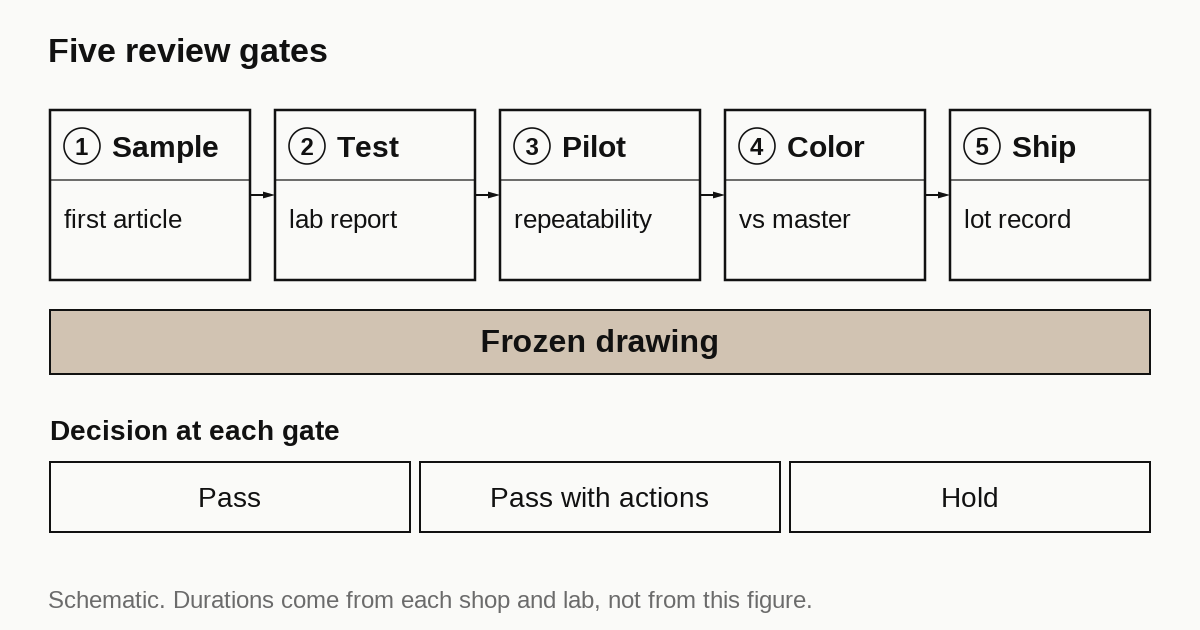
Start from a frozen drawing revision. If the drawing is still changing, the first gate has nothing to review. Then run five gates in this order.
| Gate | Question it answers | Evidence on the sheet | Decision |
|---|---|---|---|
| 1. Sample | Does the part, as machined, meet the drawing? | First article report with measured values, photos, the drawing revision | Release samples for test |
| 2. Test | Does the design pass the test in the finish it will ship in? | Lab report, sample count, finish on the samples, test standard and part | Freeze the design |
| 3. Pilot | Can the shop repeat the part in a small lot? | Pilot lot inspection, rejects and reasons, cycle and finishing times | Release the production order |
| 4. Color | Does the finished color match the approved master across the lot? | Master sample, lot sample, who judged it and under which light | Approve the finish for production |
| 5. Ship | Is the lot complete, marked and packed as agreed? | Lot release record, count, lot marks, packing photos | Release the shipment |
Gate 1 is where the part meets the drawing. Our guide to first article inspection lists what the report should hold, and the point for a product manager is to ask for measured values and not a tick box. Gate 3 is the dress rehearsal for the order, and the pilot batch guide covers how to run it.
Gate 4 sits after the test on purpose. Color depends on alloy, coating thickness and dye bath, as the color matching guide explains, so it is judged on the same finish that the test used.
Fatigue test and lab slots in the plan
The test is the gate most likely to move the launch, because the brand does not control the lab or the number of parts a test consumes.
ISO 4210 is published in parts. According to ISO’s catalogue entries, Part 5 (ISO 4210-5:2023) specifies the steering test methods that support the requirements in ISO 4210-2, and Part 8 (ISO 4210-8:2023) specifies the pedal and drive system test methods. In practice a stem is judged within the steering assembly and a crank or chainring within the drive system. The catalogue pages show the title and scope only, so confirm with the lab which clauses apply to your part and your category of bicycle before you book.
Three planning rules follow, all in our view.
- Book the slot before the sample gate. Ask the lab for the earliest date it can receive finished samples and treat that as a fixed date on the calendar.
- Ask for the sample count in writing. Tests consume parts, and a retest needs fresh ones. Our page on what brands need from a test lab explains why the finish on the sample matters as much as the count.
- Plan for a failed first test. If the calendar has no room for a second round of samples, the date is a hope, not a plan.
Color and cosmetic approval before the run
Cosmetic approval is the gate that is easiest to skip and cheapest to run early. Agree a physical master sample for each color and finish, one copy for the brand and one for the shop and its finisher. Decide how the color is judged: against the master, by whom, under what light. Agree what counts as a cosmetic reject too, for example scratches, rack marks and edge breaks on visible faces. A limit sample with the worst acceptable mark settles arguments that a written rule cannot.
Run this gate on the pilot lot, then again whenever the finisher or the alloy source changes.
Gate review meeting: 30 minutes, one sheet
A gate review is not a status call. It has one sheet, sent a day ahead, and three possible outcomes.
- Pass. The next stage starts on its date.
- Pass with actions. The next stage starts, and each open item has an owner and a date.
- Hold. The next stage waits, and the sheet names what must be shown to lift the hold.
Attendees: the brand’s product manager, the person who owns quality for the brand, and the shop’s contact who can say what is ready. Spend the first ten minutes on the evidence, the next ten on open items and the last ten on the dates for the next gate. Send the minutes the same day as a copy of the sheet with the decision marked.
Need a quote for this part? Get a quote for your bike parts
Milestone sheet template
Copy this sheet for each gate. One part number per sheet.
| Field | Entry |
|---|---|
| Part number and drawing revision | |
| Gate (1 Sample, 2 Test, 3 Pilot, 4 Color, 5 Ship) | |
| Planned date / forecast date | |
| Evidence attached | |
| Open items, owner, due date | |
| Decision (pass, pass with actions, hold) | |
| What lifts a hold | |
| Next gate and its date | |
| Signed by (brand) / (shop) |
Milestone calendar example
The example counts backward from the date the parts must be in the brand’s warehouse. Every duration below is an assumption chosen to show the method, not a typical figure for any shop or lab. Replace them with the days each shop and lab give you.
Suppose the brand wants a stem and a chainring at its warehouse ahead of a show. Taipei Cycle lists 24 to 27 March 2027 on its official site, and the organizer of Eurobike announced 30 June to 2 July 2027 in September 2026 after earlier changes, so check the organizer’s page before fixing any date to a show.
| Gate | Stem (weeks before parts-in-warehouse date) | Chainring (weeks before parts-in-warehouse date) | Note |
|---|---|---|---|
| Drawing freeze | 20 | 20 | Revision frozen before samples are cut |
| 1. Sample approved | 16 | 16 | Samples leave for the lab |
| 2. Test report in | 11 | 12 | Stem: steering test. Chainring: drive system test. Lab gives its own time |
| 3. Pilot lot inspected | 7 | 7 | Production order released after this gate |
| 4. Color approved | 6 | 6 | Judged on the pilot lot |
| Production order released | 6 | 6 | Production lead time starts |
| 5. Ship release | 1 | 1 | Lot release record, packing photos |
| Parts in warehouse | 0 | 0 | The date that matters |
The chainring row for the test sits a week earlier than the stem in this example only because a drive system test may need a different sample count. That is an assumption. Ask the lab.
Read the table from the bottom. If the production order is released six weeks before the warehouse date, every gate above it has a latest date. A gate that slips by a week moves the warehouse date by a week unless a later stage shortens, and a stage that shortens is a risk to name, not a saving to count on.
Send the dates with the drawing
Put the date the parts must arrive on the RFQ and say which gates you plan to hold. A shop that quotes with its own days per stage gives you the numbers for the calendar above. Send the drawing through the RFQ page and we quote the finished parts within 24 business hours and place the work with a partner shop that machines and anodizes bike components.
Sources
- ISO, ISO 4210-5:2023 Cycles, safety requirements for bicycles, Part 5: Steering test methods
- ISO, ISO 4210-8:2023 Cycles, safety requirements for bicycles, Part 8: Pedal and drive system test methods
- Taipei Cycle, official site (next show dates)
- Cleanrider, Eurobike 2027 new dates (published 2 September 2026)
- Wikimedia Commons, Bicycle stems.jpg

Frequently asked questions
How many milestone reviews does a bike component launch need?
Five is a workable number for a machined part: sample, test, pilot, color approval and ship. Each one is a short meeting with a decision, not a status call. Add a sixth, a drawing freeze, before the first order if the design is still moving.
When should the fatigue test be booked?
When the sample is approved, and ideally before. The lab needs finished samples, the number of samples a test consumes is the usual surprise, and a failed test means new parts. Put the lab slot on the calendar as a fixed date and plan the sample gate to land ahead of it.
Who attends a gate review?
The brand's product manager, whoever owns quality at the brand, and the shop's contact with the authority to say what is ready. Thirty minutes is enough if the sheet is filled in beforehand. The output is one of three decisions: pass, pass with named actions, or hold.
Can the gates run in parallel?
Some can. Color approval can start while a test runs, because it uses a different sample. Pilot should not start before the test result on the design you intend to ship, since a design change after the pilot repeats the pilot.
Need a quote for this part?
Send the drawing. We quote the finished parts, place the work with a partner shop that machines bike parts and reply within 24 business hours.
Get a quote for your bike parts