Guides / Process
How Long a Machined Bike Part Takes: Lead Time Stage by Stage
November 18, 2026
Lead time on a machined bike part is not one number. It is the sum of several stages, and the buyer controls only some of them. This post is part of our guide to custom bike parts manufacturing. It lists the stages, shows which ones you can change and gives a worked example for planning back from a season date.
What lead time means here
Wikipedia defines lead time as the latency between the initiation and completion of a process. For a made-to-order part, it runs from the release of the order to production and shipment that fulfills it. For a buyer the useful measure is the day the PO lands to the day the parts are in your warehouse. That is longer than the number a shop quotes for machining alone, so ask what the number covers.
Wikipedia lists the components of manufacturing lead time as order preparation, queue time, setup time, run time, move time, inspection time and put-away time. Each has a counterpart in a bike part order.
The stages of a bike part order
| Stage | What happens | Who controls the time |
|---|---|---|
| Order release | PO issued at a drawing revision | Buyer |
| Material | Billet or bar is bought or taken from stock | Shop, supplier |
| Programming and fixturing | CAM, workholding, first piece | Shop; buyer through drawing clarity |
| Queue | Job waits for a machine | Shop |
| Machining and deburring | Parts are cut and edges broken | Shop; buyer through design |
| First article | Measured and approved before the batch | Shared; buyer through approval speed |
| Finishing | Anodizing, laser marking, other finishes | Finisher; buyer through color and batch choice |
| Final inspection and packing | Checks, labels, packing | Shop; buyer through the pack spec |
| Transport and customs | Shipment to your warehouse | Carrier; buyer through the delivery term |
Caption: author’s stage list. We found no public duration for any of these stages for bike parts, so the table gives none. Ask the shop for days per stage.
Why finishing surprises buyers
Machining is predictable once the program runs. Finishing is not, because it is a batch process. Wikipedia describes the anodizing sequence as a coating step that can be followed by dyeing, and calls sealing the final step. Parts wait until enough pieces are ready to fill a load, then pass through the bath, the dye and the seal.
Three things stretch the time. A custom color match adds a sample approval loop. A shop that sends parts to a partner anodizer adds transport out and back. A second finishing step, such as laser marking after anodizing, adds one more handoff. Ask the shop who anodizes, how long it takes including waiting for a batch and whether your parts will be grouped with other jobs.
The shortest practical route is a stock color, a single finishing step and parts that share a batch. Our guide on prototype to production explains why you also want the pilot batch to prove that the anodizer holds color.
Transport and customs
Transport is the last stage and is easy to forget. The delivery term decides who arranges it. Under Incoterms 2020, as Wikipedia summarizes them, a buyer on EXW arranges export clearance, import clearance and freight, while a seller on DAP arranges export clearance and freight and the buyer clears import. A seller on DDP does all three. That allocation is directional, so confirm it in the ICC rules text.
If parts cross a border, add time for customs. CBP’s guide for commercial importers, an older edition, states that goods are not legally entered until the shipment has arrived, delivery has been authorized and estimated duties have been paid. We found no lane-independent figure for how long that takes, so ask a broker or the carrier for your route. Our comparison of domestic and overseas shops covers where the extra time sits.
Plan back from a season date
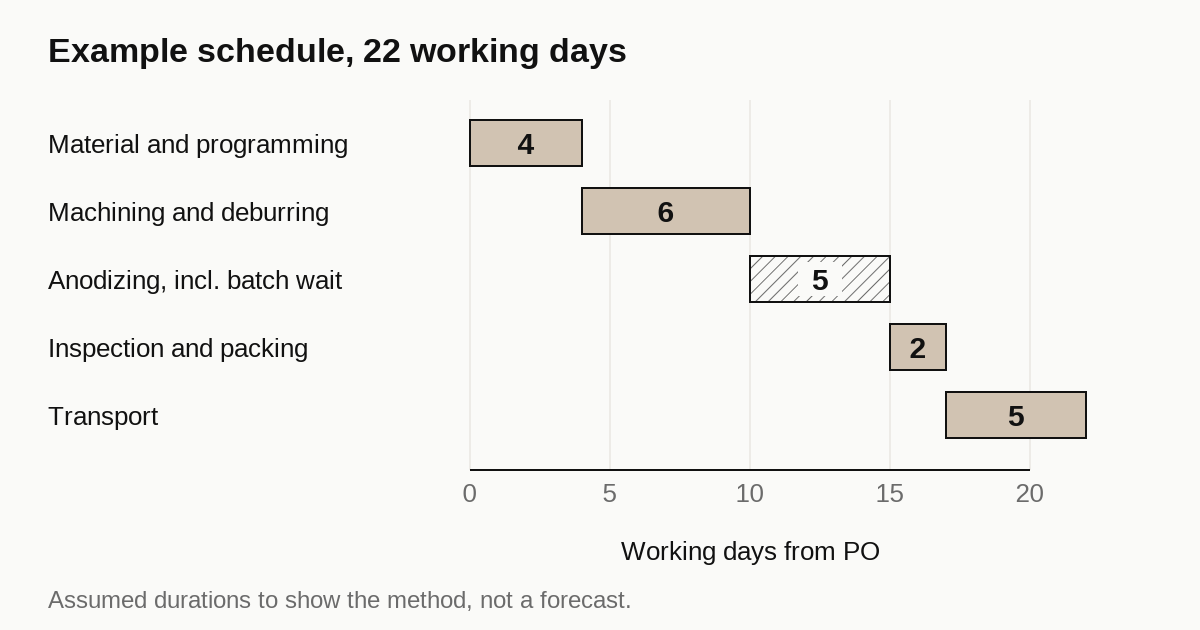
A worked example, with assumed durations. They are chosen only to show the method and are not a forecast for any shop.
| Stage | Assumed working days |
|---|---|
| Material and programming | 4 |
| Queue and machining, deburring | 6 |
| Anodizing, including waiting for a batch | 5 |
| Final inspection and packing | 2 |
| Transport to your warehouse | 5 |
| Total from PO | 22 |
Twenty-two working days is more than four calendar weeks. Now plan back. Suppose the parts must be in your warehouse on a fixed date for a launch. Subtract the 22 working days to find the latest PO release. Then subtract the time you need for a first article before the batch runs, plus a buffer for a failed one. If your date has no room for a failed first article, you have no schedule.
Do the sum with each shop’s own days, not the example’s. Ask each shop for numbers per stage and put them in one table, as in our guide to first article inspection for the approval step.
Need a quote for this part? Get a quote for your bike parts
Where a schedule slips
Most late orders slip at one of five points, and each has a defense you can build into the schedule.
- A failed first article. The batch waits for the cause and a second first piece. Defense: a buffer after the first article, and a drawing with the finish and fit rules already written.
- A drawing change after the PO. Programming and sometimes material restart. Defense: freeze the revision before you release the order, and send changes as a new revision with a new date.
- A finishing queue. The anodizer works in loads, and a color match adds a sample loop. Defense: approve the color master early and ask which batch day your parts will join.
- A material shortage. A shop that buys billet for your job depends on its supplier. Defense: ask whether the alloy and temper are in stock and say so on the RFQ.
- A customs hold on crossing a border. The importer of record must have the entry in order, and goods are not legally entered until delivery is authorized. Defense: agree the delivery term, the documents and who files before the parts ship.
None of these needs a number to plan around. Each needs a named owner and a date on the calendar.
What you control
- Freeze the drawing early. A change after the PO restarts programming and may restart material.
- Approve the first article fast. Set a review day in advance, so the batch does not wait for you.
- Choose a stock color. It removes the sample approval loop.
- Group parts into one anodize batch. Several parts in one color fill a load.
- Pick the delivery term on purpose. It decides who manages transport.
- Ask where your order sits in the queue. A shop with open capacity may start sooner.
Checklist for the schedule
- Ask each shop for days per stage, not one total.
- Ask who anodizes and whether it is in house.
- Ask whether the time includes waiting for an anodize batch.
- Ask how transport and customs are handled and by whom.
- Add the first article review and a buffer for a failed one.
- Subtract everything from your required in-warehouse date.
- Write the latest PO release date on the calendar.
Send the drawing with the date
Put the date you need the parts on the RFQ, and say whether a late first article moves it. Send the drawing through the RFQ page. We read it, quote the finished parts within 24 business hours and place the work with a partner shop that already machines and anodizes bike components. For the whole order path, return to the guide to custom bike parts manufacturing.
Sources
- Wikipedia, Lead time
- Wikipedia, Anodizing
- Wikipedia, Incoterms
- CBP, Importing into the United States: A Guide for Commercial Importers
Frequently asked questions
What is the lead time for CNC machined bike parts?
It depends on the part, the finish and the shop queue, and we found no public lead time figure for machined bike parts. Build your own: ask each shop for days per stage, count finishing and transport and add a buffer for a failed first article.
Why does anodizing add so much to lead time?
Anodizing is a batch process, so parts wait for a load, then go through the bath, dyeing and sealing and often a second inspection. Wikipedia lists sealing as the final step. A shop that anodizes through a partner also adds transport both ways.
How do I plan back from a launch date?
Start at the date the parts must be in your warehouse. Subtract transport, packing, inspection, finishing and machining, then programming and material, then the time for first article approval. Put the result on the calendar as the latest date to release the PO, and add a buffer.
Can I shorten lead time by paying more?
Sometimes. A shop may move your job ahead in its queue or fly parts instead of shipping them slowly, and each has a price. The stages you control are faster drawing freeze, faster first article approval, a stock color and sharing an anodize batch across parts.
Need a quote for this part?
Send the drawing. We quote the finished parts, place the work with a partner shop that machines bike parts and reply within 24 business hours.
Get a quote for your bike parts