Guides / Process
Moving a Bike Part to a New Shop Without a Color Change
November 21, 2026
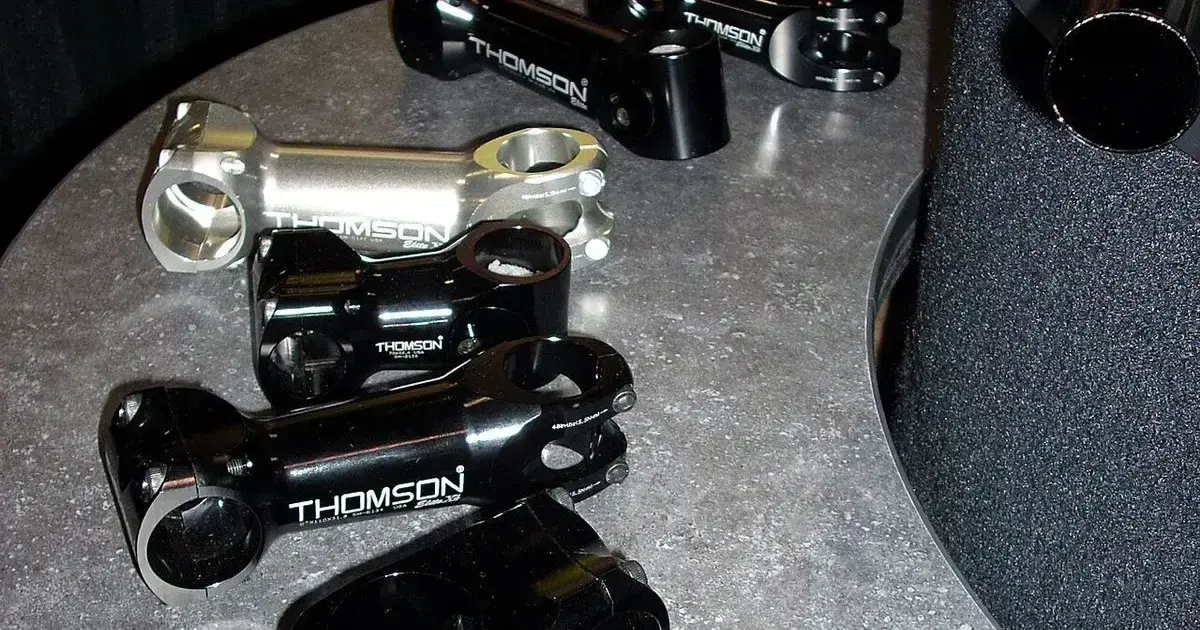
You can move a bike part to a new shop and keep the anodize color, but only if you treat color as a result to prove and not a setting to copy. Machining transfers well when the drawing is complete. Color does not, because it comes from the alloy, the oxide thickness, the dye and the seal, and a new anodizer changes the last three. This guide gives a five-step transfer, the records to hand over and a way to approve color that the old and new shops can both follow. It builds on our guide to why anodized parts do not match.
Why the color moves
Wikipedia describes dyed anodizing as a porous oxide layer that takes up dye and is then sealed so that the dye stays in. It says the colors produced tend to vary according to the base alloy, and that some colors, reds and blues in particular, are prone to fading. Each of those variables can differ at a new shop: its alloy source, its coating thickness, its dye and its seal. Even when the drawing says the same thing, the chain behind it is different.
That is why the same black can look different from two shops, and why red and blue show it first. Black hides more variation. If your range allows, a dark finish is the lowest-risk color to move.
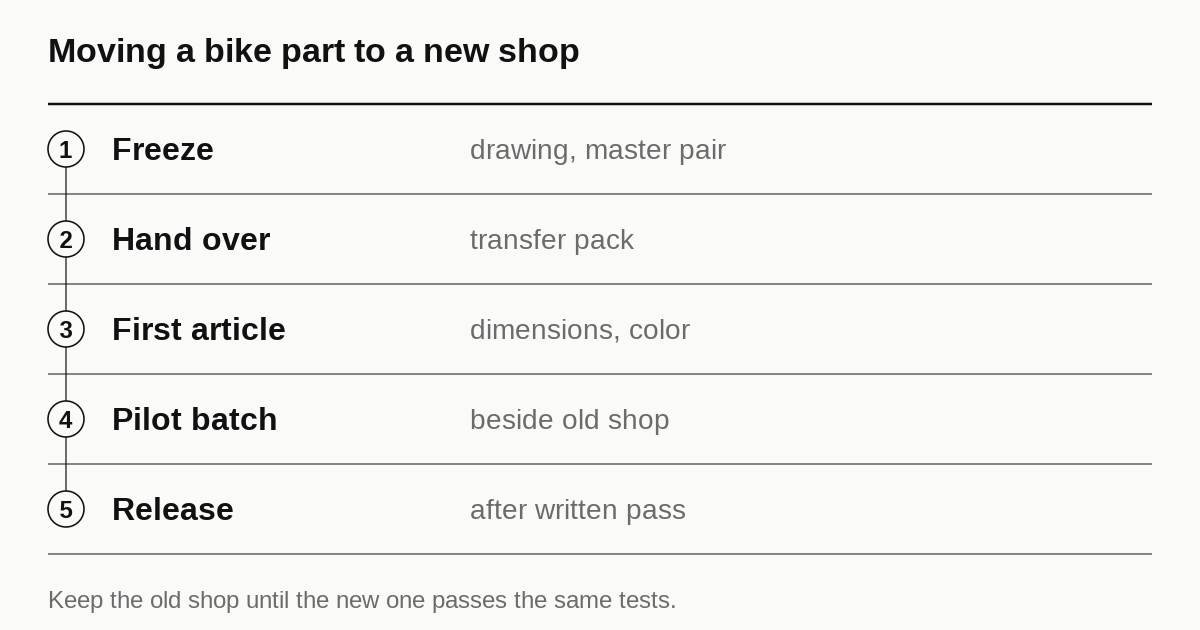
Step 1: Freeze the reference
Before you tell the new shop anything, lock what you are matching.
- The drawing revision, with the finish callout complete: alloy and temper, pre-treatment, finish type, thickness range, seal, color.
- A color master pair. One physical part, approved and kept by you, and a twin kept by the old shop. If you have only one, ask the old shop for a second from the same lot while you still can.
- The records of an approved lot: measured dimensions, anodize thickness, material certificate.
- Photos taken under one light as a record. They are a note, not a standard.
Step 2: Hand over a transfer pack
A new shop quotes from a drawing. It makes a matching part only if it also knows how the old parts were made.
| Item | Why the new shop needs it | Who holds it |
|---|---|---|
| Drawing revision and 3D model | The base for the program | You |
| Color master and retained twin | The target for color | You and the old shop |
| First article report of the approved lot | Shows the dimensions and gauges that passed | Old shop, then you |
| Anodize record: thickness, seal, dye, rack position | Shows what produced the approved color | Old shop’s finisher |
| Material certificate | Fixes alloy and temper | Old shop |
| Notes on fixtures, clamping and cosmetic faces | Cosmetic faces and rack marks decide acceptance | Old shop |
| Packing and labeling spec | Parts must arrive unmarked | You |
| Inspection plan and gauges | Same checks, same method | You |
Ask for these in the first request. Some records are the old shop’s property or belong to its finisher, so settle that before you tell it you are leaving. Our guide to working with bike startups covers who owns programs and fixtures, and the NDA step before files move. If you share a drawing, share only what the new shop needs to quote.
Step 3: First article at the new shop, with a color sample
A first article is a validation step. Wikipedia defines first article inspection as a production validation process that verifies a new or modified process produces conforming parts, normally done by the supplier and reviewed by the purchaser. A change of shop is a new process, so require one. Our first article inspection guide lists what the report should hold, including measured values and the anodize growth step.
Add the color. Ask the new shop to anodize two or three first pieces from the alloy lot you will use, send them with the first article report and compare them to your master.
How to judge color
| Method | What it shows | Weakness |
|---|---|---|
| Visual against the master, agreed lighting, parts held side by side | What a customer sees | Depends on the observer and the light |
| Handheld spectrophotometer, delta E against the master | A number you can record | Needs the formula, the illuminant and a limit agreed first |
| Both, with the master as the tie-breaker | A record plus a final eye check | Takes more steps |
On the numbers: Wikipedia says delta E is a distance between two colors in a device-independent color space, that a delta E of about 2.3 in the CIE76 formula corresponds to a just noticeable difference, and that the CIEDE2000 formula was published in 2001. It also says industries quote tolerances under stated illuminants, with automotive limits often very tight and printing typically looser. No standard hands a bike brand a limit. Choose the formula, the illuminant and the limit together with the shop, write them down and test them against two samples you already know look the same to you.
Need a quote for this part? Get a quote for your bike parts
Step 4: Run both shops in parallel
Do not move the whole order on a first article. Place a pilot batch with the new shop while the old shop keeps making your regular run. That gives you a comparison on real production parts and a safe supply while you decide.
- Use the same alloy source, the same finish callout and the same inspection plan.
- Judge both batches at the same time and place, under the same light.
- Compare dimensions, thickness records and color together. A part can pass on color and fail on a bore.
Our guide to a pilot batch before a bike part run lists what the batch should prove. If you want a formal gate, Wikipedia’s page on the production part approval process lists a master sample, an appearance approval report and initial process studies among the elements an automotive customer can ask for after a process change. Use them as a menu, not a template.
Step 5: Release volume in steps
Move the order only after a written pass, and move it in steps: a share of the next run first, then the rest. Keep the old shop’s program and its master for at least one full cycle after the switch, so that you can go back if the new chain drifts.
Move the machining first when color is the worry
You can split the move in two. Keep the old anodizer for the first run, with the new shop shipping machined parts to it. Color stays in the chain you have already approved, and you test the new shop’s machining on its own. It adds transport and a handoff, so plan for the time, as in our lead time guide. It also depends on the old anodizer agreeing to take parts from a new source. When the new shop has proven machining and you move finishing too, you need only prove color.
If the new batch is off
Do not tune it by eye. Check four things, in this order: the alloy and temper of the parts that went into the bath, the oxide thickness against the old records, the dye lot and bath age, and the seal. The crazing guide on anodize crazing lists causes that look like color problems but are coating faults. Ask the new anodizer to show its records for the lot and to make a second sample before you decide.
Send the drawing and the master requirement
Say on the RFQ that you are moving an existing part and that color must match a master. Send the drawing through the RFQ page, and we read it, quote the finished parts within 24 business hours and place the work with a partner shop that already machines and anodizes bike components. Our guide to choosing a CNC shop for bike parts lists what to check in the replies.
Sources
- Wikipedia, Anodizing
- Wikipedia, Color difference
- Wikipedia, First article inspection
- Wikipedia, Production part approval process
- Wikimedia Commons, Thomson stems

Frequently asked questions
How do I switch bike part suppliers without a color change?
Freeze a physical color master and the drawing revision, hand the new shop the records of the approved lots, and approve its first article against the master under agreed lighting. Run a pilot batch beside the old shop before you move volume. Keep the old shop until the new one passes in writing.
Why does the color change when I change anodizer?
Color depends on the alloy, the oxide thickness, the dye and the seal, and a new anodizer changes the dye, the bath and the process. Wikipedia notes that the colors produced tend to vary according to the base alloy. Matching is therefore a result you prove with samples, not a setting you copy.
Can I move the machining but keep the old anodizer?
Yes, and it separates two risks. The new shop ships machined parts to the old anodizer for the first run. Color then stays in the proven chain while you check dimensions. It adds transport and a handoff, so use it for the first run or two, not forever, unless the shop has no finishing of its own.
What delta E should I accept between two batches?
There is no bike-specific number. Wikipedia gives a delta E of about 2.3 as a just noticeable difference in one color space and says industries quote their own tolerances under stated illuminants. Agree a visual rule against the master and, if you measure, name the formula, the illuminant and the limit in writing.
Need a quote for this part?
Send the drawing. We quote the finished parts, place the work with a partner shop that machines bike parts and reply within 24 business hours.
Get a quote for your bike parts