Guides / Choosing a Shop
Three Quotes, One Drawing: Reading Bike Part Quotes Side by Side
November 19, 2026
Three shops quote the same stem drawing and the totals are far apart. Before you take the lowest, find out whether they quoted the same job. This post is part of our guide to custom bike parts manufacturing, and it gives you a line by line way to read quotes, with a checklist for each stage of the quoting process.
Why quotes for one drawing do not match
A quote is a set of assumptions with a price on the end. Two shops can read the same drawing and assume different things: how many setups it takes, whether the anodizing is in the price, whether a first article report with measured values is included, whether the parts are packed one by one. None of those assumptions is wrong. They are different jobs, and the totals reflect that.
The aim of a comparison is to turn the quotes back into one job. You do that by listing the lines a bike part quote should contain, then marking each quote against the list.
The comparison table
Use one column per quote and one row per line. The table below is the layout we suggest. The right-hand column says what a complete line looks like.
| Line | Ask | What good looks like |
|---|---|---|
| Material | Alloy, temper, form, certificate | Alloy and temper named; certificate stated as included or extra |
| Setup and programming | One-time or repeated, who keeps the fixture | A separate line, with the repeat price stated |
| Machining | Price at your quantity and the next break | Two quantity breaks, not one |
| Finish | Type, thickness, color, batch minimum, masking | Type and color named, batch rule written out |
| Inspection | First article, in-process checks, certificate of conformity | Measured values, frequency stated |
| Packing | How parts are protected and labeled | Sleeve or bag, dividers, label content named |
| Delivery term | Incoterm and place | A rule and a named place, such as EXW or DAP |
| Validity and lead time | Price validity, days from PO | A date, with finishing days counted |
Caption: author’s layout. Delivery terms follow Incoterms 2020, which the ICC describes as eleven rules. Incoterms allocate cost and risk of delivery and do not set the price. The allocation named in this post is directional, from Wikipedia: confirm it in the ICC rules text.
Four stages of a quote review
Stage 1: before you send the RFQ
Every item in this stage makes the later comparison possible.
- Send the same package to every shop. Why: different inputs produce different assumptions. Good: one STEP file, one PDF at a named revision, one quantity, one finish description.
- Name the stage of the order. Why: a fit sample and a pilot batch are different jobs. Good: “pilot batch, 50 pieces, repeats in spring”.
- Say the real quantity and the repeat volume. Why: a shop that knows more is coming treats the fixture as an investment. Good: both numbers on the RFQ.
- Ask for quantity breaks. Why: you see where the price drops. Good: the quantity you plan and the next break above it.
Stage 2: the RFQ itself
The site’s RFQ form asks for part type, a description of the part, material, quantity, the tightest tolerance, finish, needed-by date, preferred supplier region and the drawing file, with a checkbox if you need an NDA before the drawing is shared. Fill each field. Where the form leaves room, add the three lines most buyers forget: the delivery term you want priced, the inspection you expect and how you want parts packed.
Stage 3: reading the quotes
- Mark every row of the table for every quote. Why: a blank cell is a question, not a zero. Good: each blank gets a question to the shop.
- Check material and temper first. Why: an alloy swap changes machining time and finish response. Good: the quote names the alloy and temper from your drawing.
- Check the finish line next. Why: anodizing is charged by the batch, and shops assume different batch sizes. Good: type, thickness, color and the batch rule are written.
- Check what inspection includes. Why: a first article report with measured values is a stronger document than a pass sheet. Good: the quote says “measured values”.
- Check the delivery term. Why: EXW leaves export clearance, import clearance and freight with the buyer, while DDP gives all three to the seller. Good: the quote uses an Incoterms rule and a place.
- Check validity and lead time. Why: an undated price can be revised. Good: a validity date and a lead time that counts finishing.
Stage 4: before you release the order
- Confirm the drawing revision on the order. Why: the quote was for one revision and the order must match. Good: the revision letter is on the PO.
- Confirm the first article rule. Why: you approve the first piece before the batch runs. Good: written approval step, with the measured report. See first article inspection for bike parts.
- Confirm the repeat price. Why: it saves you a second setup charge later. Good: written, with conditions.
Need a quote for this part? Get a quote for your bike parts
A worked example
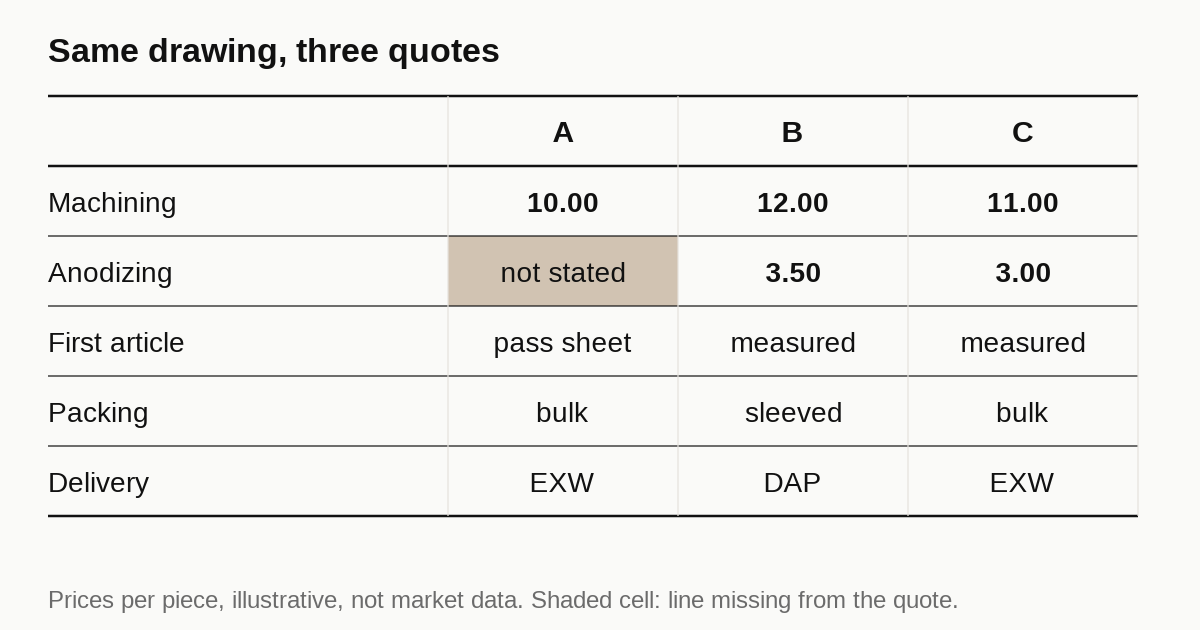
The numbers below are invented to show the arithmetic. They are not market prices and not a statement about any shop. Suppose three quotes for 100 aluminum stems, per piece:
| Quote A | Quote B | Quote C | |
|---|---|---|---|
| Machining | 10.00 | 12.00 | 11.00 |
| Anodizing | not stated | 3.50 | 3.00 |
| First article report | pass sheet | measured values | measured values |
| Packing | bulk | sleeve per part | bulk |
| Delivery term | EXW | DAP | EXW |
Quote A looks cheapest at 10.00, but anodizing is missing, inspection is the weaker kind and delivery leaves transport to you. If you add the anodizing from the other quotes, A becomes about 13.00 to 13.50 per piece with the weaker inspection. Quote B at 15.50 includes sleeves, measured inspection and delivery. Quote C at 14.00 matches B on finish and inspection, but with bulk packing and EXW. Neither C nor A can be compared with B until you add the packing and the delivery.
The point is the method. Add the missing lines to the quotes that left them out, or ask the shop to price them. Compare totals only then. To check the finish line, remember that anodizing grows a part outward: Wikipedia states that each surface gains half the oxide thickness, so a bore may need a machining allowance or a measurement after finish. Ask each shop how it handles that.
Red flags
- A quote far below the others, with no explanation of which line it left out.
- A quote that says “finishing available” without naming type, color or batch rule.
- No questions on a drawing with ambiguities.
- An inspection line that says “per standard practice”.
- A material line that says “aluminum” with no alloy and temper.
- Unwillingness to state a validity date.
- Reluctance to supply a material certificate. Wikipedia describes the EN 10204 type 3.1 certificate as one issued by the manufacturer, declaring that the products comply with the order and giving test results.
What to do with the table
Once the table is complete, rank quotes by total, then by risk. The cheapest complete quote is a fair starting point. Before you choose, ask the top two shops one question each about a line you could not confirm. Their answers, and how fast they arrive, tell you how the shop will behave when something goes wrong on the order. Our guide to cost drivers explains why the lines differ.
Send one RFQ and read the quotes
If comparing shops yourself is not how you want to spend the week, send the drawing once on the RFQ page. We read it, quote the finished parts within 24 business hours and place the work with a partner shop that already machines and anodizes bike components. Use the table above and the RFQ checklist to read what comes back, and see the full path in our guide to custom bike parts manufacturing.
Sources
- ICC, Incoterms 2020
- Wikipedia, Incoterms
- Wikipedia, Anodizing
- Wikipedia, Mill test report
- Wikipedia, First article inspection
Frequently asked questions
Why do CNC quotes for the same bike part differ so much?
They often price different jobs. One quote may assume more setups, leave anodizing or inspection out, include a larger minimum finish batch or use a different delivery term. Put every quote into one table with the same rows and the gap usually explains itself.
Should I always accept the lowest quote?
Only after the quotes cover the same material, finish, inspection and delivery term. A low total with finishing excluded is not a low quote. If one quote is far below the rest with no explanation, ask the shop which line it left out.
How long should a quote stay valid?
Long enough for you to approve a first article and release the order, so ask for a stated validity date in writing. Material prices and shop capacity move, and a quote with no date can be repriced when you place the order.
What is a repeat price and why ask for it?
It is the price of a second order of the same part. If the shop keeps the fixture and the program, the repeat should skip most of the setup cost. Ask for it at the first order and have it in writing, or you may pay setup again.
Need a quote for this part?
Send the drawing. We quote the finished parts, place the work with a partner shop that machines bike parts and reply within 24 business hours.
Get a quote for your bike parts