Guides / Choosing a Shop
Sourcing CNC Bike Parts: A Guide for Bike Brand Founders
November 21, 2026
A bike brand founder who sources CNC parts has eight jobs in a fixed order: choose the process and material, draw the part so a shop can quote it, budget the order, pick a shop, agree terms, prove the part, clear the legal duties and plan the launch. Each job has one decision and one proof to collect. This guide is the route table: for every stage it names the decision and points to the guide on this site that settles it, so you read what you need and skip what you do not. It repeats none of those guides.
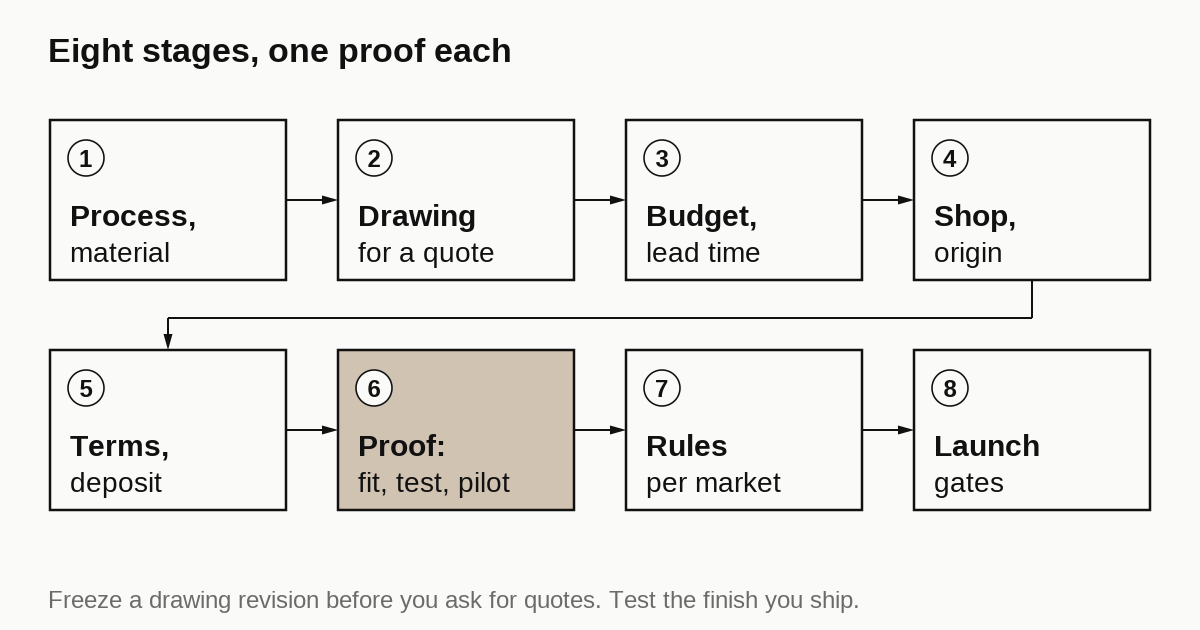
The route in one table
| Stage | Decision | Read | Proof to collect |
|---|---|---|---|
| 1 Process and material | Machine it, forge it or print it; which alloy | CNC or forging, CNC vs 3D printing, best material by part | A one-line reason for the process and the alloy with its temper |
| 2 Drawing | What the drawing must say for a shop to quote it | Design for machining, tolerances, material callout | A drawing with revision, material, finish and only the tolerances that matter |
| 3 Budget | What the first order costs and how long it takes | Cost drivers, low MOQ, lead time, 2026 tariffs | A landed cost per piece at three quantities |
| 4 Shop | Which shop and which country | Choose a shop, domestic or overseas, Taiwan, China or Europe, compare quotes | Three quotes on one drawing, compared line by line |
| 5 Terms | Deposit, prototype fee, who owns fixtures and files | A shop’s view of a startup order, quality agreement clauses | A written agreement before material is bought |
| 6 Proof | Fit, function, fatigue and repeatability | Prototype to production, first article, pilot batch, test labs, fatigue reports | Measured first article, lab report on the shipping finish, pilot lot result |
| 7 Rules | Which standards and laws apply where you sell | ISO 4210 and EN 15194, EU GPSR, CPSC 1512, 2027 calendar | A list of rules per market, checked by an adviser |
| 8 Launch | Gates, color, packing, traceability | Five gate reviews, color matching, lot marking, packaging and kitting | A milestone sheet with dates the shop has accepted |
The sections below add what the guides do not say: the order that works, where founders lose time and one legal fact that changes how you hold records.
Do the stages in this order
Stages 1 to 3 cost nothing but time and decide what you ask for. A founder who skips the drawing stage gets quotes that do not compare, which is the problem the quote comparison guide describes. Stage 4 comes before terms because the shop’s answers on finish, inspection and communication tell you whether you want to sign anything. Stage 5 comes before the first paid prototype, since the deposit and file terms apply to it.
Proof comes in layers, and the order matters. The first article report shows that the part meets the drawing. A lab report shows that the design survives the test, but only on the finish that was tested. A pilot lot shows that the shop can repeat the part. The launch milestone guide places color approval after the test for the same reason: color depends on alloy, coating thickness and dye bath, so it is judged on the finish the test used. Do not release a production order on one layer alone.
Where founders lose time
- A moving drawing. Every revision changes the quote and sometimes the finish. Freeze a revision before you request quotes, and put the revision on every document.
- Quotes that cannot be compared. One shop includes anodizing and inspection, another does not. Ask each to quote the same finished part.
- Landed cost. An overseas price is not a delivered price. Add freight, duty and brokerage, and recheck duty on the day you place the order.
- A test on the wrong finish. Our test lab guide explains that the finish can invalidate a test, so a result on raw parts does not cover anodized parts. Test the finish you will ship.
- Starting the paperwork last. In our view the technical file and the markings need time, and a retailer or distributor may ask for them before the first order.
Need a quote for this part? Get a quote for your bike parts
One legal fact: your name on the part makes you the manufacturer
Under the EU General Product Safety Regulation, 2023/988, a manufacturer is any person who manufactures a product or has a product designed or manufactured and markets it under that person’s name or trademark. A brand that has a shop machine a stem and sells it under its own name is the manufacturer in the Regulation’s sense, not the shop. Article 9 then puts several duties on the brand: an internal risk analysis and technical documentation kept for 10 years, a type, batch or serial number on the product, the brand’s name and postal and electronic address, and instructions in a language consumers understand. Article 16 says a product shall not be placed on the market unless an economic operator established in the Union is responsible for the tasks it sets out, which matters if you sell into the EU from elsewhere.
This is why the proof stage and the records matter beyond quality. The first article report, the material certificate and the lot code are the documents that fill the technical file. We are not a notified body and this is not legal advice, so have an adviser confirm what applies to your part and market, as of October 2026.
A first pass through the route
Most founders do not need every guide on the first day. A workable first pass is to take one part, usually the simplest one in the range, through stages 1 to 4 before you touch the rest.
- Write the part’s job in one line: what load it carries, what it fits and what finish it wears. The weight and strength guide helps with the trade between the two.
- Draw it to the level a shop can quote, and have someone who has not seen it read the drawing cold. If they ask three questions, the drawing is not finished.
- Price it at three quantities, for example one inside each band in the low MOQ guide, so you see where the unit price stops falling.
- Request three quotes and read them with the 20-point visit checklist beside you, even if you will never visit. It lists what a well-run shop looks like.
Only then open stages 5 to 8 for that part. The rest of the range reuses what you learned, and the second part moves faster because the drawing format, the finish call-out and the proof pack already exist.
Questions for the first call with a shop
- Which drawing revision are you quoting, and what is excluded from the price?
- Who anodizes the part, and can you see a finished sample from the same alloy?
- What do you measure on a first article, and do you measure after anodizing?
- What does a pilot lot look like in your shop, and what happens when it fails?
- How do you want to handle the deposit, the prototype fee and the files?
The answers matter more than the price. How to choose a CNC machine shop explains why each question is on the list and lists the red flags.
What a shop will ask of you
Shops treat startups as a different kind of customer, and it helps to know why. The design may change monthly, money may arrive after the parts and the second order depends on how the first one sells. The shop-side guide on startup orders says shops tend to ask for deposits, price prototypes separately and write down who owns fixtures. Treat those as normal and settle them at stage 5, in writing. A founder who comes with a frozen drawing, a target quantity and a delivery term gets a faster and better quote.
Send the first drawing
Send the drawing at the revision you froze, the finish, the quantities you want priced and the market you sell in through the RFQ page. We quote the finished parts within 24 business hours and place the work with a partner shop. Compare the quote with the table above, line by line.
Sources
The route table links to guides on this site. Each of them carries its own sources.
Frequently asked questions
How many CNC bike parts should a new brand order first?
Order in steps. Our prototype guide uses bands of 1 to 3 pieces for a fit sample, 5 to 20 for a function sample and 25 to 100 for a pilot batch before a production run. The low MOQ guide says 50 to 100 is where most shops are comfortable for a small brand. Ask for the 20 piece price anyway.
Is a bike brand the manufacturer in law if a shop machines the part?
Under the EU General Product Safety Regulation, a manufacturer is anyone who has a product designed or manufactured and markets it under its own name or trademark. The brand then carries the technical file, identification marks and the contact details on the product. Confirm what applies to your product with a compliance adviser.
Should a founder pay a deposit to a machine shop?
Expect to be asked. Shops tend to ask for a deposit before buying material or building a fixture, and they price prototypes as a separate paid service. We found no public benchmark percentage, so agree the amount, whether it is refundable and the milestones in writing before the shop starts.
What proof should a founder collect before releasing a production order?
A first article report with measured values on the finished part, a lab report on the same finish and drawing revision, and a pilot lot that the shop repeated without surprises. Each is covered by one of the guides in the route table, and none replaces the others.
Need a quote for this part?
Send the drawing. We quote the finished parts, place the work with a partner shop that machines bike parts and reply within 24 business hours.
Get a quote for your bike parts