Guides / Choosing a Shop
How Custom Bike Parts Get Made: A Buyer Guide From Drawing to Delivery
November 20, 2026
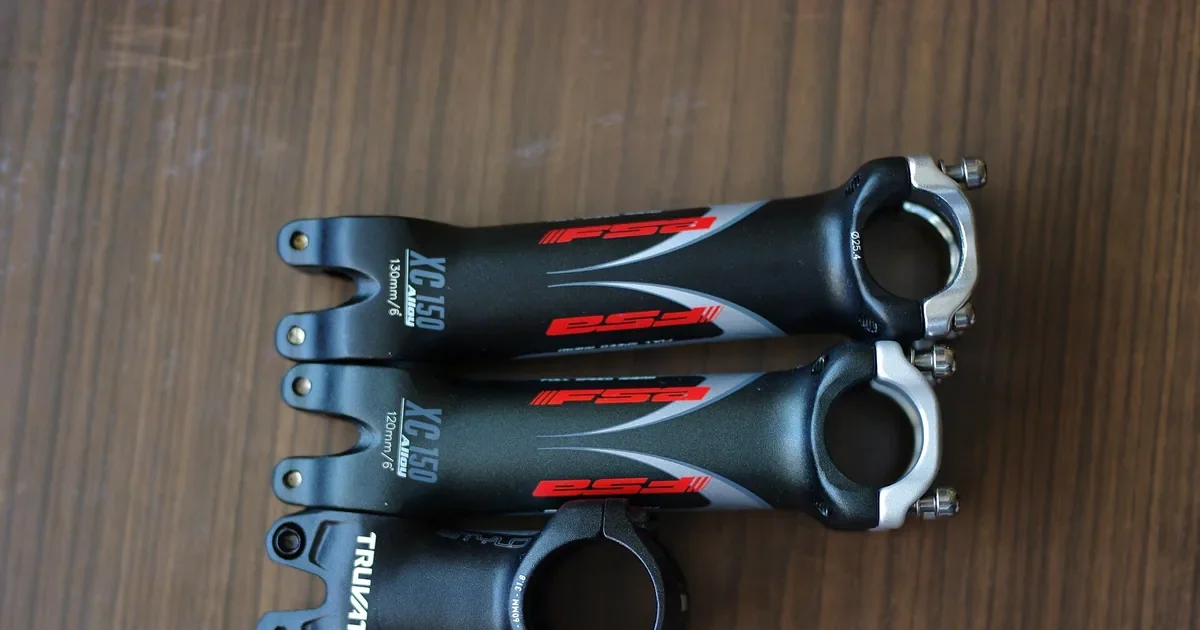
A custom bike part reaches your door through a chain of decisions: which process makes it, which machine setup, which shop, which quote, what you approve before the run, how long the parts take and how they are packed. Each link has a cost you can see in advance. This guide is for a bike brand or a founder with a design that needs a machined part made, and it leads to one decision: whether your drawing is ready to send for quotes.
We make no claim about any shop’s certificates. You send one drawing, we quote the finished parts and place the work with a partner shop that already machines and anodizes bike components.
Last reviewed: October 2026. Figures carry the date they were checked; confirm duties and customs rules with your broker before you rely on them.
- The path from drawing to delivered order
- Machining, forging or printing
- 3-axis, 4th axis or 5-axis
- Design choices that lower the quote
- What sets the price and the minimum order
- Choose the shop
- Domestic or overseas
- Compare quotes line by line
- Four stages from fit sample to production
- First article and quality documents
- Lead time from PO to shipment
- Packing and kitting before the first run
- Checklist before you send the RFQ
- Send the drawing
The path from drawing to delivered order
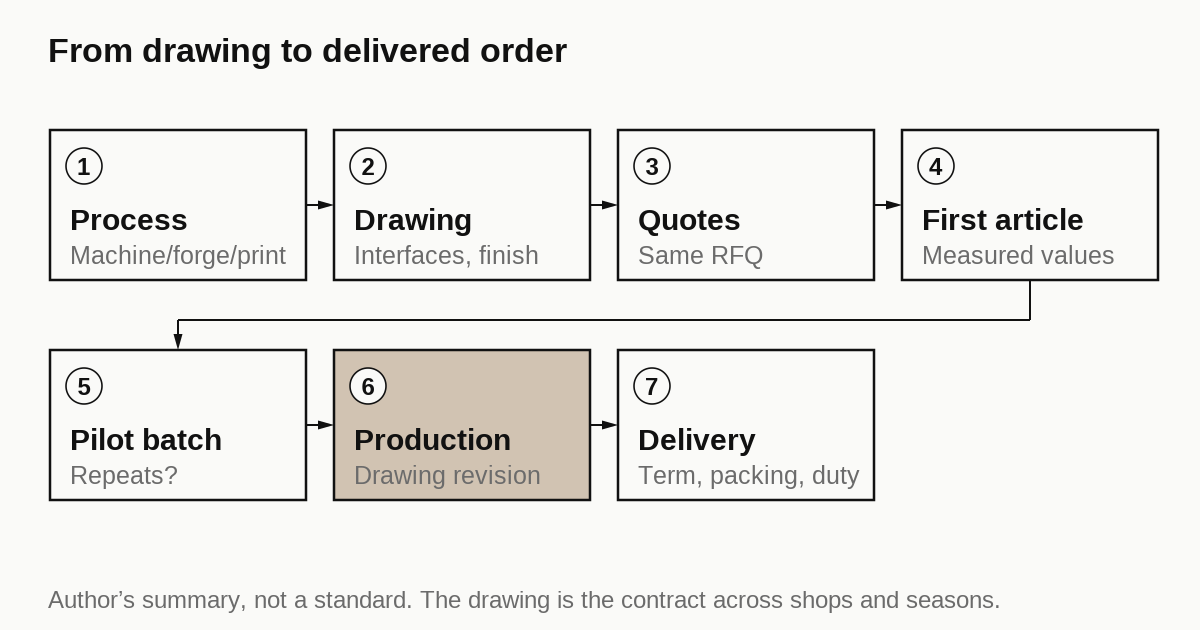
Most machined bike parts follow the same seven steps. What changes from brand to brand is who owns each step and how early the owner thinks about it. The table below is the whole path in one view: what you decide, what you hand over and what you get back.
| Step | You decide | You hand over | You get back |
|---|---|---|---|
| 1. Process | Machined, forged blank, printed prototype | Geometry, expected volume | A short list of processes |
| 2. Drawing | Which interfaces carry tolerances, material, finish | STEP file and PDF drawing | A drawing a second shop could also quote |
| 3. Quotes | Which shops, which quantity break | RFQ with the real quantity | Quotes on the same basis |
| 4. First article | What you measure and approve | Approval rules, gauges | A measured report |
| 5. Pilot batch | Whether the process repeats | Pack and label rules | A batch and a real lead time |
| 6. Production | Release date, repeat terms | PO with drawing revision | Parts with a certificate of conformity |
| 7. Delivery | Delivery term, packing, documents | Ship-to, duty responsibility | Parts at your door |
Caption: author’s summary of the order path, not a standard. Each step is covered in the sections below.
Two ideas run through everything that follows. First, the drawing is the contract: when the shop, the operator or the season changes, only the drawing survives. Second, the cheapest moment to fix a problem is the moment before the order. A wrong bore costs one part at first article and a whole batch after release.
Read more: Machined bike parts by part type
Machining, forging or printing
Any machined bike part could in principle be forged, cast or printed instead. The useful question is which process is cheaper at the volume you will really order, and how sure you are about that volume.
| CNC machining | Forged blank, then machined | Metal 3D printing | |
|---|---|---|---|
| Tooling | None | A die, often owned by the supplier | None |
| Cost trend with volume | High start, falls with quantity | High step, then low per part | Close to flat per part |
| Revising the design | Days, a new program | Weeks, a new or modified die | Days, a new build file |
| Interfaces (bores, threads, clamp faces) | Cut directly | Still machined after forging | Still machined after printing |
| Best fit | Prototypes, small runs, parts in revision | Settled structural parts at volume | One-offs and shapes a mill cannot reach |
Caption: qualitative summary. Forging statements follow Wikipedia’s Forging article (high die cost, low recurring cost, further machining usually needed). Printing statements follow Wikipedia’s Selective laser melting article (porosity affects fatigue, post-processing and machining needed). We found no public break-even quantity for bike parts, so ask each supplier for a break-even in writing.
Wikipedia’s Forging article says forgings generally have about a 20 percent higher strength-to-weight ratio than cast or machined parts of the same material. Treat that as a general statement about the process, not a number for your crank: the geometry, the alloy and the test result decide. For structural parts such as cranks and pedal bodies, the fatigue result on your own sample matters more than the process label.
Printed metal gets its own caution. Porosity and surface roughness are known issues of laser powder bed fusion, and the same source says unintended porosity can reduce strength and fatigue life. If a printed part carries a rider, ask for fatigue data on that exact build, not a tensile number.
The version most brands settle on is simple: print or machine the prototype, freeze the design after testing, then machine the production part. Move to a forged blank only when the volume is high, the design is settled and one die serves every size you sell.
Read more: CNC or forging for bike parts.
Read more: CNC machining vs. metal 3D printing for bike parts
3-axis, 4th axis or 5-axis
An axis is a direction the cutter or the part can move. A 3-axis mill moves the tool along three straight lines. A 4th axis adds a rotary table that spins the part, and a 5-axis machine adds a second rotation so the tool reaches most faces without unclamping. For a bike part the useful question is how many times a person has to take the part out of the vise and put it back.
Every re-clamp has three costs: a fixture and a program, a small loss of position between the features cut before and after and handling marks on faces that were already finished. A stem body with features on several faces and two cross bores is the usual example. On a plain 3-axis mill it takes more setups than on a machine with a 4th or 5th axis.
That does not make 5-axis the default. A flat chainring or a spacer with features on one side gains nothing from it, and the higher machine rate shows up in the quote with nothing to offset it. Describe the part, the quantity and the faces that must look good, and let each shop say how it would run the job. Then compare the number of setups each shop plans, not only the price.
Read more: 5-axis vs 3-axis machining for bicycle components
Design choices that lower the quote
Two engineers can draw the same stem and receive quotes that differ widely. The difference is rarely the shape. It is how many setups the part needs, how deep and narrow the pockets are, how small the inside corners are and how many dimensions carry a tight tolerance.
Four changes cost nothing visually and change the machining time:
- Open the inside corners. A vertical inside corner has the radius of the cutter that cut it. A bigger radius lets a bigger, stiffer cutter do the work.
- Keep pockets shallow compared with their width. A deep, narrow slot needs a long thin tool that must run slowly.
- Put features on fewer faces. Moving a boss from a side face to the top face can remove a setup.
- Tolerance only what has to fit. Steerer bores, bearing seats, clamp faces and thread positions are real. The outside of a stem body is not.
The last item matters most on the quote. A drawing that carries one tight default tolerance on every dimension gets priced as if every dimension matters. Mark the three to six interfaces that matter and leave the rest at a general tolerance. A shop that sees a clear drawing quotes faster and with less padding.
Also send a STEP file and a PDF together. The STEP carries the geometry. The PDF carries the intent: which surfaces are cosmetic, where the part may be clamped and what the finish is.
Read more: Design for machining bike parts
What sets the price and the minimum order
A machined part price has five blocks: setup and programming, material, machine time (which tolerance and design drive), finish and quantity. Setup and programming are paid once per order, so they dominate a prototype quote and almost vanish on a large run. Material is paid on the billet you buy, not the part you receive. Finish is usually charged by the batch, which is why a small run can pay a lot per part for anodizing.
That batch effect creates the practical minimum order. No shop is unable to make 25 pieces. A minimum is a price statement: below it the fixed costs are spread over too few parts. Three habits keep a small run affordable:
- Group several parts into one anodize batch and one color.
- Accept a stock color rather than a custom match.
- Agree in writing that the shop keeps the fixture and program and quotes the repeat order without setup.
| Cost block | Paid | What you control |
|---|---|---|
| Setup and programming | Once per order | Quantity, drawing clarity, repeat terms |
| Material | Per part | Stock size of the envelope |
| Machine time | Per part | Setups, corner radii, tolerances |
| Finish | Per batch | Batch grouping, color, Type II or III |
| Inspection and packing | Per order and per part | What you ask for on the RFQ |
Caption: author’s summary. We found no public price survey for machined bike parts, so this guide gives no price. Ask for quotes on your own drawing.
Say the true quantity on the RFQ, and say whether it repeats. A shop that knows 250 pieces follow a 25 piece order treats the first order as an investment. A shop that sees only 25 treats it as a one-off.
Read more: CNC bike parts cost.
Read more: Low MOQ CNC bike parts
Choose the shop
Every shop with a mill can machine a bike part. Fewer can deliver an inspected, color-matched batch on the promised date. The questions that separate them are about finishing, inspection and who keeps the fixture, more than about machines.
Ask precisely:
- Machines: the axis count, the work envelope, whether turning with driven tools is available for round parts such as hub shells.
- Finishing: whether anodizing is in house or through a partner, who the partner is and the turnaround including finishing.
- Inspection: what the first article report looks like, whether measuring is done in house and whether material certificates and lot traceability are kept.
- Repeats: who owns the fixture and the program, and what the repeat price assumes.
One test costs nothing. Send a deliberately incomplete RFQ to the shops you are comparing, with the finish or one important tolerance left out. A shop that quotes fast and cheap without a question is guessing. A shop that returns two specific questions has read the drawing.
Also ask for the documents in writing before you pick one. Wikipedia notes that purchasers often make a first article report a purchase order requirement, and that a manufacturer-issued EN 10204 3.1 certificate declares the material complies with the order and supplies test results. A shop that supplies both routinely has a process. A shop that treats them as unusual requests has not done this kind of work before. Put the requirement on the RFQ, not in a later email, so every shop prices the same job.
Read more: How to choose a CNC machine shop for your bike parts
Domestic or overseas
Where the shop is changes five things: lead time, how easily you talk to the shop, access to finishing, how you protect the design and what you pay in duty and freight. It does not change the drawing or the inspection requirements, which stay yours.
The delivery term in the quote decides who handles transport and customs. Incoterms are the standard set of terms for this. The table shows how four of the eleven rules split the work.
| Rule | Export clearance | Import clearance | Main freight |
|---|---|---|---|
| EXW (Ex Works) | Buyer | Buyer | Buyer |
| FOB (Free on Board) | Seller | Buyer | Buyer |
| DAP (Delivered At Place) | Seller | Buyer | Seller |
| DDP (Delivered Duty Paid) | Seller | Seller | Seller |
Caption: directional allocation per Wikipedia’s Incoterms article, checked October 2026; confirm the exact allocation in the ICC rules text before you rely on it. The ICC describes Incoterms 2020 as eleven rules, and trade.gov says they do not list the contract price or decide when title passes.
In the United States, the importer of record files the entry, and CBP’s guide says imported goods are not legally entered until they have arrived, CBP has authorized delivery and estimated duties have been paid. The guide is an older edition, so confirm current practice with your broker. CBP also requires foreign-origin articles to carry a country-of-origin mark unless an exception applies. The duty itself depends on the classification and origin of the goods, so ask a broker for the rate that applies to your part before you compare landed prices. Our bicycle parts tariffs guide holds the dated US figures.
For design protection, put a non-disclosure agreement in place before you send the drawing. The UK Intellectual Property Office describes an NDA as a way to keep an invention secret while you discuss it with others. An NDA is a start, not a guarantee, so ask a lawyer about the rest.
Read more: Domestic or overseas CNC bike parts: cost, lead time, risk
Need a quote for this part? Get a quote for your bike parts
Compare quotes line by line
Two totals are not comparable until you know what each one includes. The fastest way to make them comparable is a table with one column per quote and one row per line. The quote template below lists the rows that most often differ.
| Line | What to confirm | What good looks like |
|---|---|---|
| Material | Alloy, temper, bar or plate, certificate | Named on the quote, not “aluminum” |
| Setups and programming | Included or separate, one-time or per repeat | Separate line, repeat price stated |
| Machining | Quantity breaks | Prices at your quantity and the next break |
| Finish | Type, color, batch minimum, masking | Type and thickness named, batch rule stated |
| Inspection | First article, in-process checks, certificate | Measured values, stated frequency |
| Packing | Sleeve, divider, carton, labels | Specified, not “standard packing” |
| Delivery term | Incoterm and named place | Written as a rule and a place |
| Validity and lead time | How long the price holds, days from PO | Dates, with finishing counted |
Caption: author’s checklist. Terms in the delivery row follow Incoterms 2020.
Do not compare the cheapest total. Compare the lowest total among quotes that include the same finish, the same inspection and the same delivery term. When one quote leaves a line out, ask the shop to price it, or add the missing line to the others.
Read more: How to compare CNC quotes for bike parts line by line
Four stages from fit sample to production
The brands that get through development quickly are not the ones with the most polished CAD. They know what each stage is for.
- Fit sample, a few pieces. Machined with no finish. It answers one question: does it fit and assemble? Lock the geometry and every interface dimension afterward.
- Function sample, enough to ride and to break. Machined in the production material and finish. Testing an unanodized part tells you about a part you will never sell. Lock material, temper, finish and the design itself, as a dated revision.
- Pilot batch. This proves the process rather than the part: whether the shop repeats, whether the anodizer holds color, whether inspection catches problems. Lock the inspection plan, the color master, the packaging and the real lead time.
- Production. Nothing new should happen. Failures here are changes someone thought were minor: a different billet source, a different anodizer, a small design tweak or a new operator with an incomplete drawing.
Two mistakes cost a season. One is skipping the pilot batch and meeting volume for the first time on the real order. The other is changing the design after testing, which leaves the part untested.
Read more: From prototype to production for machined bike parts
First article and quality documents
A first article inspection is a measured report on the first piece from a production setup. Wikipedia describes it as a production validation process for verifying that a new or modified process produces conforming parts, usually by fully inspecting the first part or a sample from the first batch. The supplier performs it and the purchaser reviews the report, and buyers often make it a purchase order requirement. AS9102 is the aerospace standard for these reports and defines the report forms. We did not read it, so read the standard before you cite it. Bike parts do not require AS9102, but a report that identifies the part, records materials and processes and lists each characteristic with its measured result is a useful model for what to ask.
Four documents carry most of the weight:
- First article report with measured values. A sheet of ticks is a promise, not a report.
- Material certificate. A mill document stating alloy, lot and test results. Wikipedia’s mill test report article describes the EN 10204 type 3.1 certificate as one issued by the manufacturer that declares the products comply with the order and supplies test results. Ask for it on the RFQ, because it cannot be added afterward.
- In-process inspection record. The critical dimensions, how often they are checked and with what.
- Certificate of conformity. It pins the batch to a drawing revision.
One interface needs special care. Anodizing builds outward as well as inward: Wikipedia says each surface grows by half the oxide thickness, so a 2 micrometer coating adds 1 micrometer per surface. Bores and threads therefore need either a machining allowance or a measurement after finish. Say which on the drawing.
Read more: First article inspection for bike parts.
Read more: Quality control for machined bike parts
Lead time from PO to shipment
Lead time is a sum of stages, not one number: material, programming and fixturing, machining, deburring, finishing, inspection, packing and transport. Finishing is the stage that surprises buyers most, because anodizing is a batch process and the parts wait for a load. Add transport last, and add it again if parts cross a border.
We found no public lead time figure for machined bike parts, so this guide does not quote one. Build your own from the stages. Ask each shop for days per stage, count finishing and transport and plan backward from the date the parts must be in your warehouse.
A worked example, with assumed durations only. Suppose a shop quotes 4 working days for material and programming, 6 for machining and deburring, 5 for anodizing including waiting for a batch, 2 for inspection and packing and 5 for transport. The total is 22 working days, more than four calendar weeks. If a season launch is fixed, subtract 22 working days and add a buffer for a failed first article. These numbers are for the arithmetic, not a forecast.
What you control: how early you freeze the drawing, how fast you approve the first article, whether you accept a stock color and whether several parts share an anodize batch. What you do not: the shop’s queue and the anodizer’s schedule, so ask where your order sits.
Read more: CNC bike parts lead time
Packing and kitting before the first run
A machined bike part is not retail-ready when it leaves the anodizer. Decide early who packs: the shop and its finisher, or your own warehouse after bulk shipment. A quote that assumes bulk packing does not include retail packing labor and materials, so settle it before the PO.
Protect the finish with one part per sleeve or bag for any cosmetic face, dividers between layers and labels on the pack, not on the part. State the pack in one sentence a packer cannot misread, for example: one part per anti-scratch sleeve, divider between layers, lot code on the sleeve label. Add the barcode, the part number and revision, the lot code and the origin mark your market requires. CBP’s marking guide says a mark should sit where it can be seen with casual handling and it discourages labels because they can come loose, so check the rule for your sales channel with a broker.
CBP’s marking guide lists an exception for goods whose marked container reaches the ultimate purchaser unopened and shows the origin, so whether the mark must be on the part or only on the pack depends on how the part is sold. That is another reason to settle the pack early: the pack design and the origin mark are one decision. Do not discover retail packing after the shop has quoted the machined part. Put it on the RFQ.
Read more: Retail packaging and kitting for bike parts
Checklist before you send the RFQ
Copy this list into your RFQ. A drawing that answers all of it gets narrower quotes and fewer questions.
- STEP file and PDF drawing at a named revision.
- Alloy, temper and form (bar, plate, forging blank) and whether a material certificate is required.
- The three to six interfaces that carry tolerances; all other dimensions at a stated general tolerance.
- Finish type, thickness, color, masked surfaces and a physical color master if color matters.
- Quantity for this order and the realistic repeat volume.
- Stage of the order: fit sample, function sample, pilot batch or production.
- Inspection: first article with measured values, in-process frequency, certificate of conformity.
- Packing: pack type, labels, barcodes, quantity per carton.
- Delivery term as an Incoterms rule and a named place, and who handles duty.
- Required delivery date, and whether a late first article moves it.
- Confidentiality: NDA in place before the drawing is shared.
- Who owns the fixture and program, and the repeat terms.
The site’s RFQ checklist covers the machined-part lines in more depth.
Send the drawing
Send the drawing and the honest quantity through the RFQ page. We read it, quote the finished parts within 24 business hours and place the work with a partner shop that already machines and anodizes bike components. The quote is itemised and has no separate service fee.
Sources
- Wikipedia, Forging
- Wikipedia, Selective laser melting
- Wikipedia, Anodizing
- Wikipedia, First article inspection
- Wikipedia, Mill test report
- Wikipedia, Incoterms
- ICC, Incoterms 2020
- trade.gov, Know your Incoterms
- CBP, Importing into the United States: A Guide for Commercial Importers
- CBP, Marking of Country of Origin on U.S. Imports
- UK Intellectual Property Office, Non-disclosure agreements
Frequently asked questions
What do I need before I ask a shop to make a custom bike part?
A STEP file, a PDF drawing that marks the few dimensions that must fit, the alloy and temper, the finish and color, the quantity for this run and the likely repeat volume. With those six items a shop can quote in a day or two. Without them it guesses, and the guess carries padding.
How many pieces should my first order be?
Order by stage, not by price. A fit sample is a few pieces, a function sample is enough to ride and to break in testing and a pilot batch proves the process. Each stage answers a different question, and skipping the pilot batch is the most common way brands lose a season.
Is CNC machining or forging better for a custom bike part?
Neither is better in general. Machining has no tooling bill and takes design changes in days, so it suits prototypes, small runs and parts still being revised. Forging needs a die, which only pays back at volume on a settled design. Many brands forge a blank and machine the interfaces.
Why do two quotes for the same drawing differ so much?
Usually because they price different jobs. One may assume more setups, leave finishing or inspection out, quote a larger minimum anodize batch or price a different delivery term. Put the quotes in a table line by line before you compare totals.
Should I choose a domestic or an overseas shop?
It depends on lead time, how much communication the part needs, access to finishing, how you protect the design and what you will pay in duty and freight. Prototypes and small runs often favor a nearby shop. Settled production parts can justify the longer chain.
Who checks that the parts match my drawing?
You decide that before the run. Ask for a first article report with measured values, a material certificate and a certificate of conformity naming the drawing revision. The shop measures and reports, and you approve the first article before the batch ships.
Need a quote for this part?
Send the drawing. We quote the finished parts, place the work with a partner shop that machines bike parts and reply within 24 business hours.
Get a quote for your bike parts