Guides / Standards
EU Forced Labour Regulation and Bicycle Components: What Brands Must Document
November 21, 2026
The EU Forced Labour Regulation, Regulation (EU) 2024/3015, applies from 14 December 2027. It bans placing on the EU market, or exporting, any product made with forced labour, and it does so whatever share of the product is affected. It does not tell a bike brand to run audits. It asks for a result, so a brand needs records that let it answer an authority’s request about a part within 30 working days. This guide sets out what the text and the Commission’s June 2026 guidelines say and lists the records to keep for each machined component. It is not legal advice, and facts are as of 25 October 2026.
What the Regulation bans, and what it does not require
Article 3 is one sentence: economic operators shall not place or make available on the Union market products that are made with forced labour, nor export them. Article 2 takes the definition of forced labour from ILO Convention No 29, including forced child labour. Article 1(3) states that the Regulation creates no additional due diligence obligations other than those already in Union or national law.
The Commission’s guidelines, adopted on 26 June 2026 as Commission Notice C(2026) 4386, add four points a bike brand should read:
- The result is the obligation. The Regulation imposes an obligation of result and recognizes due diligence as a useful tool, not a legal duty of its own.
- Any share counts. Products are in scope “in whole or in part”, so a component made with forced labour puts the product in scope whatever its share.
- Old stock counts. The Regulation applies to all products made available on the market from 14 December 2027, even if the products or their components were produced or imported earlier. Items already sold to end users are outside it.
- Services are not covered. Transport, warehousing and logistics services are outside the scope, but the product that moves is not.
A brand that sells to EU consumers online is covered too when its offer is targeted at EU end users, and the same applies to a brand outside the EU.
How a case reaches a brand
Authorities follow a risk-based approach under Article 14. They weigh the scale and severity of the suspected forced labour, the volume of products on the EU market and the share of the part suspected of being made with forced labour in the final product. The Commission leads when the suspected forced labour is outside the EU, and Member State authorities lead when it is on their territory. The lead authority is told to focus on the operators closest to where the forced labour is likely to occur and to take account of SMEs.
| Stage | What happens | Time limit in the text |
|---|---|---|
| Preliminary phase (Art. 17) | The authority asks the operator, and where relevant other suppliers, what it did to identify, prevent and end forced labour risk for the product | 30 working days to answer |
| Investigation opens (Art. 18) | The operator is told of the product, the reasons and its right to submit information | Within 3 working days of the decision |
| Decision (Art. 20) | The authority endeavors to decide or close the case | 9 months from the opening |
| Non-cooperation (Art. 20(2)) | A refusal, late answer or misleading answer allows a finding on the facts available | None |
| Review (Art. 21) | An operator may ask for a review with new substantial information | 30 working days to decide |
| Disposal (Arts. 24, 25) | Withdrawal and disposal by recycling or rendering the product inoperable | Set in the decision |
At the border, customs authorities check products under Article 26. Article 27 lets the Commission adopt delegated acts that name products for which importers must give customs information on the product, the manufacturer and the suppliers. The Regulation itself names no products, so check whether an act has been adopted for yours. Penalties under Article 37 apply to non-compliance with a decision, not to the first request.
The Commission’s database of forced labour risk areas and products was due by 14 June 2026 under Article 8(3). The guidelines still describe it in the future tense (“will indicate risks relating to products and geographical areas”), and a law firm note of 9 July 2026 reports it as under development. We did not find a published database.
What to keep on file for each part number
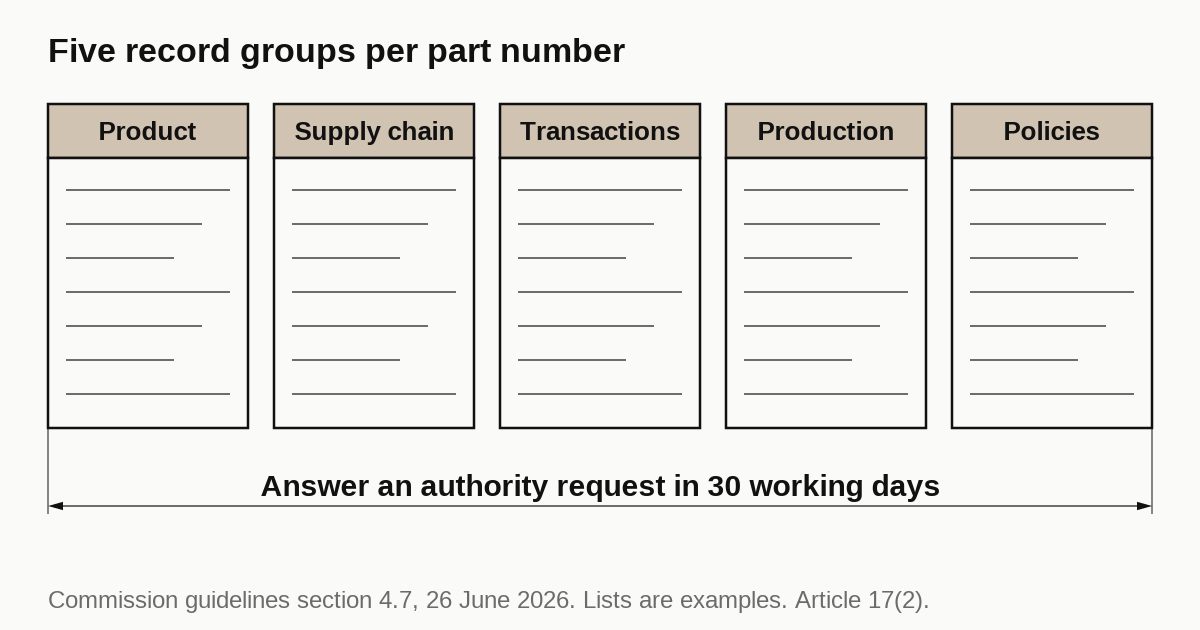
Section 4.7 of the guidelines gives illustrative, non-exhaustive lists of what an authority may ask for, and says that supplying them does not guarantee a favorable decision. Mapped to a machined bike component, they become five record groups.
| Record group | Examples from the guidelines | What it looks like for a stem or a crank |
|---|---|---|
| Product identity | HS code, type, model, batch or serial number, bills of materials, certificates of origin | Part number and drawing revision, lot code, HS 8714 line, material and lot of billet |
| Supply chain map | List of manufacturers and suppliers per key step, with names, addresses, EORI where available; maps with tiers and sub-tiers | Billet supplier, machine shop, anodizer, heat treater, fastener and bearing supplier |
| Transaction records | Purchase orders, invoices, packing lists, payment records, bills of lading, import records | One order file per lot, linked to the lot code |
| Production evidence | Production orders, factory capacity reports, input against output volumes | Shop’s route card, material received against parts shipped |
| Policies and actions | Supplier code of conduct, contract clauses, onboarding and monitoring, grievance mechanism, third-party audit reports | Signed supplier code, the clause in the purchase terms, audit reports a shop already holds |
Lot marking makes the first row workable. Lot marking for warranty tracing shows how a code links a part to its records, and clause 4 and clause 8 of the quality agreement guide cover record retention and access to sub-suppliers.
Need a quote for this part? Get a quote for your bike parts
Due diligence the guidelines suggest
Section 6 of the guidelines follows the OECD six-step framework: embed policies, identify and assess risk, prevent and mitigate, monitor, communicate and remediate. It says the steps are not a tick-box list and that companies choose measures to fit their size. For a small brand the first practical step is the scoping exercise in section 6.4.2.1: look at where sourcing sits by geography, sector and product, using the information reasonably available, and review it when sourcing changes. The guidelines tell SMEs and other companies with limited resources to use the Commission’s risk database for that exercise once it exists, and to draw on industry associations and other outside support. For SMEs under assessment, Article 17(2) lets the operator ask a national contact point how to engage with the authority.
What the guidelines do not do is name bicycle parts as a high-risk product. Do not assume a risk or a safe harbor for any country or material from this page.
Sample steps before December 2027
- List the part numbers you sell and, for each, the shop, anodizer and billet source.
- Ask each supplier for the records in the table above and note what is missing.
- Put a forced labour clause and a sub-supplier disclosure clause in the purchase terms.
- Check stock: parts already in your warehouse in December 2027 are covered.
- Name one person who receives an authority’s request and keeps the 30 working day clock.
We place the work with a partner shop. We do not audit the shops and make no claim about any shop’s labor practices, so ask each one for the records above. The supplier codes of conduct page explains the audits brands accept.
The US side in one paragraph
US Customs and Border Protection applies a rebuttable presumption under the Uyghur Forced Labor Prevention Act, effective June 21, 2022, that goods made wholly or partly in Xinjiang or by listed entities are barred from entry. An importer must show by clear and convincing evidence that the goods were not made with forced labor and answer CBP’s information requests fully. CBP points importers to supply chain tracing. The same records answer both regimes.
Send drawings, the target market and your supplier requirements through the RFQ page. The shops reply within 24 business hours. For the other rules dated 2027, see the bike component compliance calendar.
Sources
- Regulation (EU) 2024/3015 on prohibiting products made with forced labour, Articles 1 to 3, 8, 11, 14, 17, 18, 20 to 27, 37 and 39 (Publications Office)
- European Commission, Guidelines on the application of Regulation (EU) 2024/3015, Commission Notice C(2026) 4386 final, 26 June 2026
- European Commission, Forced Labour Regulation page
- U.S. Customs and Border Protection, Uyghur Forced Labor Prevention Act
- Covington, key takeaways from the Commission’s guidelines, 9 July 2026 (database status, secondary)
- Latham and Watkins, Commission publishes guidelines on the EU Forced Labour Regulation, 2 July 2026 (secondary)
Frequently asked questions
When does the EU Forced Labour Regulation apply to bicycle parts?
From 14 December 2027. The Regulation applies to products made available on the EU market from that date, even if the products or their components were made or imported earlier. Stock on the shelf or in a warehouse is covered. Products that have already reached end users are not.
Does the Regulation require a bike brand to run supplier audits?
No. Article 1(3) says it creates no due diligence obligations beyond those in other Union or national law. It imposes an obligation of result: the product must not be made with forced labour. The Commission's guidelines present due diligence as a useful tool for meeting that result.
How long does a brand have to answer an authority's request?
In the preliminary phase, Article 17(2) gives economic operators 30 working days from receipt of the request. If an investigation opens, the authority informs the operator within 3 working days and sets its own deadline for information. Failing to answer can lead to a finding on the facts available.
Does one component made with forced labour affect the whole bicycle?
The guidelines say a product falls within the scope whatever the share of the product made with forced labour. The authority may limit an investigation to the part concerned, and it weighs the share of that part in the final product as one criterion when it prioritizes cases.
Need a quote for this part?
Send the drawing. We quote the finished parts, place the work with a partner shop that machines bike parts and reply within 24 business hours.
Get a quote for your bike parts