Guides / For Shops
How to Price a Bike Part Production Run of 200 to 2,000 Pieces
November 17, 2026
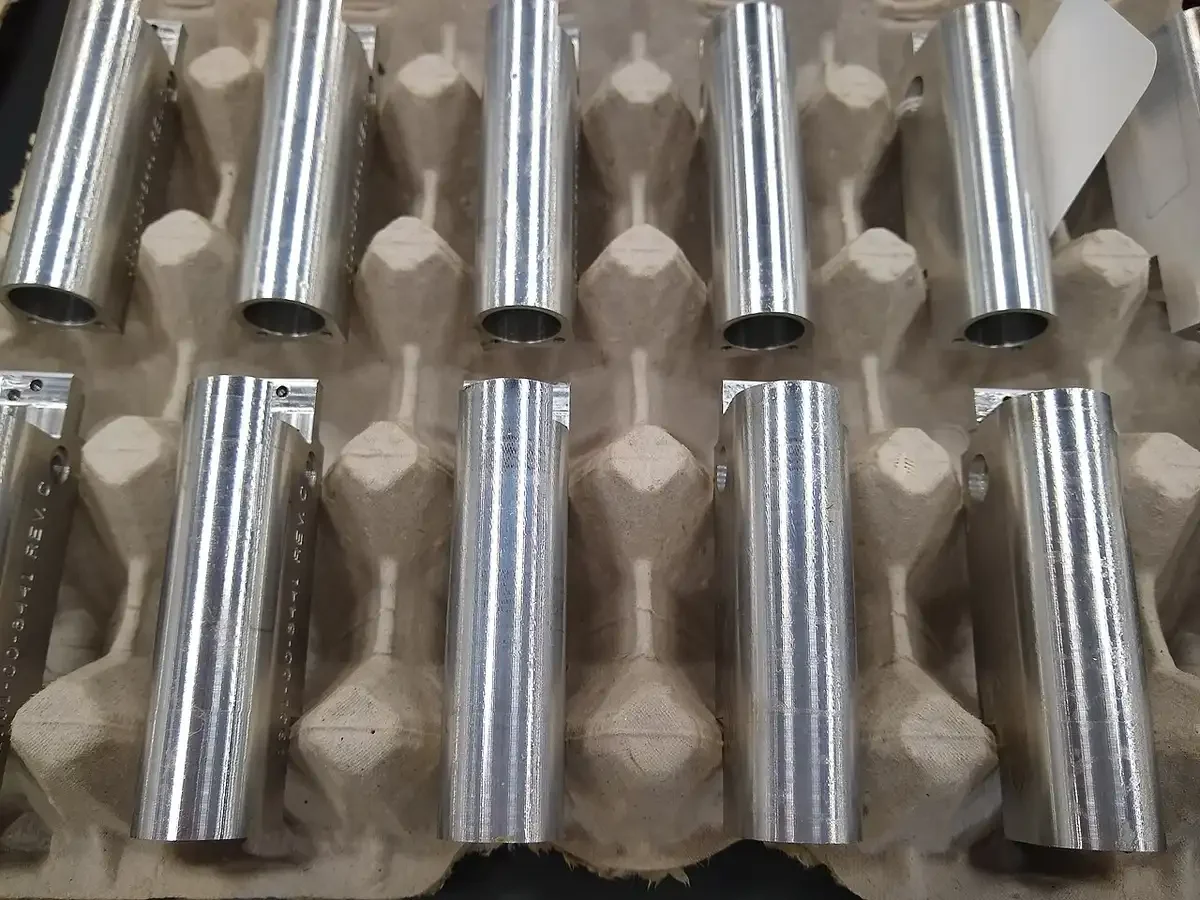
A bike brand that asks for 500 stems is buying a different thing from a brand that asks for five. The five-piece quote is mostly setup and attention. The 500-piece quote is mostly cycle time, material, finishing and the cost of things going wrong. If you carry the prototype price into production, you lose the order. If you carry a quantity discount you cannot support, you win it and lose money. This article shows how a shop can build a price for runs of roughly 200 to 2,000 pieces from blocks you can check, and how to present it so the brand can compare it with other quotes.
The numbers below are illustrative, not market data. No public survey of shop rates for bike parts exists that we could find, so the method is the useful part. Replace every input with your own.
Build the price from blocks, not from the last quote
A price copied from the last similar job carries that job’s mistakes. Build it from six blocks and write each one down.
| Block | What goes in it | Scales with quantity? |
|---|---|---|
| Material | Bar or billet per part including sawing, kerf, the drop at the end of the bar and the scrap allowance | Per part |
| Machine time | Cycle time times your machine rate, plus load and unload time | Per part |
| Setup and one-time work | Programming, first article, workholding, fixture, tool prep | Once per run (or once ever) |
| Finishing | Deburr and tumble in house, anodize or plating passed through from your vendor | Per part, with a vendor minimum |
| Inspection and packing | Gauging per the plan, record keeping, packaging | Per part, with a first article block |
| Margin and risk | Overhead, profit, scrap beyond the allowance, payment terms, price validity | Percentage |
Wikipedia describes overhead as costs “incurred for output generally and not for particular work order”. That is the reason to load a machine rate rather than a flat percentage: a rate that already includes the building, the machine, the tooling and the supervision tells you what an hour of spindle time must earn. It does not tell you the price. The same article notes that overheads are calculated mainly to estimate what a business must charge to make a profit.
Material
Standard bar sizes avoid waste and delay. Wikipedia’s bar stock entry says suppliers keep standard sizes and that a nonstandard size needs a special mill run, which costs more and takes longer. Pick the nearest standard diameter or section and price the extra stock you remove. For a short part, count the drop: the remnant too short to use at the end of each bar. If your supplier of 6061 or 7075 bar sells on lot-traceable certificates, say so in the quote, because the brand’s test samples need the same material. The billet supplier guide explains what these customers want from the metal.
Machine time
Material removal rate is the volume of workpiece removed per unit time, and it follows from cutting speed, feed rate and depth of cut. A milling feed rate comes from spindle speed times number of teeth times chip load. The point for pricing is that the cycle time in the quote must come from a proven program, not a guess. A prototype program that has never run 200 parts hides tool-life surprises. Wikipedia’s speeds and feeds article gives the Taylor tool life relation between cutting speed and life, which is the reason a faster cycle can cost you more in tooling than it saves in time.
Setup: spread it, but show it
Setup includes the program, the first article, workholding and any fixture. For a repeat part it is mostly done once. Spread it over the run and the number looks small at 2,000 pieces and large at 200. That is correct and the brand should see why.
Economic order quantity theory formalizes the same trade: ordering or setup cost per run falls as the quantity grows while holding cost rises. The classic formula is Q = the square root of (2 x annual demand x setup cost / annual holding cost per unit). For a bike brand this suggests that a bigger batch is not always cheaper for the brand, because it must carry the stock, but it does explain why a shop pushes for rounder, larger orders. Show the setup line separately on the quote and the brand can decide for itself.
Fixtures are the one-time block that causes the most disputes. Decide before quoting whether the fixture is billed, spread over the first runs or included, and who owns it. The fixturing guide covers soft jaws, plates and zero-point systems and how to document the setup so the second order starts faster.
Worked example (illustrative)
Assume a machined aluminum bike part with these inputs. They are placeholders, not benchmarks.
- Material: 1.80 per part including sawing
- Machine rate: 55 per hour, cycle time 6.0 minutes at 200 pieces improving to 5.3 minutes at 2,000 as the program is tuned
- Per run setup: 3 hours (program proving, first article, workholding) at 55, so 165 per run
- Fixture: 600, one time, charged on the first run
- Deburr and tumble 0.40, outsourced anodize 0.90, inspection 0.35, packing 0.15 per part
- Scrap allowance: 3 percent on per-part cost
- Margin: 25 percent of the price
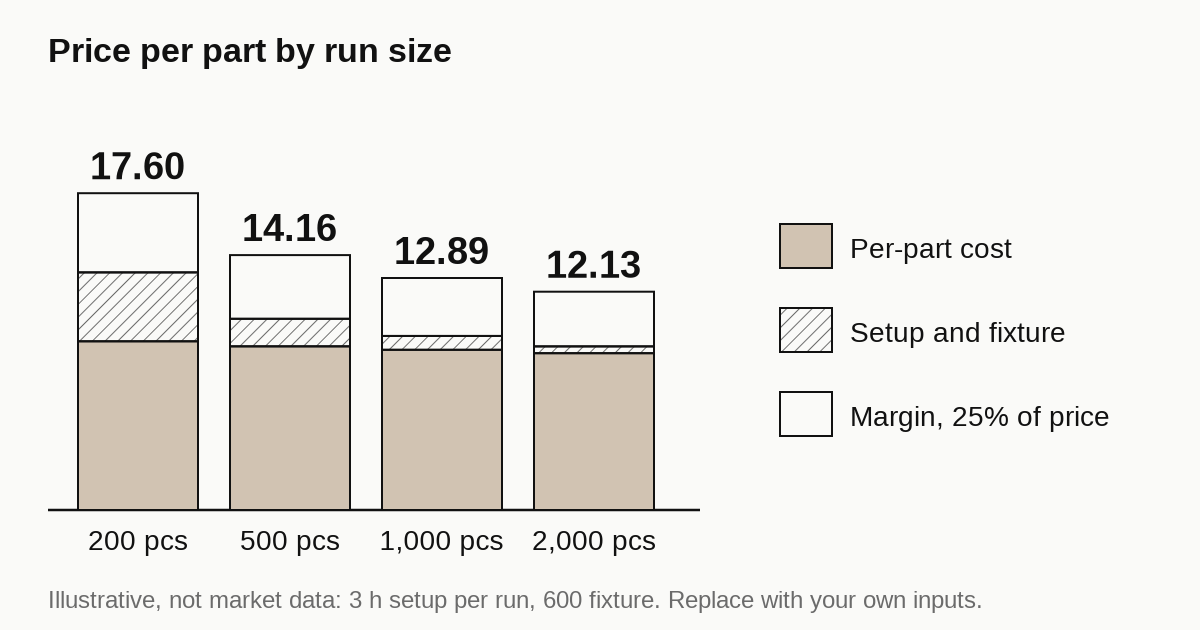
| Quantity | Cycle (min) | Per-part cost | Setup and fixture per part | Total cost per part | Price per part |
|---|---|---|---|---|---|
| 200 | 6.0 | 9.37 | 3.83 | 13.20 | 17.60 |
| 500 | 5.7 | 9.09 | 1.53 | 10.62 | 14.16 |
| 1,000 | 5.5 | 8.90 | 0.77 | 9.67 | 12.89 |
| 2,000 | 5.3 | 8.71 | 0.38 | 9.09 | 12.13 |
The price falls 31 percent from 200 to 2,000 pieces. About 85 percent of that drop comes from the setup and fixture block shrinking, and the rest from the cycle time you tuned. Price is cost divided by 0.75, so a 25 percent margin on price.
The repeat price
When the same part returns and the fixture and program are on the shelf, the setup drops. At 500 pieces with 1.5 hours of setup and no fixture charge, the same inputs give a cost of 9.25 and a price of 12.34, against 14.16 on the first run. Telling the brand this at the start is a selling point. The quoting guide lists the quote mistakes that lose bike work, and a missing repeat price is one of the cheapest to fix.
Need a quote for this part? Get a quote for your bike parts
Price breaks
A quantity discount is a price reduction for bulk purchasing. Wikipedia lists the usual reasons: sellers gain economies of scale and share some or all of the saving with the buyer, and larger orders cost less to bill, fill and ship. It also distinguishes a non-cumulative discount, based on one order, from a cumulative one, based on total purchases over a period.
Practical rules for the shop:
- Make each break from your own numbers, as in the table. Do not invent a round percentage.
- Quote three or four quantities that match how brands buy: a first batch, a typical order, and a stretch order.
- Say what happens between breaks: usually the price of the lower break holds.
- If you offer a cumulative scheme, such as a blanket order with call-offs, state the period and what happens to unused quantity. The low MOQ guide shows the other end of the range.
Learning curve: use it with care
Wright’s law says unit cost falls by a fixed percentage each time cumulative output doubles. Wright found about 80 percent in aircraft manufacturing, which is a 20 percent drop per doubling. Boston Consulting Group later observed experience-curve effects of 10 to 25 percent across various industries, according to the same article.
From 200 to 2,000 pieces is 3.3 doublings. An 80 percent curve applied to that range would predict unit cost falling to about 48 percent of the starting figure, which no machine shop would price and no brand should expect on a single part. In the example above, cycle time falls only 12 percent over the range because the program was tuned, and the rest of the price drop is setup. Use the effect only where you have measured it: cycle time after proving out, scrap rate after the first lots, and the time the operator takes to load. Keep the remainder as margin for risk.
Finishing and outside processes
Anodizing, plating and heat treatment usually come from a vendor with its own minimum charge. Three habits protect you:
- Get the finisher’s price for the actual quantity, not a per-piece list price. A minimum lot charge can double the per-part cost on a small run.
- Include rejects. If your anodizer’s color rejects are 5 percent, that is your cost unless the contract says otherwise.
- Quote the finish thickness range you will hold. The Type II versus Type III guide explains why it matters for fits.
Add handling and freight to the vendor’s price. A pass-through at cost with no handling means you are carrying the risk for free.
Cost-plus is a start, not a strategy
Cost-plus pricing sets a price by adding a fixed percentage markup to unit cost. The formula is simple and it is the method in the example. Wikipedia lists its drawbacks: it can weaken the incentive to control costs, it ignores consumer demand and competitors’ prices, and it cannot show in advance whether customers will buy at the calculated price.
So use it as a floor. Then check it against what you know of the market: your capacity, how much the job helps fill the machine, how much you want the brand’s repeat work, and what the buyer cost guide says drives the price of a machined bike part from the other side. If the cost-plus number is above what the brand will pay, the answer is usually to change the design with the brand or the process, not to shave margin to zero.
What to put on the quote
- Drawing number and revision, material, finish and tolerance class assumed
- Price per part at three or four quantities
- One-time charges listed separately: setup, fixture, first article report
- The repeat price, with the condition that the fixture and program are kept
- Lead time from approved first article and from material receipt
- Price validity in days, and what triggers a re-quote
- Payment terms, and the Incoterm for the shipment
- Scrap and overrun policy, for example a plus 3 percent quantity tolerance
If you want work requests for bike brands, register your shop through the supplier page. Work requests carry the part, material, quantity, tolerance, finish and deadline. You quote us and, if price and lead time work, we place the purchase order with you. Nothing here promises orders.
Sources
- Wikipedia, Learning curve
- Wikipedia, Economic order quantity
- Wikipedia, Quantity discount
- Wikipedia, Cost-plus pricing
- Wikipedia, Overhead (business)
- Wikipedia, Bar stock
- Wikipedia, Speeds and feeds
- Wikimedia Commons, Lampin Machined Components

Frequently asked questions
How do I price a 500-piece run differently from a 5-piece prototype?
Split the price into per-part cost and one-time cost. At 500 pieces the setup, programming and fixture are spread over the run, so they shrink to a small share of each part, and the cycle time can be tuned. Quote the prototype as a service with its own price, then quote production as a price per part at stated quantities.
How many price breaks should a quote show?
Three or four is enough, for example 200, 500, 1,000 and 2,000 pieces. A quantity discount works because the seller shares part of the savings from scale with the buyer. Each break should be calculated from your own setup and cycle time, not copied from a rule of thumb.
Should I build a learning curve into the price?
Only the part you have measured. Wright's law came from aircraft work, where unit cost fell about 20 percent per doubling of output. A machine shop running one part on one setup will not see that. Use the cycle time you actually reach after proving out the program, and keep the margin for the risk.
What should a quote say about price validity?
State how many days the price holds, which material and finish it assumes, and the drawing revision it is based on. Add that a new revision, a different alloy or an anodize spec change needs a re-quote. Brands then see that a changed drawing is a changed price, not a dispute.
Need a quote for this part?
Send the drawing. We quote the finished parts, place the work with a partner shop that machines bike parts and reply within 24 business hours.
Get a quote for your bike parts