Guides / For Shops
Fixturing for Repeat Bike Part Runs: Pallets, Soft Jaws and Vises
November 12, 2026
Bike brands tend to buy the same part more than once. A stem, a crank spider or a thru-axle is ordered for a model year, then ordered again when the stock runs low, and the brand expects the second batch to look and measure like the first. If your second setup is a fresh start every time, you pay for the learning twice and you risk the second batch drifting. This guide covers how to choose workholding for runs of roughly 200 to 2,000 pieces, which options keep a setup repeatable, and what to document so the next order starts from the same place.
What a fixture has to do
Wikipedia defines a fixture as a work-holding or support device that securely locates and supports a workpiece so that every part made with it stays consistent and interchangeable. It cuts setup time, reduces the skill needed to mount parts and improves accuracy. Two design points from the same article apply directly to bike parts:
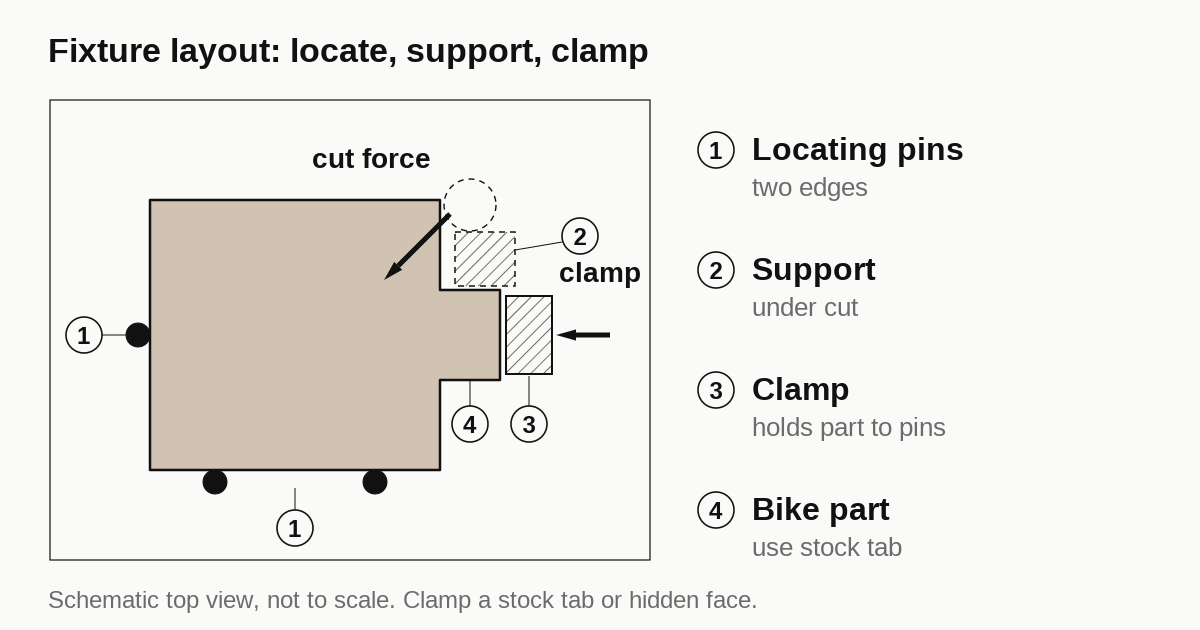
- Locating and support are separate jobs. Locating components fix position and orientation. Support components resist the cutting forces. Keep them apart so the clamp is not the thing that carries the load.
- Machining force should press toward the solid component, not toward the clamps. Orient the part so the cut pushes into a fixed jaw or a hard stop.
A fixture is worth building only if its savings outweigh its cost. A modest saving on a job you run constantly is generally worth more than a large saving on a job you rarely run. For a bike part, “constantly” means the same part number returning a few times a year, plus other part numbers that can share the same base.
The options at a glance
| Option | Good for | Repeat-job storage | Weak point |
|---|---|---|---|
| Soft jaws in a machine vise | One or two operations, prismatic parts, round stock in a chuck | A labeled set of jaws on a shelf | Jaw position and clamp force drift if the vise is moved or re-indicated |
| Fixture plate or subplate with vises and stops | Several parts per setup, multiple operations on one plate | The plate with its stops, kept assembled | Higher first cost, takes bench space |
| Zero-point pallet system | Many different parts through the same machines, short changeovers | Pallets or plates with the part-specific fixture on top | System cost, and chips on the locating faces |
| Dedicated machined fixture | A high-volume part with an awkward shape | One fixture per part, with a drawing | Cost is carried by one part number |
| Collet, mandrel or expanding arbor (turned parts) | Small turned parts and hubs | The collet or arbor tagged to the part | Wear and runout when the pad is worn |
Soft jaws
Soft jaws are made of soft material, typically an aluminum alloy for machine chucks, and are machined to conform to a particular workpiece. Wikipedia’s vise article shows an aluminum soft jaw holding five parts at once in a CNC milling machine. For bike parts they work well on:
- stem bodies and bar clamps that need one face and one bore machined,
- brake mount adapters and caliper brackets in a milled pocket,
- turned parts in a chuck, where the jaw bores to the outside diameter.
Practical rules for a repeat job, in our view:
- Machine the jaws on the machine they will run on, at the clamp pressure or torque you will use in production, so the jaw springs back the same way it did when it was cut.
- Mark the jaw set with part number, drawing revision, vise and position, and note it in the job record.
- Keep dowel pins in the jaws or use a hard stop, so the jaws seat the same way after removal.
- Do not re-cut a pocket for a new revision without a record. If the drawing revision changes, write the new revision on a new set of jaws, or machine the old set and mark it as rev B.
- Design clamps for thin walls. A stem faceplate or a thin clamp ear distorts under heavy force. Rough the part, release, then re-clamp lightly for the finish pass.
Fixture plates and pallets
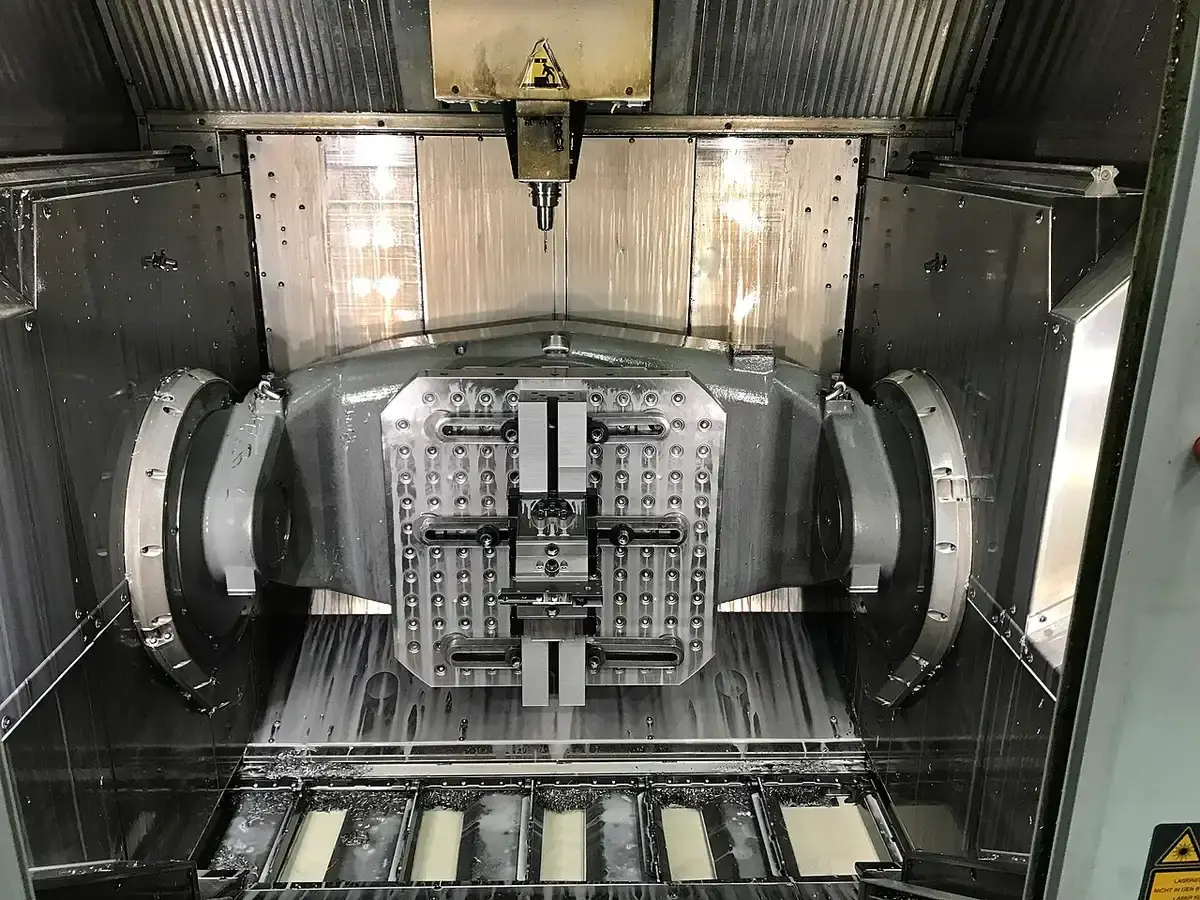
When one part needs several operations, a plate with vises and stops allows two or more parts per setup. The photo above shows a grid plate with two vises in a five-axis machine. A plate is also the natural base for a family of bike parts that share a clamp pattern, because the vises and stops can be set once and reused.
Add these to a plate for repeat jobs:
- Hard stops for each part number, with a record of their positions in the machine coordinates.
- A probing cycle that checks the setup before the first cut. The offsets live with the program, as the next section describes.
- A scribed or stamped part number on the plate, so nobody has to ask which job it is.
- A rule for chips and coolant: blow off the seats and stops before every mount.
Zero-point systems
A zero-point system gives a pallet or fixture a known position in the machine every time it is clamped. Most of what is public comes from vendors, so treat the numbers as vendor figures.
- A buyer’s guide from a vendor says 0.005 mm is the common repeatability standard, and that premium modules repeat within 0.0025 mm.
- The same guide says a single chip on a locating taper erases the repeatability, and recommends sealed seats and air-blast cleaning.
- It gives typical pull-in force as 4 to 25 kN, and says release needs compressed air at roughly 5 to 6 bar.
- It recommends a layout where one pin fixes the zero point in X and Y, a second controls rotation and the remaining pins clamp only, so the setup is not over-constrained.
- It says to verify the figure with a repeated-mount study on your own machine and recheck it periodically.
The last point is the one that matters to a shop selling to bike brands. If you claim repeatability, you can show the data from your own machine, which the brand can see in your first article report.
Need a quote for this part? Get a quote for your bike parts
Bike part specifics
- Cosmetic faces. A clamp mark on a visible face shows after anodizing. Put the clamping on a stock tab, a non-cosmetic face or a face that will be removed in a later operation. The deburring guide covers what happens to edges before the finish.
- Anodize growth. If a second operation locates on a bore that will be anodized, set it before the finish or mask the bore. Wikipedia says anodizing increases dimensions on each surface by half the oxide thickness, so a 2 micron coating adds about 1 micron per surface. The growth calculator gives the numbers.
- Fewer setups. A five-axis machine can reduce the number of fixtures needed because the part is machined on more faces in one setup. The 5-axis versus 3-axis guide covers when it pays.
- Thin walls and long parts. A seatpost head or a crank arm bends under clamp force. Use more supports and lower force, and allow time for stress relief between roughing and finishing if the part moves.
Is the fixture worth building?
Take the cost of the fixture and divide it by the saving per run.
Illustrative numbers, not market data: a plate and stops cost the shop 900 in parts and machining time. The new setup saves 45 minutes per run against re-indicating soft jaws. At a shop rate of 70 per hour, that is 52.50 saved per run, so the fixture needs about 17 runs to pay for itself on that saving alone. If the part returns twice a year, that is a long wait. The plate earns its place when it also cuts cycle time through two parts per setup, when the stops serve several part numbers or when it reduces scrap, and with a zero-point base, the same base serves every job.
Replace those numbers with your own shop rate, your own setup minutes and your own reorder history. The quoting guide also advises giving the brand a repeat price. A fixture you keep is how you can do that honestly.
Document the setup so the second order starts fast
For each repeat job, keep a packet with:
- Part number, drawing revision and program revision.
- Fixture ID, jaw ID, vise and position.
- Clamp torque or pressure, and the order in which clamps are tightened.
- Work offsets and the probing cycle used to check them.
- Tool list and tool-life limits for the finishing tools.
- The first article record and the in-process check plan. The inspection plan guide shows how to write that.
- Photos of the setup from the operator’s position.
Agree who owns the tooling
State the fixture cost treatment on the quote: billed once, spread over the first runs or included in the piece price. State who owns it and what happens if the brand moves the work. The prototype to production guide describes the stages where fixture investment usually changes.
If you are a machine shop that wants to make bike parts for brands, register your shop through the supplier page. Work requests carry the part, material, quantity, tolerance, finish and deadline. You quote us and, if price and lead time work, we place the purchase order with you. Nothing here promises orders.
Sources
- Wikipedia, Fixture (tool)
- Wikipedia, Chuck (engineering)
- Wikipedia, Vise
- Wikipedia, Anodizing
- Fabrico, Zero point clamping systems (vendor buyer’s guide, directional)
- Wikimedia Commons, Mechanische Fertigung

Frequently asked questions
Are soft jaws or a fixture plate better for a 200-piece bike part run?
It depends on how often the part returns and how many faces need machining. Soft jaws in a vise are cheap and quick for one or two operations. A fixture plate or zero-point pallet pays back when a part comes back several times a year or needs several setups. Compare the cost with the setup minutes you save per run.
How accurate is zero-point clamping?
Vendors commonly quote 0.005 mm repeatability, with some premium modules at 0.0025 mm. Those are vendor figures. The buyer's guide we read says to verify them with a repeated-mount study on your own machine, since one chip on a locating taper can erase the repeatability.
How should a shop store soft jaws between runs?
Label each set with the part number, drawing revision, vise and position, and keep the dowel pins and orientation marks intact. Store the jaws with the program and the first article record, so the second order starts from the same setup and the same offsets as the first.
Who owns a fixture a shop builds for a bike brand?
It depends on the purchase order. Agree in writing whether the fixture cost is billed, amortized over the first runs or absorbed, who owns it, and what happens to it if the brand moves the work. A silent PO leads to a dispute at the worst time, which is when the brand wants to move production.
Need a quote for this part?
Send the drawing. We quote the finished parts, place the work with a partner shop that machines bike parts and reply within 24 business hours.
Get a quote for your bike parts