Guides / For Shops
Writing an Aluminum Price Clause for a Repeat Bike Part Contract
November 21, 2026
A bike brand that signs a repeat contract wants a price it can plan a season on. The shop that signs it carries the aluminum market for the whole term, and the metal can move far more than a shop’s margin does. The fix is a price clause: a base month, a published index, a threshold, a check interval and one formula that moves only the material part of the price. This guide shows how a shop writes that clause for a machined bike part, what to name as the index and where such clauses go wrong. For the quoting side of the same problem, read the quoting mistakes that lose orders.
Why a year-long price needs a metal clause
Aluminum is a traded commodity. The U.S. Geological Survey, using S&P Global Platts Metals Week data, gives the average U.S. spot ingot price as 138.5, 152.6, 125.9, 129.5 and an estimated 180 cents per pound for 2021 to 2025. That is a rise of 39 percent from 2024 to 2025, and a fall of about 18 percent in the year before it. A fixed price written in a month like 2024 looked fine until the next year.
The USGS also records that the United States imposed a 25 percent tariff on aluminum in March 2025 and doubled it to 50 percent for most countries by June, with later additions that apply to the aluminum content of derivative products. Trade measures like that can move the metal cost without any move in the exchange price, which is why a clause must say which costs it follows. Our guide to bicycle parts tariffs covers the duty side separately.
How much of a machined bike part’s price is aluminum depends on the part, the bar size and the cycle time. No public survey gives a figure for bike parts, so measure it on your own quote. Our guide to material cost for machined bike parts shows the lines to look at, and pricing production runs shows where the material line sits in the whole price.
What goes in the clause
The BLS guide for price adjustment in contracts and a Freshfields note on escalation clauses agree on the parts. Draft each one.
| Element | What to write | Why it matters |
|---|---|---|
| Base price | Price per part, quantity range, drawing revision, alloy and temper, finish, and the month it applies from | Everything is measured from here. A base price with no date cannot be adjusted |
| Material portion | The part of the base price that follows the metal, in currency per part, built from buy weight (the blank, not the finished part) | Only this part moves. Machining and finishing stay fixed |
| Index | Full name of one published series, its source and its currency | The BLS guide says to cite the full index title and code, not just a family name |
| Base period | The base month and year, not a stated index value | Index values can be rebased. The BLS guide says to reference the month and year |
| Check interval | Monthly, quarterly or at each release, counted from the base month | Both sides know when a new price can start |
| Threshold | A percentage move from the base before anything changes | Small moves are absorbed. Freshfields calls this threshold escalation |
| Cap | A maximum total adjustment or a limit on how often it can happen | Gives the brand a ceiling it can budget |
| Direction | Up and down | A two-way clause is easier to sign and easier to defend |
| Notice | How many days before a new price starts, and who calculates it | Stops a surprise on the invoice |
| Fallback | A successor index if the series stops | The BLS guide advises a successor provision for discontinued series |
Leave out any promise about the figure itself. The clause states the method. The number comes from the index on the day.
Pick an index both sides can read
The wrong index is the usual cause of a dispute. The BLS guide says an index should track what a producer buys, not what it sells, and the Freshfields note adds that an index never reflects actual cost, only the direction of the market. Choose with that in mind.
| Reference | What it tracks | Where it fits | Watch out |
|---|---|---|---|
| LME aluminium price | The world reference price for the primary metal, quoted in U.S. dollars | A contract priced in dollars with a metal-only material portion | Leaves out the regional premium and the mill and distributor charges you actually pay |
| A regional premium, for example the U.S. Midwest premium or a European duty-paid premium | The extra paid for metal delivered to one region, quoted on top of the exchange cash price | A contract where delivery region and duty matter | Often published behind a subscription. Name only a series the brand can check |
| A BLS producer price index for aluminum mill products | Prices received by U.S. producers, published monthly and free | A U.S. shop or a U.S. brand that wants a public series | Release lag and revisions; confirm the exact series title and code in the BLS database |
| Your supplier’s published price list or invoices | What you actually paid | A contract with an open-book material portion | Needs proof, and the BLS and Freshfields notes both flag substantiation as a drafting issue |
The premium is not a footnote. A Platts assessment reported by Hellenic Shipping News on February 2, 2026 put the U.S. Midwest premium at 91.05 cents per pound on December 31, 2025, up 55 percent from June 4, 2025, the day the 50 percent tariff took effect. It passed $1 per pound on January 23, 2026 and sits on top of the exchange cash price. The same report gave a Rotterdam duty-paid midpoint of $350 per tonne on that date. If your contract names only the exchange price, it ignores the line that moved most that year. If it names the premium, say which region.
Check that you can read your chosen series without a subscription before you write it in. If the brand cannot verify the number, the clause will not survive its first adjustment.
Need a quote for this part? Get a quote for your bike parts
A worked example
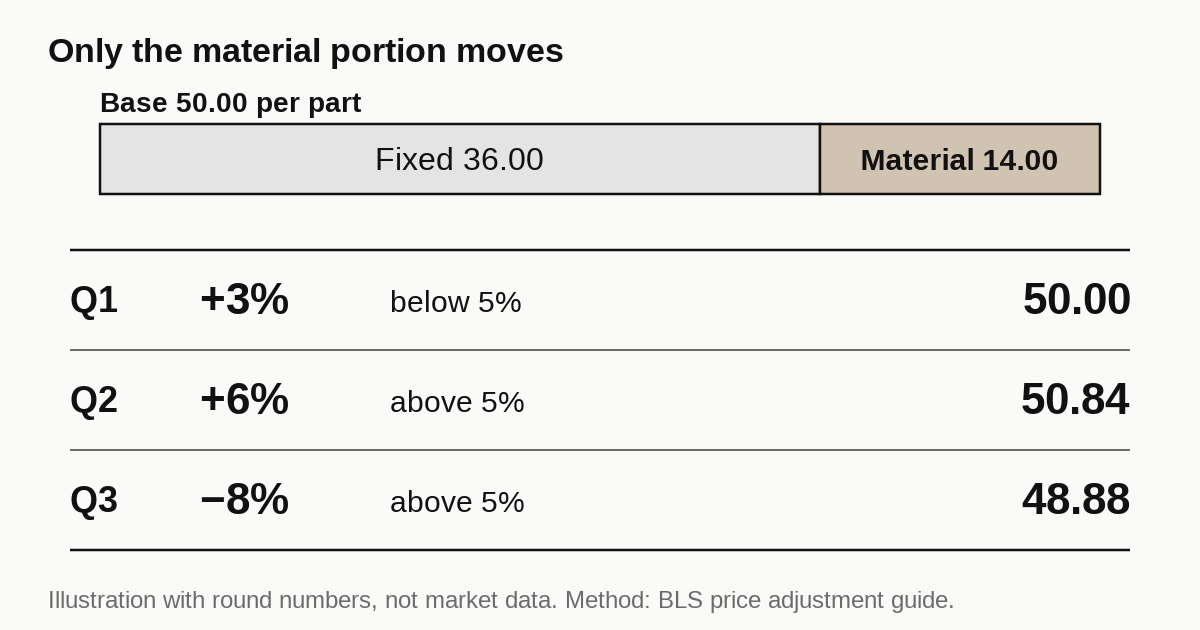
This is an illustration with made-up round numbers, not market data. Take a stem priced at 50.00 per part. The shop’s contract states a material portion of 14.00, built from the buy weight of the bar at the base month. The threshold is 5 percent, checked quarterly against the base month, adjusting both ways.
| Quarter | Index change vs base month | Result |
|---|---|---|
| 1 | +3 percent | Below the threshold. Price stays 50.00 |
| 2 | +6 percent | 14.00 x 6 percent = 0.84. New price 50.84 for the next quarter |
| 3 | -8 percent | 14.00 x -8 percent = -1.12. New price 48.88 |
Two details carry the example. The percentage is always measured against the base month, not the last adjustment, so moves do not compound. And the BLS guide describes the same method as partial escalation: only a stated portion of the price is adjusted, in currency per 1 percent of index change.
Our view is to tie the adjustment to the date a release is placed, because the shop buys bar when the release arrives. State this in the clause. Otherwise a brand may argue for the price on the day of shipment, weeks later.
Where these clauses go wrong
- Imprecise wording. Freshfields lists imprecise drafting among the reasons clauses become hard to operate. Write the formula as a formula.
- The whole price moves. A clause that scales the finished part price charges the brand for metal it never bought.
- A premium the clause ignores. Name the regional premium or accept that it is yours to carry.
- Revised data. The BLS guide says index data can be revised for up to four months after first publication. State whether first-published or final values apply.
- A seasonal series. The BLS guide recommends series that are not seasonally adjusted, so the clause follows actual price moves.
- Duty hidden in the metal. Tariff changes are a different risk from the metal price. Say who pays a new duty, or leave it out and say so.
- No end date. A base price needs a period. State how long it holds before a re-quote, and tell the brand which drawing revision it covers.
How to raise it with a brand
A brand’s buyer may prefer one fixed price. You can offer a fixed price for a short horizon, such as releases placed within a set number of days, and the clause after that. Or the brand can buy the bar itself, so it holds the metal risk and you quote machining and finishing only; the guide on supplying billet to bike part machinists shows the bar side of that. Show the worked example from your own part on one page. A clause the brand can calculate in a minute gets signed. For alloy and temper choices that change the material portion, see our aluminum alloy reference.
Talk to us
If your shop mills aluminum bike parts and wants to be considered for work for brands abroad, read the for suppliers page and talk to us. We will tell you plainly whether your parts and finishing route fit the requests we see.
Sources
- U.S. Bureau of Labor Statistics, Price Adjustment Guide for Contracting Parties (PPI)
- Freshfields, Dealing with supply cost volatility on major projects: the use of price escalation clauses
- U.S. Geological Survey, Mineral Commodity Summaries 2026: Aluminum
- Hellenic Shipping News, US ALUMINUM: Trade uncertainty, supply tightness push Midwest Premium above $1/lb (Platts report, February 2, 2026)
- Wikipedia, Escalator clause
- Wikipedia, London Metal Exchange
- Wikimedia Commons, Aluminium ingots St-Saphorin 180310.jpg

Frequently asked questions
What is an aluminum price clause in a bike part contract?
A sentence set that lets the part price move when the aluminum price moves. It names a base month, a published index, how often the price is checked, how big a move must be before anything changes and how the new price is worked out. Without it, a price that holds for a year leaves the shop carrying the metal risk.
Should the clause move the whole part price?
No. Move only the material portion. Machining, finishing and packing do not follow the aluminum market, so a clause that scales the full price overshoots. State the material portion in currency per part in the contract and apply the index change to that figure alone.
Which index should a shop name?
One that tracks what you buy and that both sides can read without paying. The BLS guide for price adjustment says to pick an input-cost index rather than the index of the finished product. A benchmark behind a subscription is a poor choice for a contract the brand has to check.
What if the brand wants a fixed price for the year?
Offer a fixed price for a short horizon, for example for releases placed within a stated number of days, and the clause after that. Or let the brand fix the metal by buying the bar itself. Do not quietly accept a flat year with no way out; write down how long the price holds.
Need a quote for this part?
Send the drawing. We quote the finished parts, place the work with a partner shop that machines bike parts and reply within 24 business hours.
Get a quote for your bike parts