Guides / Design
Chainring Offset Explained: What It Is and How It Differs From Chainline
November 21, 2026
Chainring offset is how far the teeth of a chainring sit from the face that bolts to the crank. Chainline is where the chain ends up relative to the bike, and the offset is one of the numbers that sets it. Mixing the two up is the most common reason an order for machined chainrings comes back wrong, so this post separates them and shows the figures that ring makers publish.
Two numbers that point in opposite directions
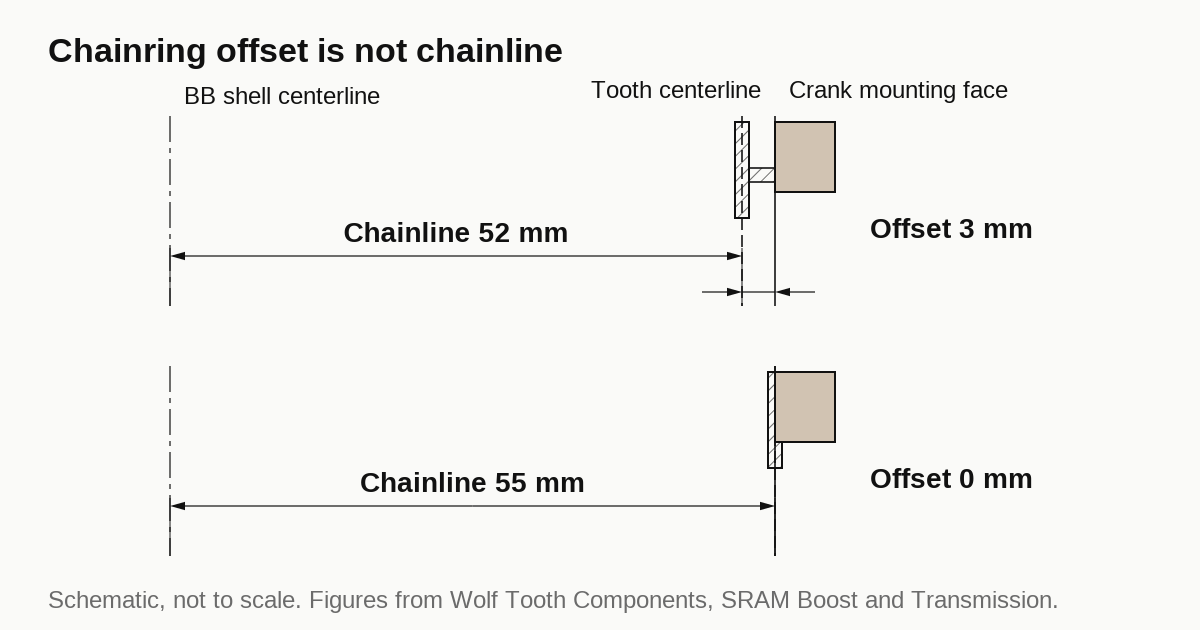
Ring makers define the two terms like this. Chainline is the distance between the center of the bottom bracket shell and the chainring, measured positive in the outboard direction, away from the center of the bike. Offset is the dish of the ring itself: a 0 mm ring is flat, and a 3 mm ring has 3 mm of dish away from the crank mounting point, measured positive toward the center of the bike. Wolf Tooth Components states both definitions in its guide to SRAM Transmission rings.
Sheldon Brown measures the same thing from the frame instead of the shell: chainline is measured from the centerline of the frame to the center of the chain. Both measure the same quantity from different references, so write down which reference your drawing uses.
The practical rule follows from the opposite signs. On one crank, swapping a 3 mm ring for a 0 mm ring moves the chain outward by 3 mm. The offset is a property of the part. The chainline is a property of the whole system.
Offset and chainline on current mountain bike cranks
The table collects the pairings one ring maker publishes for SRAM style direct mount cranks. It is a snapshot of one maker’s guide, not a standard, and it will change as new cranks arrive.
| Crank and drivetrain | Rear hub spacing | Chainline (mm) | Ring offset (mm) |
|---|---|---|---|
| DUB or Cane Creek eeWings, 3-bolt, Eagle mechanical or AXS | Boost 148 mm | 52 | 3 |
| Same 3-bolt crank, SRAM Transmission | Boost 148 mm | 55 | 0 |
| DUB Wide or 2025 eeWings, 8-bolt, Transmission | Boost 148 mm or Super Boost 157 mm | 55 | 3 |
| DUB SB+ (Super Boost) crank, Eagle or Transmission | Super Boost 157 mm | 56.5 | 3 |
| Race Face crank, Boost 136/137 mm spindle, Transmission | Boost 148 mm | 55 | 0 |
Source: Wolf Tooth Components, SRAM Transmission chainring guide, opened October 2026. Chainline and offset are as stated on that page for its own rings. Check your crank maker’s documentation before ordering.
Two readings matter. First, the same older crank sits at a 52 mm chainline with its stock 3 mm ring and at 55 mm with a 0 mm ring, which is how an old crank is made to suit a drivetrain built around a 55 mm chainline. Second, a newer 8-bolt crank reaches 55 mm with a 3 mm ring because its spindle and arm geometry already sit further out. The ring alone never tells you the chainline.
Where chainline numbers come from
Sheldon Brown’s chainline article lists typical values by use. They give context for why these numbers vary so much between bike types.
| Application | Chainline (mm) |
|---|---|
| Road double (midpoint between rings) | 43.5 |
| Road triple (middle ring) | 45 |
| Mountain bike triple | 47.5 to 50 |
| Single chainwheel, Boost 148 | 52 |
| Freeride and downhill | 55 |
| Fat bike, 170 mm rear spacing | 66 |
Source: Sheldon Brown, Chainline. Values are the article’s, listed for context and not as a current standard. The article also notes that dropping one ring of a double moves the chainline by generally about 2.5 mm, half the spacing between rings.
Our chainring machining guide quotes about 52 mm for Boost against about 49 mm for non-boost. That non-boost figure is the guide’s, not one this post re-checked.
Need a quote for this part? Get a quote for your bike parts
What this means for a machined ring
The ring drawing controls a few things and not others.
- The part controls: the dish from the mounting face to the tooth centerline, the flatness of the mounting face and the tooth form.
- The part does not control: the spindle length, the arm geometry, the bottom bracket shell width or the rear hub spacing. Those belong to other makers.
A drawing that says only “52 mm chainline” asks the ring maker to guarantee something it cannot measure on its own part. A drawing that says “offset 3 mm from the mounting face to the tooth centerline” can be checked on a measuring machine. Name the face, since a ring with a raised step or a recessed mounting land has more than one candidate for the datum. Tolerance practice is covered in the tolerance guide for bike part drawings.
One more case: some narrow cranks need a different ring even on the same drivetrain. The same Wolf Tooth page notes that SRAM’s XXSL Transmission crank has a narrow Q factor and needs a 0 mm offset ring for Transmission. The page gives no reason. A narrower crank sits closer to the bike centerline, so a flatter ring is consistent with moving the chain back outward. The next post in this series explains Q factor.
What to send with the drawing
- The crank interface, such as 3-bolt direct mount, 8-bolt direct mount or a bolt circle diameter, with the crank maker’s name and model
- The offset in millimeters, the datum face and the tolerance
- The chainline the ring should produce, as a note for the supplier, labeled as a target and not a tolerance
- Rear hub spacing of the bike, so a shop can sanity check the pairing
- Tooth count, tooth profile and chain type
If you are unsure which of these your drawing already carries, the chainring guide walks through the full set. To get quotes from shops that machine rings, send the drawing through the RFQ page. We quote the finished parts within 24 business hours and place the work with a partner shop.
Sources
- Wolf Tooth Components, how to find the correct chainring for SRAM Transmission (ring maker, definitions and pairings)
- Sheldon Brown, Chainline
- Sheldon Brown, glossary entry for chainline
Frequently asked questions
Is chainring offset the same as chainline?
No. Offset is a dimension of the ring itself: the dish between its mounting face and the centerline of its teeth. Chainline is a result: the distance from the bottom bracket shell center to the chain. The crank, the ring and the frame together decide chainline, so one ring can give different chainlines on different cranks.
Does a bigger offset move the ring outward or inward?
Inward, toward the bike centerline. One ring maker states that on the same older Boost crank, a 3 mm offset ring gives a 52 mm chainline and a 0 mm offset ring gives 55 mm. More dish puts the teeth closer to the bike, which lowers the chainline number.
What should a chainring drawing say about offset?
State the offset in millimeters, name the face it is measured from and the tolerance, and give the crank interface it mounts on. Do not write only a chainline: the ring maker cannot control the crank or the frame, so the drawing should carry only what the part itself decides.
Need a quote for this part?
Send the drawing. We quote the finished parts, place the work with a partner shop that machines bike parts and reply within 24 business hours.
Get a quote for your bike parts