Guides / Design
Q Factor Explained: Crank Width, Shell Width and the Part You Machine
November 21, 2026
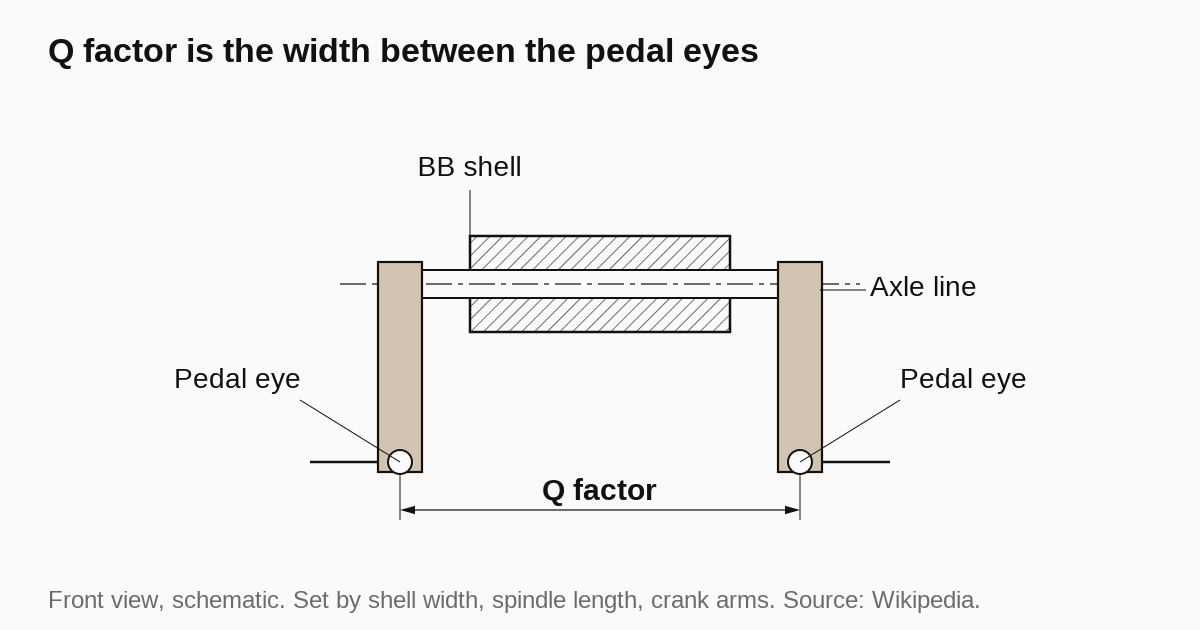
Q factor, also called the tread of a crankset, is the distance between the pedal attachment points on the two crank arms, measured parallel to the bottom bracket axle. It is a system dimension: the frame’s bottom bracket shell, the spindle and the two machined crank arms all add to it. This post explains what sets it, the ranges sources give and which part of the number a crank drawing can control.
Where the name and the definition come from
Wikipedia defines Q factor as the distance between the pedal attachment points on the crank arms, measured parallel to the bottom bracket axle. It adds that the value is a function of both the bottom bracket width and the cranks. Sheldon Brown’s glossary lists it as another name for the tread of a crank set and credits Grant Petersen with that use in 1991.
A wider Q factor reduces cornering clearance at the same bottom bracket height and crank length. Narrow values suit faired recumbents and record bikes. A German bike magazine writes that the value should be as small as possible for biomechanical reasons and that an overly large one can contribute to knee pain. That is the magazine’s view and not a rule, and rider fit is not something a part drawing can settle.
Figures from the sources
| Item | Value | Source |
|---|---|---|
| Bottom bracket axle lengths in use | 102 mm to 127 mm | Wikipedia, Q factor (bicycles) |
| Mountain bike cranks versus road cranks | typically about 20 mm wider | Wikipedia, Q factor (bicycles) |
| Mountain bike cranks surveyed in 2014 | usually 156 mm to 173 mm | BIKE Magazin, 2014 |
| SRAM XX and Shimano XTR, 2014 examples | 156/166 mm and 163/168 mm | BIKE Magazin, 2014 |
| Narrow bottom bracket, Obree “Old Faithful” | 40 mm | Wikipedia, Q factor (bicycles) |
| Narrow bottom bracket, Pinarello Bolide F HR | 54 mm | Wikipedia, Q factor (bicycles) |
Source line: the BIKE Magazin figures are from a 2014 article, so treat them as dated examples and read the current manufacturer figure for any new crank. The two values per model in that article are given as written there.
What adds up to the number
Think of Q factor as two distances added together: the distance from the bike centerline to the left pedal attachment point and the same distance on the right.
- The frame side: the bottom bracket shell width and the way the cups sit in it.
- The spindle side: the spindle length and where the arm seats on it. Wikipedia gives 102 to 127 mm as the spread in axle lengths.
- The arm side: how far the pedal eye sits from the spindle interface, which is set by the arm’s shape.
- The pedal side: the definition stops at the attachment point, but the pedal body and axle length still change where the foot sits.
The crank arm drawing controls the third item. It does not control the frame or the pedal. That is why a crank maker quotes a Q factor only for its own crank on its own spindle and shell width.
A stack-up example (assumed numbers)
The numbers below are an illustration, not a product. Assume each pedal eye face sits 80.0 mm from the bottom bracket shell centerline plane. The Q factor is then 160.0 mm, inside the 156 to 173 mm range above. Assume each arm is machined with the pedal eye face position held to ±0.2 mm.
- Worst case, both arms at the same limit: ±0.4 mm on the Q factor.
- Statistical case, independent errors added as the square root of the sum of squares: about ±0.28 mm.
The arithmetic shows why a drawing should dimension the pedal eye face from the spindle interface datum on each arm, and why the frame’s shell width tolerance adds on top. A wide shell tolerance can erase an expensive arm tolerance. The tolerance guide for bike part drawings covers how to choose datums.
Need a quote for this part? Get a quote for your bike parts
Q factor changes other numbers
A narrower crank moves the chainring closer to the bike centerline. Wolf Tooth Components notes that SRAM’s XXSL Transmission crank has a narrow Q factor and needs a 0 mm offset ring for Transmission. The chainring offset post shows how offset and chainline pair up. Q factor also depends on the bottom bracket shell standard, covered in the guide to T47 and BSA bottom bracket cups.
How to measure it
The BIKE Magazin method needs a folding rule: put the crank horizontal, slide the rule through the rear wheel’s spokes, rest it against the outside of the pedal-side arm at pedal height, rotate the other arm back until it touches the rule and read the value. On a crankset fitted to its spindle, a long caliper across the two pedal eye faces measures the same dimension more directly. Record the method with the number so that two measurements can be compared.
What to put on a crank order
- The Q factor target, labeled as a target, with the shell width and spindle length it assumes
- The pedal eye face position from the spindle interface datum, with a tolerance, on each arm
- Which side is drive and which is non-drive
- The pedal thread and its perpendicularity requirement
- How you will inspect the first article
The crank arm guide lists the interfaces and the places cracks start. To get quotes on a crank drawing, send it through the RFQ page. We quote the finished parts within 24 business hours and place the work with a partner shop.
Sources
- Wikipedia, Q factor (bicycles)
- Sheldon Brown, glossary (Q-factor entry)
- BIKE Magazin, how to measure the crank width correctly (2014)
- Wolf Tooth Components, chainring guide for SRAM Transmission (XXSL note)
Frequently asked questions
What is a normal Q factor for a crankset?
No single value is standard. A 2014 magazine survey of mountain bike cranks found values usually between 156 and 173 mm, and Wikipedia notes that mountain bike cranks are typically about 20 mm wider than road cranks. Fat bikes and e-bikes are usually wider again. Check the crank maker's published figure for the exact model.
How do you measure Q factor?
Measure between the pedal attachment points on the two crank arms, parallel to the bottom bracket axle. One magazine method sets the crank horizontal, rests a folding rule against the outside of the pedal-side arm at pedal height, rotates the other arm back onto the rule and reads the value. Use calipers on a bare crank.
Does the machined crank arm set the whole Q factor?
No. Q factor depends on the bottom bracket width and on the cranks, so the shell width, the spindle length and the arm geometry all count. A crank drawing controls the arm geometry and the spindle interface. The frame maker controls the shell, so the Q factor is agreed between the two, not set by one part.
Need a quote for this part?
Send the drawing. We quote the finished parts, place the work with a partner shop that machines bike parts and reply within 24 business hours.
Get a quote for your bike parts