Guides / Materials
4130 Chromoly Steel for Dropouts, Yokes and Frame Fittings
October 9, 2026
Steel is not a headline material for CNC bike parts. Aluminum and titanium get most of the attention. But steel is still the material of many frames, and the small machined parts that join them, such as dropouts, yokes, bridges and fittings, are mostly 4130 chromoly. If you build steel frames or supply frame builders, these parts are a steady line of work, and the details of the steel decide how they behave in the welding shop and on the road.
What 4130 is
4130 is a low-alloy steel with roughly 0.3 percent carbon, about 1 percent chromium and a quarter percent molybdenum. The name comes from the grade system: the 41 marks a chromium-molybdenum steel and the 30 means about 0.30 percent carbon. The chromium and molybdenum add strength and hardenability without making the steel brittle or hard to weld.
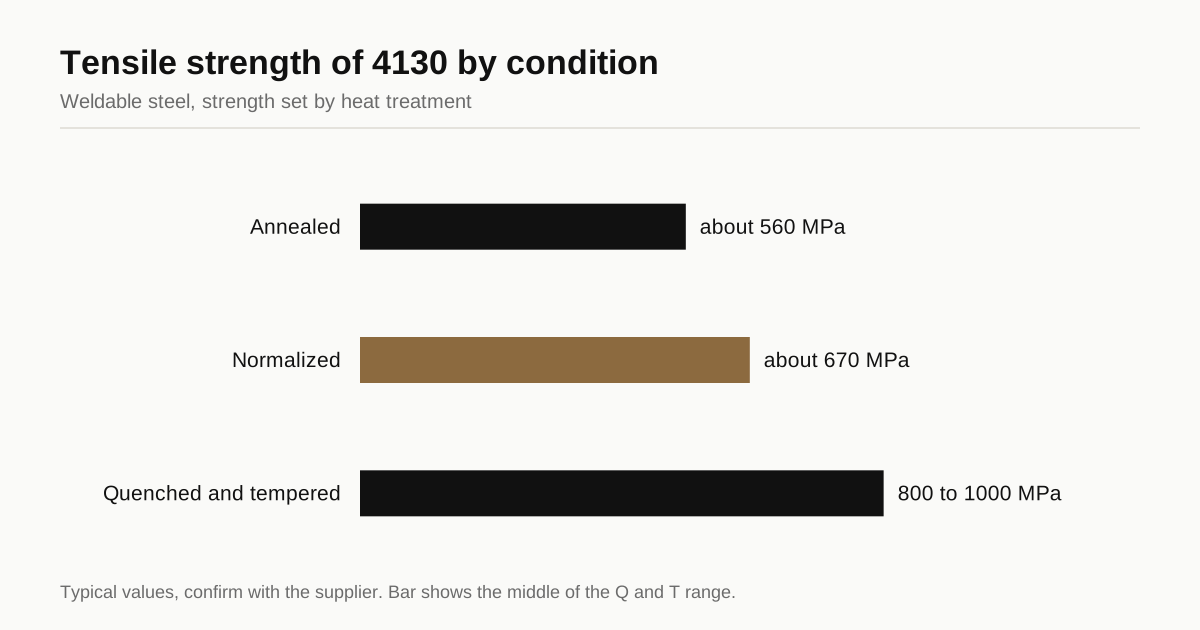
Typical properties for orientation. The exact values depend on the heat treatment and the product form.
| Condition | Tensile strength (typical) | Notes |
|---|---|---|
| Annealed | About 560 MPa | Soft, machines well |
| Normalized | About 670 MPa | Common supply condition for tubing and plate |
| Quenched and tempered | 800 to 1000 MPa and above | Higher strength, needs care with welding and plating |
Density is about 7.85 g/cm³, nearly three times that of aluminum. The modulus is about 205 GPa, which means a steel part is stiff for its thickness. A thin steel tab can be as stiff as a much thicker aluminum one, which is why steel dropouts can be so slim. The weight versus strength guide explains how density and stiffness trade off.
Bar is commonly purchased to ASTM A29, mechanical tubing to ASTM A519 and sheet and plate to the AMS or ASTM sheet and plate specifications. State the specification and the supply condition on the drawing.
Where 4130 is used on a bike
- Dropouts. Cut from plate by laser, waterjet or wire EDM, then machined for the axle slot, derailleur hanger mount and brake mount. Steel dropouts are brazed or welded to the stays.
- Yokes and bridges. Parts that join two tubes, such as a seatstay bridge or a chainstay yoke.
- Frame fittings. Cable guides, bottle bosses, rack mounts and brake studs.
- Bottom bracket shells and head tube cups on welded frames
- Suspension links and pivots, where steel is chosen for strength and wear
- Fork crowns and dropouts on steel forks
For most of these, the part is small, the profile is cut from plate and the machining is mostly milling and drilling. Dropouts are a good example of the work: thin plate, tight slot, threaded hanger holes. The derailleur hanger guide has more detail on that part.
Machining 4130
In the annealed or normalized state, 4130 machines well. It is tougher than aluminum, so tool wear is higher and cutting speeds are lower. A shop will use carbide tools, flood coolant and rigid fixturing.
Points to know:
- Burrs. Steel burrs are sharper and harder than aluminum burrs. Plan a deburring step, and see the deburring guide for edge sizes.
- Heat treatment before machining. Quenched and tempered 4130 is much harder to machine. Most shops machine in the annealed or normalized state and, if the design needs higher strength, heat treat afterward. That causes distortion, so critical features may need a finish pass or grinding.
- Thread cutting. Steel threads are strong. Tap breakage is a risk in blind holes, and thread milling is an option, as in the thread guide.
- Burn-through on thin sections. Thin plate can warp from cutting heat. Light cuts and good clamping help.
Welding and brazing
4130 is one of the most weldable alloy steels. For bike frames, it is usually TIG welded or brazed, and the builder sets the process.
- Same-family steels. Dropouts and tubes should be compatible in carbon content, so the weld cools without cracking.
- Heat-affected zone. Welding softens or hardens the steel near the joint, depending on cooling rate. Thin sections of normalized 4130 are forgiving. Parts that were heat treated to high strength may lose strength in the heat-affected zone.
- Clean surfaces. The weld area must be free of oil, scale and coating. If a part is plated, plating must be masked or removed at the joint.
- Filler. TIG welding uses filler rod chosen by the builder, with strength matching the base metal. Brazing uses a bronze or silver filler.
Machined parts should arrive clean, with a light oil to stop rust, and with a note on whether the weld faces are machined or left as-cut. Welding is a different process from machining, so state who is responsible for fit-up gaps. A tab with a weld gap too wide gives a weak joint.
Corrosion protection
Bare 4130 rusts quickly. A coating system is part of the part design.
| Coating | Where it fits | Notes |
|---|---|---|
| Paint and powder coat | Whole frames | The standard finish for steel frames |
| E-coat | Frames and fittings | Covers internal surfaces, good base for paint |
| Zinc or zinc-nickel plating | Small fittings, bolts | Good protection, needs care for hydrogen embrittlement |
| Black oxide with oil | Interior parts | Mild protection |
| Clear coat | Raw steel look | Needs maintenance |
The inside of frame tubes needs protection too, since water gets in through drain holes and bolt holes. Frame builders use rust-inhibiting oil or wax inside the tubes.
Hydrogen embrittlement. High-strength steel can crack after plating or pickling if hydrogen is absorbed and trapped. The risk grows with strength, and a common rule is to take care above about 1000 MPa tensile strength, with a baking step after plating. Normalized 4130 at 670 MPa is much less at risk, but a quenched and tempered part needs a plating process that controls it. Ask the platers about baking if the part is heat treated. Other options are covered in the finishes guide.
4130 versus alternatives
| Material | Strength to weight | Weldability | Corrosion | Cost |
|---|---|---|---|---|
| 4130 | Good | Excellent | Poor, needs coating | Low |
| Stainless 304 or 316 | Lower strength | Good | Excellent | Medium |
| Titanium Grade 9 or 5 | Excellent | Good with shielding | Excellent | High |
| 6061 aluminum | Good | Good with care | Good | Low |
For steel frames, 4130 is the natural match for dropouts and fittings. For titanium frames, titanium fittings are the norm. For aluminum frames, forged or machined aluminum dropouts are used. The titanium guide covers the lighter options.
What to put on the drawing
- Material, grade, specification and supply condition, such as “4130 plate, normalized, per ASTM A29 or equivalent”
- Whether heat treatment after machining is required, and to what hardness
- Weld faces: machined, as-cut or edge-prepared
- Corrosion protection and whether weld zones are masked
- Tolerance on the axle slot and hanger threads
- Surface finish on faces that mate with tubes
Cost and lead time
4130 plate and bar are widely available and cheap compared with titanium. Machining time is longer than for aluminum but shorter than for titanium. The costs that surprise buyers are secondary steps: heat treatment, plating and the transport between vendors. Plan the sequence. The prototype to production guide explains how to organize that.
Steel is one family in our guide to the best material for CNC bike parts.
Send your drawing and quantity through the RFQ page and we match you with up to 3 machine shops that run steel. They reply within 24 business hours.
Frequently asked questions
Is 4130 the same as chromoly?
4130 is the most common chromoly, a steel with chromium and molybdenum added to carbon steel. Other chromoly grades exist, such as 4140 and 4340, and bike frame tubing is sometimes called chromoly whatever the grade. For machined parts, state 4130 by number.
Can 4130 dropouts be welded to a frame?
Yes. 4130 welds well by TIG and can be brazed. The part and the tubes should be the same family of steel so the weld behaves, and the frame builder decides on preheat and post-weld treatment. Machined parts should be supplied clean, with no coating in the weld zone.
Why does 4130 need a coating?
It rusts. Unlike stainless steel or aluminum, it has no protective oxide. Frames and fittings use paint, powder coat, plating or e-coat, and the inside of the tubes needs protection too. Plan the coating when you design the part.
Need a quote for this part?
Send the drawing. We match you with up to 3 shops that machine bike parts and reply within 24 business hours.
Get matched with a bike parts shop