Guides / For Shops
Working With Bike Startups: Deposits, Prototypes and Drawing Protection
November 16, 2026
A bike startup is a different kind of customer from an established brand. It may have one product, a drawing that changes monthly and a funding plan rather than a purchase history. It may also be the next bike brand that reorders for years. For a machine shop the risk is not that the startup is dishonest. It is that the shop pays for material, setup and finishing before the brand’s own money or test results have arrived. This article sets out how a shop can protect itself, and the startup’s design, without making the first conversation hostile.
None of this is legal advice. Contract and IP law differ by country, so have a lawyer in your jurisdiction review the wording you use.
What is different about a startup order
Four things, in our view, change how you quote:
- The design is not frozen. A stem or thru-axle goes through test results, a revision and sometimes a second revision before the first sellable batch. Each revision changes the drawing, and sometimes the finish.
- The money arrives in stages. Funding, pre-orders and sales may all come after the parts. You do not have to finance that.
- Volumes are uncertain. A first order may be small, and the second order depends on how the first sells. The low MOQ guide covers what small runs cost. Do not promise a price for volumes the startup has not ordered.
- The brand needs the shop’s help. A startup often does not know about test samples, anodize allowances or how to write a tolerance. Teaching that in the first email is the reason a startup comes back, and the prototype to production guide lays out the stages.
Deposits and milestones
We found no public benchmark for deposit percentages on bike parts, and we will not invent one. Set the structure from your own exposure.
| Stage | What you are risking | Common terms to consider |
|---|---|---|
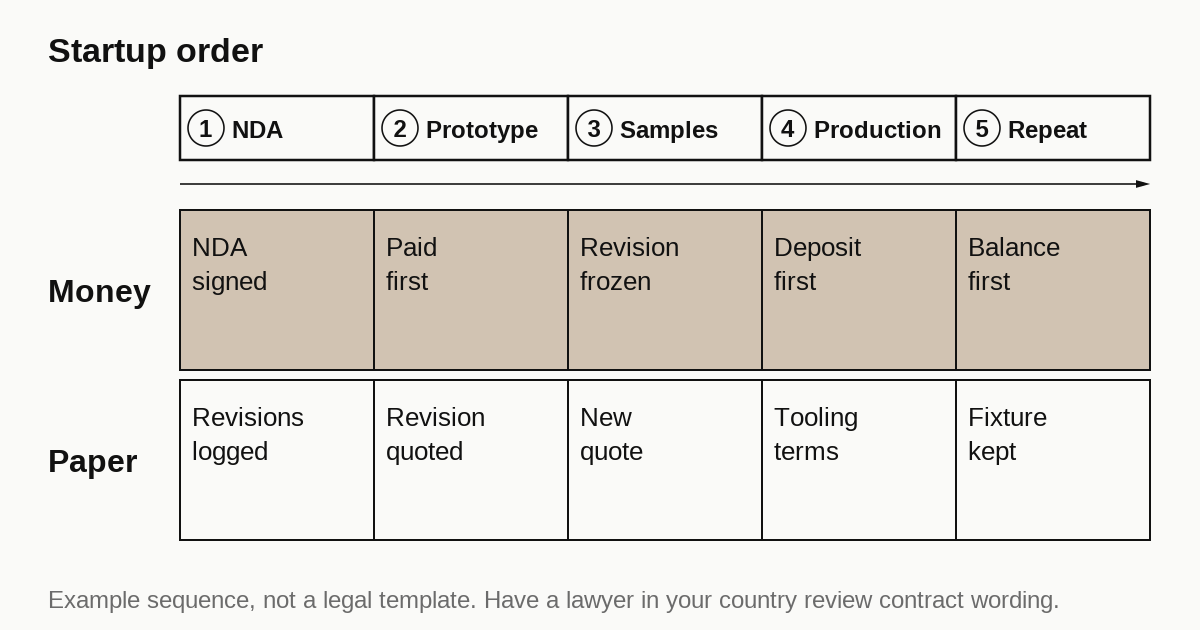
| Prototype (1 to 10 pieces) | Programming, a small amount of material, your time | Paid in full before work starts |
| Fixture or tooling | Hours and parts that serve only this job | Billed once, or spread over the first runs, stated on the quote |
| Material for a production run | Bar or billet you cannot easily resell, and lead time | A deposit before the material is ordered |
| Outside finishing | Anodize or plating vendor minimums | Included in the deposit, or billed when the parts are sent |
| Delivery | The finished goods in your stock | Balance before shipment, or on terms you have checked the buyer can meet |
Wikipedia defines an advance payment as the portion of a sum paid in advance for goods or services, with the rest billed after delivery. It also notes that an advance is not always repayable: in Leibson Corporation v TOC Investments Corporation (English Court of Appeal, 2018), the court held that without specific contrary language an advance is not always repayable. The practical lesson is to write the refund rule down. State whether the deposit is refundable, when it stops being refundable, and what happens to parts and material already made if the order is cancelled.
Other clauses that cost nothing to include:
- Cancellation: the startup pays for finished and in-process parts and for material bought for the order.
- Storage: finished goods that the customer does not collect after a stated number of days incur a storage charge, or may be invoiced as delivered.
- Overruns and shortfalls: a stated quantity tolerance, for example plus or minus a few percent, so scrap does not become an argument.
- Revision control: the quote names the drawing revision. A new revision means a new quote. The reading-a-drawing guide is a useful checklist for what must be on the drawing before you price it.
Prototypes: charge, and say what they are
A prototype is a paid service. Quote it with its material, finish and quantity, and state plainly that the prototype price is not a production price. The pricing guide for production runs shows how production prices are built from different blocks.
Four things to settle before cutting metal:
- How many samples the startup really needs. Fatigue tests consume parts, and a failed test followed by a revision needs a fresh set. The test lab guide explains why.
- Finish. Samples for testing should be finished the way production parts will be, otherwise the test result is not valid. The Type II versus Type III guide covers the choice.
- What you will keep. Your program, your tooling and your process notes. Say whether any of it is part of the sale.
- Whether prototype work is credited. Some shops credit part of the prototype fee against a first production order. That is a commercial choice and must be written in the quote, not left to goodwill.
Need a quote for this part? Get a quote for your bike parts
Protecting a startup’s design, and your own
A startup will usually ask for an NDA before it sends a drawing. Agree to a reasonable one. It is a sign the brand takes its design seriously, and a shop that handles it well is chosen again.
What an NDA does and does not do
Wikipedia describes a non-disclosure agreement as a contract in which at least two parties agree not to disclose specified confidential information they share for certain purposes. Key terms to read:
- One-way or mutual. A unilateral NDA binds only the receiver. A mutual one binds both. A shop that also shares its process know-how, such as fixtures and cycle times, should ask for a mutual agreement.
- Definition of confidential information. Often a broad list. Some agreements require marking.
- Exclusions. Restrictions generally do not apply to what the receiver already knew, later got from another source, or what becomes public, or what a subpoena requires.
- Duration. How long the duty lasts, in years, and how long the agreement is binding.
- Return or destruction of materials, and who owns the information.
An NDA is not a patent. Under the trade secret rules summarized by Wikipedia, information qualifies only if it is not generally known, has commercial value because it is secret, and the holder takes reasonable steps to keep it secret. Independent discovery by a third party is not misappropriation, and reverse engineering a product already on the market is generally allowed, though some countries let a contract prohibit it.
What registrations do, in plain terms
The shop is not the startup’s lawyer, and should not give advice. But a shop should know the vocabulary so it can answer when a brand asks what it needs.
- A US provisional patent application gives an early filing date, is not examined, and lasts 12 months. The USPTO says that period cannot be extended, and the brand must file a nonprovisional application within it to keep the earlier date.
- A US design patent protects the visual ornamental characteristics of an article, which is how it looks. A utility patent protects how it is used and works. A design patent from an application filed on or after May 13, 2015 runs 15 years from the date of grant (35 U.S.C. 173, quoted by the USPTO).
- In the European Union, a registered design can last up to 25 years from the filing date with maintenance fees, according to Wikipedia, which also notes the right was renamed the EU design from 1 May 2025 and the page needs updates. Check the current rules with the EUIPO before relying on that.
A brand that wants to protect a stem or crank shape should speak to a patent attorney early. Ask the brand what its attorney wants kept quiet before filing, and do not show its parts in your own marketing until it says you may.
Handling files and parts day to day
A shop’s behavior matters more than a clause. A short internal rule set does most of the work:
- Keep a startup’s files in one folder with limited access, logged by drawing revision.
- Do not post photos of the parts or the brand’s name without written approval.
- Do not make a second batch, an overrun or a similar part for any other customer from the startup’s geometry.
- Scrap and rejects with the brand’s marking or unique geometry are destroyed or returned, not sold or left in a bin.
- Return or delete the files at the end of the relationship, as the NDA says.
Who owns what
Two items are routinely left silent. The first is the design: the drawing and the CAD belong to the startup, and your quote should say you acquire no rights to them. Under US copyright law, work by a contractor is not automatically a work made for hire, and a valid arrangement needs a written agreement signed before the work starts, according to Wikipedia. If you create the design, for example a shop-developed modification, the same logic applies in the other direction: write down who owns it. The second is your tooling and know-how: the fixtures, programs and process settings you built. Keep them yours unless the quote says they are sold. The fixturing guide explains how to document and store them so a repeat order starts fast.
When a startup is not a fit
Walk away, politely, if a startup:
- will not accept a written quote with a revision and a deposit,
- wants you to carry the material and finishing cost until it has sold the product,
- asks for exclusivity without any purchase commitment,
- insists on terms that make you liable for its sales losses if parts are late, or
- cannot say what test the part must pass.
None of these makes the startup a bad business. They are signals that the order may cost you more than it pays. The quoting guide shows how to say so without losing the customer you do want.
A short checklist
- Mutual NDA, signed before files are exchanged
- Files logged by drawing revision, with access limited
- Prototype quoted as a paid service with revision, material and finish
- Deposit and refund rule written before material is bought
- Fixture and tooling treatment stated on the quote
- Cancellation, storage and quantity tolerance clauses
- Production price quoted separately, after the design is frozen
- A lawyer in your country has reviewed your standard terms
If your shop wants bike brand requests, register through the supplier page. Work requests carry the part, material, quantity, tolerance, finish and deadline. You quote us and, if price and lead time work, we place the purchase order with you. Nothing here promises orders.
Sources
- Wikipedia, Non-disclosure agreement
- Wikipedia, Trade secret
- Wikipedia, Advance payment
- Wikipedia, Works made for hire
- Wikipedia, Community design
- USPTO, Provisional application for patent
- USPTO, Design patent application guide
- USPTO, MPEP 1505, Term of design patent
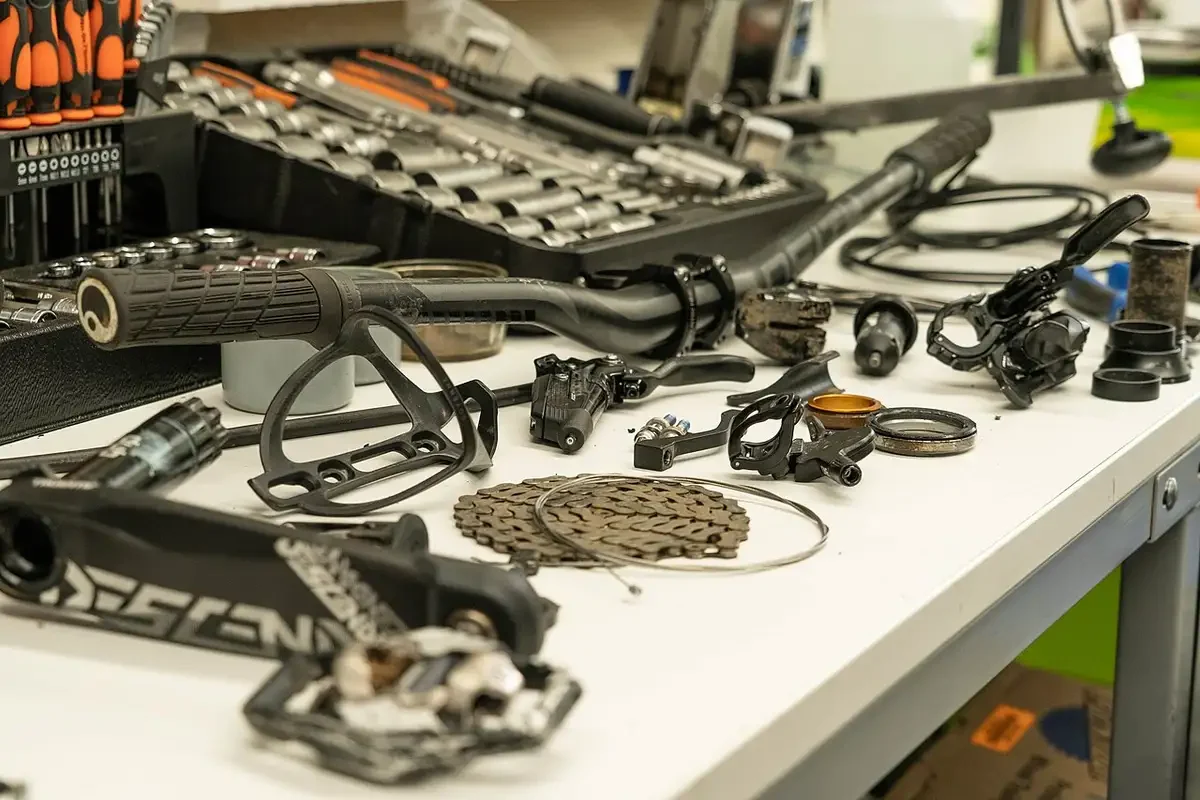
- Wikimedia Commons, Bicycle repair shop - bike parts on work bench

Frequently asked questions
Should a machine shop ask a bike startup for a deposit?
In our view, yes, before you buy material or build a fixture. There is no public standard percentage, so set it from your own exposure: material you cannot resell, outside processes and fixtures. Write down whether the deposit is refundable and when, because an advance is not automatically repayable without specific contract language.
Does a non-disclosure agreement protect a startup's design?
It protects information the startup gives you, within the terms of the agreement. It normally excludes what you already knew, what you got from another source and what becomes public. It does not stop you from independently developing something similar, and it does not replace a patent or a design registration.
Who owns the fixture a shop builds for a startup order?
Whoever the written agreement says. Decide before quoting whether the fixture is billed, spread over the first runs or included in the piece price, and whether the brand can take it if it moves the work. Silence leads to a dispute at the moment the brand wants a second source.
How should a shop price prototypes for a startup?
As a separate paid service, not as a promise of production. Quote the prototype with its revision, material and finish, and say the production price is quoted separately once the design is frozen. Some shops credit part of the prototype fee against a first production order, but that is a commercial choice.
Need a quote for this part?
Send the drawing. We quote the finished parts, place the work with a partner shop that machines bike parts and reply within 24 business hours.
Get a quote for your bike parts