Guides / Materials
Why Bolts and Inserts Corrode Machined Bike Parts and How to Stop It Before the Order
November 21, 2026
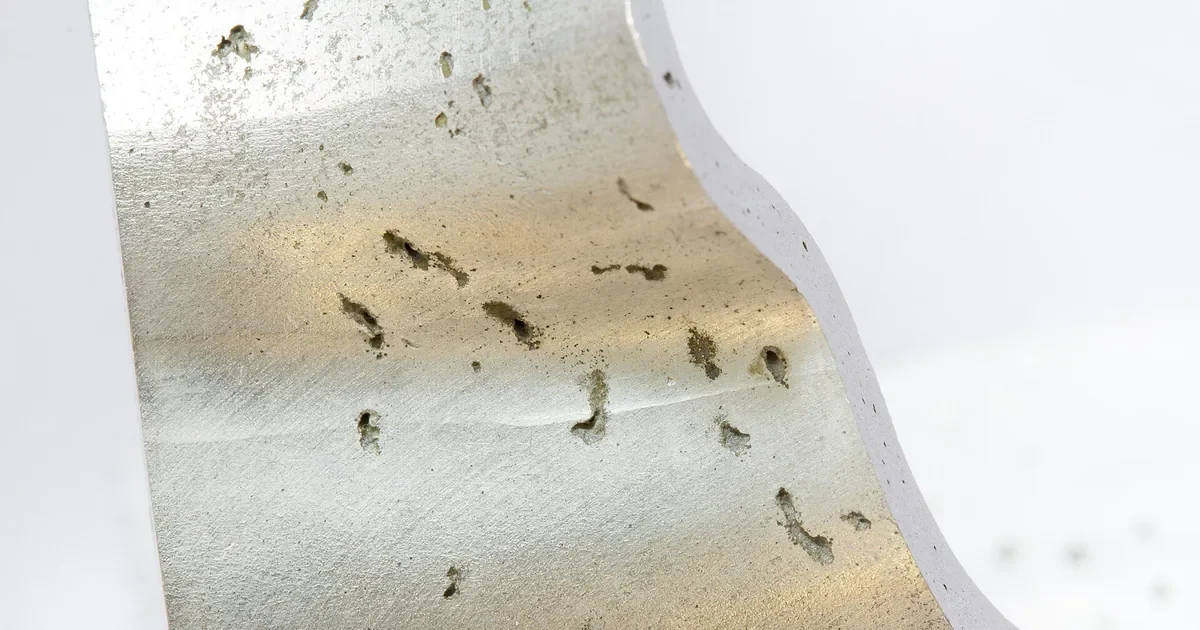
Galvanic corrosion on a bike part starts where two different metals touch and water sits between them. The less noble metal corrodes. On a machined bike part that is most often the aluminum: around a stainless or steel bolt, against a titanium axle, or where an aluminum insert meets carbon fiber. Keeping the metals apart, keeping water out or choosing a closer pair prevents it, and the decision belongs on the drawing before the RFQ. This post is part of our guide to the best material for CNC bike parts, and it covers which pairs corrode, what helps and what to write about who pays.
How the corrosion cell forms
Wikipedia describes galvanic corrosion as one metal corroding when it is in electrical contact with a different metal, with an electrolyte present and a conducting path between them. The FAA’s corrosion control circular for aircraft adds two practical points. The rate depends on how far apart the two metals sit in the galvanic series, and it depends on the size of the parts. If the corroding metal is smaller than the less active metal, corrosion is rapid and severe. If it is larger, corrosion is slow and superficial.
On a bike the electrolyte is rain, sweat, wash water and road salt. The conducting path is the bolt thread, the clamp face or the bore. The aircraft document is written for aircraft, and we found no bike-specific standard for any of this, so read the aircraft guidance as physics, not as a bicycle rule.
Which pairs corrode on a bike
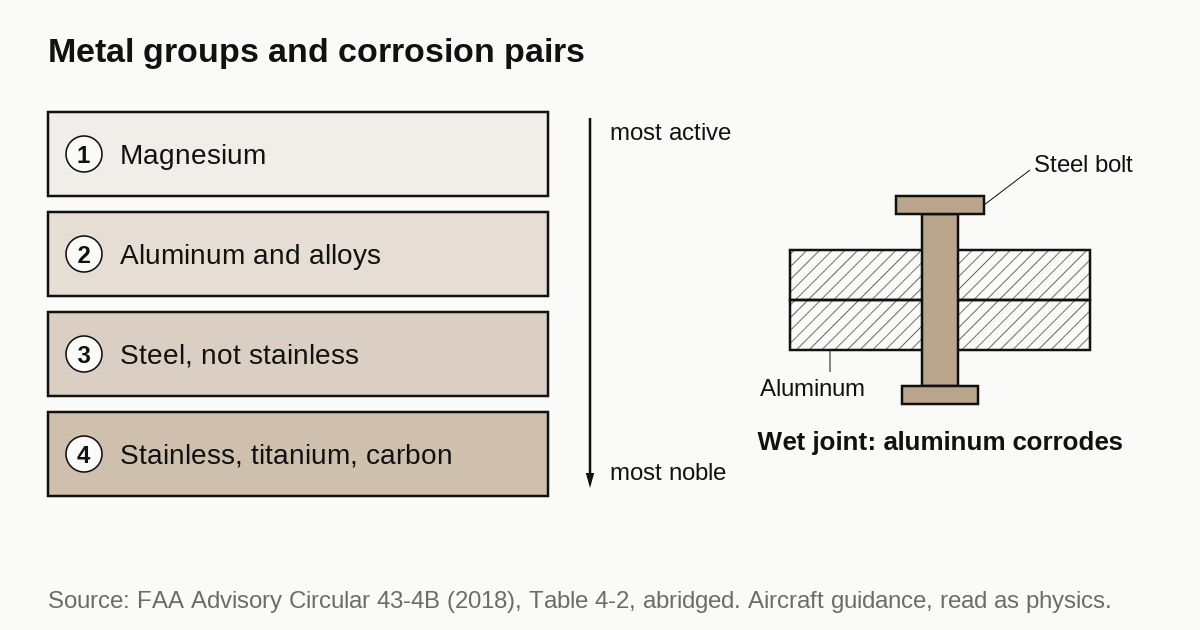
The FAA circular groups metals so that metals within one group are safe to put in contact and metals from different groups are not. The pairs below follow its groups and the anodic index table in Wikipedia’s galvanic corrosion article.
| Pair | Metal that corrodes | Where it shows up on a bike | What we found |
|---|---|---|---|
| Aluminum with stainless steel | Aluminum | Stainless bolts in aluminum clamps and stems | FAA groups differ. Anodic index gap is 0.40 V (aluminum -0.90, 18% chromium stainless -0.50) |
| Aluminum with steel | Aluminum | Steel bolts in aluminum threads, aluminum seatpost in a steel frame | FAA groups differ. FAA shows 7075-T6 corroding next to a steel fastener |
| Aluminum with titanium | Aluminum | Titanium bolts and axles in aluminum | FAA says titanium is prone to cause severe corrosion of adjacent parts |
| Aluminum with carbon fiber | Aluminum | Aluminum inserts and fittings in carbon parts | Carbon is cathodic to aluminum in the FAA text and in two papers |
| Magnesium with steel or aluminum | Magnesium | Magnesium parts with steel bolts | Anodic index gap to aluminum is 0.85 V (magnesium -1.75) |
| Titanium with stainless or carbon | Little | Titanium bolts in carbon parts | FAA puts titanium, stainless steels and carbon graphite in one group |
Caption: FAA Advisory Circular 43-4B (2018), Table 4-2 and paragraphs 3.2.5 and 4.7.7; anodic index values from Wikipedia’s galvanic corrosion article, checked October 2026. The gaps are our subtraction. Wikipedia quotes 0.15 V as a limit for harsh environments and 0.25 V for normal storage, so a 0.40 V pair is past both. The values are guides, and they shift in service.
Bolts and inserts in aluminum: stainless, steel and titanium
The common case is a bolt in an aluminum part. Our 17-4 PH hardware guide says stainless and aluminum are close enough in the series that the effect is usually minor. The FAA circular and the anodic index table we opened rate the pair as dissimilar. Read “minor” as slower than the magnesium or carbon cases, and still real when the joint stays wet. Both sources agree on the remedy, which is grease or isolation at the joint.
For steel the picture is plainer. The FAA circular shows intergranular corrosion in 7075-T6 aluminum next to a steel fastener, and it lists steel, titanium and stainless fasteners among its trouble areas. Titanium gets the strongest wording. The FAA says titanium is prone to cause severe corrosion of adjacent parts through galvanic corrosion, and that it can be isolated with barrier coatings or films that need frequent inspection. Our titanium guide says only that titanium can still corrode aluminum in a wet joint. We read the aircraft wording as the conservative one. For a bike, the safe reading is the same as the guide’s: grease or isolate.
Thread sizes make the area argument matter. A small bolt in a large aluminum part is a small cathode against a large anode, which the FAA says tends toward slow, superficial attack. Where damage does occur it concentrates where water is trapped, such as in the thread and under the head, and the FAA lists fastener areas among its trouble spots for moisture intrusion and dissimilar metal corrosion.
Aluminum next to carbon fiber
Carbon fiber is the hardest case. Wikipedia’s CFRP article says carbon fibers can cause galvanic corrosion when CFRP parts are attached to aluminum or mild steel. A 2019 review in the journal Materials explains that carbon has a more positive galvanic potential than most structural metals, and that the risk grows when the carbon area is much larger than the metal area. A 2023 paper in Frontiers in Metals and Alloys also treats the CFRP as the cathode and the aluminum as the anode. Reviewing earlier studies, it reports that galvanic corrosion occurs to a lesser degree with anodized aluminum or some titanium alloys, but it does occur.
The FAA circular recommends a nonconductive layer between composite and dissimilar metal, such as fiberglass and epoxy, sealant or both. It also warns that a sealant over the junction can hide corrosion if the seal fails. The details for inserts are in our guide to bonded, press-in and threaded inserts in carbon fiber bike parts.
Magnesium
Magnesium is far more active than aluminum in the anodic index table, at -1.75 against -0.90. The FAA circular uses magnesium next to a steel fastener as its picture of galvanic corrosion. A bike part in magnesium should therefore never meet a bare steel bolt. Our magnesium guide covers the finishing and sealing that this implies.
Need a quote for this part? Get a quote for your bike parts
Symptoms, causes and who pays
Use the table to write the acceptance line before the order. We found no public standard that sets an acceptance limit for galvanic corrosion on bicycle parts, so the limit is a contract line you agree with the shop, not a number from a standard.
| Symptom | Likely cause | Prevention | Acceptance line to agree | Who pays |
|---|---|---|---|---|
| White or gray powder and pits around a bolt in an aluminum part | Dissimilar fastener, water in the thread | Grease, isolating washer, closer metal pair | No corrosion product at fastener interfaces after the agreed exposure test | Depends on cause; settle in writing |
| Bolt seizes in an aluminum thread | Same cell, oxide filling the thread | Grease or anti-seize at assembly, correct fastener material | Fasteners remove at the agreed torque after the agreed exposure | Depends on cause; settle in writing |
| Aluminum post swells and sticks in its bore | Oxide forms and takes more room than the metal | Grease the bore, keep the pair dry | No sticking after the agreed exposure | Buyer, if the pair was on the drawing |
| Corrosion at an aluminum insert in carbon | Carbon cathode, aluminum anode, wet joint | Isolating layer, titanium or stainless insert | No corrosion product at the bond line after the agreed exposure | Shop if the layer on the drawing is missing; otherwise settle in writing |
| Magnesium part pitted at a bolt | Magnesium is anodic to the bolt | Sealant, coated bolts, isolation | No pitting at fastener seats after the agreed exposure | Depends on cause; settle in writing |
Caption: author’s summary. The columns “acceptance line” and “who pays” are suggestions to adapt, not rules from a standard. Sheldon Brown’s seatpost page says aluminum oxide expands the post and tells you to coat the inside of the seat tube with grease.
Anodize, grease and washers: what helps
Anodize helps and is not enough. The FAA circular describes anodizing as thickening aluminum’s natural oxide film and warns that damage to it is only partly restorable. A thread cut after anodizing, or a hole drilled after it, is bare metal. Do not rely on the anodize at the places where the bolt goes.
Grease helps because it keeps the electrolyte out. Wikipedia lists water-repellent compounds such as greases as a way to exclude it, and says to coat the more noble metal, because coating only the active one and then damaging the coating leaves a small anode, and corrosion at the exposed spot can be high. In bike terms: a coated aluminum part with a bare steel bolt is the worse arrangement. Isolation helps too. A nonconductive washer or sleeve breaks the conducting path; Wikipedia lists nonconductive material between the metals as a mitigation. Sheldon Brown’s seatpost page adds a carbon caution: do not grease carbon frames or posts, because grease can make them swell.
Writing the limit into the contract
Put the pair on the drawing and ask for the finish by name. An example, with placeholders to replace:
Fasteners in tapped holes: [material and finish], assembled with [grease or anti-seize]. Threads and bores listed as [bare or masked]. No corrosion product at fastener seats after [agreed exposure test]. Failures traced to material or finish not as ordered are replaced at the shop’s cost.
On the purchase order, add who supplies the fasteners and who tests. The test method and the hours are for you and a lab to agree, and we are not citing a method here. Our guide to specifying the material on the drawing covers the callout.
Checklist
- Every metal that touches the part is named on the drawing, bolts and inserts included.
- Aluminum is not paired with magnesium, bare steel or bare carbon.
- Titanium, stainless and steel hardware has grease or an isolating layer at threads and under heads.
- The finish at threads and bores is stated: bare, masked or coated.
- Carbon parts get an isolating layer or a titanium or stainless insert.
- The acceptance line and the payer are written in the order.
- Inspection of the joint is part of the maintenance advice you give riders.
Send the drawing
Add the pairs and the finish at each fastener to the drawing, then send it and the honest quantity through the RFQ page. We read it, quote the finished parts within 24 business hours and place the work with a partner shop that already machines and anodizes bike components. The quote is itemised and has no separate service fee. For the wider choice, read our guide to the best material for CNC bike parts.
Sources
- Wikipedia, Galvanic corrosion
- FAA, Advisory Circular 43-4B, Corrosion Control for Aircraft
- Wikipedia, Carbon fiber reinforced polymer
- Ofoegbu, Ferreira, Zheludkevich, Galvanically Stimulated Degradation of Carbon-Fiber Reinforced Polymer Composites: A Critical Review, Materials 2019
- Jáquez-Muñoz et al., Corrosion behavior of aluminum-carbon fiber/epoxy sandwich composite exposed on NaCl solution, Frontiers in Metals and Alloys 2023
- Sheldon Brown, 16 Ways to Unstick a Seatpost
Frequently asked questions
Which metal corrodes when aluminum touches stainless steel?
The aluminum. Where two different metals touch with water between them, the less noble one corrodes. Aircraft corrosion guidance from the FAA groups aluminum apart from steel, stainless steel and titanium, so in a wet joint the aluminum part is the one that suffers. Grease or isolate the joint.
Does anodizing stop galvanic corrosion?
It reduces the risk but does not remove it. A 2023 paper that reviews earlier studies of aluminum and carbon fiber reports that anodized aluminum corrodes to a lesser degree, but still corrodes. A thread cut after anodizing is bare metal, and a damaged coating on the less noble metal leaves a small anode, so isolate the joint too.
Can I use titanium bolts in an aluminum bike part?
Yes, and it is common, but treat the joint as a galvanic pair. FAA corrosion guidance says titanium can cause severe corrosion of adjacent parts and suggests barrier coatings or films. Use grease or an isolating layer at threads and under heads, and inspect the joint during service.
Who pays when a bolt seizes in an anodized part?
It depends on the cause, and we found no public rule. If the shop did not apply the finish or material on the order, the shop pays. If the drawing paired the metals and nobody isolated them, the cost may be shared or fall on the buyer. Settle it in writing before the order.
Need a quote for this part?
Send the drawing. We quote the finished parts, place the work with a partner shop that machines bike parts and reply within 24 business hours.
Get a quote for your bike parts