Guides / Design
Machined Chain Guides and Bash Guards: Mount Standards and Materials
November 2, 2026
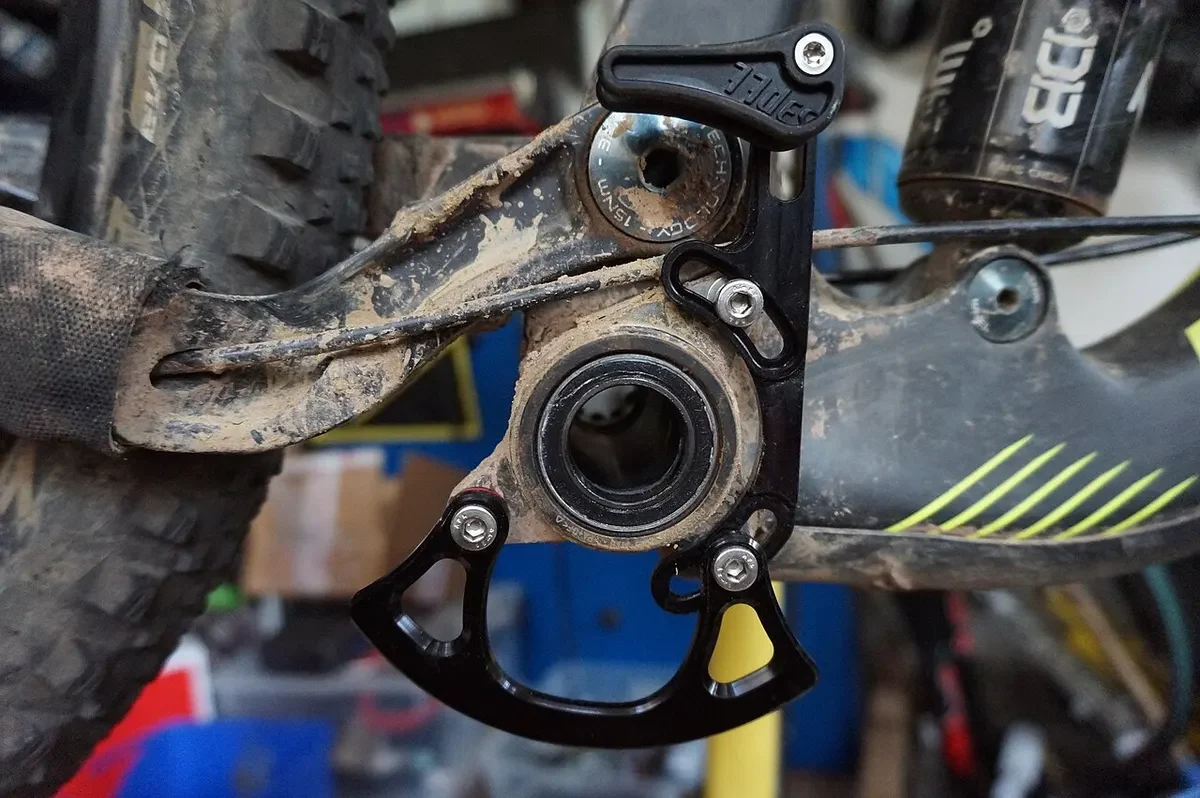
A machined chain guide is a back plate that bolts to the ISCG tabs on the bottom bracket shell, carrying a guide that keeps the chain on the chainring and, on a bash guard, a plate that protects the ring. The drawing has to settle four things first: which tab standard the frame uses, the tooth range, the chainline and the materials of the plate and the guide. The rest is machining detail.
Start with the tab standard
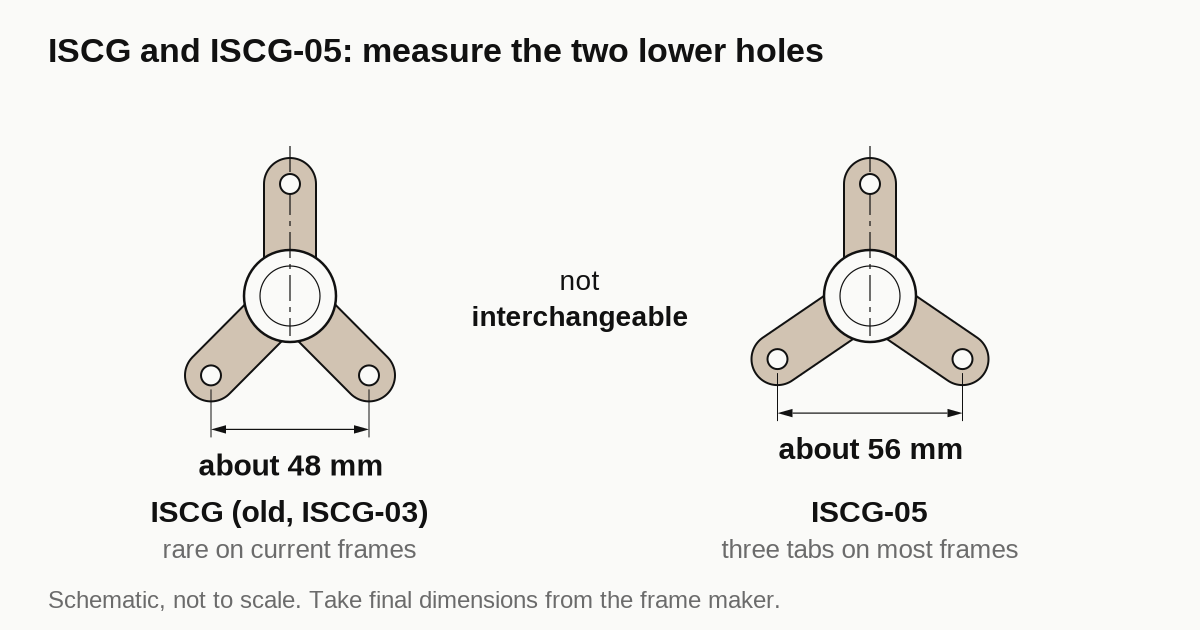
ISCG stands for International Standard Chain Guide. Hive’s service guide says the system was developed by a number of companies to give frame makers a consistent pattern in 2003. The original pattern is called ISCG-03, ISCG-old or plain ISCG. ISCG-05 came later, made by drivetrain and frame makers to set tighter rules and improve compatibility.
You cannot tell them apart by eye. MRP’s guidance is to measure the two lower holes center to center: about 48 mm for standard ISCG and about 56 mm for ISCG-05. MRP adds that standard ISCG has been rare on mainstream bikes for over a decade, so a frame with three tabs is most likely ISCG-05. A German glossary gives the same two numbers but calls them bolt circle values of about 47.8 and 55.9 mm. The sources do not agree on whether the figures are hole spacing or bolt circle, so the drawing should not rest on either. Take the pattern from the frame maker’s drawing and state the tab thickness and the hole thread.
Three more points belong in the quote request:
- Two-tab frames. MRP notes that some frames have only two tabs, and guards made for three mount points should not be used on them.
- Out-of-spec tabs. OneUp’s listing names several frame models its ISCG 05 guide will not fit because their tab placement is out of spec. A matching standard does not guarantee a fit, so send the frame list with the RFQ.
- No tabs. Some guides clamp at the bottom bracket, between the bottom bracket and the crankset. That changes the bottom bracket stack and the chainline. The T47 and BSA cup guide covers the cup widths involved.
Tooth range and chainline
A guide only works over the chainring sizes it was made for. Listings show the range clearly. One MRP guide is listed for 32 to 36 teeth and chainlines from 49 mm, and one OneUp guide for a 26 to 38 tooth range with 7.5 mm of chainline adjustment, using five spacing shims. Both work with oval and round rings. The tooth range sets the radius of the guide profile, and the chainline adjustment sets slot lengths or shim thickness, so both need numbers on the drawing, with a tolerance.
Chainline also links the guide to the crank and the ring. Our chainring guide and the crank arm guide cover the neighboring parts, and the chainline table in the reference standards lists the common values. Ask the buyer which crank and ring the guide must clear, and test the first article on that exact set.
Material choices
| Part | Typical choice | Why | What to specify |
|---|---|---|---|
| Back plate | Machined aluminum, for example 7075 | Stiff, light, takes anodize | Alloy and temper, thickness, flatness of the tab seat face |
| Top guide | Glass-reinforced thermoplastic or UHMWPE | The chain slides on it, so it wears instead of the plate | Material grade, color, replaceable or fixed |
| Bash ring | Machined aluminum, often part of the back plate | Takes strikes from rocks and logs | Thickness, edge radius, tooth range |
| Hardware | Stainless steel | Sees mud and water | Thread, length, head type, thread locker |
The 7075 and stainless choices come from one maker’s listing, so treat them as typical, not as a rule. The 6061 versus 7075 guide and the 7075 temper guide cover the alloy choice.
UHMWPE is worth a short note because it is a common sliding surface. Wikipedia gives its density as about 0.93 to 0.94 g/cm³ and its Shore D hardness as about 60 to 65. It has a friction coefficient significantly lower than nylon and acetal, comparable to PTFE, and better abrasion resistance than PTFE. It is also self-lubricating with low moisture absorption, which suits a part that lives in mud. Those are material properties, not a guide design. We found no public test standard for a chain guide or a bash guard, so there is no impact value to quote. Agree a test with the buyer, such as a defined strike or a defined chain-drop test on a rig, and write it into the first article requirements.
Need a quote for this part? Get a quote for your bike parts
Anodize and the seat faces
A chain guide plate sits flat against the frame tabs, so the anodize on its seat face adds to the stack. Wikipedia’s anodizing article says the oxide grows into and out of the surface equally, so each surface grows by half the coating thickness. It also says Type II is roughly 1.8 to 25 µm thick, and Type III is thicker than 25 µm. On a thin plate with a tight stack, the coating on both faces and in the bolt holes matters. Decide whether the seat faces and bores are masked or machined to a size that allows for the growth. The Type II versus Type III guide and the anodize growth calculator give the numbers, and color matching matters if the plate must match a ring or a crank.
Hardware
Retailer listings show M6 hardware on aluminum guides. One 77designz connector lists M6 bolts with a Torx 25 drive and a length of 11 mm, and an MRP guide ships with three bolts, six washers and two spacers. These are directional, since bolt length depends on the plate thickness and the tab. Put the thread, the length range and the washer or spacer stack on the drawing, along with a torque and thread locker. Taking the values from the frame maker is safer than copying a retailer listing.
For other frame-mounted parts built the same way, our page on brackets and mounts lists the checklist, and the disc brake mount guide covers a similar flat-seat problem.
What to put on the drawing
- Tab standard and the measured hole spacing, with the frame maker’s drawing as reference
- Number of mount points and bolt thread
- Tooth range and chainline range, with tolerance
- Plate alloy, temper and thickness, and flatness of the seat face
- Guide material and whether it is replaceable
- Anodize type, thickness and masked areas
- Hardware list, torque and thread locker
- A named frame and crank set for the first article fit check
Common mistakes
- Choosing ISCG by name, not by measurement. The two patterns do not interchange.
- Ignoring frames with out-of-spec tabs. A guide that fits the pattern may still not fit the frame.
- No tooth range on the drawing. The guide profile is made for a ring size.
- Anodize on the seat face with no allowance. The stack changes by up to the full coating thickness.
- Inventing a bash test. Agree the method with the buyer first.
Send the frame list, the pattern and the first article requirement through the RFQ page. We quote the finished parts within 24 business hours and place the work with a partner shop that cuts plates like this.
Sources
- Hive, ISCG explained
- MRP, tech resources (ISCG and ISCG-05)
- pedali.de, ISCG glossary entry
- bike-components, MRP SXg 2-bolt chain guide listing
- MTB Direct, OneUp ISCG 05 chain guide listing
- bike-components, 77designz crash plate connector listing
- Wikipedia, Ultra-high-molecular-weight polyethylene
- Wikipedia, Anodizing
Frequently asked questions
What is the difference between ISCG and ISCG-05?
Both are three-hole mounts on the bottom bracket shell, but they are not compatible. MRP says ISCG-05 tabs are roughly 56 mm apart and standard ISCG tabs roughly 48 mm apart, measured between the two lower holes. Standard ISCG has been rare on mainstream bikes for over a decade, so three tabs usually means ISCG-05.
What material is a CNC chain guide made from?
The back plate is usually machined aluminum. One maker lists a 7075 aluminum back plate with a glass-reinforced thermoplastic top guide, held by stainless steel hardware. UHMWPE is another common guide plastic because it has low friction and good abrasion resistance.
Can I fit a chain guide to a frame with no ISCG tabs?
Some guides mount at the bottom bracket instead, clamped between the bottom bracket and the crankset. MRP recommends that route over an adapter, because an adapter may push out the chainline. Check the cup width and crank clearance on the real frame first.
How many bolts does a chain guide use?
Most full guides use three, one per tab. Some designs use two and mount on the lower two tabs only. MRP also warns that frames with only two tabs should not take guides made for three mount points.
Need a quote for this part?
Send the drawing. We quote the finished parts, place the work with a partner shop that machines bike parts and reply within 24 business hours.
Get a quote for your bike parts