Guides / For Shops
Cost of Poor Quality in Anodized Bike Parts: Strip, Re-anodize, Scrap
November 21, 2026
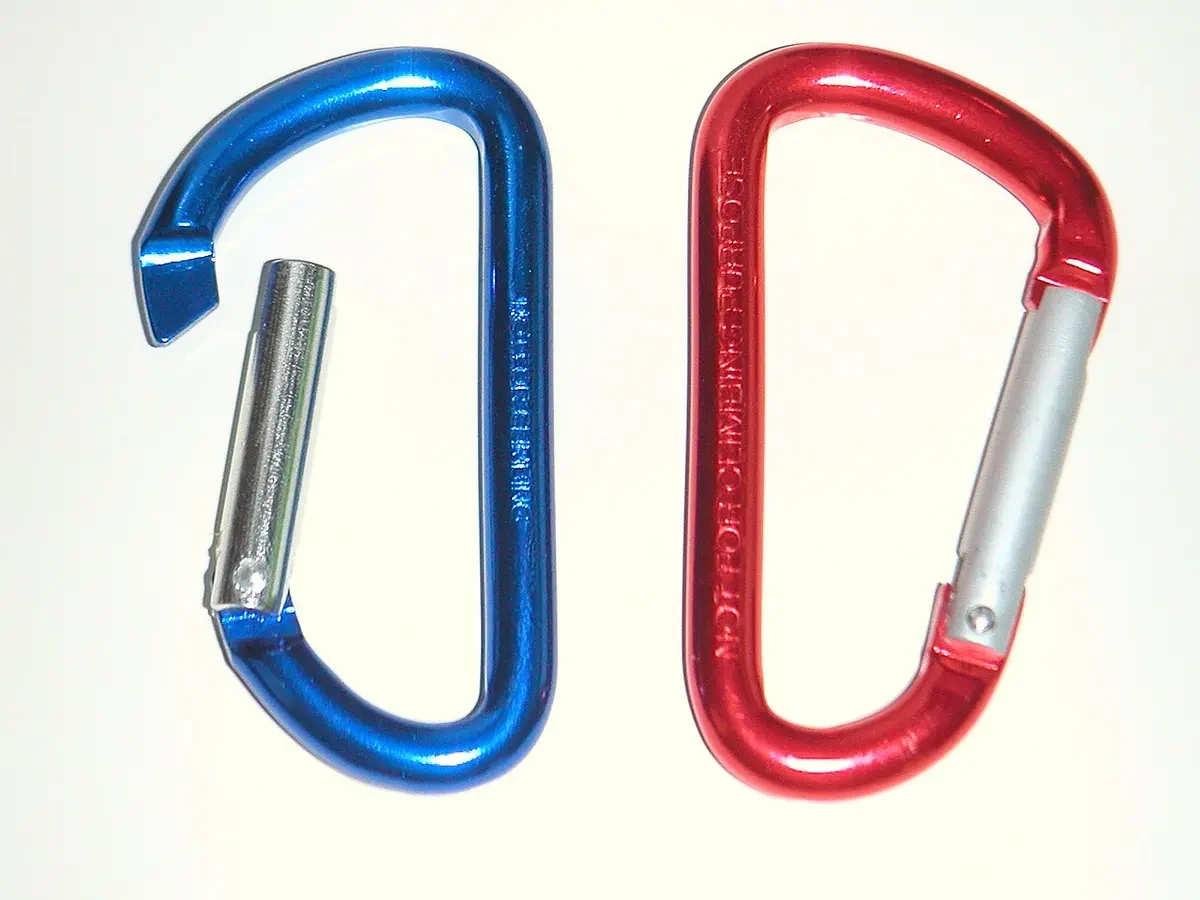
Anodize is the last step on most bike parts and the one that spoils the most work. A part with a good bore, a clean thread and a perfect edge comes back from the finisher with the wrong shade, a rack mark on a visible face or a coating thick enough to close a fit, and the shop has paid for machining that now needs a second loop. Most shops know that loop costs money. Few have written down how much, line by line. This guide shows how to count it with four cost categories and a worksheet, and where prevention pays first on short runs.
Why anodize rejects hurt short runs most
A bike brand’s order is often a few dozen to a few hundred pieces, as our guide to how machine shops win bike parts work describes. Anodizing is priced by the rack or batch, so a small run pays close to the full cost of a batch whatever the piece count, a point our guide to anodizing in house or through a partner makes with a collar example. When a lot comes back wrong, the shop pays that batch cost again, plus the transport, the handling and the delay, and spreads it over a small number of good parts.
The same loop on a long run is a smaller share of the whole. That is arithmetic, not a measured effect, and we found no public data on reject rates for anodized bike parts. Count your own.
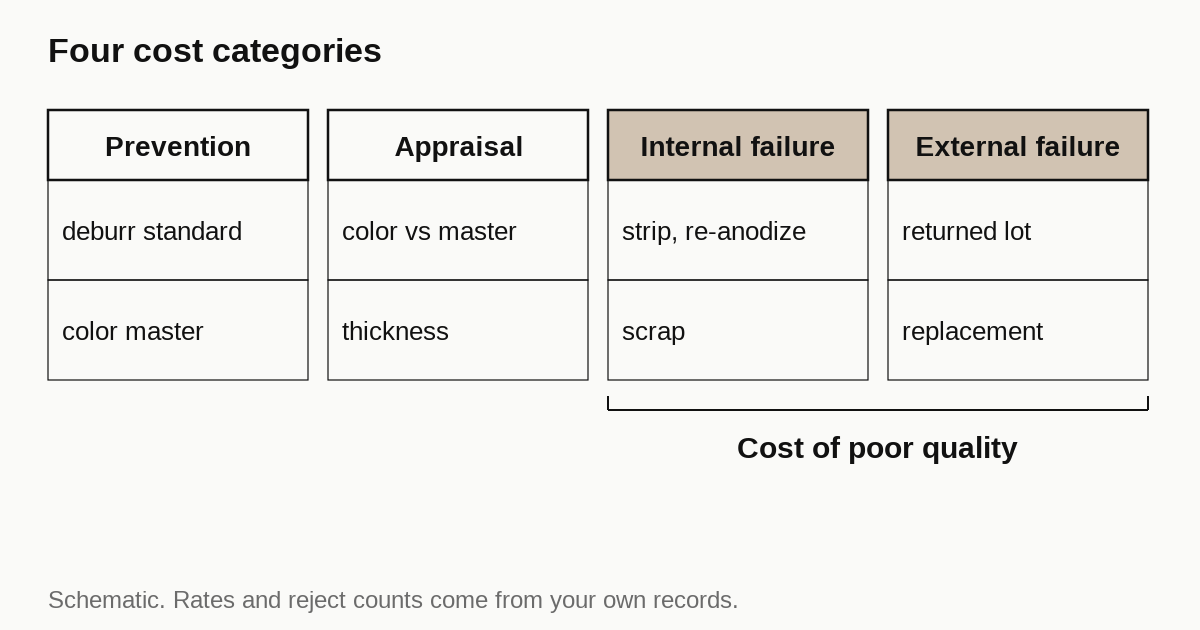
Prevention, appraisal, internal and external failure costs
Quality references split the cost of quality into four categories. Wikipedia’s page on cost of poor quality names them prevention, appraisal, internal error and external error costs, and calls the first two controllable and the last two resultant. Other sources say internal and external failure.
| Category | Meaning | Examples on an anodized bike part |
|---|---|---|
| Prevention | Spent to stop defects happening | Deburring step and standard, rack design, masking plugs, color master approval, finisher agreement |
| Appraisal | Spent to find defects | Color check against master, thickness reading, post-anodize dimension check, gauge calibration |
| Internal failure | Defects found before delivery | Strip and re-anodize, re-inspection, rework, scrap, lost machine time, delay |
| External failure | Defects found by the customer | Returned lots, replacement parts, freight, a warranty claim traced to your lot, time spent on the complaint |
The cost of poor quality is the two failure rows. Prevention and appraisal are the cost of keeping failures low. The aim of the worksheet is not to push the failure rows to zero but to see which row is largest and what moves it.
Costing a strip and re-anodize loop
Count every step of the loop. A shop that counts only the finisher’s charge usually undercounts.
- Pull the lot. Receive, count and quarantine the parts, and write the nonconformance note.
- Decide. Someone looks at the parts, the master sample and the drawing. That time is cost.
- Strip. The finisher removes the coating, which is a separate charge.
- Rework. Polish, re-blast or re-deburr if the surface needs it before the second coat.
- Check size. Anodizing grows the part outward by about half the coating thickness on each surface, so a bore loses about the full coating thickness in diameter. Wikipedia gives Type II coatings as roughly 1.8 to 25 micrometers and Type III as thicker than 25. A second coat adds that growth again to whatever size the strip left behind.
- Re-rack and re-anodize. A second batch charge, plus a new color match if the dye bath has changed.
- Re-inspect. Color against the master, thickness, dimensions on the fit features.
- Re-pack and re-ship. A second transport if the finisher is a partner.
- Delay. The brand’s date moves, and that has a cost to the relationship that no ledger shows.
On step 5 the facts are limited. Practitioners on a metal finishing forum disagree about how much base metal a strip removes, one saying a dedicated strip works without much affecting the base metal and another that anodize penetrates the surface, so stripping loses some size. We found no published figure, so ask your anodizer what its process removes and measure the critical bores and threads after the strip. Some parts will not come back into tolerance, and those are scrap.
Warranty returns as external failure
External failure is the expensive row, because the part is on a bike and the problem is the brand’s too. A returned lot carries freight, a replacement lot, the time of everyone who handles the complaint and, if the cause is not found, a doubt about every other lot. If the brand needs to trace a problem to a lot, the lot marking and records described in our guide to lot marking and warranty tracing decide how many parts the doubt covers. Count the external failure row separately from internal failure, even if you have only one entry in it so far.
Where to spend first: deburring, racking, color approval
Spend in the order that your own worksheet ranks. In our view, three prevention items repay first on anodized work.
- Deburring before anodizing. Sharp edges and burrs take coating unevenly and show as defects. Our guide to deburring bike components before anodizing covers the methods. A written deburr standard with a limit sample is prevention, and the check at the end of the step is appraisal.
- Racking and masking. A rack contact mark on a visible face is a rack design problem. Agree the contact points with the finisher once and keep them the same.
- Color approval before the run. A master sample and a pilot lot compared against it, as in our guide to color matching across bike part batches, catch the color problem when it affects a few parts and not the whole lot.
Prevention has a cost too, and the worksheet shows it. Whether a prevention step costs less than the failures it replaces depends on your shop, your reject history and your rates. The worksheet is how you find out, and we do not offer a general ratio because we found no public one.
Need a quote for this part? Get a quote for your bike parts
COPQ worksheet
Fill this in for one lot, one month or one part number. Use your own rates. Leave a line blank if it does not apply.
| Category | Line | Quantity | Rate | Cost |
|---|---|---|---|---|
| Prevention | Deburring step and standard | |||
| Prevention | Rack and masking design | |||
| Prevention | Color master approval | |||
| Prevention | Training and finisher agreement | |||
| Appraisal | Color check against master | |||
| Appraisal | Thickness and post-anodize dimension check | |||
| Appraisal | Gauge calibration | |||
| Internal failure | Quarantine, note and decision time | |||
| Internal failure | Strip charge | |||
| Internal failure | Rework before second coat | |||
| Internal failure | Second batch charge | |||
| Internal failure | Transport both ways | |||
| Internal failure | Re-inspection and re-pack | |||
| Internal failure | Scrap (material and machining already spent) | |||
| External failure | Returned lot freight and replacement | |||
| External failure | Complaint handling time | |||
| Total cost of poor quality (the two failure categories) | ||||
| Divide by good pieces shipped |
Example: a chainring batch with a color mismatch
The numbers below are assumptions chosen to show the arithmetic. They are not a benchmark for any shop.
A shop machines a batch of 60 chainrings. After anodizing, 14 are visibly a different black from the approved master. The batch goes back for strip and re-anodize, and 2 of the 14 come back out of tolerance on a bore and are scrapped.
| Line | Quantity | Rate (assumed) | Cost |
|---|---|---|---|
| Strip and second batch charge | 1 rack | 180 | 180 |
| Transport both ways | 1 | 60 | 60 |
| Re-inspection of color and thickness | 1.5 hours | 55 per hour | 82.50 |
| Dimension recheck on 14 pieces | 1.4 hours | 55 per hour | 77 |
| Scrap, 2 pieces | 2 | 38 each | 76 |
| Internal failure total | 475.50 |
Divide by the 58 good pieces and the loop adds about 8.20 to each. The shop’s own cost is not the whole picture: the brand’s lot arrives later, and the brand pays for that in its own calendar. A color approval on the pilot lot, which takes someone’s time and a master sample, sits in the prevention row. Whether it would have caught this mismatch depends on whether the dye bath or the alloy changed between the pilot and the batch, which is why the change notice described in our guide to telling a bike brand about an anodizer or bar change matters too.
Talk to us
If your shop wants bike brand work, register on the supplier page. Work requests carry the part, material, quantity, tolerance, finish and deadline. You quote us and, if price and lead time work, we place the purchase order with you. No orders are promised.
Sources
- Wikipedia, Cost of poor quality
- Wikipedia, Anodizing
- Finishing.com, practitioner Q&A on stripping anodize and dimensional change (directional)
- Wikimedia Commons, Cheap carabiners.JPG

Frequently asked questions
What is cost of poor quality?
The money a shop spends because work was not right the first time: scrap, rework, re-inspection, returns and the time spent explaining them. Quality references split it into internal failure, found before delivery, and external failure, found after. Prevention and appraisal are the money spent to avoid or detect failures.
Can a rejected anodized part be stripped and anodized again?
Often, yes, but it is not free. Stripping removes the coating, and practitioners on a metal finishing forum disagree on how much base metal goes with it, from very little to some. We found no published figure. Anodizing grows the part again, so check critical bores and threads after the second coat.
Why do anodize rejects hurt short runs most?
A small run pays for a rack and a batch, and a reject loop adds a second batch charge, transport and inspection to the same few parts. On a large run the same loop is spread over more good pieces. The effect is arithmetic: fixed cost divided by fewer parts.
Where should a small shop spend first?
On the causes that show up as rejects: deburring before anodizing, racking and contact marks, and a color master approved before the batch. They sit in the prevention and appraisal categories. Whether they cost less than the failures they replace depends on the shop, and a filled-in worksheet shows it.
Need a quote for this part?
Send the drawing. We quote the finished parts, place the work with a partner shop that machines bike parts and reply within 24 business hours.
Get a quote for your bike parts