Guides / Design
Machining Thru-Axles: Thread Pitch, Material and Fatigue
November 1, 2026
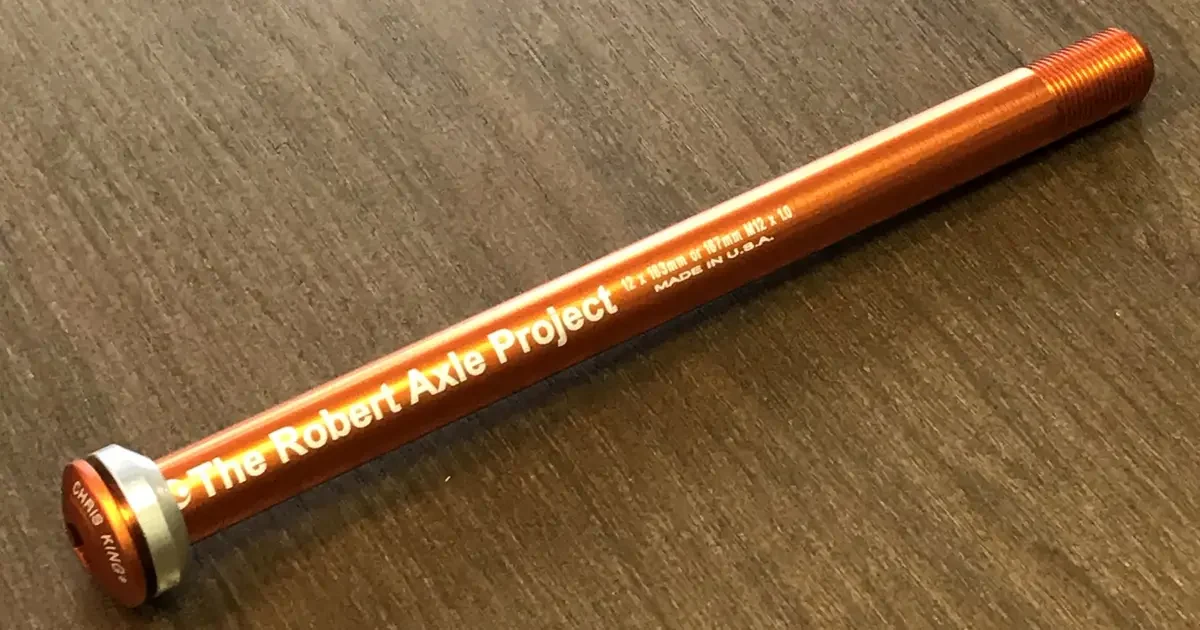
A thru axle is essentially a threaded bolt slid through the bicycle wheel hub from one side. It looks simple, and a brand can buy thousands of them with little thought. The risks sit in four places: the thread, the length, the material and the radii. This guide covers what to put on the drawing and what to ask a machine shop before a quote.
What a thru axle has to match
The axle is a bridge between three other parts: the hub, the frame or fork and, at the rear, the derailleur hanger. Wikipedia’s thru-axle article notes that axle length and thread pitch must be chosen to match the frame and derailleur hanger. The hub sets the diameter, the frame or fork sets the thread and the dropout fit, and the whole assembly has to clamp the wheel without play.
Hub spacing tells you what diameter and length family you are in. Sheldon Brown’s spacing sheet lists a rear 148 mm Boost spacing for mountain bikes with a 12 mm thru axle, a front Boost 110 mm for hubs with 12, 15 or 20 mm thru axles and a rear 142 mm spacing for 12 mm axles. The hub spacing table on this site lists the common pairs. Treat that table as a starting point and take the real data from the frame or fork maker.
Thread pitch is not a standard
Most 12 mm thru axles use a metric thread, and a metric M12 thread has a coarse pitch of 1.75 mm and fine pitches of 1.5 mm or 1.25 mm in the ISO 262 table. Thru axles sit on the fine side:
| Axle | Listed thread | Source type |
|---|---|---|
| M12 through-axles shown in the Wikipedia article | 1.5 mm pitch on two axles, 37 mm thread length on two | Encyclopedia, photo captions |
| Syntace X-12, 12 mm rear, 142 and 148 versions | M12, pitch 1 | Retailer listing |
| NEWMEN 12x148 and Burgtec 12 mm rear axles | M12 x 1.0 and 1.00 mm pitch | Retailer listing titles |
| Fox Kabolt 15x110, 15 mm front | M15 x 1.5, aluminum, 155 mm | Retailer listing |
The listings are not drawings, so treat them as directional. The point they make is firm: 1.5 mm and 1.0 mm pitches both exist on 12 mm axles, and the difference is hard to see by eye. A wrong pitch can start into the thread and then bind, which is how a frame thread gets damaged. The axle in the photo at the top of this page is marked M12 x 1.0. Take the thread from the frame or fork maker, and measure it when the data is missing.
Put the thread on the drawing as designation, pitch, class and length: for example, thread type, thread length and the standard that defines it, with the frame or fork maker’s drawing as the reference. Thread length matters as much as pitch. The axles pictured in the Wikipedia article show thread lengths from 13.5 mm to 37 mm, so thread engagement is a design choice for each frame. Thread milling and tapping both cut the internal thread in a frame, covered in the thread milling guide.
Material and where it fails
The common materials for a machined axle are 7075 aluminum, 4130 chromoly, 17-4 PH stainless and titanium. The existing guides cover each: 7075 tempers, 4130 chromoly, 17-4 PH hardware and Grade 9 titanium. The Fox Kabolt listing names aluminum for an axle, so aluminum is a normal choice, with the thread diameter sized to carry the load.
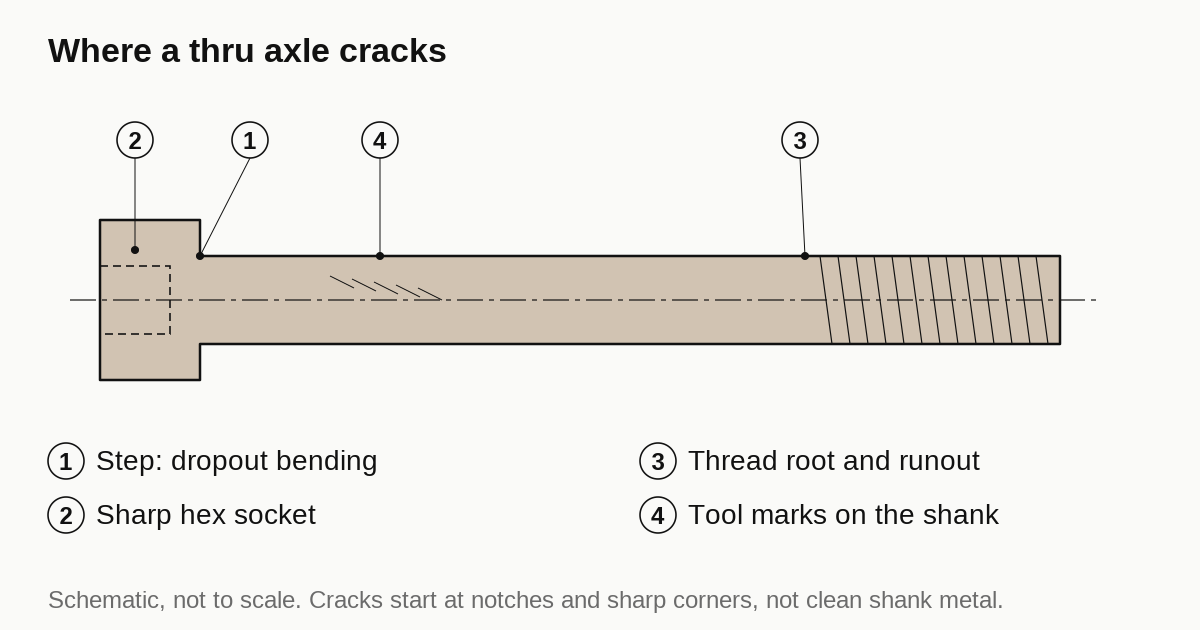
Wikipedia’s fatigue article lists geometric stress concentrators such as a sharp internal corner or fillet as common crack starting points. On a thru axle the main places are:
- The thread root, where the axle is thinnest and the thread form acts as a series of notches.
- The step between head and shank, where bending from the dropout concentrates.
- The drive socket, where a deep or sharp-cornered hex raises stress in the head.
- Tool marks across the shank near the dropout.
The countermeasure is geometry first and process second. Specify a generous radius at the head and at the thread runout, a smooth finish on the shank and a stated thread class. Rolled threads are stronger than cut threads, with tensile strength gains of 10 to 20 percent, and the Wikipedia article says the fatigue gain may be larger. On a small run a shop may cut the thread instead, so ask which one the quote assumes. The shot peening guide covers a further step.
Galling and the aluminum thread
An aluminum axle in an aluminum frame thread is a galling risk. Wikipedia’s galling article says aluminum “will gall very easily” and that threaded inserts of hardened steel are often used in metals that gall. That is why many frames carry a steel insert or a thread in a harder part, and why the axle thread needs a stated finish and lubrication. If you change the axle material or finish, test the thread against the real frame, not a bench gauge.
Need a quote for this part? Get a quote for your bike parts
Anodize and the dimensions
Anodize grows into and out of the surface by equal amounts, so each surface grows by half the oxide thickness. A threaded end and the journals where hub end caps seat need either a mask or a stated size after coating. Wikipedia notes that thick coatings may lower fatigue life, though anodizing may also help by preventing corrosion pitting. The article gives no fatigue figures, so test the exact finish. The Type II versus Type III guide and the anodize growth calculator cover the numbers.
What to put on the drawing
- Axle diameter with tolerance, and the length with tolerance
- Thread designation, pitch, class and thread length, taken from the frame or fork maker
- Material, temper and specification
- Radii at the head and thread runout, and the drive socket depth
- Rolled or cut thread
- Surface finish on the shank and finish of the thread
- Anodize type, thickness and masked areas
- Torque from the frame or hub maker, since torque is not a standard value
- Inspection: thread gauge, length and diameter check, first article report
The derailleur hanger guide and the hub shell guide cover the parts that sit beside the axle.
Common mistakes
- Taking the thread from the old axle. Old axles may be a different pitch or worn.
- Choosing length by guess. Length must fit the frame and hanger.
- A cut thread with a sharp runout. It is the weakest point on the part.
- Anodizing the thread with no allowance. The axle may not start into the frame.
- No torque on the drawing. The user has no number to follow.
Send the drawing and the frame or fork data through the RFQ page. We quote the finished parts within 24 business hours and place the work with a partner shop with axle experience.
Sources
- Wikipedia, Thru-axle
- Sheldon Brown, Hub spacing crib sheet
- Wikipedia, ISO metric screw thread
- bike-components, Syntace X-12 thru-axle listing
- bike-components, thru-axle listings (NEWMEN, Burgtec)
- bike-components, Fox Kabolt 15x110 listing
- Wikipedia, Thread rolling
- Wikipedia, Galling
- Wikipedia, Fatigue (material)
- Wikipedia, Anodizing
Frequently asked questions
What thread pitch does a thru axle use?
There is no single pitch. Published M12 axles show a 1.5 mm pitch, Syntace X-12 style rear axles are listed at 1.0 mm and a 15 mm Fox axle is listed as M15 x 1.5. Pitch is hard to judge by eye, so measure the frame or fork thread before you draw the axle.
Can I use any thru axle with a given frame?
No. Axle length and thread pitch must match the frame and the derailleur hanger, and the diameter must suit the hub. A wrong pitch can start into the thread and damage it. Take the thread data from the frame maker's drawing, not from the old axle.
Is a CNC thru axle weaker than a standard one?
Not by default. Fatigue life depends on the alloy, the thread form, the radii and the finish. Rolled threads gain 10 to 20 percent in tensile strength over cut threads and may gain more in fatigue resistance, so ask whether the thread is rolled or cut.
Should a thru axle be anodized?
Often yes for color and wear, but the coating adds thickness. Each surface grows by half the oxide thickness, so a threaded end and the hub journals need either a mask or a stated post-anodize size. Thick hard anodize can also lower fatigue life.
Need a quote for this part?
Send the drawing. We quote the finished parts, place the work with a partner shop that machines bike parts and reply within 24 business hours.
Get a quote for your bike parts