Guides / Design
Machining Platform Pedals: Bodies, Spindles and Bearings
October 31, 2026
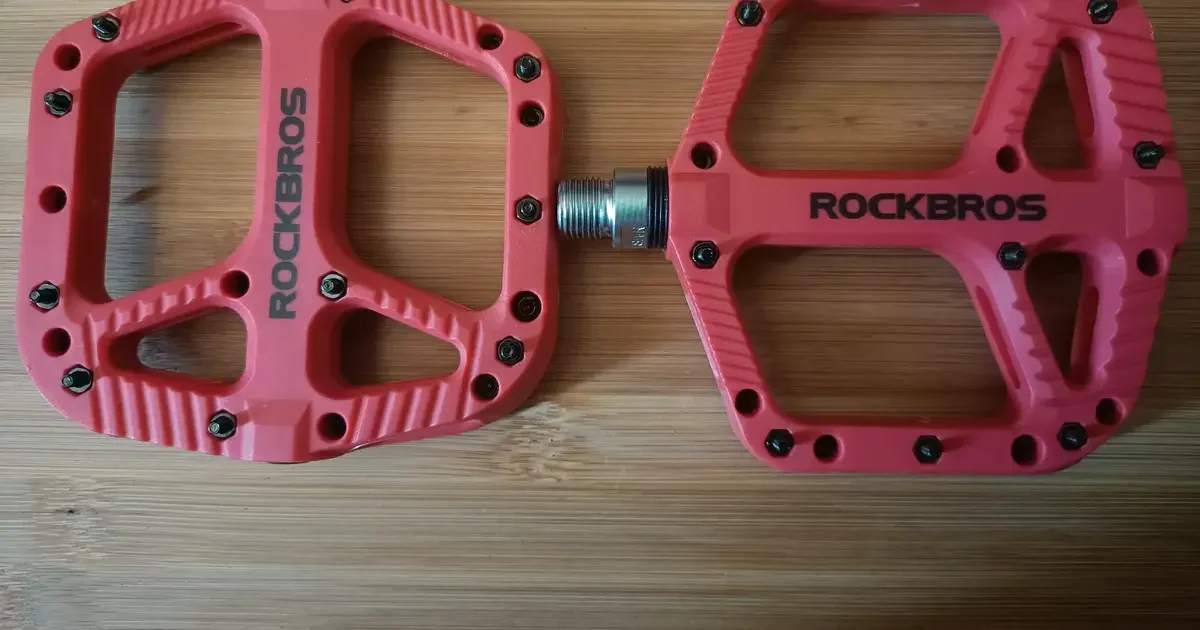
A platform pedal looks like one part and is really three: a body that carries the foot, a spindle that threads into the crank and a bearing set between them. A machine shop can make all three, but the drawing must make them agree. This guide covers the thread rules, the bearing options, what each part needs on the drawing and where machined pedals tend to fail.
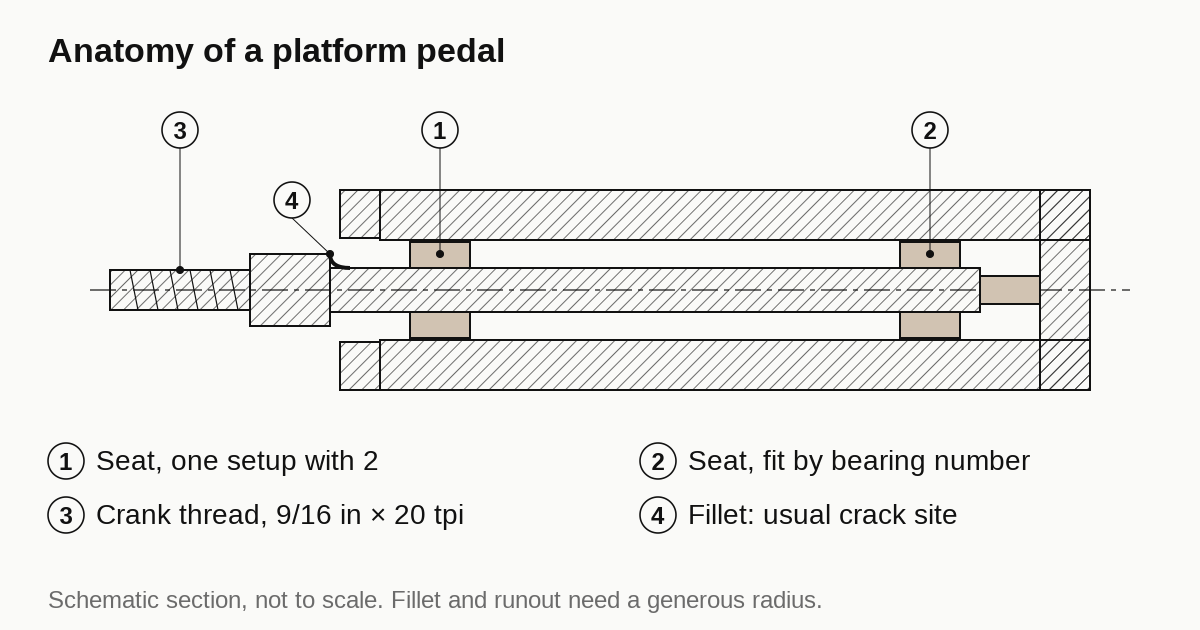
How a platform pedal is built
The spindle threads into the crank. The body, which carries the foot platform, rotates on bearings around that spindle. Everything else is a variation: how the bearings are made, how the body is shaped and how the traction pins are fitted.
The thread is the part with no freedom. Multi-piece cranks use a 9/16 inch by 20 tpi hole (14.28 mm by 1.27 mm pitch). One-piece cranks use 1/2 inch by 20 tpi. The right pedal has a normal thread and the left pedal a left-hand thread, because left pedals kept unscrewing before the reverse thread was adopted. Old French spindles are M14 x 1.25, which starts into a 9/16 inch crank and then binds. Park Tool puts typical pedal torque at about 360 inch-pounds, which is roughly 40 Nm, with grease on the threads. The pedal spindle thread is cut slightly smaller than the crank thread, so the spindle must be inside tolerance and free of burrs. The standards table lists the thread data with its sources.
Three bearing options
| Bearing type | How it works | What it means for the body |
|---|---|---|
| Sealed cartridge | Pre-assembled ball bearings that cannot be opened | Two precise bearing seats in the body bore, bearing part number on the drawing |
| Self-lubricating bushing | A sleeve in the body bore, more tolerant of dirt, replaced when worn | A bore sized for the bushing’s press fit, a shoulder for end float |
| Cup and cone | Loose balls, usually 1/8 inch, in a cup with a cone and locknut | A machined cup, adjustable and rebuildable, more parts and more skill to assemble |
The type decides the body. A cartridge pedal needs two seats that are coaxial and a known width between shoulders. A bushing pedal needs a bore with the right finish for the bushing’s fit. Cup-and-cone needs a cup profile and a thread for the locknut. Choose before the body is drawn. Retrofitting a bearing type into a finished body is not a design change, it is a new part. The bearing press fit guide covers bore tolerance, and the Delrin and nylon guide covers plastic bushings.
What the body needs on the drawing
The body is the part a shop prices. Most of its cost sits in the profile, the pockets and the number of setups. Aluminum is the common material for machined bodies and magnesium appears on lightweight models, with corrosion risk covered in the magnesium guide. On the drawing, state:
- Material and temper, for example 6061-T6 or 7075-T6, and whether it is billet or plate
- The bearing part number and the seat fits, not only the bore diameter
- Coaxiality between the two seats, referenced to the spindle axis, because that callout tells the shop how to hold the part
- The pin layout: pin count, thread, hole depth and whether pins are replaceable
- Platform edge radii and the concave profile, with the surface finish
- Anodize type, thickness and which surfaces to mask
Replaceable pins are a feature buyers ask for, since metal pins or studs give grip when pedals are wet or muddy. Fix the pin first, then dimension the hole to suit it. Pin holes are blind threaded holes in aluminum, and thread engagement and depth matter, so see the thread milling guide.
Anodize changes every fit in the body. Each surface grows by half the oxide thickness, so a bore that is anodized closes in by about the full coating thickness. A bearing seat should be masked, or machined oversize so it lands in tolerance after coating. The anodize growth calculator does the arithmetic.
What the spindle needs
The spindle is a turned steel part with four zones: the crank thread, the wrench flats or hex socket, the bearing journals and the retention feature at the outer end. It carries bending from every pedal stroke, so its weak point is the transition where the thread meets the shoulder. Fatigue cracks start at geometric stress concentrators such as a sharp internal corner or fillet. A thread runout with a tight radius is a notch, so put a generous radius on the drawing and keep tool marks out of that zone. A rolled thread has better fatigue resistance than a cut one, and the thread rolling article gives a 10 to 20 percent gain in tensile strength as a reference point. The 4130 chromoly guide and the shot peening guide cover steel and surface treatment.
The wrench interface matters too. Pedal spindles have wrench flats, an Allen fitting on the inner end or both. Park Tool notes that some pedals have an 8 mm hex fitting in the back side of the pedal thread. If the design uses one, the hex must be deep enough for a real tool to seat.
Need a quote for this part? Get a quote for your bike parts
What goes wrong
- Bearing seats cut in two setups. If the body is flipped and the second seat re-located, the seats are not coaxial. The pedal drags and wears early.
- Anodize on a bearing bore. The press fit changes and the bearing either will not seat or spins in the bore.
- A sharp radius under the spindle shoulder. It is the most likely place for a spindle to break.
- Mixing thread standards. A French spindle in a 9/16 inch crank damages the crank. Check the crank on the drawing.
- A pedal that passes assembly and fails the test. A body that survives hand loading can still crack under a dynamic durability run.
Standards and testing
ISO 4210-8 specifies the pedal test methods: static strength, impact and dynamic durability. The current edition is the 2023 revision, which replaced the 2014 edition and tightened the wording on test specimens for pedals. A lab test belongs in the cost of any new pedal. The ISO 4210 overview and the test lab guide explain how to book it and what to send.
In the US, 16 CFR 1512.16 requires essentially colorless or amber reflectors on the front and rear of each pedal on a bicycle, either built in or attached, and recessed from the pedal edge. Check whether your pedal is sold with a bicycle or as an aftermarket part, and confirm the rules for your market with a compliance specialist.
No public price survey exists for machined pedals, and shop quotes vary by body profile and finish. Compare quotes against the same drawing and make sure each one states the bearing, the finish and the inspection.
Before you ask for quotes
- Pick the bearing type and the part number.
- Confirm the spindle thread and the crank standard.
- Mark the bearing seats and the coaxiality callout.
- State the anodize type and the surfaces to mask.
- Name the test you plan to run on production-intent parts.
Send the drawing through the RFQ page. We quote the finished parts within 24 business hours and place the work with a partner shop with pedal experience.
Sources
- Sheldon Brown, Pedals
- Wikipedia, Bicycle pedal
- Park Tool, Pedal installation and removal
- BSI, BS EN ISO 4210-8 (2014 edition, withdrawn January 2023)
- Show Daily, ISO 4210 reissued
- Cornell LII, 16 CFR 1512.16 Pedal reflectors
- Wikipedia, Anodizing
- Wikipedia, Thread rolling
- Wikipedia, Fatigue (material)
Frequently asked questions
What thread does a platform pedal use?
Multi-piece cranks take a 9/16 inch by 20 tpi pedal thread, right-hand on the drive side and left-hand on the non-drive side. One-piece cranks use 1/2 inch by 20 tpi. French spindles are M14 x 1.25 and bind in a 9/16 inch crank, so mixing them damages the crank.
Which bearings do platform pedals use?
Three types appear: sealed cartridge bearings, self-lubricating bushings and cup-and-cone bearings with loose balls. Cartridge and bushing types are replaced when worn, while cup-and-cone can be rebuilt. The choice drives the body bore design, so settle it before drawing the body.
Does a bike pedal need a standard test?
ISO 4210-8 specifies pedal tests for static strength, impact and dynamic durability. In the US, 16 CFR 1512.16 adds reflector rules for pedals on bicycles. Brands also run their own durability tests, so plan a lab run on production-intent parts.
Which metal should a CNC pedal body be?
Aluminum is the common choice for machined bodies, and magnesium appears on lightweight models. For a machined body, 6061 or 7075 from billet are the usual starting points, and the spindle is a separate turned part that carries the bearing journals.
Need a quote for this part?
Send the drawing. We quote the finished parts, place the work with a partner shop that machines bike parts and reply within 24 business hours.
Get a quote for your bike parts