Guides / Materials
Acetal and Nylon Bike Parts: Bushings, Spacers and Pulleys
October 15, 2026
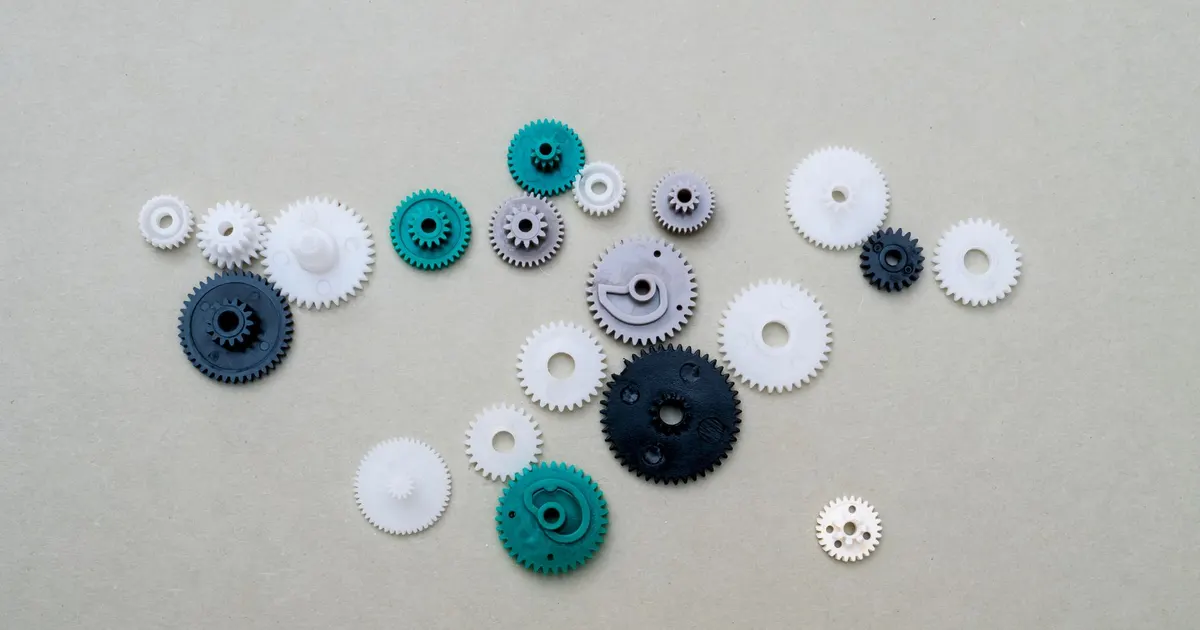
Not every machined bike part is metal. Behind a derailleur there is a pulley wheel made of plastic. Inside a suspension linkage a polymer bushing carries a pivot. A spacer between a chainring and a crank, a cable guide, a chain slider: all are often cut from rod or plate of acetal or nylon. These parts are cheap, quiet and light. They are also easy to get wrong, because plastics do not behave like metal.
The two plastics
Acetal, also called POM or polyoxymethylene, and sold as homopolymer under the Delrin name, is a stiff, slippery, dimensionally stable plastic. It has low friction and good fatigue resistance. Acetal copolymer is a close relative with better chemical and hot-water resistance and less porosity at the center of thick rod.
Nylon, also called polyamide or PA, comes in several grades. Nylon 6/6 and nylon 6 are the common ones. Nylon is tougher than acetal under impact and wears well, but it absorbs water, which changes size and stiffness.
| Property | Acetal (POM) | Nylon 6/6 |
|---|---|---|
| Density | About 1.41 g/cm³ | About 1.14 g/cm³ |
| Elastic modulus | About 2.8 to 3.1 GPa | About 2.0 to 3.0 GPa dry, lower when wet |
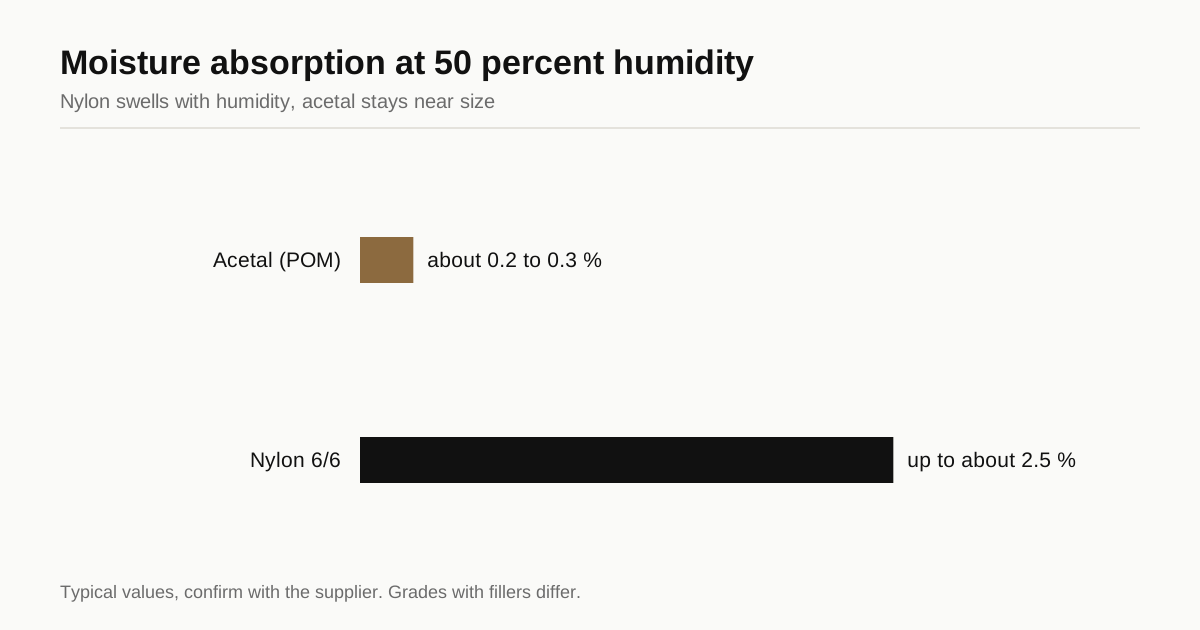
| Moisture absorption | About 0.2 to 0.3 percent | Up to about 2.5 percent at 50 percent humidity, more when wet |
| Friction against steel | Very low | Low |
| Impact toughness | Good | Very good |
| Continuous use temperature | About 90 degrees Celsius | About 100 degrees Celsius and above |
| UV resistance | Poor without stabilizer | Fair, better with black grades |
These are typical values for orientation. Grades with glass fiber, lubricant or other additives differ. Acetal is covered by ASTM D6778 and nylon by ASTM D4066, and the plastic maker’s datasheet is the reference for design.
Where they appear on a bike
- Derailleur pulley wheels. Acetal or nylon pulleys run quiet and light, often with a bushing or bearing in the center. The pulley guide covers the metal alternatives.
- Bushings and wear pads. In suspension pivots and linkages, plastic bushings carry the load of the joint with low friction.
- Spacers and washers. Between mixed materials, to isolate aluminum from steel or carbon.
- Chain guides and sliders. The part that sees the chain.
- Cable guides and housing stops. Low-load parts.
- Seatpost shims and clamp liners. Parts that protect carbon from clamp pressure.
- Insulating parts in e-bike assemblies
For motor mounts and structural brackets, plastics do not replace metal. They go where friction, noise or isolation matter more than strength.
Choosing between them
Choose acetal when dimensional accuracy matters. A bushing that has to hold a bore tolerance of a few hundredths needs a plastic that does not change size with the weather. Acetal also has the lowest friction against steel, which suits sliding parts.
Choose nylon when impact and wear matter more than size. A chain slider that gets hit by a chain benefits from nylon’s toughness. Nylon also tolerates a slight misalignment, as it is more flexible.
Choose a filled grade when needed. Nylon with molybdenum disulfide or oil is made for bushings. Glass-filled nylon is stiffer. Acetal with PTFE has even lower friction. State the grade on the drawing, not just the base plastic.
Machining plastics
Plastics machine easily but not like metal.
- Sharp tools. Use high positive rake angles and polished flutes. Dull tools melt and smear plastic instead of cutting it.
- Low heat. Plastics soften at fairly low temperatures and conduct heat poorly. Use air blast or a light coolant, and avoid dwelling.
- Stress relief. Plastic bar and plate have internal stress from extrusion or molding. Cutting releases it, and the part moves. Annealed stock and rough-then-finish machining reduce the problem.
- Light clamping. Plastics deform under clamp pressure and spring back when released, leaving the machined size wrong. Soft jaws and gentle clamping help.
- Thread strength. Threads cut in plastic are weak. Use a metal insert for any thread that sees torque. See the thread guide.
Typical machining tolerances on plastic are looser than on aluminum. Plus or minus 0.05 to 0.1 mm is a normal range. Tighter is possible on small parts, at a cost.
Thermal expansion and fits
Plastics expand far more than metals. Acetal expands about 100 to 110 micrometers per meter per degree Celsius, which is four to five times as much as aluminum. A plastic bushing in an aluminum housing grows faster than the housing when it warms, so an interference fit gets tighter in heat and looser in cold.
For a bushing, the usual approach is a light press fit in the housing and a running clearance on the shaft, with allowance for expansion and for the bore closing slightly when pressed in. The plastic maker’s design guide gives clearances. For a bearing seat in metal, see the bearing fit guide, since plastic follows different rules.
Creep and steady load
Plastics keep deforming under steady load. A bolt tightened through a plastic spacer loses preload as the plastic creeps. The effect is larger at higher temperature and higher stress.
For a spacer in a bolted joint, the fix is to use a metal sleeve inside the plastic, or to design the joint so the bolt load goes through metal. For a bushing, keep the bearing stress below the maker’s limit, and check that the part does not squash over time. A part that works on the bench at 20 degrees may soften in a hot e-bike motor housing.
Colors and finish
Plastic rod comes in natural, black and a few colors. Black is usually UV-stabilized, which suits parts exposed to sun. Natural acetal is white to off-white and will chalk in UV over time. Color can only be changed by choosing stock, not by dyeing in most cases.
Machined plastic parts have tool marks that show. A smooth surface needs fine finishing passes, light polishing or vapor smoothing. Parts for sliding contact benefit from a smooth finish.
Cost and minimums
Plastic rod and plate are cheap compared with aluminum and far cheaper than titanium. Machining time is short. For small runs, a part is priced by machine time and setup, and the unit cost is low. For high volumes, injection molding takes over, since tooling pays off at thousands of parts. The low MOQ guide explains where machining stops being the right process. For prototypes, machining acetal and nylon gives accurate parts that behave like molded ones, in days.
What to put on the drawing
- Material with grade and form: “Acetal copolymer (POM-C) rod, natural, annealed”
- Tolerances realistic for plastic, with the reference temperature and humidity for tight fits
- Which surfaces slide, and the required finish on them
- Whether threads are cut in the plastic or in an insert
- Operating temperature range
- Color or UV requirement
Common mistakes
- Writing a metal tolerance on a plastic part. Plus or minus 0.01 mm is not realistic on a part that changes size with temperature and humidity.
- Using nylon where size matters. A nylon bushing in a humid climate grows and binds.
- Threading plastic for a high-torque bolt. Use a metal insert.
- Ignoring creep. A plastic spacer in a bolted joint loses preload over weeks.
- Skipping UV protection. Natural acetal chalks in sunlight. Use a black stabilized grade for parts that sit outdoors.
Plastic parts are cheap enough to test. Order a small batch, fit it to the assembly and run it through the temperatures it will see before committing to volume.
Plastics are covered with the metals in our guide to the best material for CNC bike parts.
Send the drawing through the RFQ page and we match you with up to 3 machine shops. They reply within 24 business hours and can say what plastic stock they hold.
Frequently asked questions
Is Delrin the same as acetal?
Delrin is a brand name for acetal homopolymer (POM-H). Acetal copolymer (POM-C) is sold under other names and behaves very similarly. On a drawing, write acetal or POM and the form, and say whether homopolymer or copolymer is required.
Why does a nylon part change size?
Nylon absorbs moisture from the air and swells, so a part machined dry gets larger in humid conditions. Acetal absorbs far less. For parts with tight fits, choose acetal or specify the conditioning state of the nylon.
Can plastic parts take the loads of a bike?
For bushings, spacers, guides and light pulleys, yes. They are not used for primary structure. Check the load, the temperature and the creep over time, since plastic keeps deforming under steady load where metal does not.
Need a quote for this part?
Send the drawing. We match you with up to 3 shops that machine bike parts and reply within 24 business hours.
Get matched with a bike parts shop