Guides / Design
Machining Pulley Wheels and Derailleur Cages: Tooth Profile and Fits
October 22, 2026
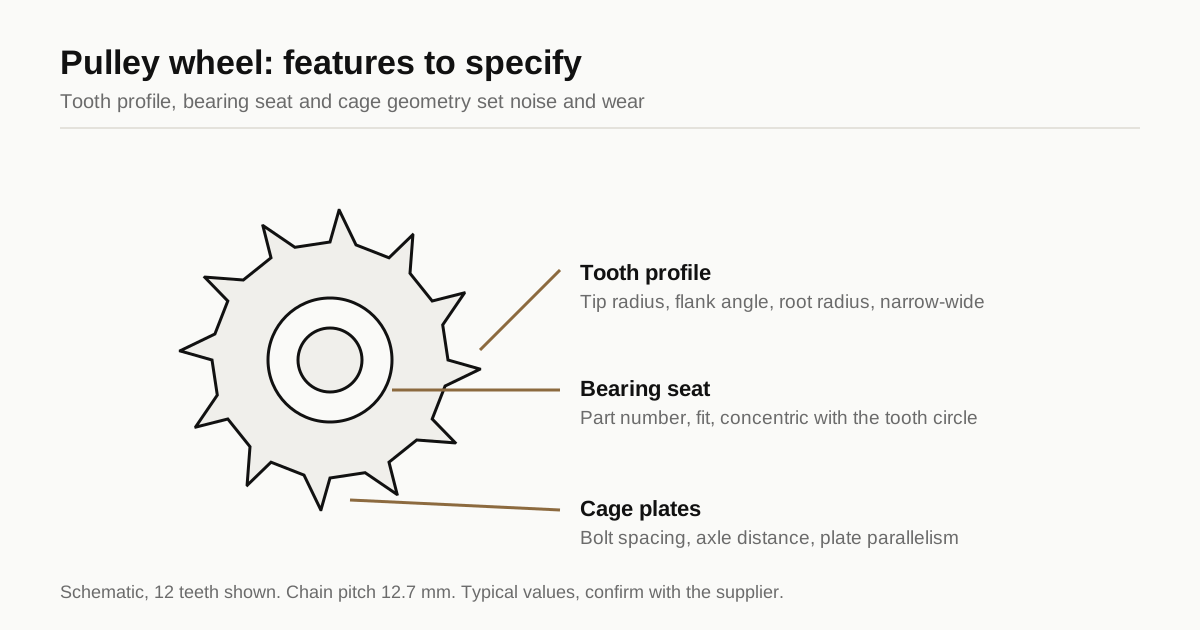
A derailleur has two small wheels in a cage that guide the chain and keep tension. They turn on bearings or bushings, and every pedal stroke the chain wraps around them. The wheels are small and look like trivial parts. In practice they are precision gears. A pulley wheel with a poor tooth profile or wobbly bearing seat runs noisy, wears fast and throws the chain at the wrong moment. Aftermarket pulley wheels and cages are a popular machined product, and they reward careful drawings.
What the wheel has to do
A pulley wheel has four jobs.
- Guide the chain laterally, so it stays in line through the cage.
- Engage the chain with teeth that match the pitch and the link widths.
- Spin freely on a bearing or bushing with little friction.
- Last through grit, mud and years of wear.
The chain has an inner width between the inside plates and an outer width over the outside plates. Modern chains use a pitch of 12.7 mm (half inch). Chain widths differ by speed count, since 11 and 12 speed chains are narrower than 8 and 9 speed. A pulley wheel cut for one chain width does not necessarily run well on another. The inner gap of modern chains is around 5 mm. Measure the chain you are targeting and take the dimension from the chain maker’s data.
Narrow-wide teeth
Narrow-wide teeth alternate in width around the wheel. The narrow teeth enter the inner gaps of the chain, between the inner plates. The wide teeth are thicker and fit the larger gap between the outer plates. The result is a chain that sits more securely and has less side-to-side play.
The same idea is used on narrow-wide chainrings, where it retains the chain on 1x drivetrains. On a pulley wheel the benefit is smaller, since the chain is under tension and wraps about half the wheel. But the shape is common on premium pulleys, and it keeps noise and wear low when tuned to the chain.
The tooth profile is a precise shape. The tip radius, the flank angle and the root radius all matter. A profile that is slightly off lets the chain ride up on the tooth tip or bind at the root. Shops that make chainrings often have a validated profile. For pulleys, ask the shop whether it can supply or copy a profile and how it checks it. An optical comparator or a CMM scan is the usual check, as explained in the gauging guide.
Typical wheel details
| Item | Typical figure | Notes |
|---|---|---|
| Tooth count | 10 to 17 teeth standard, 15 to 19 oversized | Oversized wheels need a longer cage |
| Chain pitch | 12.7 mm | Half-inch pitch |
| Center bearing | 688 (8 x 16 x 5 mm) in many designs | Check the maker’s drawing |
| Wheel mass | 8 to 20 g | Depends on size and material |
| Bearing seat fit | Light press or transition | See bearing fit guide |
These are typical values for orientation. The derailleur maker’s drawing is the reference for any specific part. The bearing table lists the sizes that turn up most often.
Cutting the teeth
The teeth are cut in one of three ways.
- Milling with a small end mill on a 3-axis or 4-axis machine, tooth by tooth. Flexible, but slow and the profile is made of straight steps.
- Wire EDM for steel or stainless wheels, cutting the whole tooth profile in one pass with a continuous wire. Accurate and clean, but slower and costlier per piece.
- Turning and form cutting on a lathe with live tooling, using a form cutter to produce the tooth profile.
For aluminum wheels in volume, a milling process on a machine with a 4th axis is common. A fixture holds the blank on its bore, and the machine cuts the teeth and the hub step in one or two setups. The bore must be finished first, since it is the datum for the teeth. See the axis comparison guide for how setups affect cost.
Edge quality matters. A burr on a tooth edge catches the chain and makes noise. Break the edge lightly, as the deburring guide explains.
Bearing seat and bolt fit
The center of the wheel carries a bearing, a bushing or a sleeve on a bolt. The seat must be concentric with the tooth circle. If it is off by a few hundredths of a millimeter, the teeth wobble, the chain tension varies and the wheel is noisy. Concentricity between the seat and the tooth tip circle is the key callout.
The bolt that holds the wheel in the cage is usually an M5 or M4 with a step. The bolt step must clear the bearing inner race and not press the outer race. If a pulley is not free after assembly, the cause is often a stack-up error. Add dimensions for the bearing width, the wheel step and the cage spacing, and check them on a first assembly with real parts.
Cage plates
The cage holds the two wheels between two plates. The plates are made from aluminum, steel or composites, and the aftermarket ones are usually CNC machined from 6061 or 7075 plate. Key features:
- Bolt hole spacing and position that match the derailleur body, within a position tolerance
- Pulley axle holes with accurate center distance, since the distance sets chain wrap
- Plate thickness and flatness, with plates parallel to each other once assembled
- Chain slot clearances, wide enough to avoid rubbing on a chain at an angle
- Standoffs or spacers that set the gap between the plates
Slotted holes for chain length adjustment are common on larger cages. Tolerances on position and parallelism are usually 0.05 mm or better. A cage whose plates are not parallel makes the chain rub on one side. Check the final assembly on a flat plate.
Weight pockets and cutouts in the cage plates are common. Keep them away from bolt holes and thin bridges, and radius the inside corners. The cage sees the chain tension and impacts from the ground, so a cut that weakens a bridge can crack. The weight versus strength guide explains how to place material.
Materials and wear
| Material | Wear life | Weight | Notes |
|---|---|---|---|
| 6061-T6, hard anodized | Fair | Light | Common, low cost |
| 7075-T6, hard anodized | Good | Light | Stronger teeth |
| Stainless steel | Excellent | Heavy | Wire EDM cutting |
| Acetal or nylon | Good, quiet | Very light | Cheap, see the plastics guide |
| Titanium | Good | Light | Expensive, may gall |
Aluminum teeth wear quickly in grit unless hard anodized. A Type III coating raises wear resistance greatly but reduces fatigue strength, which is not a concern for a wheel that is mostly compressed. The Type II versus Type III guide covers the coatings. Remember that anodize grows into the bearing seat and the tooth flanks, so account for it in dimensions. Use the growth calculator.
Testing
Run a bench test with a real chain at the speeds and tensions of use. Check noise, chain retention and temperature of the bearing. Track wear over a few hundred hours or kilometers. An aftermarket pulley with poor bearing quality can fail inside a season. Request a sample of the chosen bearing, with its data sheet, before approving production.
What to put on the drawing
- Chain model and width the tooth profile is made for
- Tooth profile drawing or CAD file, with tip and root radii
- Tooth count and pitch circle diameter
- Bearing part number, seat size, tolerance and concentricity
- Bolt step and stack dimensions
- Material, finish, hard anodize thickness and masking of the bearing seat
- Cage plate hole positions, parallelism and flatness
- Inspection plan: profile check and concentricity
Send your drawing through the RFQ page and we match you with up to 3 machine shops. They reply within 24 business hours.
Frequently asked questions
What does narrow-wide mean on a pulley wheel?
The teeth alternate between a narrow shape that fits the inner gap of a chain link and a wide shape that fits the outer gap. It matches the chain's alternating link widths so the chain sits more securely. The idea is borrowed from narrow-wide chainrings.
Do oversized pulley wheels help?
A larger pulley wheel, with more teeth, bends the chain through a gentler angle and can lower friction a little. The gain is small and measured in watts. The cage must be machined to hold the larger wheel and keep chain wrap. Quality of the bearing and the alignment matter more.
Which material suits a pulley wheel?
7075 or 6061 aluminum, often hard anodized for wear. Steel and stainless steel last longer in tooth wear but weigh more. Plastic wheels are quiet and cheap. Choose on wear life against weight and cost.
Need a quote for this part?
Send the drawing. We match you with up to 3 shops that machine bike parts and reply within 24 business hours.
Get matched with a bike parts shop