Guides / Choosing a Shop
What Lean Looks Like in a Bike Parts Machine Shop: Signs on a Visit
November 21, 2026
A bike brand that visits a machine shop usually sees machines, a tidy bay and a friendly owner. All of that can be arranged. What cannot be arranged in an afternoon is the way the work moves: where parts wait, how fixtures are stored, whether the first piece is measured before the batch runs and whether the board on the wall shows today or last month. This guide turns those signs into a 20-point checklist you can score on the floor. It reads lean practice as evidence of discipline. It is not a promise about delivery or quality, and we say where the evidence stops.
Why lean matters to a bike brand
Lean is a set of methods for doing work with less waiting, searching and rework. The ones that show on a shop floor have Japanese names, and the Lean Enterprise Institute (LEI) and other lean references define them in plain terms. Three are used below. Genba means the actual place where the work is done, so a genba visit means looking at the work where it happens. 5S is a workplace organization method built on five Japanese words, usually translated as sort, set in order, shine, standardize and sustain. Visual management means keeping tools, materials, production activities and performance indicators in open view so that anyone can read the state of the system at a glance, which is how LEI puts it.
For a brand, the interest is practical. A shop that cannot find a fixture takes longer to start your second order. A shop that does not measure the first piece finds the error on the last piece. A shop whose parts wait three days for an anodize rack tells you, if you ask, why your lead time is what it is.
We found no public study that links these signs to on-time delivery for bike parts, so treat a high score as a reason to look closer, not as a guarantee.
Flow: where parts wait between machining and anodize
LEI describes continuous flow as moving items through a series of processing steps as continuously as possible, one at a time or in a small, consistent batch. A job shop is not a flow line, but the idea still applies: look for the places where parts stand still.
On a bike part route the long waits are usually before the first operation, between machining and deburr, and between deburr and the finisher. Our guide to lead time for machined bike parts explains why finishing is a batch step. At the visit, look for:
- a marked staging area for each stage, not parts on any free bench;
- a tag on every tray with part number, revision, lot and next operation;
- a rule for how long finished parts may sit before the next step;
- parts that move in small, defined lots and not as a pile that grows.
Example, crank arm cell. Ask where a crank arm blank is after the second operation. In a shop with flow, the answer is a place and a tag. In a shop without it, the answer is a search. Ask where crank arms wait for anodize and who decides when a rack is full.
5S and fixture storage
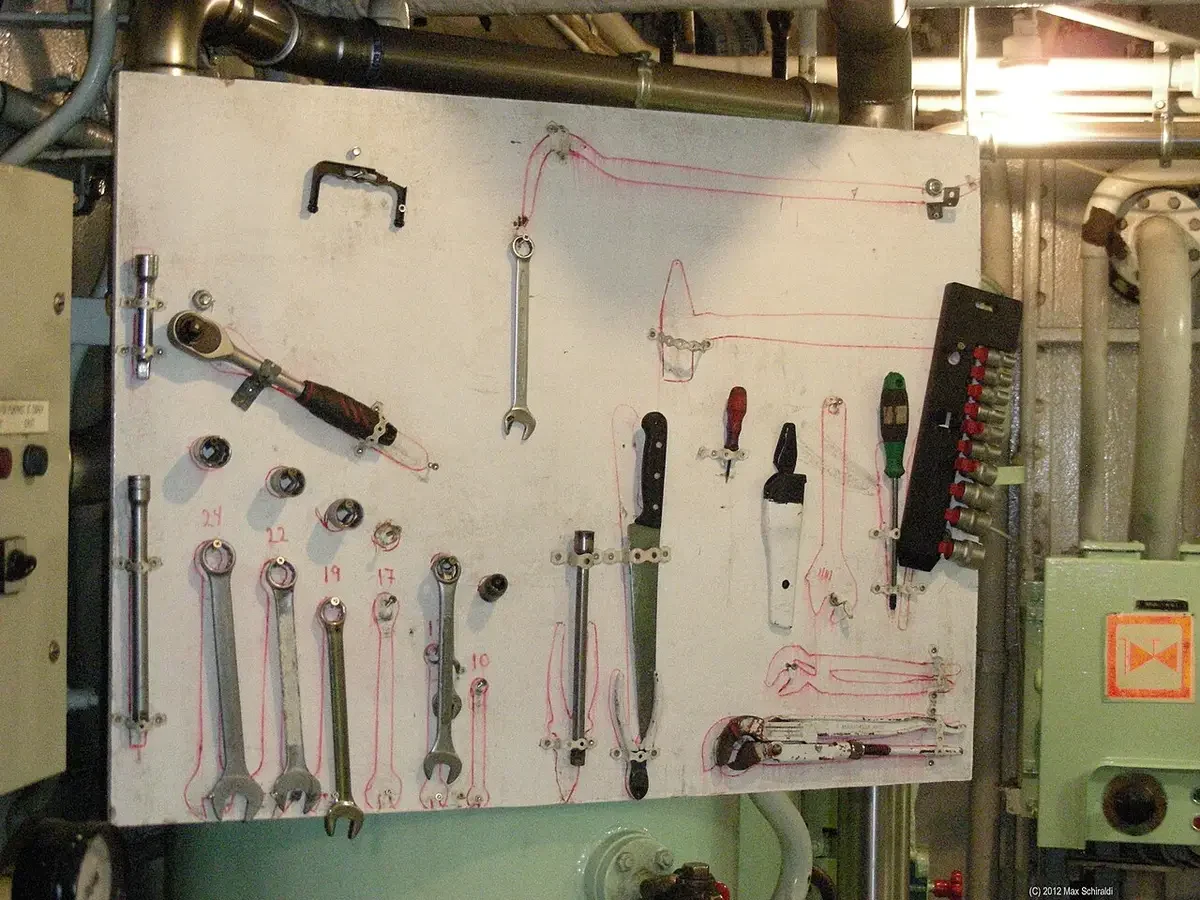
Wikipedia lists the five terms as sort, set in order, shine, standardize and sustain, and notes that the fourth is often mistranslated. For a visit, the useful ones are set in order (a marked place for every tool, gauge and fixture) and shine (cleaning that doubles as inspection of the machine).
ISO 9001:2015 has a clause on the environment for the operation of processes, clause 7.1.4. Practitioner summaries describe it as asking an organization to work out the conditions its processes need, such as temperature, humidity, cleanliness and lighting, to provide and maintain them and to keep records. It does not mention 5S by name, but a shop that controls those conditions has usually done the housekeeping too. A shop does not need an ISO certificate to show this.
Fixture storage is the sign that matters most for repeat bike orders, because the second order starts from the shelf. Our guide to fixturing for repeat bike part runs describes labeled soft jaw sets and plates with part number and revision. At the visit, ask to see the fixture for a part that shipped last quarter, and time how long it takes to find.
Setup and first-piece checks
Watch a setup if you can. The signs to look for are a written setup sheet at the machine, the tool list and offsets recorded for the job, and a first piece that is measured against the drawing and not only looked at. Ask where the first piece goes, who signs it and what happens if it fails.
Example, stem cell. A stem has a bar clamp bore, a steerer clamp bore and a faceplate with threaded holes. Ask which of those are measured on the first piece, with which gauge, and whether the thread is checked with a go/no-go gauge. Our guide to gauging bike part interfaces lists the usual tools. A shop that answers by pointing at a form and a gauge is further along than one that answers with a description.
Boards that are updated today
Visual management only works if the board is current. Look for a schedule board or screen at the machines and read the date on it. Check that:
- the jobs on it match the jobs on the machines;
- late jobs are marked and have a reason written next to them;
- a quality board or sheet shows rejects and what was done about them;
- the people at the machine can explain the board without looking for the manager.
A board that is three weeks old is worse than no board, because it tells you the shop writes things down and does not read them.
Need a quote for this part? Get a quote for your bike parts
Visit scoring sheet
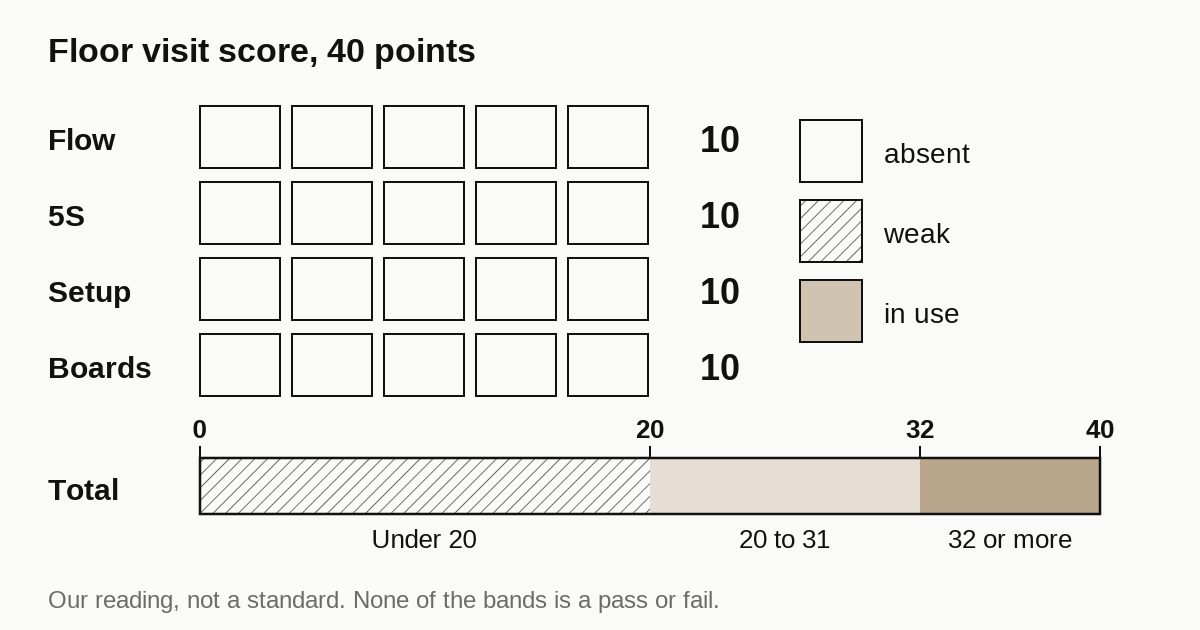
Score each point 0, 1 or 2: 0 means absent, 1 means present but weak or out of date, 2 means in place and in use today. The total is out of 40. The scale is our own and is not a standard. Agree with the shop beforehand that you are scoring a representative route, not auditing it.
| # | Area | What to look for | Score (0, 1, 2) |
|---|---|---|---|
| 1 | Flow | Marked staging place for each stage of the route | |
| 2 | Flow | Tag on every tray: part, revision, lot, next operation | |
| 3 | Flow | Parts move in defined small lots, no growing piles | |
| 4 | Flow | A rule for how long parts may wait before finishing | |
| 5 | Flow | The crank arm or stem blank can be found in minutes | |
| 6 | 5S | Every tool and gauge has a marked place | |
| 7 | 5S | Machines are clean and the cleaning also checks for leaks and wear | |
| 8 | 5S | Fixtures and soft jaws are stored labeled by part and revision | |
| 9 | 5S | A fixture from last quarter’s job is found in minutes | |
| 10 | 5S | A routine, with a name and a day, keeps the area in order | |
| 11 | Setup | Written setup sheet at the machine | |
| 12 | Setup | Tool list and offsets recorded for the job | |
| 13 | Setup | First piece measured against the drawing, not only looked at | |
| 14 | Setup | Critical thread or bore checked with a gauge | |
| 15 | Setup | First piece has a signature and a rule for a failure | |
| 16 | Boards | Schedule board is dated within the last working day | |
| 17 | Boards | Late jobs are marked with a reason | |
| 18 | Boards | Rejects and actions are shown | |
| 19 | Boards | Operators can explain the board | |
| 20 | Boards | Records of a shipped job can be shown within minutes |
How to read the total, in our view: 32 or more suggests a shop where the routine is real and worth a pilot lot. Between 20 and 31 suggests a shop with good habits in some areas and gaps in others, so ask about the low scores. Under 20 suggests that results depend on individuals. None of the bands is a pass or fail. A small shop with a 24 and an honest answer to every gap may serve you better than a polished 36 that hides its late jobs.
What the checklist does not cover
A visit does not replace the quality work. It does not prove capability on your tolerance, your finish or your color. Use the first article and the pilot lot for that, and read our guide on choosing a CNC shop for bike parts for the questions to ask before you visit. Ask also for the shop’s inspection plan and its records for a past job, since a shop that is tidy and has no records is a risk of another kind.
Send the drawing, then visit with it
Visit with your drawing in hand and ask the shop to walk it through its route. Send the drawing through the RFQ page and we quote the finished parts within 24 business hours and place the work with a partner shop that already machines and anodizes bike components.
Sources
- Lean Enterprise Institute, Visual management
- Lean Enterprise Institute, Continuous flow
- Wikipedia, 5S (methodology)
- Wikipedia, Genba
- The Core Solution, ISO 9001:2015 Clause 7.1.4 explained
- Wikimedia Commons, Shadowboard-mmschiraldi.jpg

Frequently asked questions
Does a clean shop mean good parts?
No. A tidy floor is a sign, not proof. Clean can be staged for a visit, and a busy honest shop can look rough. Use the visit to test whether the order is routine: ask to see yesterday's board, a setup sheet from last month and the records of a job that has already shipped.
What is 5S?
A workplace method built on five Japanese words usually translated as sort, set in order, shine, standardize and sustain. In a machine shop it shows up as tools and fixtures with a marked place, a clean machine that is inspected while it is cleaned, and a routine that keeps it that way.
Should a small brand visit a shop before ordering?
When the part is critical or the order is large, yes, and a video visit can cover much of the same ground. Ask the shop to walk the route a part of yours would take, from bar stock to packing, and to show records, not only machines.
Is lean the same as cheap?
No. Lean here means doing the work with little waiting, rework and searching. It can lower cost, but this guide uses it as a way to read the shop's discipline, and we do not give a savings figure because no public figure applies to bike part shops.
Need a quote for this part?
Send the drawing. We quote the finished parts, place the work with a partner shop that machines bike parts and reply within 24 business hours.
Get a quote for your bike parts