Guides / Design
Machining Headset Cups and Top Caps: Bearing Seats and Press Fits
October 21, 2026
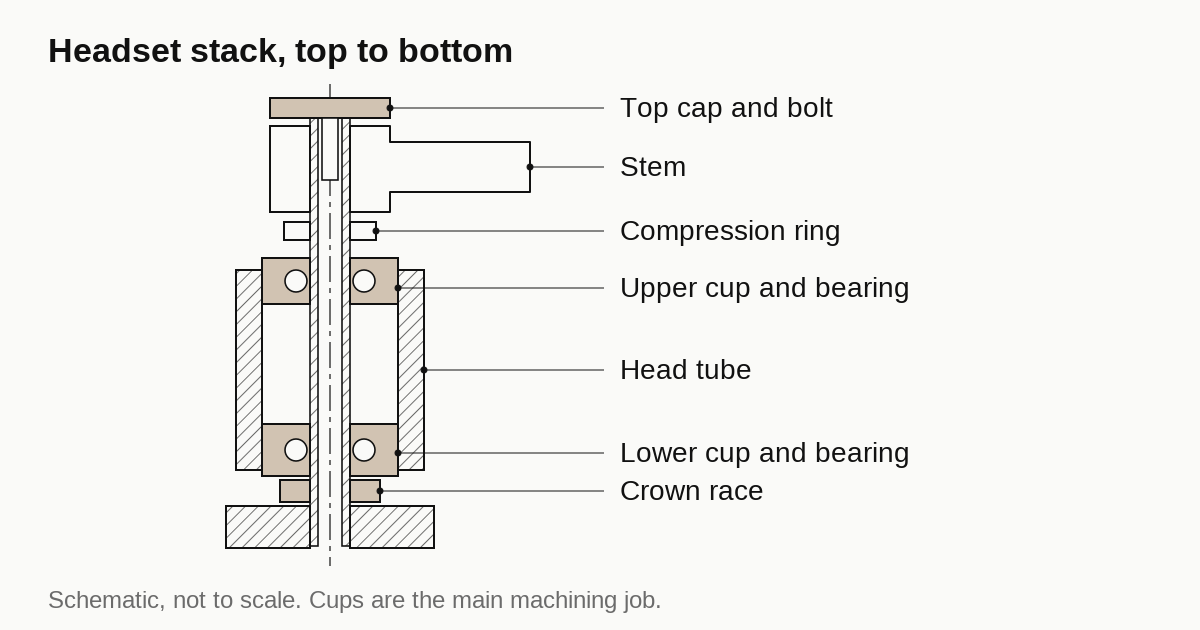
A headset lets the fork turn in the frame. It is a pair of bearings, one at the top and one at the bottom of the head tube, held in cups that press into the frame. Above them sit the stem and a small top cap that sets the bearing preload. The parts a CNC shop makes here are the cups, the crown race, the compression ring and the top cap. They share one theme: bearings need precise seats, and the head tube they fit in is a rough, welded structure. This guide covers what makes a headset cup work.
How a headset is built
From the bottom of the steering system up, the stack is:
- Crown race, a ring pressed onto the fork crown, that supports the lower bearing
- Lower bearing, in a cup in the bottom of the head tube
- Upper bearing, in a cup in the top of the head tube
- Compression ring or spacer, on top of the upper bearing, around the steerer
- Spacers and stem, which clamp the steerer
- Top cap and bolt, which pull the stem down onto the stack and set the preload
The steerer sizes are in the standards table: 1 1/8 inch (28.6 mm) is the default, with tapered steerers that grow to 1.5 inch (38.1 mm) at the bottom. Cup sizes follow the head tube bore. Common codes are ZS44 and ZS56 for press-fit cups, EC34 for external cups and IS42 and IS52 for integrated designs. The code gives a bore size in millimeters. Check the frame maker’s drawing and the headset standard before cutting.
Cups: the main machining job
A press-fit cup is a turned part with an outside diameter that fits the head tube, an inside seat for the bearing and a flange that sits against the head tube end.
Outside diameter. The cup presses into the head tube bore. The head tube is the weak link, since it is often reamed rather than finish-bored, and its bore varies between frames. A typical cup is made slightly larger than the nominal bore, by a few hundredths to about a tenth of a millimeter, so it grips by friction. The exact interference comes from the headset standard and the frame maker’s tolerance.
Bearing seat. The inside of the cup holds a bearing, often an angular contact cartridge bearing with a chamfered edge or a bearing that rests on a ramp. The seat must match the bearing maker’s drawing. A seat that is too tight distorts the bearing and makes the steering rough. One that is too loose lets the bearing creep and creak. Details on seat tolerances are in the bearing fit guide.
Concentricity. The outside diameter and the bearing seat must be concentric. If not, the steering feels notchy as the bearing is pressed off-axis. Turning the outside diameter and the seat in one chucking is the way to hold this.
Flange face. The flange sits against the end of the head tube. It must be flat and square to the axis. The head tube ends are usually faced by the frame builder, but not perfectly. A cup flange that is uneven rocks against the tube and creaks.
Edge chamfers. A lead-in chamfer on the outside edge helps the cup start straight in the press. A sharp edge can shave aluminum from the head tube or dig into carbon.
Why the head tube makes it hard
The cups must pair up. The top and bottom head tube bores should be concentric and parallel, since the two bearings define the steering axis. A frame with a misaligned head tube makes cups bind however good they are. Frame builders face and ream the head tube to fix this, and a good cup design tolerates small errors.
Aluminum head tubes are stiff and carry press-fit cups easily. Carbon head tubes are thin walled and sensitive to interference, since too much press can crack them. Steel and titanium head tubes sit in between. A cup maker supplying many frame types has to choose an interference that suits the worst case. State the head tube material and wall thickness on the drawing, or ask the frame builder for tolerances.
Thick coating on a cup makes the problem worse. Anodize grows on the outside diameter by a few micrometers, which raises the interference. A hard anodized cup can grow enough to need a lower interference target. See the growth calculator.
Crown race and compression ring
The crown race is a ring that presses onto the steerer’s base. For a standard 1 1/8 inch steerer, the seat on the fork crown is 39.8 mm in diameter, and the race presses onto it with a small interference. The seat is cut by the fork maker. The race must be a firm press without distorting. A cut slit in the race gives it spring, and it is common on split crown races. Details differ by headset standard, so use the fork maker’s drawing.
The compression ring sits between the top bearing and the first spacer. It is a split ring with a slight taper, and it guides the steerer into the bearing and keeps the stack tight. It needs a precise bore to clear the steerer, and a taper that matches the bearing top cover.
Need a quote for this part? Get a quote for your bike parts
Top cap
The top cap is the part most people see. It is a small turned disc with a center hole for a bolt, usually M6, and a low-profile head. A top cap does not carry steering loads. It pushes the stem down to set preload, then the stem bolts are tightened and the cap bolt stops working.
Machining is straightforward. The details that matter are:
- Bolt hole and counterbore, so the bolt head sits flush or slightly below
- Outer diameter that matches the stem top, with a small overhang
- Under-face flatness, so the cap sits evenly on the stem
- Edge break that avoids sharp edges where the rider’s knee or glove may touch
- Finish, typically anodize and laser mark
Top caps are an easy first product for a new brand, since they are quick and cheap and a good test of a shop’s cosmetic quality. An uneven color between the cap and the stem is easy to see, so the color matching guide is worth a read before ordering.
The preload bolt torque is low, a few newton meters, and set by the headset or stem maker. State it in the documentation. Over-tightening the cap bolt does nothing useful and can strip the star nut.
Materials and finish
| Material | Use | Notes |
|---|---|---|
| 6061-T6 | Most cups and caps | Anodizes well, light |
| 7075-T6 | Premium caps, crown races | Stronger |
| Stainless steel | Crown races, compression rings | Wear surface, heavy |
| Titanium | Premium caps and cups | Light, galls on aluminum |
Aluminum cups in aluminum head tubes can seize or corrode in a wet environment. Grease at installation helps. Cups in carbon frames need care about galvanic contact between aluminum and carbon, which is why many designs use plastic isolators or a coating. State the installation instructions.
For wear surfaces such as the bearing ramp, hard anodize is an option, but it raises dimensions and reduces fatigue strength, as the Type II versus Type III guide explains.
Machining route
A cup is a turned part. A typical sequence:
- Cut and face bar stock
- Turn the outside diameter, the flange and the bearing seat in one setup
- Part off and finish the back face in a second operation
- Deburr and break edges
- Inspect bearing seat and outside diameter
- Blast, anodize and laser mark
- Final inspection
Top caps are turned from bar and counterbored in one setup. The cost is mostly cycle time. The cost guide breaks it down.
Inspection
- Outside diameter with a micrometer or air gauge
- Bearing seat with a bore gauge or air gauge
- Concentricity between outside diameter and seat on a CMM or runout fixture
- Flange squareness
- A test fit with a real bearing and a real head tube sample, at first article
- Anodize thickness on a sample
See the gauging guide for the tools and the quality control guide for how much to ask for.
What to put on the drawing
- Headset standard and cup code, with the head tube bore and material
- Outside diameter, tolerance and target interference
- Bearing part number, seat tolerance and chamfer
- Concentricity and flange squareness callouts
- Crown race and compression ring dimensions
- Top cap bolt size, counterbore and finish
- Material, finish and masking of the seats
- Torque and installation notes
Send your drawing through the RFQ page and we quote the finished parts within 24 business hours and place the work with a partner shop.
Frequently asked questions
What do ZS44 and ZS56 mean?
They are headset cup sizes named by the head tube bore: ZS44 fits a 44 mm bore and ZS56 a 56 mm bore. The first is used on the top of many tapered setups and the second on the bottom, paired with a 1 1/8 to 1.5 inch tapered steerer. The code names the bore, not the steerer.
How tight is a headset cup in the head tube?
A light press, with an interference of a few hundredths of a millimeter up to roughly a tenth. The cups are pressed in with a tool and stay by friction. Too loose and they creak. Too tight and they distort the bearing seat or crack a thin head tube.
What does the top cap do?
It sits on top of the stem and pulls it down with a bolt into a star nut or an expander in the steerer. That sets bearing preload. Once the stem clamp bolts are tightened, the cap bolt carries no load, so the cap itself is light and mostly cosmetic.
Need a quote for this part?
Send the drawing. We quote the finished parts, place the work with a partner shop that machines bike parts and reply within 24 business hours.
Get a quote for your bike parts