Guides / For Shops
Weekly Production Update to a Bike Brand: Format, Photos and Dates
November 21, 2026
A bike brand in launch season has a lot of parts coming from a lot of places, and the one it chases is the shop that does not say anything. A short update every week, in the same shape, moves a shop from the list of parts to worry about to the list of parts that look after themselves. This guide gives the format a brand tends to trust: dates against plan, four photos at fixed steps, the anodize status and the open issues. It ends with a template and a delay notice you can copy.
What brands want each week
A brand’s project manager wants three answers without writing an email: Is my date still safe? What has changed since last week? Is there anything I need to decide? A weekly update that answers those on one page is read. One that is a status essay is skimmed, and the brand then asks by email anyway.
ISO 9001:2015 clause 8.2.1 covers communication with customers. Practitioner summaries list what it takes in: product information, inquiries, order acknowledgments and changes to orders, shipping documents, feedback and complaints, and reports or notes of customer visits. A weekly update is a small, regular part of that. You do not need ISO certification to send one, and sending one does not claim a certificate.
Status against plan, not percent complete
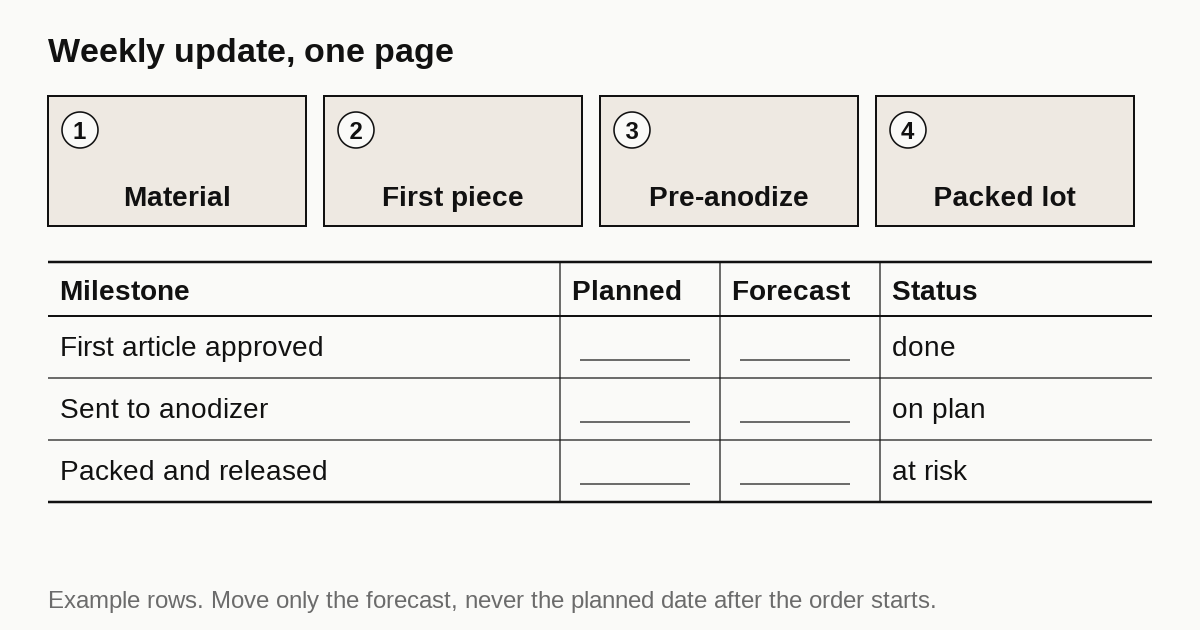
Percent complete answers a question nobody can use. A part that is 70 percent complete may be waiting on a finisher for two weeks. Give each milestone a planned date, a current forecast date and a status word.
| Milestone | Planned | Forecast | Status | Note |
|---|---|---|---|---|
| Material received, lot marked | Done / On plan / At risk / Late | |||
| Programming and fixture ready | ||||
| First article approved | ||||
| Machining complete | ||||
| Deburr complete | ||||
| Sent to anodizer | ||||
| Back from anodizer, inspected | ||||
| Packed and released |
Use four status words and define them once: done, on plan, at risk and late. At risk means you can see a threat to the date but the date has not moved yet. A brand that sees at risk early can help, for example by approving a first article faster. A brand that sees late for the first time has no help to offer.
Photos at four fixed steps
Photos answer questions that a status word cannot, and a fixed set makes them comparable from week to week. Take the same four for each part number, in the same place.
- Material. The bar or billet with its lot mark visible, next to the mill certificate reference. This is the start of the traceability the brand needs, as in our guide to lot marking and warranty tracing.
- First piece. The first part on the gauge or beside the filled-in inspection sheet. A bore on a gauge says more than a picture of a part on a bench.
- Before anodize. The deburred parts on the rack or in the tray, with the visible faces up. This is the last chance to catch an edge or a mark, and our guide to deburring before anodizing explains why the brand cares.
- Packed lot. The packed box or tray with its label and lot code visible, and a count.
Name each file with the part number, the revision, the week and the step, for example STEM-31.8-revB_wk43_03-before-anodize.jpg. Do not edit the photos. A brand reading a photo wants to see the part as it was.
Anodize and outside process status
Finishing is where a weekly update usually hides a problem, so give it its own line. Our guide to anodizing in house or through a partner explains why a written turnaround from the finisher matters and why a small run still pays for a batch. In the update, say:
- the date the parts left for the finisher, or will leave;
- the finisher’s batch day your parts are booked on, if you know it;
- the date the parts are due back and the date you will inspect them;
- whether the color master is with the finisher and whether the color has been approved.
If a part goes to another outside process, such as shot peening or laser marking, give it a line of its own with the same four facts. A brand that asks “where are my parts?” is almost always asking about an outside process.
Need a quote for this part? Get a quote for your bike parts
Reporting a delay early
A weekly update is not the place to announce a late date for the first time. Send a delay notice as soon as you know, and then show it in the next update. The notice has four parts: what moved, why, the new forecast and what you are doing about it. Add what, if anything, you need from the brand.
Do not soften it. A date that moved by three days is reported as three days. A brand that learns of the delay on its own date loses the days it could have used to adjust. Reply to the brand’s questions about it within 24 business hours.
Delay notice, ready to copy.
Subject: Delay notice, [part number] rev [X], order [number]
What moved: [milestone] from [old date] to [new date]. Why: [one sentence, plain: for example the finisher’s batch day moved, or the first article failed on bore diameter]. Effect on your delivery date: [none / moves from [date] to [date]]. What we are doing: [action, owner, date]. What we need from you, if anything: [decision, by date]. Next update: [date].
Update template
Send on the same day each week, one page, to the same person.
| Section | Entry |
|---|---|
| Header | Brand, part number, revision, order number, week, shop contact |
| Summary | One sentence: on plan, at risk or late, and the delivery date as it stands |
| Milestones | The table above, one row per milestone |
| Photos | Four fixed steps, filed by name |
| Anodize and outside processes | Sent date, batch day, due back, color status |
| Open issues | Issue, owner, due date |
| Decisions needed from the brand | Decision, by when |
| Changes since last week | One line each, including any change in material lot, finisher or process |
| Next update | Date |
Keep a copy of every update in the job file. When the brand asks in October what happened in June, the file answers, and the same file is part of the records the brand may ask for later.
What to leave out
Three things make an update harder to use. Leave them out.
- Machine detail the brand did not ask for. Spindle hours and program names are yours. The brand needs dates, photos and decisions.
- Good news padded around bad news. Put the status word first. A late milestone buried in the fourth paragraph reads as concealment even when it was not meant that way.
- Promises without dates. “We will try to catch up” is not an action. “Second shift on the finish pass Wednesday and Thursday, back on plan Friday” is.
Add one more rule for yourself: never change a milestone’s planned date after the order starts. Keep the planned date from the first plan and move only the forecast. A brand that can see the planned date, the forecast and the gap between them can judge how reliable your plans are, and a shop whose forecasts hold week after week is the shop the brand puts on the next launch.
A week in two lines
The simplest version of the update, for a week where nothing changed: “On plan. Machining complete one day ahead of plan, parts to the anodizer Thursday, due back Tuesday. No open issues.” If you can write that line every week, you have already done most of the work.
Talk to us
If your shop wants bike brand work, register on the supplier page. Work requests carry the part, material, quantity, tolerance, finish and deadline. You quote us and, if price and lead time work, we place the purchase order with you. For how the shops that win this work behave, read how machine shops win bike parts work. No orders are promised.
Sources
- The 9000 Store, ISO 9001:2015 customer communication (clause 8.2.1)
- Wikimedia Commons, FSA Crankset.JPG

Frequently asked questions
How often should a shop send a production update?
Weekly on a fixed day is a good default for an open order, and the same day each week matters more than the exact day. Send it even when nothing changed, because a one-line update that says on plan is what lets the brand stop chasing. Send a separate delay notice the moment a date moves.
Should the update show percent complete?
No. Percent complete hides the stage that is stuck. Show each milestone with its planned date, your current forecast date and a status. A brand can plan around a date, and it cannot plan around 70 percent.
Which photos should a shop include?
Four at fixed steps: material with its lot mark, the first piece on the gauge or inspection sheet, the parts after deburring and before anodizing, and the packed lot with its label. Same four each week for the same part, so the brand compares like with like.
What counts as a delay worth reporting?
Any change to a milestone date the brand has in its plan, including a date that moves by a day, if the next stage depends on it. Report it when you know, not when the date passes. Reply to the brand's questions about it within 24 business hours.
Need a quote for this part?
Send the drawing. We quote the finished parts, place the work with a partner shop that machines bike parts and reply within 24 business hours.
Get a quote for your bike parts