Guides / Process
Packaging and Kitting Machined Bike Parts for Retail Sale
November 11, 2026
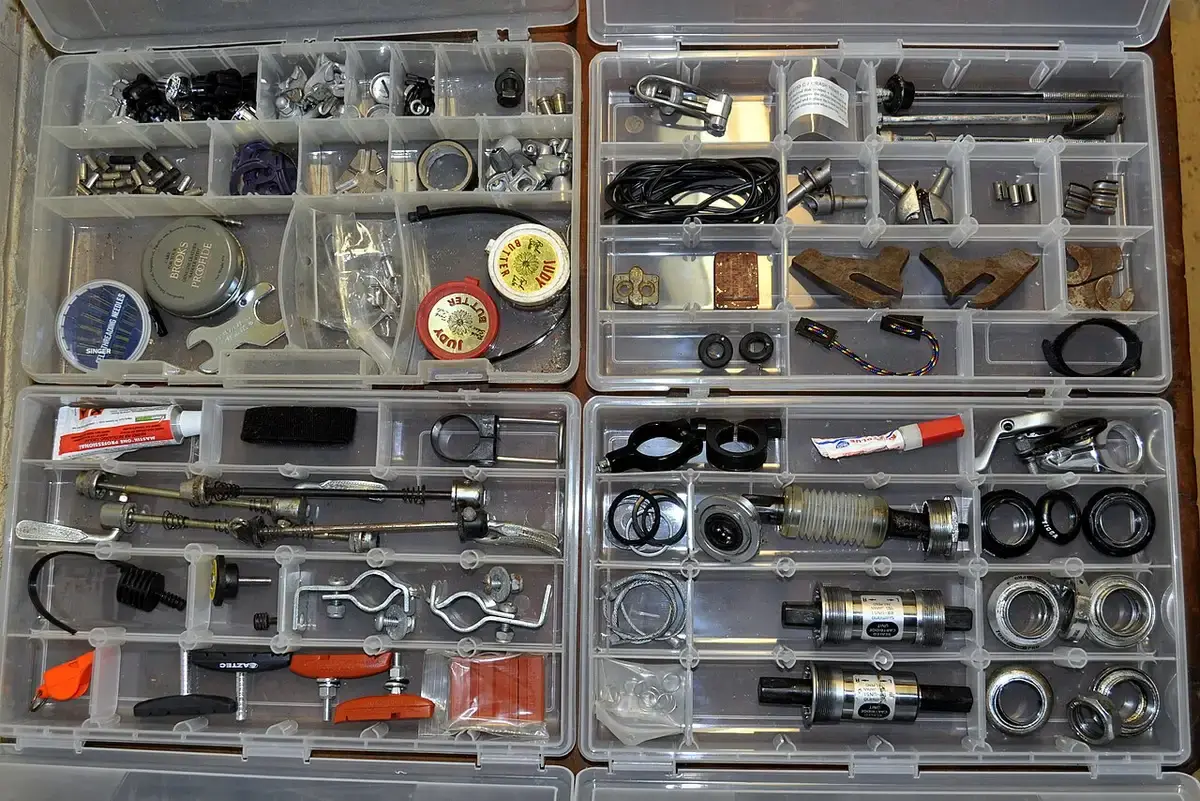
A machined bike part is not retail-ready when it leaves the machine shop and the anodizer. Retail-ready means it sits in a protected pack, carries the barcode and the legal marks the sales channel needs, comes with the right hardware and instructions, and reaches the shelf with no scratches. This guide lists what to specify, who should do the packing and which facts you can check before you place a purchase order.
Decide who packs before you ask for a quote
There are two common arrangements. The shop and its finisher can pack and kit the parts, or they can ship bulk to the brand’s own warehouse or logistics partner, which packs. Both work. The cost shows up in different places, so settle it first, because a quote that assumes bulk packing does not include the labor and materials of retail packing.
| Question | Shop packs retail-ready | Bulk to the brand’s packer |
|---|---|---|
| Handling steps for a finished part | Fewer, if packed straight after the final check | More, with extra unpacking and repacking |
| Scratch risk on anodized faces | Lower, if the shop packs from the finishing line | Higher, if parts travel loose in bulk |
| Flexibility for late changes to the pack | Low, the pack is fixed on the PO | High, the brand changes the label or insert late |
| Barcode and label printing | The shop needs your artwork and GTIN list | The brand prints in its own system |
| Where the kit hardware lives | In the shop’s stock | In the brand’s stock |
If a brand sells in several countries, bulk shipment and local packing often fit better, because the legal marks and languages differ by market. If it sells one SKU in one market, packing at the shop is simpler. The quoting guide for shops explains why a quote for the finished, packed part usually wins over one for the machined part alone, and that is also how the packing cost should appear on the RFQ.
Protect the finish
Anodized aluminum looks hard, but a decorative film is thin. Wikipedia’s anodizing article gives moderate-thickness Type II coatings as 1.8 to 25 microns, and a visible mark can appear wherever parts rub against each other or a rough carton. The common sense rules:
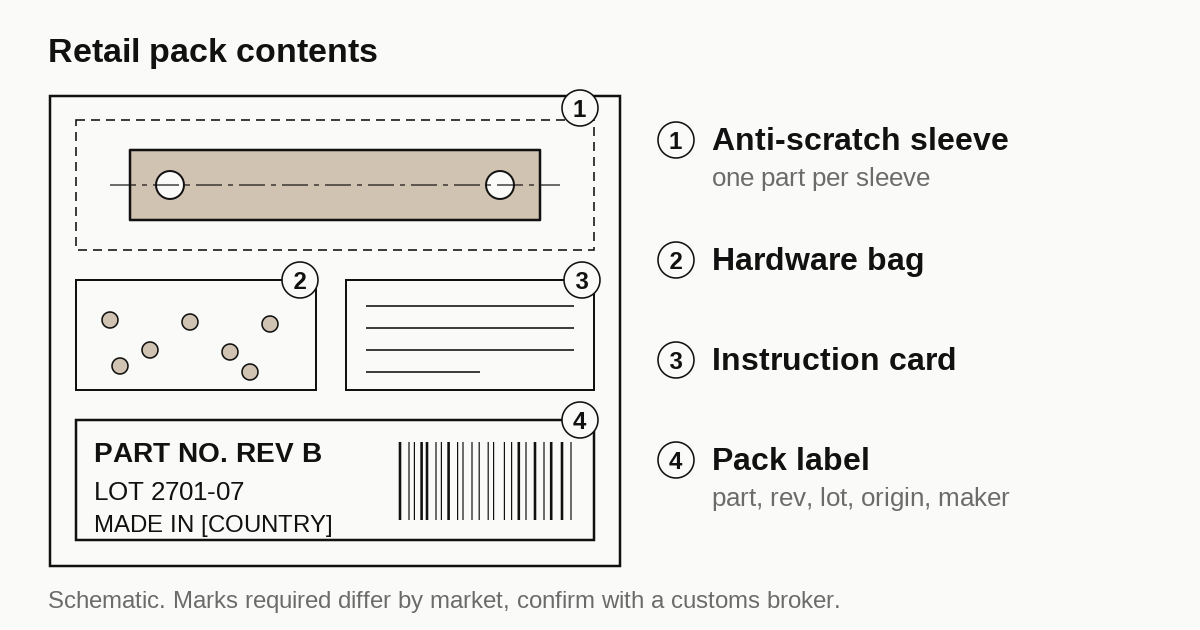
- One part, one sleeve or bag for any visible face. Do not bulk-bag cosmetic parts such as stem faceplates, cranks and bar clamps.
- Dividers between layers in the carton, so the weight of the layers above does not press parts together.
- Soft inserts on contact points, such as thread ends and bearing seats, which are the edges that bite.
- No taped-on paper labels on a finished face, since adhesive can mark a cosmetic surface. Put labels on the bag or pack.
- Deburr before finishing, as the deburring guide explains, because sharp edges cut bags and other parts.
The wording on the drawing or PO should state the pack in a sentence a packer cannot misread: “one part per anti-scratch sleeve, 25 sleeves per inner carton, divider between layers, lot code on the sleeve label.”
What the pack has to carry
Packaging carries a mix of commercial and legal marks. The list changes by market and by product, so treat it as a checklist to confirm, not as legal advice.
| Mark | Why | Detail to check |
|---|---|---|
| Barcode (GTIN) | Retailers and marketplaces need it to receive and sell the item | One GTIN per variation. GS1 says each size, each color and each combination needs its own |
| Part number and revision | The packer, the shelf and the warranty desk need to match it to the drawing | Match the PO and the drawing revision |
| Lot code | Warranty tracing, as in the traceability guide | Put it on the smallest pack |
| Country of origin | US imports must show it in English | See below |
| Maker or importer name and address | EU rules ask for a name and postal and electronic address on the product, or on the packaging when the product is too small | See below |
| Installation and torque information | A rider needs it, and your design team owns the number | Print the brand’s own spec, never a number copied from a similar part |
| Children’s product tracking marks | US rule for products meant for children 12 years of age or younger | Manufacturer or importer, place and date of production, batch or run number |
US origin marking. CBP guidance says every foreign-origin article entering the US must be legibly marked with its English country-of-origin name unless an exception applies. The ultimate purchaser is generally the last person in the US who receives the article in the form in which it was imported, which for retail goods is the shopper. The marking must be conspicuous, legible and as permanent as the article allows, and CBP prefers stamping, molding or printing over adhesive labels, which can come loose. “Made in” is required only when another locality on the article or container could mislead. For retail packs, the importer decides whether the mark sits on the part, on the pack or both, so ask a customs broker. CBP says unmarked articles are subject to additional duties unless they are marked, exported or destroyed under supervision before liquidation.
EU product information. According to an unofficial copy of Regulation (EU) 2023/988, the manufacturer’s name, trade name or trademark and postal and electronic address must be on the product, or on the packaging or an accompanying document if the product’s size or nature does not allow it. The same text asks for a type, batch or serial number on the product or its pack. We could not open the official EUR-Lex text, so confirm the details there and with your compliance adviser.
Children’s products. CPSC tracking labels apply to products designed or primarily intended for children 12 years of age or younger. The label must allow someone to determine the maker or importer, the place and date (month and year) of production and a batch or run number, on the product and its packaging to the extent practicable. If marks are fully visible through clear packaging, the packaging does not need separate marking. A complete kid’s bike is a children’s product, and a component sold as its part may be. Check the age range on the product page. The CPSC 16 CFR 1512 guide covers the bicycle safety rule itself.
Need a quote for this part? Get a quote for your bike parts
Kitting: what goes in the box besides the part
A kit is the part plus the things needed to install it. Common examples are a stem with faceplate bolts, a bottom bracket cup with its bearings and spacers, or a thru-axle with a spare nut. Write a bill of materials for the kit, and state for each line:
- Part number and revision, including hardware such as bolts and washers.
- Quantity per kit, with a counting method. Count by tray, by weight or by sensor, and do not rely on a packer’s eye.
- Source, meaning whether the shop buys the hardware or the brand ships it free of charge to the shop.
- Lot rule: one lot of each item per carton, no mixing.
- Who owns a shortage: if the shop runs out of bolts mid-kit, who pays for a rush buy.
- Spare parts policy: whether a spare bolt or a thread-locking product goes in the box.
Hardware needs a spec as much as the machined part does. The pivot hardware guide and the stainless bike hardware guide show what to define on bolts and axles. A wrong bolt length in a kit is an avoidable assembly error, so the kit BOM deserves the same revision control as the part.
Test the pack before the volume run
You do not need a test lab for every part, but a test pack on the pilot lot is cheap. ISTA’s 3A procedure simulates shipment through a parcel delivery system for individual packages weighing 150 lb (70 kg) or less, in standard, small, flat and elongated package types. ISTA’s overview says certification requires an ISTA-certified lab and that the procedure be followed in full. Whether to certify is the brand’s decision. A drop and vibration check on 10 to 20 packed units from the pilot lot, followed by a look at the parts, is a practical middle path. The prototype to production guide describes how pilot batches work.
Approve one packed sample in writing before the full run: photograph it, keep it, and send a copy to the shop so the packer has a reference.
What to put on the RFQ
- Pack type per part: sleeve, bag, box, blister or clamshell, with dimensions and artwork files.
- Quantity per inner and outer carton.
- Label content and a sample, with GTINs from the brand’s list.
- Origin and legal marks, as the brand’s compliance contact has defined them.
- Kit BOM with revisions and the source of each item.
- Lot code placement on the pack.
- Who prints the labels and who supplies the boxes.
- Pack approval method: golden sample, photo, pilot lot.
Packing is the last stage of our guide to custom bike parts manufacturing.
The RFQ checklist covers the machined-part lines. Send the drawing and your pack requirements through the RFQ page. We quote the finished parts within 24 business hours and place the work with a partner shop.
Common mistakes
- Quoting machined parts and discovering retail packing later. Packing adds labor and material that the shop did not price.
- One GTIN for all colors. Retail systems cannot tell a black part from a silver one.
- Origin marked only on the carton, when the part is sold out of the carton.
- Loose kit hardware with no count, no lot rule and no revision.
- No packed sample approval, so the first retail pack is the first time anyone sees it.
Sources
- CBP, Marking of Country of Origin on U.S. Imports
- GS1, How many GTINs do I need when I have a product with many sizes and colours
- CPSC, Tracking label FAQ
- ISTA, Test procedures
- Wikipedia, Anodizing
- Eduverse, GPSR operator obligations (unofficial text of Regulation (EU) 2023/988, Article 9)
- Wikimedia Commons, Bicycle parts

Frequently asked questions
Does each color of a bike part need its own barcode?
Yes. GS1 states that each product variation needs its own GTIN, and it defines a variation as each size, each color and each combination of sizes and colors. A black stem and a silver stem of the same design are two products to a retailer's system, so the pack barcodes must differ.
Who is responsible for country of origin marking on imported bike parts?
The importer is accountable to US Customs. CBP says every foreign-origin article must be legibly marked with its English country-of-origin name unless an exception applies, and the marking has to reach the ultimate purchaser, which for retail goods is the shopper. Confirm the wording with a customs broker.
Should anodized bike parts be bagged one by one?
In our view yes, for finished cosmetic parts. Loose parts in a shared bag rub together in transit, and a mark on an anodized face is visible to the customer. A sleeve or individual bag, with a divider between layers in the carton, costs little against the cost of a returned part.
Do I need ISTA testing for a retail pack?
Not by law. ISTA 3A is a simulation test for individual packages of 150 lb (70 kg) or less sent through parcel delivery, and it suits parts that go to customers by courier. Retail pallets use other procedures. Run a simple drop and vibration check on a pilot lot even if you skip formal certification.
Need a quote for this part?
Send the drawing. We quote the finished parts, place the work with a partner shop that machines bike parts and reply within 24 business hours.
Get a quote for your bike parts