Guides / Process
Valve Stems, Spoke Nipples and Small Turned Bike Parts
November 4, 2026
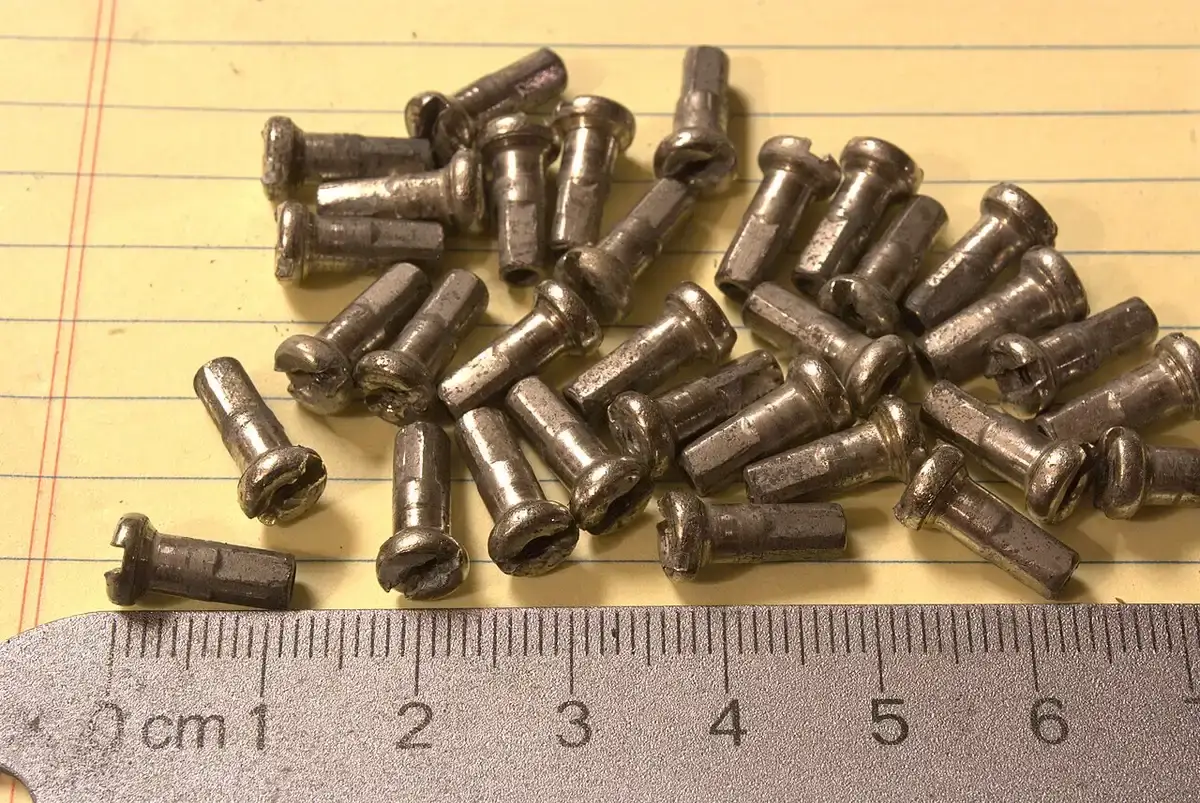
Valve stems and spoke nipples are turned parts. They are cut from bar on an automatic lathe or a CNC turning center, not milled from a block, and they are priced by cycle time and material rather than by machine hours on a 5-axis mill. A buyer who sends these to a bike part shop that normally quotes stems and cranks can get a high price. This guide covers what to specify and where the money goes.
How small turned parts are made
Wikipedia’s article on automatic lathes says screw machines are the class for small to medium parts, roughly up to 80 mm in diameter and 300 mm long, as a rough guide. They almost always work from bar, gripped by a collet chuck, with bar feeds pushing or pulling the stock. The article says a mechanical screw machine is often still the most cost-efficient option for high-volume work, and that Swiss-type machines support the workpiece with a guide bushing near the cutting tool. That support is why Swiss-type machines suit slender parts such as long valve stems.
Threads on these machines are cut or roll-formed with self-releasing die heads, and internal threads are tapped. The same article says threading and tapping run at about one fifth of high speed, so a thread is a real part of the cycle. Rotary broaching forms hex sockets. Nipple flats and slots may be added in a second operation. For the brand, the practical points are:
- These parts are normally bought in volume, so a quote at 200 pieces says little about the real price.
- Tooling and cams are paid once, and the per-piece price drops steeply after setup.
- A bike part shop that does not run bar-fed lathes will subcontract the part, so ask who actually makes it.
Our low MOQ guide and the cost guide explain how setup spreads across a batch.
Valve stems
Wikipedia gives the Presta stem as 6 mm in diameter against 8 mm for Dunlop and Schrader valves. The tip thread is 5V2 (#12-24 TPI, 5.2 x 1.058 mm) and the body thread on threaded valves is 6V1 at 6 x 0.80 mm, following ISO 4570. The valve uses a lock nut to secure the stem at the rim, and not every Presta valve has a removable core. Wikipedia suggests a stem at least 10 mm longer than the rim is deep, and says Presta valves are commonly used on tubeless setups. The smaller Presta hole allows narrower rims while keeping strength, and enlarging a hole to Schrader size weakens the rim.
Specify for a machined valve stem:
- Stem diameter and tolerance, and the body thread if it is threaded
- Overall length, with a tolerance, and the rim depth it is made for
- Whether the core is removable and who supplies it
- Seal seat geometry for the rubber base or tubeless seal, which the valve maker defines
- Material and finish, and the lock nut thread
The main risk on a valve is a leak. Seal faces need a surface finish and a leak test, for example a pressure decay test, written into the first article requirement.
Spoke nipples
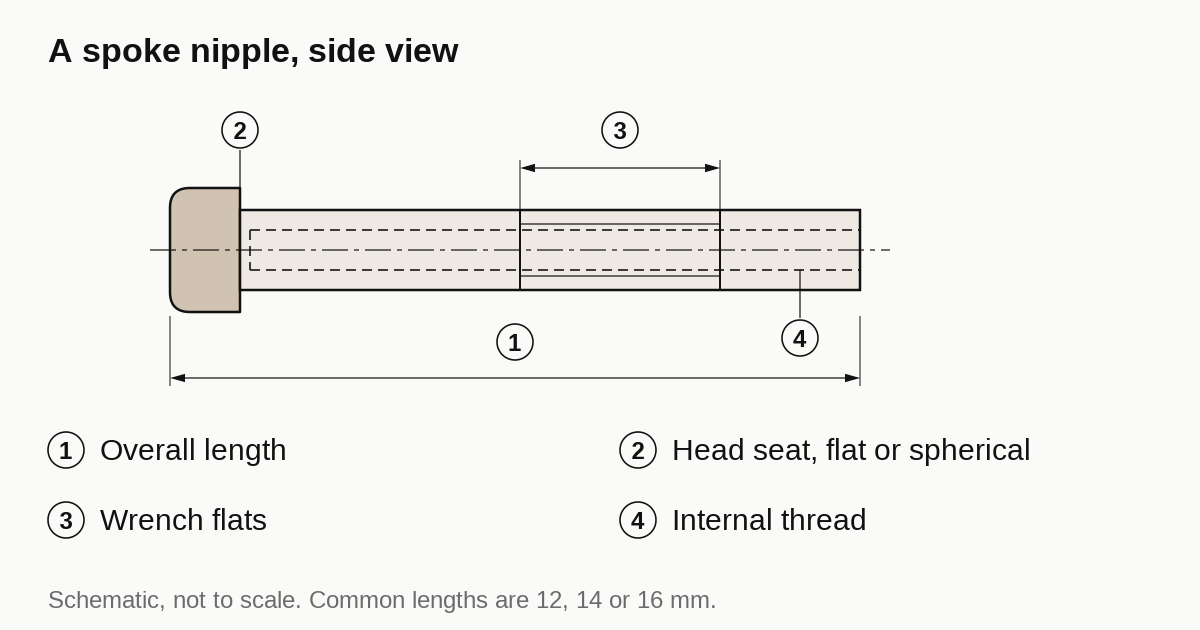
Spoke nipples are small, but their dimensions are tied to the spoke and the rim. Wikipedia gives usual spoke diameters of 1.8 mm for 15G, 2.0 mm for 14G and 2.3 mm for 13G. DT Swiss lists its brass Pro Head nipple in thread and flange groove sizes of 1.8 / FG 2.0, 2.0 / FG 2.3 and 2.34 / FG 2.6, in lengths of 12 and 14 mm, and its standard nipple in lengths of 12, 14, 14.5 and 16 mm. Retail listings of the standard brass nipple give a wrench interface of 3.23 mm across flats (directional) and about 1 g per 12 mm nipple. One listing of a 16 mm alloy nipple gives 0.409 g.
Sheldon Brown adds fit points that the drawing should respect:
- Spoke ends should land between the bottom and top of the nipple’s screwdriver slot at full tension.
- If the rim covers much of the nipple, a longer nipple may be needed so the spoke wrench can reach the flats.
- Short nipples have narrowed the acceptable spoke-length tolerance to about 3 mm.
- Brass nipples are much stronger than aluminum ones, and a spoke that does not reach into the head puts the nipple at risk of breaking.
Head shape matters too. DT says its Pro Head nipple is made for short spokes with a large deflection angle, such as e-bike wheels, and has a spherical contact surface that lines the nipple up with the spoke. Its Squorx adds a Torx and square tool interface. DT also recommends all brass nipples for e-bikes, and notes that brass nipples are not approved for children’s products in the USA. Ask your compliance lab what that means for the market you sell into.
Our view: a plain nipple is a catalog part, and a custom run rarely beats a catalog price. Custom turning makes sense when the brand wants a special head, a new interface or a color the catalogs do not offer.
Material, brass and lead
Free-machining brass is the usual choice for turned parts because it cuts easily. Wikipedia lists free machining brass C360 at 61.5 percent copper, 35.5 percent zinc and 2.5 to 3.7 percent lead, and says it has high machinability. The same article says cutting can smear lead over a surface and cause significant lead leaching even from brasses with fairly low lead content, and that lead-free brass for plumbing in California is limited to 0.25 percent lead. That rule is for wetted plumbing parts and does not apply to spoke nipples, but it shows why a buyer selling to children, or into regulated markets, must ask the supplier for the exact alloy and let a lab confirm the limit. Do not assume a brass part is cleared for every market.
For stainless and aluminum alternatives, the 17-4 PH hardware guide and the 6061 versus 7075 guide cover the grades.
Need a quote for this part? Get a quote for your bike parts
Finish and threads
Anodized aluminum nipples take color well, and the same growth rule applies as on any aluminum part. Wikipedia says the oxide grows equally into and out of the surface, so each surface grows by half the coating thickness. A 2 µm coating adds 1 µm per surface. On a threaded nipple, that growth can bind a spoke thread, so mask the thread or leave it uncoated, and state the thread class after finishing. The Type II versus Type III guide and the color matching guide cover the choice, and the deburring guide covers burrs at the thread start. DT’s ProLock injects a dual-compound adhesive into the nipple thread, so say whether the part is sold with or without a thread lock. Thread forming is covered in the thread milling versus tapping guide, although screw machines tap or roll threads rather than mill them.
What to put on the drawing
- Part type, material and exact alloy, with the market it is sold in
- Length, diameter and tolerances for each critical feature
- Thread designation, pitch, class and length
- Seat geometry and finish on the sealing or seating face
- Wrench interface: across-flats size and flat length
- Finish, color and masked areas, plus the thread lock status
- Gauges: thread go and no-go, length, leak test for valves
- Annual volume and release size, so the shop can choose the right machine
Common mistakes
- Quoting 200 pieces of a part sold in tens of thousands. The price will not reflect the real run.
- A nipple length chosen without the rim depth and spoke length. The wrench may not reach, or the spoke may not seat.
- Brass alloy left open. Lead content then depends on the supplier.
- Anodize on threads with no allowance.
- No leak test on a valve stem.
Send drawings, annual volumes and market through the RFQ page. We quote the finished parts within 24 business hours and place the work with a partner shop that runs bar-fed turning.
Sources
- Wikipedia, Automatic lathe
- Wikipedia, Presta valve
- Wikipedia, Spoke
- Wikipedia, Brass
- Wikipedia, Anodizing
- Sheldon Brown, Spoke length
- DT Swiss, Nipple technology
- DT Swiss, DT Pro Head nipples
- Peak Sports, DT Swiss standard brass nipples listing
- Velomine, DT alloy ProLock nipple listing
Frequently asked questions
How are small bike parts like valve stems and spoke nipples made?
As turned parts cut from bar stock on an automatic lathe, a Swiss-type machine or a CNC turning center, then threaded, cross drilled or milled for flats. Screw machines handle small to medium parts, roughly up to 80 mm in diameter, and Wikipedia says they are often the most cost-efficient choice for high volume.
What size is a Presta valve stem?
The stem is 6 mm in diameter, against 8 mm for Dunlop and Schrader valves. Wikipedia lists the tip thread as 5V2 and the body thread of threaded valves as 6V1 at 6 x 0.80 mm, and says the valve threads follow ISO 4570. Confirm the rim hole and the stem length with the rim maker.
What are spoke nipples made of?
Brass or aluminum alloy. DT Swiss offers its standard nipple in both, with lengths of 12, 14, 14.5 and 16 mm. Sheldon Brown says brass nipples are much stronger than aluminum ones, while alloy nipples are lighter. DT notes that brass nipples are not approved for children's products in the USA.
Is custom machining worth it for a spoke nipple?
Rarely for a plain nipple, since catalog parts exist in many sizes and colors. Custom turning makes sense for a branded valve stem, a special head seat, a new wrench interface or a short run in a brand color. Ask for a quote on both and compare with the catalog part.
Need a quote for this part?
Send the drawing. We quote the finished parts, place the work with a partner shop that machines bike parts and reply within 24 business hours.
Get a quote for your bike parts